Morgan James – Human
An evening pause: With Doug Wamble (guitar), Ron Mcbee (percussion), and Sam Reider (accordion). The song is by Rag’n’Bone Man.
Hat tip Judd Clark.
An evening pause: With Doug Wamble (guitar), Ron Mcbee (percussion), and Sam Reider (accordion). The song is by Rag’n’Bone Man.
Hat tip Judd Clark.
Courtesy of BtB’s stringer Jay. This post is also an open thread. I welcome my readers to post any comments or additional links relating to any space issues, even if unrelated to the links below.
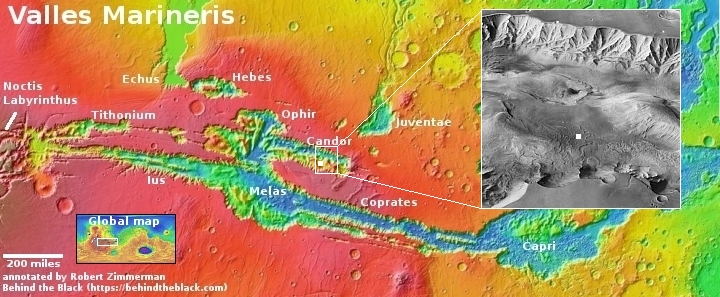
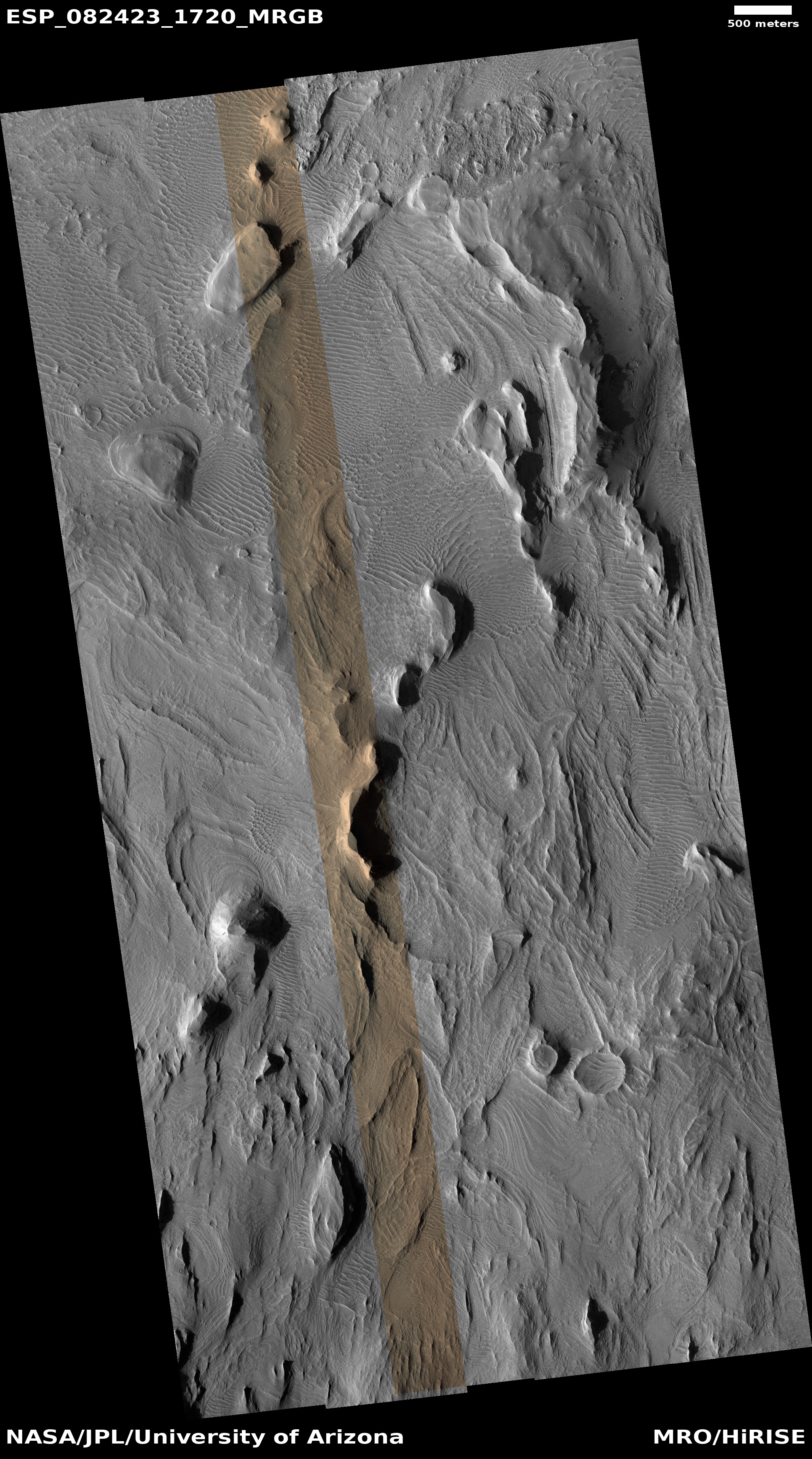
Cool image time! The picture to the right, cropped, reduced, and sharpened to post here, was taken on September 1, 2024 by the high resolution camera on Mars Reconnaissance Orbiter (MRO). It shows what the scientists label “a fracture with clays.”
This canyon is about a mile and a half wide, with the floor ranging from 800 to 1,100 feet to the rim. It was not formed initially by any ice or water flow, but by a spreading of the crust, forcing cracks to form that might have later been modified by wind, ice, or water. The presence of clays in this canyon strengthens that later ice/water modification, as clays require water to form.
The streaks on the northern wall are slope streaks, an unexplained phenomenon unique to Mars. While at first glance they look like avalanches, they have no debris piles at their base, and do nothing to change the topography. In fact, streaks can sometimes go uphill for short distances, following the surface. They happen randomly throughout the year, and fade with time.
It is believed their cause is related to dust avalanches, but this is only one of a number of theories that attempt to explain them. None is entirely satisfactory.
» Read more

The sample site on Bennu, with OSIRIS-REx
superimposed for scale. Click for full image.
First, I hope my readers will notice that — unlike NASA and the entire press — I make no mention in my headline above of the discovery of a “mix of life’s ingredients” or “the key building blocks of life” from the samples brought back by the probe OSIRIS-REx from the asteroid Bennu.
This is the game NASA does all the time, to hint at the discovery of life when this is not the real discovery. NASA does it because it knows that if you hint at such a discovery, the press will go crazy and give you lots of press.
The real news from the two papers published this week, available here and here, however, is more fundamental. Before the samples from Bennu and Ryugu (brought back by the Japanese probe Hayabusa-2) had arrived, our understanding of the make-up and chemistry of the early solar system was very incomplete and badly biased. The only asteroid samples we had of carbonaceous chondrite asteroids, the most primitive and fragile carbon-rich asteroids in the solar system, had came from meteorites that had survived the journey through the Earth’s atmosphere. Thus, the only material that survived was robust enough to do so. The more fragile molecules however were always destroyed and thus missing from meteorites, even though it was very clear from spectroscopy of these asteroids in the solar system that such molecules did exist, and likely formed the majority of these asteroids’ make-up.
Thus, though carbonaceous chondrite asteroids represent the early solar system, our understanding of them was warped and very incomplete. The whole point of both missions to Bennu and Ryugu was to fill in this data, to get a more complete census of the real make-up of the early solar system.
The two papers published this week have given us that. That’s their real discovery.
» Read more
Link here. As usual, this NASASpaceflight.com article provides an excellent overview of what SpaceX is likely to do on the next few test flights, including details about the possibility of reusing the Superheavy that was successfully recovered on the seventh flight.
And as usual, NASASpaceflight.com ignores the importance of politics and Trump’s election in changing the regulatory culture at the FAA. Just as it has made believe the Biden administration wasn’t forcing the FAA to slow-walk its license approvals to SpaceX, it is now making believe the Trump administration won’t do anything to force the FAA to speed its approvals.
We know however that it will. I fully expect that when SpaceX completes its investigation of the failures from flight 7 and describes its fixes, the FAA approval will following very quickly thereafter, within days. Under Biden that approval would still take months.
Despite high launch cost of the Ariane-6 rocket, the European Space Agency (ESA) this week arranged three more launch contracts with Arianespace, which manages the rocket.
During the 17th European Space Conference, held in Brussels on 28 and 29 January, Arianespace was awarded contracts to launch PLATO [an ESA science mission to study exoplanets], Sentinel-1D [an ESA Earth observation satellite], and a pair of second-generation Galileo satellites. [part of ESA’s GPS-type satellite constellation]. Arianespace currently has a backlog of 30 Ariane 6 launches, 18 of which are for Amazon’s Kuiper constellation.
These new launch deals are expressly because ESA wants to force feed contracts to Ariane-6 to keep it whole, as part of its policy to launch its European payloads on European rockets. The result is that ESA is also forced to pay too much for its launches. Note too that these payloads are expressly ESA science or research projects, which also applies to most of Ariane-6’s backlog of launches outside of its Kuiper launches. Profit is not the main goal of these payloads. I doubt this rocket will get much additional business from commercial satellite companies that must make a profit to survive. It costs too much.
This is also the reason ESA member nations Germany, Italy, France, and the United Kingdom are pushing hard to get new European private rocket startups operational. They don’t like being forced to pay too much for launches, and want commercial options outside of Ariane-6.
For the moment however ESA is propping up Ariane-6 and Arianespace. It means Ariane-6 will be around for awhile, even as it limits what ESA can do in space.
Embedded below the fold in two parts.
To listen to all of John Batchelor’s podcasts, go here.
» Read more
SpaceX tonight successfully launched the first satellite in a constellation of two Spanish communications satellites, the Falcon 9 rocket lifting off from the Kennedy Space Center in Florida.
The first stage completed its 21st flight. Because of the fuel needed to get the satellite into its proper orbit, the stage was not recovered.
The 2025 launch race:
13 SpaceX
6 China
1 Blue Origin
1 India
An evening pause: Performed live 2011.
Hat tip Alton Blevins, who needs to clean out his inbox, which is now so full all of my emails to him bounce.
The asteroid mining startup Astroforge today finally named the asteroid that its first commercial interplanetary mission will do a close fly-by, set to launch as a secondary payload on a SpaceX Falcon 9 on February 26, 2025.
The mining startup is headed to asteroid 2022 OB5 as soon as Feb. 26, launching alongside Intuitive Machines’ second lunar mission. CEO Matt Gialich told Payload that they picked that asteroid for the initial mission for a few reasons:
- It’s under a kilometer wide.
- It could be a high-value, metal-filled M-type asteroid.
- AstroForge’s spacecraft will fly by the asteroid when it’s close to Earth, so imagery can be sent back quickly.
This will be Astroforge’s second mission, the first being an Earth-orbit demo flight to prove out its systems. The spacecraft, dubbed Odin, was quickly prepped when the planned satellite satellite failed vibration testing. The company quickly replaced it with the cubesat intended for the third mission.
The company is also proud that the entire cost for this asteroid mission is just $6.5 million. “Hopefully we’re going to show the world that NASA doesn’t need to be funded for $5B missions when we can do it for much less,” said Gialich. The company also announced it has signed a multi-launch contract with the rocket startup Stoke Space, though no specifics were released.
Hat tip BtB’s stringer Jay.
Courtesy of BtB’s stringer Jay. This post is also an open thread. I welcome my readers to post any comments or additional links relating to any space issues, even if unrelated to the links below.
In releasing a new update on its Iphone operating system, Apple quietly revealed that it has joined T-Mobile’s partnership with SpaceX to use a subconstellation of Starlink satellites with direct-to-cellphone capability, thus acting as orbiting cell towers to fill in gaps in T-Mobile’s service.
Originally spotted by Bloomberg, it seems that Apple has secretly worked with SpaceX and T-Mobile U.S. to provide an alternative satellite service. This is quite a surprise, as T-Mobile had previously specified Starlink as an option for Samsung phones, like the Galaxy S25 Ultra and the Galaxy Z Fold 6. Meanwhile, Apple has an in-house Satellite connection service due to a partnership with Globalstar Inc.
However, the Bloomberg report states that a select number of iPhone users have been able to enable the Starlink beta through T-Mobile. While we don’t know which models will be compatible as of yet, T-Mobile told Bloomberg that the full release will support the vast majority of iPhones.
The system is being tested right now, but still requires FCC license approval.