
April 16, 2025 Zimmerman/Batchelor podcast
Embedded below the fold in two parts.
To listen to all of John Batchelor’s podcasts, go here.
» Read more
Very brief descriptions, with appropriate links, of current or recent news items.
Embedded below the fold in two parts.
To listen to all of John Batchelor’s podcasts, go here.
» Read more
Courtesy of BtB’s stringer Jay. This post is also an open thread. I welcome my readers to post any comments or additional links relating to any space issues, even if unrelated to the links below.

Click for original image.
Using the Webb Space Telescope, astronomers have discovered the earliest known well-developed spiral galaxy, dubbed Zhúlóng (meaning torch dragon in Chinese), that exists only about one billion years after the Big Bang and much too soon for such a spiral galaxy to have formed.
The false-color infrared Webb image to the right, cropped to post here, shows clearly the galaxy’s spiral structure.
Zhúlóng has a surprisingly mature structure that is unique among distant galaxies, which are typically clumpy and irregular. It resembles galaxies found in the nearby Universe and has a mass and size similar to those of the Milky Way. Its structure shows a compact bulge in the center with old stars, surrounded by a large disk of younger stars that concentrate in spiral arms.
This is a surprising discovery on several fronts. First, it shows that mature galaxies that resemble those in our neighborhood can develop much earlier in the Universe than was previously thought possible. Second, it has long been theorized that spiral arms in galaxies take many billions of years to form, but this galaxy demonstrates that spiral arms can also develop on shorter timescales. There is no other galaxy like Zhúlóng that astronomers know of during this early era of the Universe.
You can read the peer-review research paper here. The scientists posit a number of theories to explain this spiral galaxy, none of which have much merit at this time because so little data exists from that time period. That only one such spiral galaxy is presently known does not mean such galaxies were rare at that time. It merely means our census of galaxy populations in the early universe remains woefully incomplete.
The government of the Bahamas has suspended any further Falcon 9 1st stage landings within its territorial waters until SpaceX completes and submits a full environmental report that proves the one previous drone ship landing in February caused no environmental changes at all.
This quote from the article explains everything:
Addressing calls from environmentalists for an EIA, Mr Dontchev [SpaceX’s vice president of launch] said officials heard their feedback. He added that SpaceX hopes to complete the EIA by the end of summer and resume landings thereafter.
The economic impact of space tourism in The Bahamas has also come into focus. [Deputy Prime Minister Chester] Cooper said the February landing could have sparked a greater interest among students inspiring them to pursue STEM studies. SpaceX also announced its $1m donation to the University of The Bahamas in support of STEM education. [emphasis mine]
First, anti-Musk activists, using the environment as a ploy, made enough noise that the Bahamas government felt forced to bow to them. Second, SpaceX is making sure that government will bow more to it by contributing a lot money to its government educational programs.
Expect more landings soon, as SpaceX predicts.

Click for original image.
The science team for the Mars rover Curiosity has been moving the rover as fast as it can in order to get to the intriguing boxwork geology about a half mile to the west and slightly higher on Mount Sharp.
The image to the right, cropped, reduced, and sharpened to post here, was taken today by the rover’s left navigation camera, and looks downhill to the north from within the parallel canyon Curiosity entered earlier this week. Because the Martian atmosphere was especially clear at the time, the mountains that form the rim of Gale Crater are quite distinct, 20 to 30 miles away. The view down the canyon also provides a vista of the crater’s floor, more than 3,000 feet below.
In the past two Martian days the science team has had the rover climb uphill a total of 364 feet, a remarkably fast pace considering the rocky nature of the terrain. It appears the engineers have done a spectacular job refining the rover’s software so that it is possible for it to pick its way autonomously through this minefield of rocks, and do so without subjecting its already damaged wheels to more damage.
» Read more
Click for original image.
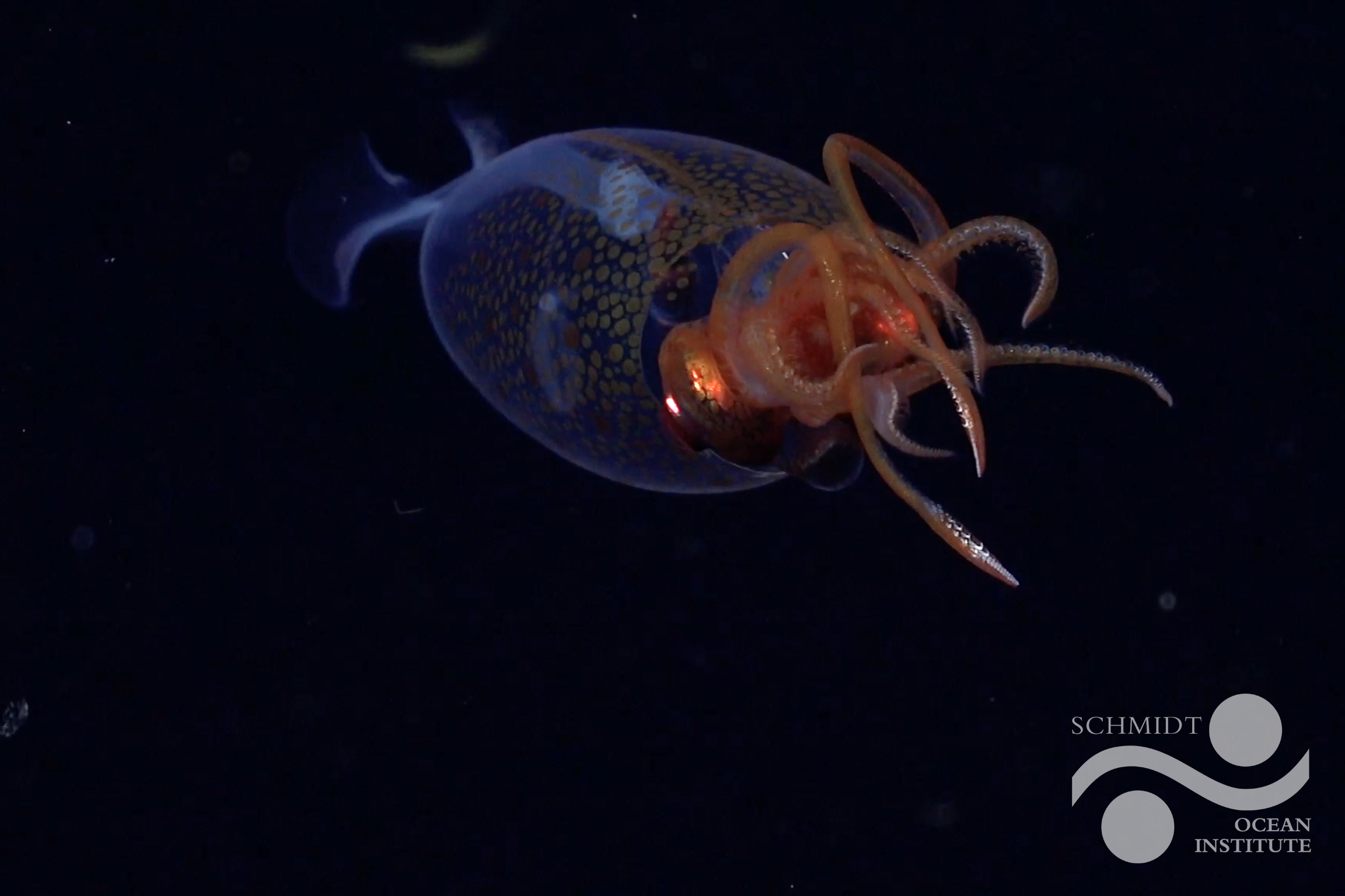
Using an autonomous submersible, scientists have captured the first pictures and video ever of a live transparent colossal squid in its natural habitat.
This one was captured on film using a remotely operated vehicle at a depth of 1,968 feet (600 m) during the team’s 35-day expedition to uncover new marine life. It’s a juvenile squid, about 0.98 ft (30 cm) long, with a transparent body, iridescent eyes, trademark hooks on the middle of each of its eight arms, and clubs on its two long tentacles.
…If you’re looking at this and wondering why this colossal squid doesn’t resemble the hefty red one you saw being pulled aboard a fishing boat back in 2007, good eye! That’s because this species starts out transparent, and loses its see-through appearance as it ages. Dr Kat Bolstad, associate professor at the Auckland University of Technology Lab, noted that the red coloration seen in the arms suggests this creature could switch between looking transparent to opaque.
I have embedded the video below.
» Read more
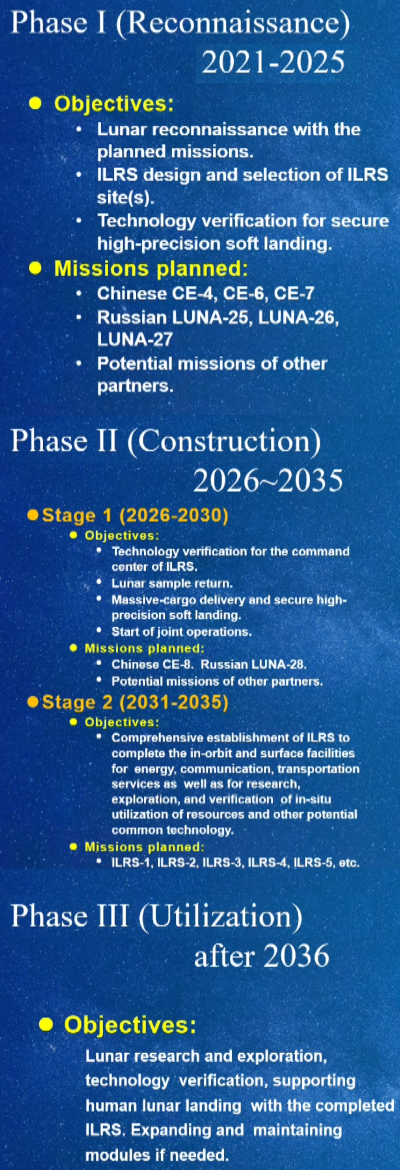
The original Chinese-Russian lunar base plan, from June 2021.
Most of the Russian components are not expected to launch.
China’s state-run press today announced that it has successfully completed the first three-satellite communications test of a constellation in a Distant Retrograde Orbit (DRO) in lunar space.
DRO-A and DRO-B, two satellites developed by the Chinese Academy of Sciences (CAS) and deployed in the DRO, have established inter-satellite measurement and communication links with DRO-L, a previously launched near-Earth orbit satellite. The achievement was disclosed at a symposium on Earth-moon space DRO exploration in Beijing on Tuesday.
DRO is a unique type of orbit, and the Earth-moon space refers to the region extending outward from near-Earth and near-lunar orbits, reaching a distance of up to 2 million kilometers from Earth. In the Earth-moon space, DRO is characterized by a prograde motion around Earth and a retrograde motion around the moon, said Wang Wenbin, a researcher at the CAS’ Technology and Engineering Center for Space Utilization (CSU). Since DRO provides a highly stable orbit where spacecraft require little fuel to enter and stay, it serves as natural space hub connecting Earth, the moon and deep space, offering support for space science exploration, the deployment of space infrastructure, and crewed deep-space missions, Wang said.
On Feb. 3, 2024, the experimental DRO-L satellite was sent into a sun-synchronous orbit and began conducting experiments as planned. The DRO-A/B dual-satellite combination was launched from the Xichang Satellite Launch Center in southwest China’s Sichuan Province on March 13, 2024, but failed to enter its intended orbit due to an anomaly in the upper stage of the carrier rocket.
Facing this challenge, the satellite team performed a “life-or-death” rescue operation under extreme conditions, promptly executing multiple emergency orbit maneuvers to correct the trajectory of the two satellites. After a journey of 8.5 million kilometers, the DRO-A/B dual-satellite combination ultimately reached its designated orbit, according to Zhang Hao, a researcher at CSU who participated in the rescue operation.
On Aug. 28, 2024, the two satellites were successfully separated. Later, both DRO-A and DRO-B established K-band microwave inter-satellite measurement and communication links with DRO-L, testing the networking mode of the three-satellite constellation, Zhang said.
China’s government space program continues to follow a very rational and well-thought-out plan for establishing a manned base on the Moon, as shown in the 2021 graph to the right that China appears to be achieving as planned. While it is very likely it will not meet its 2030 goal for landing a human on the Moon, it is clearly establishing the technology for making that landing in a reasonable timeline with a later long-term permanent presence in a lunar base possible.

Screen capture from video of test failure in August 2024.
Note the flame shooting out sideways.
In a major managerial shake-up as it preps for its first launch attempt later this year, the German rocket startup Rocket Factory Augsburg has replaced its CEO, switching from someone with more general business experience to a CEO with a lot of direct experience in the space industry itself.
In an April 11 statement not widely publicized by the company, RFA announced that Stefan Tweraser, who had been chief executive since October 2021, had been replaced by Indulis Kalnins.
The announcement did not give a reason for the change, but it suggested that the company was seeking someone with expertise in the aerospace industry to lead the company. Kalnins is on the aerospace faculty of a German university, Hochschule Bremen, and has been managing director of OHB Cosmos, which focused on launch services.
…Tweraser, by contrast, came from outside the space industry. He joined RFA after past work that included being a consultant at McKinsey & Company, country director for the DACH (Germany, Austria and Switzerland) region at Google and executive at music streaming company Deezer. [emphasis mine]
The highlighted phrase provides I think the explanation for the change. The company had hoped to launch last year, but had a major failure during a static fire engine test on the launchpad, destroying the rocket first stage. The company has probably decided it needed someone in charge who had some hands-on experience with launchpad operations.

Artist rendering of Orbital Reef design, as of
April 2025. Click for original image.
According to a NASA press release today, Blue Origin has successfully completed a ” human-in-the-loop test” in a ground mock-up of the commercial Orbital Reef space station.
The human-in-the-loop test scenarios utilized individual participants or small groups to perform day-in-the-life walkthroughs in life-sized mockups of major station components. Participants provided feedback while simulating microgravity operations, including cargo transfer, trash transfer, stowage, and worksite assessments.
…The milestone is part of a NASA Space Act Agreement originally awarded to Blue Origin in 2021 and focused on the design progress for multiple worksites, floors, and translation paths within the station. This ensures a commercial station can support human life, which is critical to advancing scientific research in a microgravity environment and maintaining a continuous human presence in low Earth orbit.
Though this test might be providing useful information, it leaves me cold. While Blue Origin’s partner in this project, Sierra Space, has been testing real hardware for its LIFE inflatable module (as seen on the left side of the artist’s rendering above), Blue Origin itself appears to have built nothing real. Instead, it is following the old big space paradigm of companies like Boeing that invest none of its own money in development. Instead, the company uses NASA’s development money solely for PR mockups, in the hope the PR will convince NASA to give it the full contract, worth billions. Only then will the real work begin.
Boeing did this with Starliner, and we can all see now how well that turned out.
It also appears that the overall scale of Orbital Reef has been reduced significantly when comparing the current design above with the earlier artist renderings.
Based on this new information, I have dropped Orbital Reef to the bottom in my rankings of the four private space stations presently under development. While Starlab has built as little (following the same play-it-safe paradigm), the company has at least gotten its final design approved. It has also signed a partnership with the European Space Agency, giving it a powerful government backer in addition to NASA.
Courtesy of BtB’s stringer Jay. This post is also an open thread. I welcome my readers to post any comments or additional links relating to any space issues, even if unrelated to the links below.

Click for original image.
Cool image time! The picture to the right, rotated, cropped, reduced, and sharpened to post here, was taken on February 27, 2025 by the high resolution camera on Mars Reconnaissance Orbiter (MRO).
That the science team labels this “Monitoring Slopes for Changes on Eastern Terraces of Mojave Crater” is quite understandable. The number of apparent dentritic channels suggests strongly the possibility of change over time, which is why MRO has been used repeatedly to monitor this location, beginning in 2006, when the science team noted this in a caption:
Aptly-named Mojave Crater in the Xanthe Terra region has alluvial fans that look remarkably similar to landforms in the Mojave Desert of southeastern California and portions of Nevada and Arizona.
Alluvial fans are fan-shaped deposits of water-transported material (alluvium). They typically form at the base of hills or mountains where there is a marked break, or flattening of slope. They typically deposit big rocks near their mouths (close to the mountains) and smaller rocks at greater distances. Alluvial fans form as a result of heavy desert downpours, typically thundershowers. Because deserts are poorly vegetated, heavy and short-lived downpours create a great deal of erosion and nearby deposition.
There are fans inside and around the outsides of Mojave crater on Mars that perfectly match the morphology of alluvial fans on Earth, with the exception of a few small impact craters dotting this Martian landscape.
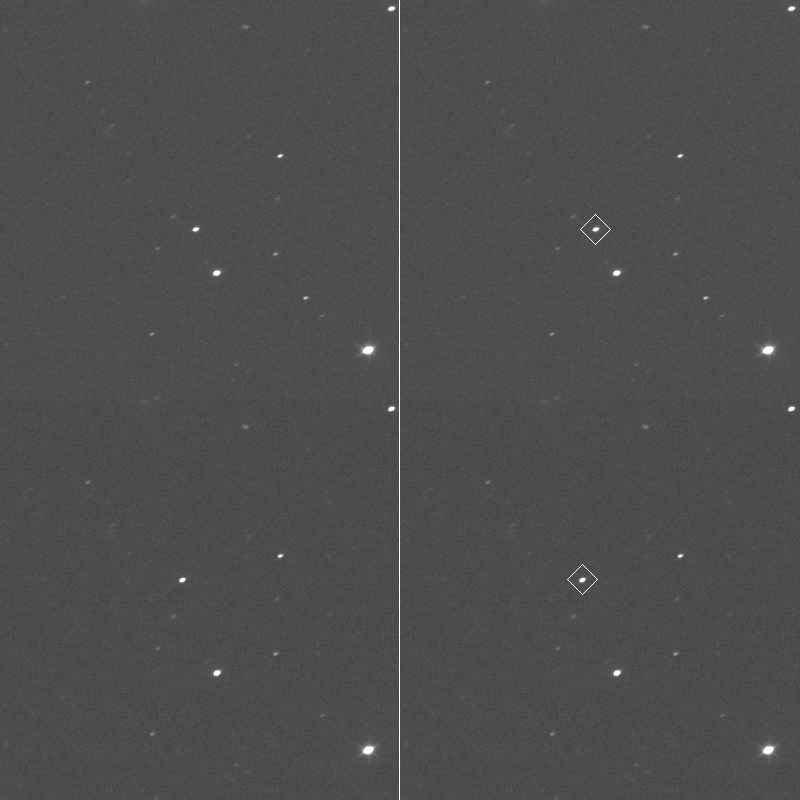
Lucy’s route to the asteroids, with its first picture
of Donaldjohanson in lower right, taken in February.
Click for original blink animation.
The science team operating the probe Lucy are now preparing for the spacecraft’s second asteroid fly-by, set of April 20, 2025, and passing within 600 miles of the surface of asteroid Donaldjohanson.
Lucy’s closest approach to Donaldjohanson will occur at 1:51pm EDT on April 20, at a distance of 596 miles (960 km). About 30 minutes before closest approach, Lucy will orient itself to track the asteroid, during which its high-gain antenna will turn away from Earth, suspending communication. Guided by its terminal tracking system, Lucy will autonomously rotate to keep Donaldjohanson in view. As it does this, Lucy will carry out a more complicated observing sequence than was used at Dinkinesh [the first asteroid that Lucy saw up close in 2023]. All three science instruments – the high-resolution greyscale imager called L’LORRI, the color imager and infrared spectrometer called L’Ralph, and the far infrared spectrometer called L’TES – will carry out observation sequences very similar to the ones that will occur at the Trojan asteroids.
However, unlike with Dinkinesh, Lucy will stop tracking Donaldjohanson 40 seconds before the closest approach to protect its sensitive instruments from intense sunlight.
“If you were sitting on the asteroid watching the Lucy spacecraft approaching, you would have to shield your eyes staring at the Sun while waiting for Lucy to emerge from the glare. After Lucy passes the asteroid, the positions will be reversed, so we have to shield the instruments in the same way,” said encounter phase lead Michael Vincent of Southwest Research Institute (SwRI) in Boulder, Colorado. “These instruments are designed to photograph objects illuminated by sunlight 25 times dimmer than at Earth, so looking toward the Sun could damage our cameras.”
Unlike most of the Trojan asteroids Lucy will study, Donaldjohanson is a main belt asteroid. It is thought to be only 150 million years old, but its history would be expected to be very different than those Trojan asteroids.
Courtesy of BtB’s stringer Jay. This post is also an open thread. I welcome my readers to post any comments or additional links relating to any space issues, even if unrelated to the links below.
Click for original image.
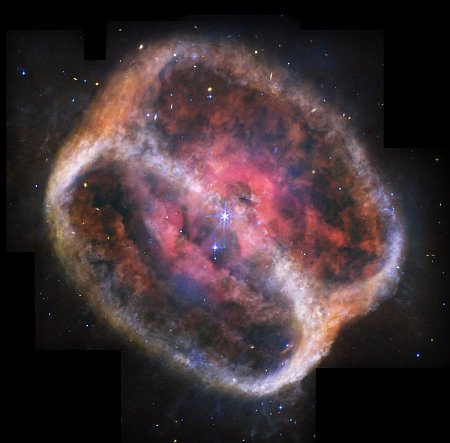
Cool image time! Using the mid-infrared camera on the Webb Space Telescope, astronomers have been able to image in false colors the ringed structure surrounding a dying star about 1,500 light years away.
The nebula’s two rings are unevenly illuminated in Webb’s observations, appearing more diffuse at bottom left and top right. They also look fuzzy, or textured. “We think the rings are primarily made up of very small dust grains,” Ressler said. “When those grains are hit by ultraviolet light from the white dwarf star, they heat up ever so slightly, which we think makes them just warm enough to be detected by Webb in mid-infrared light.”
In addition to dust, the telescope also revealed oxygen in its clumpy pink center, particularly at the edges of the bubbles or holes.
NGC 1514 is also notable for what is absent. Carbon and more complex versions of it, smoke-like material known as polycyclic aromatic hydrocarbons, are common in planetary nebulae (expanding shells of glowing gas expelled by stars late in their lives). Neither were detected in NGC 1514. More complex molecules might not have had time to form due to the orbit of the two central stars, which mixed up the ejected material.
Though this false-color image of a planetary nebular is hardly ground-breaking (Hubble has been producing such pictures for decades), Webb’s better infrared data, in higher resolution, will help astronomers untangle the nebula’s complex geography. It remains however a question whether the improved capabilities of Webb were worth its $10 billion-plus cost. For that money NASA could have built and launched many different astronomical missions in the past two decades, many of which would have been able to match this data for far less.
In announcing its future crew assignments in early April NASA also confirmed that its barter deal with Russia to fly each other astronauts to ISS has been extended to 2027.
NASA announced April 3 that astronaut Chris Williams had been assigned to the Soyuz MS-28 spacecraft scheduled to launch to the ISS in November, joining Roscosmos cosmonauts Sergey Kud-Sverchkov and Sergei Mikaev. The announcement came ahead of the April 8 launch of fellow astronaut Jonny Kim to the ISS on Soyuz MS-27.
The announcement of the Williams flight assignment was the first public indication by NASA that it has extended an agreement with Roscosmos for “integrated crews” on Soyuz and commercial crew flights to the ISS. Under the no-exchange-of-funds barter agreement, NASA astronauts fly on Soyuz spacecraft and Roscosmos cosmonauts fly on commercial crew vehicles to ensure that there is at least one American and one Russian on the station should either Soyuz or commercial crew vehicles be grounded for an extended period.
Russian sources in January 2025 had indicated the agreement had been extended, but this most recent non-announcement is the first confirmation by NASA.
One interesting change in the schedule revealed by this crew announcement is that Russia will be launching less frequently while extending its Soyuz missions. Previously Russia’s missions were six months long, the same length as NASA’s standard ISS mission. Now Russia will only launch every eight months. No explanation was given for this change, which will likely complicate the station’s already complex docking schedule. I suspect two reasons: First the Russian government probably needs to reduce costs, and flying less often serves that purpose. Second, Roscosmos officials probably want to also fly longer missions for research.
Capitalism in space: The Italian Space Agency has awarded the Italian company Blue Skies Space a contract to design a constellation of radio telescopes orbiting the Moon and designed to map the universe’s earliest radio emissions.
The project, named RadioLuna, aims to uncover whether a fleet of small satellites in a lunar orbit could detect faint radio signals from the universe’s earliest days—signals that are nearly impossible to pick up on Earth due to man-made radio interference. These signals, in the FM radio range, come from a time before the first stars formed, when the universe was mostly hydrogen gas. By listening from the far side of the Moon, free from Earth’s radio noise, scientists could use the satellites to uncover a missing piece of the puzzle in our understanding of the cosmic “dark ages.”
The study will establish the viability of operating simple and cost-effective CubeSats equipped with commercial off-the-shelf (COTS) components orbiting the Moon and will be led by Blue Skies Space Italia S.r.l., a subsidiary of UK-based Blue Skies Space Ltd. Project partner OHB Italia will be responsible for the definition of a viable platform in a Moon orbit.
The contract is another example of Italy (and Europe) shifting to private enterprise in space. Rather than design this project in-house, its space agency is contracting it out to private companies.
Continuing its relentless launch pace, SpaceX this evening successfully launched another 27 Starlink satellites, its Falcon 9 rocket lifting off from Cape Canaveral in Florida.
The first stage completed its 27th flight, landing on a drone ship in the Atlantic. This is a new record for flights by a Falcon 9 booster, exceeding the space shuttle Endeavour’s record of 25 by two, and trailing the space shuttle Columbia by only one. The record for most reflights by a spacecraft is presently 39 by the space shuttle Discovery, followed by the shuttle Atlantis at 33. Expect several Falcon 9 boosters to exceed these numbers in the next two years.
The leaders in the 2025 launch race:
43 SpaceX
19 China
5 Rocket Lab
5 Russia
SpaceX now leads the rest of the world in successful launches, 43 to 33.
SpaceX continued its relentless launch pace today, launching twice from opposite coasts.
First the company placed a National Reconnaissance Office surveillance satellite into orbit, its Falcon 9 rocket lifting off from Vandenberg in California. The first stage completed its 24th flight, landing on a drone ship in the Pacific.
Next SpaceX launched another 21 Starlink satellites, including 13 configured for direct-to-cell capabilities, its Falcon 9 rocket lifting off from Kennedy in Florida. The first stage completed its 10th flight, landing on a drone ship in the Atlantic.
The leaders in the 2025 launch race:
42 SpaceX
19 China
5 Rocket Lab
5 Russia
SpaceX now leads the rest of the world in successful launches, 42 to 33.
Embedded below the fold in two parts.
To listen to all of John Batchelor’s podcasts, go here.
» Read more
Courtesy of BtB’s stringer Jay. This post is also an open thread. I welcome my readers to post any comments or additional links relating to any space issues, even if unrelated to the links below.