Space Perspective unveils design of its Neptune tourist balloon capsule

Space Perspective's Neptune Capsule

Capitalism in space: Space Perspective yesterday unveiled the final design of its Neptune balloon capsule that it hopes to fly tourists to altitudes of almost 20 miles.

The graphic to the right reveals the biggest takeaway from this design: The “splash cone” at the bottom of the capsule tells us that the company intends to land its Florida-launched missions in the ocean, not on land.

An enhanced patent pending splash cone, refined from hundreds of digital iterations, to attenuate splashdown for a gentle and safe landing that improves customer experience and hydrodynamics. With water landings considered by NASA as the low risk way of returning a capsule from space, following the gradual, two-hour descent to Earth and a gentle splash down in the ocean, a Space Perspective crew will retrieve passengers, the capsule, and the SpaceBalloon™ by ship.

The company is presently targeting the end of ’24 for the start of commercial flights. It says it has sold about 900 $125K tickets.

The U.S. now has two balloon companies planning similar near-space missions. World View is planning flights from a variety of locations worldwide for a ticket price of $50K, with the first flights occurring no earlier than ’24.

Boeing adds another $93 million charge against earnings for Starliner manned capsule

Capitalism in space: Boeing officials revealed yesterday that they have been forced to add another $93 million charge against earnings for its much delayed Starliner manned capsule the company is building.

This is on top of $410 million in the fourth quarter of 2019 and another $185 million in the third quarter of 2021. All together, Boeing has had to cover $688 million in cost growth.

At the moment the first manned launch is tentatively scheduled to occur before the end of this year, with NASA supposedly announcing a firm date before the end of July. This new charge however suggests that the manned launch will not happen until ’23.

Boeing has not simply lost $688 million. It also has lost potential business because of the delays, both from NASA and private citizens. Instead, that business went to SpaceX.

NASA/ESA revise plan to recover Perseverance core samples from Mars

NASA and ESA yesterday announced that the agencies have revised their plan to recover Perseverance core samples from Mars, dropping the launch of a rover to pick up the samples.

Instead, they have decided to use Perseverance to bring the samples to the return vehicle, which will also carry two small helicopters.

In 2030, if all goes as planned, the NASA lander will touch down near where Perseverance is working. The rover will drive over to the lander, and an ESA-built robot arm will extract the tubes one by one and place them inside a spherical container the size of a basketball. In early 2031, a rocket on the lander will loft the container into Mars orbit, where a return craft built by ESA will snare it, enclose it in several layers of shielding for safety, and then head for home. In 2033, a saucer-shaped descent pod will carry the samples down to the Utah desert.

If Perseverance gets into difficulties during its 9-year wait for company, controllers can instruct it to drop its cargo of sample tubes onto the ground, creating a second depot. If that happens, the helicopters come into play: they can fly up to 700 meters, land next to a sample tube—each weighs up to 150 grams—and, with wheels on the bottom their feet, roll over the tube and pick it up with a grabber. On returning to the lander, they will drop the tubes on the ground for the arm to pick up.

The change means that the rover the United Kingdom was planning to build will either be abandoned, or repurposed as a lunar rover.

Update on Long March 5B core stage crash prediction

Prediction of Long March 5B crash

The Aerospace Corporation today adjusted its prediction for the uncontrolled crash of the core stage from the Long March 5B rocket that China launched on July 24th.

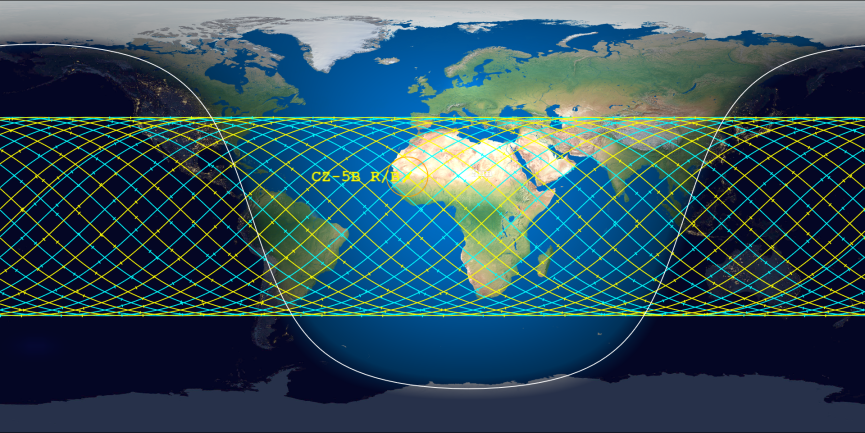
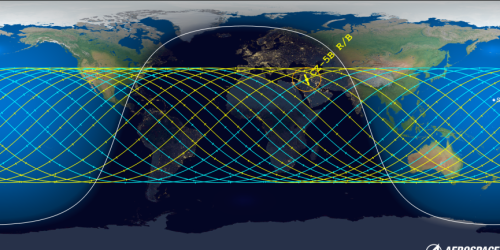
According to the new prediction, the core stage will return to Earth during a 32 hour period centered on the early morning hours of July 31st above the Middle East.

The map to the right shows this. As you can see, at present the uncertainty of the prediction means the core stage could still crash almost anywhere.

That China has still done nothing to adjust the stage’s orbit now almost certainly confirms it can do nothing. This further confirms that in the year-plus since its last Long March 5B launch in May ’21, it did nothing to fix this fundamental problem. Moreover, this is the rocket’s third launch, all of which involved a core stage crashing uncontrollably. Each launch was thus a direct violation of the Outer Space Treaty, of which China is a signatory.

Another Long March 5B launch is scheduled for later this summer, to launch the last planned module to China’s Tiangong space station. Expect another violation of the treaty then as well.

A Martian slot canyon!

A Martian slot canyon
For originals go here, here, and here.

Overview map
Click for interactive map.

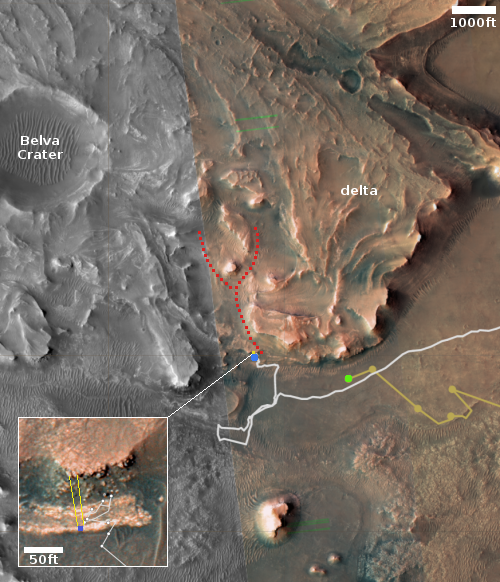
Cool image time! The mosaic to the right is made up of three images produced by the high resolution camera on the Mars rover Perseverance (found here, here, and here). All three were taken on July 24, 2022 and look north to the nearest cliff face at the head of the large delta that flowed into Jezero Crater some time in the distant past.

The rover was about 80 feet away from the feature when the photo was snapped. Though scale in the photo is not provided, using the scale in the overview map below I would guess this slot canyon is several feet wide, with some spots narrow enough that your body would touch both walls at spots. Its height is likely nor more than 20 feet high, at the very most.

On the overview map, the blue dots mark Perseverance’s location, in both the main map and the inset. The green dot marks where the helicopter Ingenuity presently sits. The red dotted line is my guess as to the future route of the rover up into the delta. The yellow lines indicate the area viewed in the mosaic.

Though hardly as deep as the many slot canyons found in the American southwest, that this slot exists on Mars is quite intriguing. Did it form like those southwestern slots from water flow? Probably not. More likely we are looking at a fracture produced by shifts in the entire delta itself, and then later widened by wind.

That the cliff shows multiple layers suggests the delta was laid down in multiple events, and that the fracture occurred after the delta was emplaced. That the layers on either side of the fracture appear to match up strengthens this conclusion. These layers also suggest that the layering is not simply in a series of small events. The layers are also grouped into larger aggregates, suggesting those larger groupings mark longer epochs, each with its own unique conditions.

A crowd of Jupiter hurricanes

Storms on Jupiter
Click for full image.

Cool image time! The photo to the right, cropped and reduced to post here, was taken on July 5, 2022 during Juno’s 43rd close fly-by of Jupiter, and was enhanced by citizen scientist Brian Swift. It shows a group of storms, what planetary scientists have labeled “vortices” near Jupiter’s north pole.

These powerful storms can be over 30 miles (50 kilometers) in height and hundreds of miles across. Figuring out how they form is key to understanding Jupiter’s atmosphere, as well as the fluid dynamics and cloud chemistry that create the planet’s other atmospheric features. Scientists are particularly interested in the vortices’ varying shapes, sizes, and colors. For example, cyclones, which spin counter-clockwise in the northern hemisphere and clockwise in the southern, and anti-cyclones, which rotate clockwise in the northern hemisphere and counter-clockwise in the southern hemisphere, exhibit very different colors and shapes.

The image highlights the type of storm Juno scientists are asking the pubic to category in a new citizen scientist project called Jovian Vortex Hunter. You go to its website and go through Juno images, noting and categorizing them. So far more than 2,400 volunteers have marked up more than 375,000 storms.

Another Webb galaxy found even closer to the Big Bang

A galaxy formed only 250 million years after the universe formed

Using data from the first Webb deep field, astronomers have identified another galaxy in that image that apparently was able to form less than 250 million years after the the Big Bang, the theorized beginning of the universe.

Like the distant galaxies described last week, it also appears to have the equivalent of a billion Suns of material in the form of stars. The researchers estimate that it might have started star formation as early as 120 million years after the Big Bang, and had certainly done so by 220 million years.

You can read the actual research paper here [pdf]. The image of the galaxy to the right is taken from figure 4 of the paper. From its abstract:

We provide details of the 55 high-redshift galaxy candidates, 44 of which are new, that have enabled this new analysis. Our sample contains 6 galaxies at z≥12, one of which appears to set a new redshift record as an apparently robust galaxy candidate at z≃16.7.

The speed in which this galaxy formed places a great challenge on the Big Bang theory itself. 220 million years is an instant when it comes to galaxy formation, which has been assumed to take far longer. Either galaxy formation is a much faster process than expected, or something is seriously wrong with the timing of the Big Bang theory itself.

Hyundai signs deal with South Korean government research agencies to develop lunar rovers

Capitalism in space: Hyundai today signed an agreement with six different South Korean government research agencies to develop a lunar rover on which those agencies can place their science instruments.

The government-funded research institutes to take part in this joint research are Korea Astronomy and Space Science Institute, Electronics and Telecommunications Research Institute, Korea Institute of Civil Engineering and Building Technology, Korea Aerospace Research Institute, Korea Atomic Energy Research Institute and Korea Automotive Technology Institute.

This deal is apparently part of South Korea’s effort to expand its space capabilities, with the government directing and funding the program. This deal also suggests that the government there is also emulating the U.S. approach and using the country’s industry to make it happen.

NASA: Russia has not officially notified it of its exit from ISS partnership

According to the NASA official who runs its ISS operations, Russia has not officially notified the agency of its decision to end its participation in ISS as of 2024.

NASA’s Robyn Gatens, who leads the agency’s ISS operations, told Reuters she “just saw that” on Tuesday morning and that there was “nothing official yet” to confirm Roscosmos was pulling out. Gatens, speaking at a conference in Washington, D.C., told the news outlet that international agreements required Russia to notify them of any such decision.

This news might simply indicate sloppiness on the part of Russia and its new chief of Roscosmos, Yuri Borisov. More likely it indicates that Russia’s announcement is a negotiating ploy, not an final decision.

As I noted yesterday, Russia doesn’t have many options in space if it leaves ISS in ’24. It won’t have a new station ready to launch by then, and it is unlikely China will agree to make it an equal partner on its station.

Meanwhile, it will be difficult (though not impossible) for the remaining ISS partners to keep the station functioning should Russia decide to detach its modules from the station.

Thus, it appears Russia is likely trying to extort cash from the U.S. by this announcement. “Nice station you got there. Sure would be a shame if something happened to it.” Either it hopes to pressure the U.S. to pay Russia to continue the partnership, or to buy the modules outright. And even in the latter case, Russia will likely insist that it continue operating them, with the U.S. paying the bill.

If we had a competent president who thinks of American self-interest first, Russia’s game here would be laughed out of the room. This Russian decision should and could be used to stimulate American industry to replace the Russians.

Our present president however does not consider this country’s interests very important, and so I’d expect the Biden administration to push for the U.S. to buy off Russia. Whether Congress will go along is uncertain. A majority in both houses probably doesn’t care much for U.S. interests either, but that majority is less likely to agree to such a deal, especially considering its hostility to Russia because of its invasion of the Ukraine.

China launches new rocket

The new colonial movement: The Chinese Academy of Science today successfully completed the first launch of Lijian-1, a new four stage solid fueled rocket, placing six satellites into orbit.

The Chinese state press announcement is here. I am using the name of the rocket from this source.

The rocket is an upgrade of a “road-mobile” ICBM, and can place two tons into orbit, making it the largest solid-fueled rocket in China’s arsenal of rockets. It launched from a pad built especially for it at China’s interior Jiuquan spaceport, which means it dumped its first, second, and maybe its third stages on Chinese territory.

The leaders in the 2022 launch race:

33 SpaceX
25 China
9 Russia
5 Rocket Lab
4 ULA

American private enterprise still leads China 46 to 25, and the entire globe combined 46 to 41.

The very end of an 800-mile-long Martian canyon

The very end of an 800-mile-long Martian canyon
Click for full image.

Cool image time! While most geeks interested in Mars are familiar with Valles Marineris, the largest canyon in the solar system, Mars has other large canyons that while not a big are impressive in their own right. The picture to the right, rotated, cropped, and reduced to post here, shows us the very very end of one such canyon. Taken on April 19, 2022 by the high resolution camera on Mars Reconnaissance Orbiter (MRO), it shows the easternmost spot where Cerberus Fossae begins. From here, this narrow fracture-caused canyon extends another 800 miles to the west, sometimes splitting into two or three parallel cracks, but always oriented in the same direction, slightly north of due west.

The overview map below provides the context and wider view.
» Read more

Today’s blacklisted American: Pro-abortion terrorists vandalize 77 churches and pregnancy centers in last ten weeks

The apparent goal of the pro-abortion left
Genocide: The apparent goal of the pro-abortion left

Persecution is now cool! Since the leak on May 8th of the Supreme Court decision to overturn Row v. Wade, pro-abortion terrorists have vandalized 77 churches and pregnancy centers without a single arrest, even as these thugs gleefully brag about their violence on social media and are provided aid and comfort by Democratic Party politicians.

From the first link:

KTTH in Seattle reported, “As churches and pregnancy centers come under assault, Democrat State Senator Emily Randall (D-WA26) is celebrating the vandalism of a pro-life billboard in Gorst. “In a pre-produced Instagram video, Randall giddily reports that a pro-life message was decorated by a pro-abortion extremist. She smiles as she tells her constituents that she ‘had to pull over when I saw the decorated/corrected billboard.'”

Democrats have refused to stop the illegal protests at the homes of justices, even after a Democrat tried to assassinate a justice. Life News reported, “House Democrats Block Resolution to Condemn Violence Against Churches and Pregnancy Centers.”

From the second link:
» Read more

New boss of Roscosmos confirms decision to leave ISS in 2024.

Yuri Borisov, the new head of Roscosmos, today confirmed that Russia will leave its partnership at ISS in 2024.

The decision to leave the station after 2024 has been made,” Yuri Borisov, appointed this month to lead the Russian space agency, Roscosmos, said during a meeting with President Vladimir Putin. He added: “I think that by that time we will start forming a Russian orbiting station.”

This announcement leaves several questions.

1. What will happen to the Russian modules on ISS? They cannot function on their own, so undocking them means they either must be de-orbited or attached to another station. Since it is more likely a snowman could exist on the Moon than the Russians launching a new station by 2024, the future of those modules must be negotiated.

2. What will the Russians do once out of this partnership? As I said, they will not be able to launch a new station by ’24. In fact, it is more likely they won’t be able to launch one at all, considering the pervasive corruption that permeates all levels of their technological society. It took them almost a quarter century to complete and launch the newest module to ISS, Nauka, with many many technical problems along the way.

3. Will Russia and China forge a closer alliance in space? I expect Russia will try to negotiate a partnership with China on its space station, but I doubt China will agree to any agreement that makes Russia an equal. It isn’t, and China has no interest in making believe Russia is.

4. Will this force an acceleration in the launch of the American private space stations now under construction? Hard to say. If we had a competent executive branch run by a clear-minded president, some action could be taken to help make this happen. The present Biden administration is neither competent nor clear-minded, so I do not expect much from it. Managers at NASA however might be able to push for increased funding to speed development, but even if successful that carries risk. It will make the private stations more beholden to the government, thus lessening their independence.

All in all, a most interesting situation.

Childhood vaccinations in ’20 and ’21 declined the most in 30 years

Surprise! According to WHO data, the number of children receiving effective vaccines for serious known diseases declined in ’20 and ’21, dropping at a rate larger than seen in 30 years.

Data collected by the World Health Organization (WHO) and the United Nations children’s charity UNICEF show that the percentage of children who received three doses of the vaccine against diphtheria, tetanus and whooping cough (DTP3) decreased by 5 percentage points between 2019 and 2021, to 81% worldwide (see ‘Childhood immunizations decline’). DTP3 is considered to be a marker of vaccine coverage; if children miss these jabs, they’re probably also missing out on crucial vaccinations for many other diseases.

The report found that in 2021, 25 million children missed out on routine immunizations against diseases such as measles — leading to avoidable outbreaks. “If this downward trend continues, we can expect to see more cases, outbreaks and deaths from diseases which are completely preventable,” a WHO spokesperson told Nature.

This article, from the very leftist science journal Nature, notes only that WHO attributes the decline to “supply-chain disruption, diversion of resources and lockdowns.” If fails to mention the loss of faith worldwide in vaccines in general, due to the hard push by WHO and other government health agencies to force the relatively ineffective and possibly harmful COVID shots on everyone.

The vaccines for measles, diphtheria, tetanus and whooping cough do work, but by lying about the effectiveness of the COVID shots, health agencies worldwide have lost their credibility. They have successfully convinced millions of parents to fear getting any vaccines, even those that really work and can prevent their children from dying.

Congratulations to WHO, the CDC, and all government agents worldwide! You have helped bring out the death of millions of children. Great work if you can get it.

OneWeb and Eutelsat sign merger deal

Capitalism in space: OneWeb and Eutelsat today confirmed stories during the past few days to announce today that the two companies have signed a merger agreement.

Eutelsat Communications (Euronext Paris: ETL) and key OneWeb shareholders have signed a Memorandum of Understanding with the objective of creating a leading global player in Connectivity through the combination of both companies in an all-share transaction. Eutelsat will combine its 36-strong fleet of GEO satellites with OneWeb’s constellation of 648 Low Earth Orbit satellites, of which 428 are currently in orbit.

The deal still needs regulatory approval, but if this is granted it should be finalized by the first half of ’23.

UAE names astronaut to fly on six month commercial ISS mission, purchased from Axiom

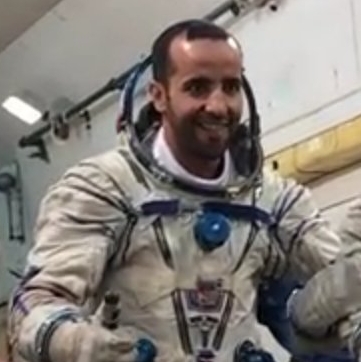
Sultan Al Neyadi in training

Capitalism in space: The United Arab Emirates (UAE) yesterday announced that 41-year-old Sultan Al Neyadi will fly on six month ISS mission, launching in the spring of 2023. purchased from Axiom.

The UAE purchased a seat on the Falcon 9 rocket from Axiom Space, a space infrastructure development company in Houston. This is the Falcon 9 seat that Axiom Space was given by Nasa after the company gave up its Russian Soyuz rocket seat for American astronaut Mark Vande Hei in 2021.

MBRSC did not disclose how much they paid Axiom for the seat, but the agreement includes transport to and from the space station; comprehensive mission support; all necessary training and preparation for launch; flight operations, landing and crew rescue services.

The deal behind this seat is very complex. Essentially, Axiom paid for the seat of Mark Vande Hei’s flight on a Soyuz capsule from 2021 to 2022 (because NASA had no authorized funds to purchase that seat), and got a later seat on a Dragon for an Axiom commercial customer. It then signed a deal with the UAE for Al Neyedi’s flight in late April.

The result is the first long term commercial mission to space.

Al Neyadi has been in training for four years, and acted as the back up astronaut to the first UAE manned flight to ISS, purchased from the Russians in 2019.

Tentative crash date for Long March 5B core stage: July 31st

Predicted crash path of Long March 5B core stage
Click for full image.

Engineers from the Aerospace Corporation have now made the first preliminary calculations and determined that the core stage of China’s Long March 5B rocket that launched July 24th will crash to Earth uncontrolled on July 31, 2022, give or take one day.

The map to the right, reduced to post here, shows all the orbits during that 48 hour period. Note that, except for most of Europe, almost all the high population regions of the globe are in the crash zone.

This prediction is very tentative, and will change as the core stage’s orbit evolves in the next few weeks. It also could change entirely if China has updated the rocket’s engines so they can be restarted at least once to de-orbit the stage properly, as it has hinted it could do. If however the orbit begins to decay without any action by China, then we will know those hints were lies, and that China is once again violating the Outer Space Treaty by acting with willful negligence to threaten harm to others with one of its launches.

Curiosity looks ahead

Curiosity looks ahead
Click for full resolution. For original images go here and here.

Overview map
Click for interactive map.

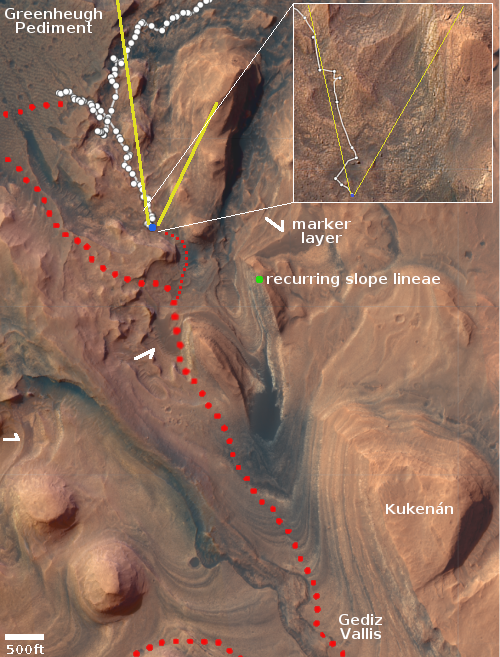
Cool image time! The panorama above, taken by one of the navigation cameras on the Mars rover Curiosity on July 23, 2022, forms a nice bookend to yesterday’s panorama. Yesterday Curiosity looked back at its past travels. Today it looks forward at where it is almost certainly heading in the days ahead.

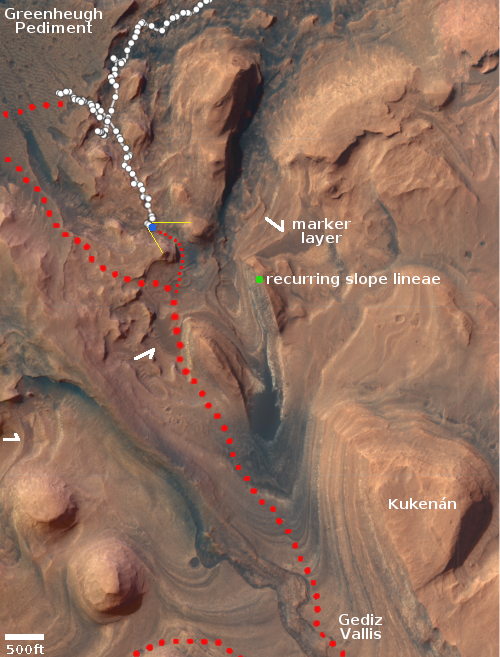
On the overview map to the right, the yellow lines indicate the approximate area viewed by the panorama. The large red dotted line marks the rover’s original planned route, abandoned when the science team found the terrain on the Greenheugh Pediment too rough for Curiosity’s wheels. The smaller red dotted line is my present guess as to the rover’s future route to get back on course.

The flat-topped mountain dubbed Kukenán by the science team has probably been one of the prime goals of the entire mission, from the beginning. Its almost vertical face has innumerable layers, all of which record in great detail the geological history of Mars and Gale Crater. As noted by Abigail Fraeman from the Jet Propulsion Laboratory on June 30, 2022:

Kukenán’s Earth namesake is a tepui, or distinctive isolated table-top mountain, found in South America. The Martian Kukenán is also somewhat flat topped and an impressive expression in Mt. Sharp’s topography. While it looks like it’s about the same size as the hills that bound it in the above Navcam image (“Deepdale” on the left and the edge of “Bolivar” on the right), this effect is just due to forced perspective. In reality, Kukenán is nearly five times farther away and over three times as tall as Deepdale! Curiosity’s strategic traverse path takes the rover right past Kukenán in about a kilometer or so, so this feature will become a familiar landmark rising in our windshield for months to come.

The science team will likely park Curiosity in the saddle of the gap ahead for at least a week and spend a lot of time documenting that cliff face with multiple cameras, since at this location the rover will have an excellent view of that entire face. As it gets closer the angle looking up will get steeper, thus making viewing of the upper layers more difficult.

Long March 5B core stage from July 24th launch remains in orbit

According to data from the U.S. Space Command, the core stage of the Long March 5B rocket used to launch China’s next large module for its Tiangong space station is still in orbit, with no indication yet that China has the ability to safely de-orbit it over the ocean in a controlled manner.

From Jonathan McDowell’s Twitter feed:

Two objects cataloged from the CZ-5B launch: 53239 / 2022-085A in a 166 x 318 km x 41.4 deg orbit, 53240 / 2022-085B in a 182 x 299 km x 41.4 deg orbit. Orbital epoch of ~1200 UTC confirms that the inert 21t rocket core stage remains in orbit and was not actively deorbited.

In all previous Long March 5B launches the core stage reached orbit, deployed its payload, and then crashed back to Earth uncontrolled a few weeks later because its engines could not be restarted. Since it is large, pieces hit the ground, but fortunately nothing landed in habitable areas. In one case however had the return occurred fifteen minutes earlier it would have landed in the New York City metropolitan area.

There were comments made during the launch countdown by Chinese officials suggesting the stage’s engine can now be restarted to allow it to be de-orbited properly, but if so there is as yet no indication that this has happened. If anything, the presence of these objects in orbit suggest otherwise.

It is also possible Chinese engineers are doing further orbital tests with both objects, and will de-orbit them properly in the next week or so. That China conducted a series of static fire tests of this stage’s engines prior to launch strongly suggested that they can now control its re-entry.

Since China won’t say, however, we can only wait and watch.

OneWeb and Eutelsat negotiating possible merger

In a press release today the geosynchronous (GEO) communications satellite company Eutelsat revealed that it is negotiating a possible merger with the low Earth orbit (LEO) communications satellite company OneWeb.

The combined entity would be the first multi-orbit satellite operator offering integrated GEO and LEO solutions and would be uniquely positioned to address a booming ~$16bn (2030) Satellite Connectivity market. OneWeb is one of the two only global LEO networks and has experienced strong momentum over recent months, with service expected to be fully deployed in 2023.

The transaction would represent a logical next step in the successful partnership between Eutelsat and OneWeb, started with Eutelsat’s equity investment in OneWeb in April 2021 and deepened with the Global Distribution Agreement announced in March 2022. Eutelsat currently holds 23% of OneWeb’s share capital, alongside a consortium of high-profile public and private investors.

Under the terms of the transaction being discussed, Eutelsat and OneWeb shareholders would each hold 50% of the combined group’s shares. [emphasis mine]

This appears to be an attempt by Eutelsat to survive, since the future of geosynchronous communications satellites is presently very questionable with the arrival of the many LEO satellite constellations like OneWeb and Starlink.

Meanwhile, the highlighted words in the quote do not match reality. If anything OneWeb has stalled badly since February, when Russia invaded the Ukraine and cancelled the remaining half dozen or so scheduled OneWeb launches. OneWeb has announced new launch contracts with SpaceX and India, but because none have even been scheduled, it increasingly appears its constellation will not be operational by 2023.

Curiosity looks back

Curiosity looks back
Click for full image.

Overview
Click for interactive map.

Cool image time! Normally I’d be hiking today, but since it is raining in southern Arizona at every mountain location we might want to go, I am forced to imagine hiking on Mars instead. The photo above, cropped to post here, was part of a mosaic of images taken on July 22, 2022 by the right navigation camera on the rover Curiosity.

Curiosity had just completed several drives that had it skirt around those two boulders visible in the center of the picture, as shown in the inset in the overview map to the right. The yellow lines indicate the approximate area covered by the photo. The blue dot marks Curiosity’s present location. The larger red dotted line the rover’s original planned route, with the smaller dotted line my guess as to the route the science team now plans to take to return to that course.

The rim of Gale Crater can be seen in the far distance, about 20 to 30 miles away and largely obscured by the winter dust that presently fills the atmosphere.

The science team had hoped to get close enough to these two boulders to touch them with the rover’s instruments, but decided to keep away because of both appeared a bit unstable.

SpaceX launches another 53 Starlink satellites

Capitalism in space: SpaceX today successfully used its Falcon 9 rocket to launch another 53 Starlink satellites into orbit.

This was the eighth flight of the first stage, which successfully landed on a drone ship in the Atlantic. This was also the company’s sixth launch in July, in only three weeks.

The leaders in the 2022 launch race:

33 SpaceX
24 China
9 Russia
5 Rocket Lab
4 ULA

American private enterprise now leads China 46 to 24 in the national rankings, and the entire world combined 46 to 40.

China successfully launches new large module to its Tiangong space station

Tiangong-3, completed
Tiangong-3 station, when completed

The new colonial movement: China on July 24, 2022 (China time) has successfully used its Long March 5B rocket to put into orbit its Wentian module, the next large section that will dock with the Tiangong station in the next day or so.

According to one announcer, the core stage will not crash to Earth in an uncontrolled manner, as in previous Long March 5B launches. However, this is China, and his statement cannot be taken at face value. We shall find out in the coming days if this is so, or whether the core stage will be a threat to habitable areas as its orbit decays.

The leaders in the 2022 launch race:

32 SpaceX
24 China
9 Russia
5 Rocket Lab
4 ULA

The U.S. still leads China 45 to 24 in the national rankings, as well as the entire globe combined 45 to 40.

Watch China’s launch of next big module to its Tiangong space station

The launch of the next big module to China’s Tiangong space station, dubbed Wentian, is scheduled for 2:15 am (eastern) tonight, using its Long March 5B rocket.

The live stream is embedded below if you want to watch. It begins at about an hour before launch.

I have added a live stream in English, below the first. One detail of importance that this broadcast has already revealed: According to one technical expert being interviewed, the core stage will not crash to Earth uncontrolled. They will be able to bring it down where and when they want.
» Read more

China releases one photo of Phobos taken by its Tianwen-1 Mars orbiter

Phobos as seen by Tianwen-1
Click to see original photo.

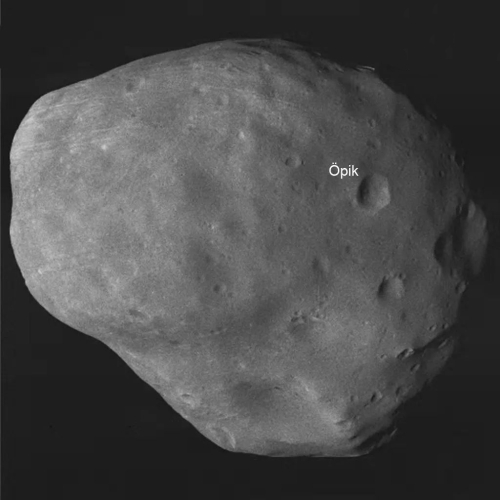
China today released a single photo of the Martian moon Phobos, taken by its Tianwen-1 Mars orbiter, to mark the second anniversary of the orbiter’s launch.

The English press release at the link conveniently did not provide the image to the non=Chinese world, but the Chinese language release did. That picture is to the right, reduced slightly to post here. Considering its disinterest in making it easy to find this photo for English speakers, it is intriguing that China included the English language name Opik for one crater.

Moreover, this single picture release illustrates the paucity of Tianwen-1 photos made available to the public by China. Very few have been released, and though eventually China has been making its raw data available, it has not been doing so in a manner that makes it easy for outsiders to access it.

Nonetheless, this is one of the best pictures of Phobos I have yet seen.

NASA’s safety panel questions NASA commitment to commercial space stations

We’re here to help you! Not surprisingly, members of NASA’s safety panel have once again expressed doubts about NASA’s ongoing effort to encourage a thriving private, competitive, and efficient commercial space industry, this time questioning the transition from NASA’s government-built space station, ISS, to privately-built and owned space stations, four of which are presently under development.

At a July 21 meeting of the Aerospace Safety Advisory Panel, members said they were concerned that commercial stations whose development is being supported by NASA were unlikely to be ready in time before the ISS is retired at the end of the decade, and that those efforts suffered from insufficient budgets.

Those plans, called Commercial Leo Earth Orbit (LEO) Destinations by NASA, “are on a precarious trajectory to realization on a schedule and within the projected resources needed to maintain a NASA LEO presence,” said Patricia Sanders, chair of the panel. “This is an area of concern for us.”

The panelists also questioned how quickly the stations would be man-rated (claiming NASA was not allocating enough time to do so) as well as whether NASA had enough work for four stations.

For the past decade this safety panel has consistently shown itself to be hostile to the new commercial space companies. It has never seen any safety issues or scheduling problems with NASA’s big SLS rocket. Nor did it notice Boeing’s significant software and valve problems on Starliner. Yet somehow, the work of SpaceX was dangerous (when it was not), and now these new stations, most of which are being built by new space companies, are equally unfit for use.

It is time to shut down this panel. Or at a minimum fire its present members and bring in new blood more willing to look at the entire space industry with a more objective eye.

A large majority of today’s college students think blacklisting is a good thing

The user manual for the modern generation

The modern dark age: Old-fashioned Americans, who believe in free speech and tolerance, often assume that the spate of cruel blacklisting stories that now dominate our society are merely the actions of a few isolated individuals who have happened to gain a position of power and are abusing it.

This assumption could not be more wrong. We are entering a future where blacklisting, censorship, and the abuse of power will become the norm, because apparently the new generation thinks such things are always justified, if they have been offended in any way. From a recent poll of 2,000 students at 130 colleges:

In one eye-opening finding, 74 percent of undergrads endorse the view that a professor who says “something that students find offensive” should be reported to the university. By a majority almost as lopsided, 65 percent believe that a fellow student who says something they consider offensive should be turned in. That informers’ mindset is especially pronounced among students who identify themselves as politically liberal, fully 85 percent of whom would report a professor who offends them. But even among self-identified conservatives, a solid majority, 56 percent, are of the same mindset. [emphasis in original]

» Read more

SpaceX successfully launches another 46 Starlink satellites

Capitalism in space: SpaceX today successfully used its Falcon 9 rocket to place another 46 Starlink satellites into orbit.

The first stage, completing its fourth flight, landed successfully on a drone ship in the Pacific.

This was SpaceX’s 32nd launch in 2022, exceeding the record of 31 launches it set last year, and doing so only a little more than halfway through the year.

The leaders in the 2022 launch race:

32 SpaceX
23 China
9 Russia
5 Rocket Lab
4 ULA

American private enterprise now leads China 45 to 23 in the national rankings, and the entire globe combined 45 to 39.

1 232 233 234 235 236 959