Webb tracks Uranus’ atmosphere over 15 hours

Uranus and its atmosphere
Click for original image.

Using the Webb Space Telescope, astronomers on January 19, 2025 were able to observe Uranus for fifteen straight hours, tracking the atmosphere’s temperature and structure more completely than ever before.

You can read the peer-reviewed paper here. The false color image to the right, reduced to post here, is just one slice of that dataset. We are looking down at Uranus’ pole, as the rotational tilt is so severe the planet rotates on its side as it orbits the Sun. The grey circles on the outside are the planet’s faint rings. The orange blobs I think are aurora that rotate around the pole at high latitudes, as shown in this video. The orange represents the upper atmosphere.

Led by Paola Tiranti of Northumbria University in the United Kingdom, the study mapped out the temperature and density of ions in the atmosphere extending up to 5,000 kilometres above Uranus’s cloud tops, a region called the ionosphere where the atmosphere becomes ionised and interacts strongly with the planet’s magnetic field. The measurements show that temperatures peak between 3,000 and 4,000 kilometres, while ion densities reach their maximum around 1,000 kilometres, revealing clear longitudinal variations linked to the complex geometry of the magnetic field.

…Webb’s data confirm that Uranus’s upper atmosphere is still cooling, extending a trend that began in the early 1990s. The team measured an average temperature of around 426 kelvins (about 150 degrees Celsius), lower than values recorded by ground-based telescopes or previous spacecraft.

Two bright auroral bands were detected near Uranus’s magnetic poles, together with a distinct depletion in emission and ion density in part of the region between two bands (a feature likely linked to transitions in magnetic field lines). Similar darkened regions have been seen at Jupiter, where the geometry of the magnetic field there controls how charged particles travel through the upper atmosphere.

There is great uncertainty in these conclusions, mostly because the observations are for such a short time. It is like trying to understand the Earth’s climate after looking at it for only one day.

0 comments

February 23, 2026 Quick space links

Courtesy of BtB’s stringer Jay. This post is also an open thread. I welcome my readers to post any comments or additional links relating to any space issues, even if unrelated to the links below.

1 comment

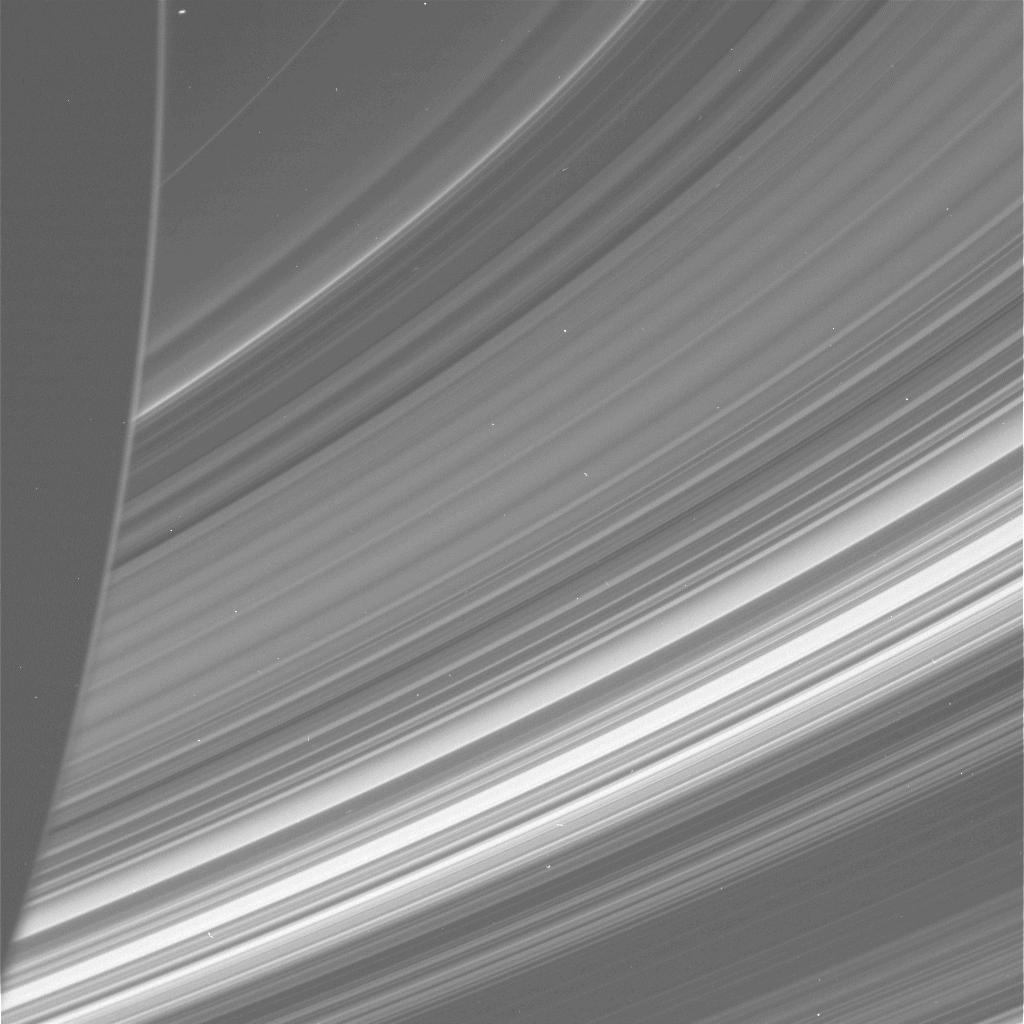
Saturn’s moon Enceladus, as seen during Cassini’s last close fly-by

Enceladus as seen during Cassini's last close fly-by
Click for original.

Cool image time! On December 19, 2015 the Saturn orbiter Cassini made its last close fly-by of the moon Enceladus, known best for the many geysers detected on its surface venting water and other carbon-based materials.

The picture to the right, reduced and enhanced to post here, shows that the entire face of this
Saturn’s moon Enceladus, as seen during that fly-by. The moon itself is only about 310 miles across.

Its icy surface is evident, as are the many fractures, some meandering almost like rivers. Interestingly, for some reason there are a lot more craters in the lower hemisphere, while the upper hemisphere is more completely covered with fractures.

The black outline indicates the approximate area captured by the two close-up images below.
» Read more

0 comments

Webb imaged a star before it went supernova

Webb detection of a supernova progenitor
Click for original image.

One of the biggest challenges facing astronomers for more than four centuries has been the detection of a star prior to its going supernova. Until very recently, no such detection had ever happened, and so astronomers could only guess at the kind of stars or binary systems that might result in these gigantic stellar explosions.

In recent years the improvement in telescopes, both in orbit and on the ground, has produced some successes, whereby the progenitor star was imaged in archival imagery and found after the explosion. The sample however has been small, and the data limited to only a few wavelengths.

Now, the Webb Space Telescope has made its first detection of a supernova progenitor, in the infrared. That image is to the right, showing the star prior to the June 2025 supernova explosion.

By carefully aligning Hubble and Webb images taken of NGC 1637, the team was able to identify the progenitor star in images taken by Webb’s MIRI (Mid-Infrared Instrument) and NIRCam (Near-Infrared Camera) in 2024. They found that the star appeared surprisingly red – an indication that it was surrounded by dust that blocked shorter, bluer wavelengths of light. “It’s the reddest, most dusty red supergiant that we’ve seen explode as a supernova,” said graduate student and co-author Aswin Suresh of Northwestern University.

This excess of dust could help explain a long-standing problem in astronomy that could be described as the case of the missing red supergiants. Astronomers expect the most massive stars that explode as supernovas to also be the brightest and most luminous. So, they should be easy to identify in pre-supernova images. However, that hasn’t been the case.

One potential explanation is that the most massive aging stars are also the dustiest. If they’re surrounded by large quantities of dust, their light could be dimmed to the point of undetectability. The Webb observations of supernova 2025pht support that hypothesis.

You can read the peer-reviewed paper here [pdf].

1 comment

First visual detection of another star’s heliosphere

A baby star's heliosphere
Click for full image.

Using both the Hubble Space Telescope and the Chandra X-ray Observatory, astronomers have made the first visual detection of another star’s heliosphere, in both X-rays and in the infrared.

The image to the right, cropped to post here.

Astronomers have nicknamed the HD 61005 star system the “Moth” because it is surrounded by large amounts of dust patterned similarly to the shape of a moth’s wings when viewed through infrared telescopes. The wings are formed from material left behind after the formation of the star, similar to the Kuiper Belt in our own solar system. Observations of these wings with NASA’s Hubble Space Telescope showed that the interstellar matter surrounding HD 61005 is about a thousand times denser than that around the Sun.

The wings are the points to the left and right. The star’s young heliosphere, which they dub an “astrosphere,” is the purple glow above and below. From the caption:

In this composite image of HD 61005 in the inset, X-rays from Chandra (purple and white) have been combined with infrared data from Hubble (blue and white). Chandra reveals a bright source of X-rays in the center of the image, which is the star itself surrounded by the star’s astrosphere. The wing-like structure sweeping away from the star in the infrared image is dusty material that remained behind after the formation of the star. These wings have been swept backwards as they fly through space.

As this star and its solar system are very young, what we have is a very dusty accretion disk interacting with a very temperamental baby star.

0 comments

Exolaunch integrates five satellites in Isar’s Spectrum rocket

Proposed or active spaceports in North Europe

Exolaunch, which specializes in preparing and integrating satellites onto rockets for satellite companies, has now completed the integration of the five satellite payloads that will fly on the second launch attempt of the German startup Isar Aerospace.

The launch is presently scheduled for March 19, 2026, lifting off from Norway’s Andoya spaceport, and is Isar’s second attempt to complete an orbital launch. The first, in March 2025, failed mere seconds after launch due to a loss of attitude control.

The payloads are as follows:

  • CyBEEsat for Technische Universität Berlin (Germany)
  • TRISAT-S for University of Maribor (Slovenia)
  • STS1 for Technische Universität Wien (Austria)
  • Platform 6 6UXL for Endurosat (Bulgaria)
  • FramSat1 for Norwegian University of Science and Technology (Norway).

These are all cubesats and are all likely student projects, willing to risk their launch on an untested rocket because the cost is low.

Of the half dozen or so rocket startups in Europe, Isar appears in the lead. Both PLD and Rocket Factory Augsburg say they will attempt a launch in 2026, but neither has set a date. And both will be trying for their first time, unlike Isar.

It also appears that Andoya is in the lead in the race to be the first European spaceport to complete an orbital launch. The spaceports in the United Kingdom started almost a decade earlier, but have been stymied by government red tape. Norway in turn moved fast to make its regulations simple and fast.

0 comments

SpaceX launches 28 more Starlink satellites on 2nd launch today; sets new 1st stage reuse record

SpaceX this evening completed its second launch today, placing 28 more Starlink satellites in orbit, its Falcon 9 rocket lifting off from Cape Canaveral Space Force Station in Florida.

The first stage (B1067) completed its 33rd flight, landing on a drone ship in the Atlantic. With this flight, B1067 has tied the space shuttle Atlantis for the second most reused launch vehicle on record.

39 Discovery space shuttle
33 Atlantis space shuttle
33 Falcon 9 booster B1067
31 Falcon 9 booster B1071
31 Falcon 9 booster B1063
29 Falcon 9 booster B1069
28 Columbia space shuttle

Sources here and here.

The 2026 launch race:

22 SpaceX
8 China
2 Rocket Lab
2 Russia
1 ULA
1 Europe (Arianespace)

As it did in both ’24 and ’25, SpaceX in ’26 so far has more launches than the entire rest of the world combined.

13 comments

SpaceX launches 25 more Starlink satellites

SpaceX early this morning successfully placed another 25 Starlink satellites into orbit, its Falcon 9 rocket lifting off from Vandenberg Space Force Base in California.f

The first stage (B1063) completed its 31st flight, landing on a drone ship in the Pacific, moving it up in the rankings for the most reused launch vehicles:

39 Discovery space shuttle
33 Atlantis space shuttle
32 Falcon 9 booster B1067
31 Falcon 9 booster B1071
31 Falcon 9 booster B1063
29 Falcon 9 booster B1069
28 Columbia space shuttle

Sources here and here.

The 2026 launch race:

21 SpaceX
8 China
2 Rocket Lab
2 Russia
1 ULA
1 Europe (Arianespace)

As it did in both ’24 and ’25, SpaceX in ’26 so far has more launches than the entire rest of the world combined.

0 comments

February 20, 2026 Quick space links

Courtesy of BtB’s stringer Jay. This post is also an open thread. I welcome my readers to post any comments or additional links relating to any space issues, even if unrelated to the links below.

12 comments

Scientists: When a SpaceX upper stage burns up in the atmosphere, it burns up in the atmosphere!

Chicken Little rules!

We’re all gonna die! In making the first direct measurement of the plume caused by the vaporization of the lithium in a SpaceX Falcon 9 upper stage as it burned up in the atmosphere, scientists now claim the pollution for those upper stages as well as the coming launch of tens of thousands of satellites is going to seriously harm the environment.

You can read their paper here. From its conclusion:

Beyond this single event, recurring re-entries may sustain an increased level of anthropogenic flux of metals and metal oxides into the middle atmosphere with cumulative, climate-relevant consequences. After oxidation and heterogeneous uptake on alumina and other metal-oxide particles, aluminium and co-injected species could perturb stratospheric ozone chemistry, modify high-altitude aerosol microphysics through new particle formation, growth, and coagulation, and thereby influence radiative balance. Key unknowns include emission inventories for rockets and satellites, lack of a systematic observational survey of mesospheric metals, altitude-time ablation profiles, chemical lifetimes, particle size-composition distributions, and transport pathways into the lower stratosphere. Addressing these uncertainties will require coordinated, multi-site observations (including resonance-fluorescence and elastic lidars, in situ sampling, and satellites), together with whole-atmosphere chemistry-climate modelling to connect event-scale injections to long-term impacts.

The problems with this study, and its conclusions, are numerous. First of all, this first direct detection of the lithium plume is really no discovery at all. We know the rocket’s upper stage carried lithium. We know it burned up in the atmosphere. It is plainly obvious that lithium would end up as vapor in the upper atmosphere where stage burned up. This detection simply measured what we already knew.

Second, the amount detected is really insignificant. At about 60 miles elevation the numbers rose from 3 lithium atoms per cubic centimeter to 31 during the stage’s burn-up, numbers that will quickly dissipate at these high altitudes. We are not talking big numbers.

Finally, the threat from debris from upper rocket stages is only a temporary problem. As the demand to launch more satellites grows — which it will — the demand to recover and reuse the upper stages will grow as well. Already two American companies, SpaceX and Stoke Space, are developing rockets that will be completely reusable.

The mentality of these scientists is the same “Chicken Little” view of life held by the establishment science community for decades, from climate to industry to Covid to any human endeavor. “Everything humans do is bad! We must ban it now before it destroys us all!” And none of their cries of panic ever carry any larger context or reasonable perspective.

Sadly, this same attitude permeates the mainstream propaganda press. They don’t question such studies, they instead reprint their claims in bold, without any skepticism. We are thus ill-served by our so-called “independent and free” press.

27 comments

SpaceX launches 29 Starlink satellites

SpaceX early today successfully launched another 29 Starlink satellites, its Falcon 9 rocket lifting off from Cape Canaveral.

The first stage completed its 26th flight, landing on a drone ship in the Atlantic, within the territorial waters of the Bahamas for the second time.

The 2026 launch race:

20 SpaceX
8 China
2 Rocket Lab
2 Russia
1 ULA
1 Europe (Arianespace)

As it did in both ’24 and ’25, SpaceX in ’26 so far has more launches than the entire rest of the world combined.

0 comments
1 34 35 36 37 38 2,413