Russia loses contact with Photon-M

Russia has lost contact with its Photon-M biology spacecraft, launched last week with a four geckos on board.

The Russians say that the receipt of telemetry from the spacecraft shows it is successfully operating autonomously without help from the ground. And since the Russians have a great deal of experience building spacecraft that can function on their own, I have no reason to disbelieve them in this. What is not clear is whether the spacecraft can come home on its own.

SLS needs more money!

Surprise, surprise! A GAO report finds that SLS is over budget and that NASA will need an additional $400 million to complete its first orbital launch in 2017.

NASA isn’t meeting its own requirements for matching cost and schedule resources with the congressional requirement to launch the first SLS in December 2017. NASA usually uses a calculation it calls the “joint cost and schedule confidence level” to decide the odds a program will come in on time and on budget. “NASA policy usually requires a 70 percent confidence level for a program to proceed with final design and fabrication,” the GAO report says, and the SLS is not at that level. The report adds that government programs that can’t match requirements to resources “are at increased risk of cost and schedule growth.”

In other words, the GAO says SLS is at risk of costing more than the current estimate of $12 billion to reach the first launch or taking longer to get there. Similar cost and schedule problems – although of a larger magnitude – led President Obama to cancel SLS’s predecessor rocket system called Constellation shortly after taking office. [emphasis mine]

I want to underline the current $12 billion estimate for the program’s cost to achieve one unmanned launch. That is four times what it is costing NASA to get SpaceX, Boeing, and Sierra Nevada to build their three spaceships, all scheduled for first manned launch before 2017. SLS not only can’t get off the ground before 2017, it can’t even get built for $12 billion.

If this isn’t the definition of a wasteful, boondoggle designed merely as pork, I don’t know what is. And what I do know is that there is no way SLS is going to ever get the United States back into space. It should be shut down, now.

Falcon 9 soft lands on water

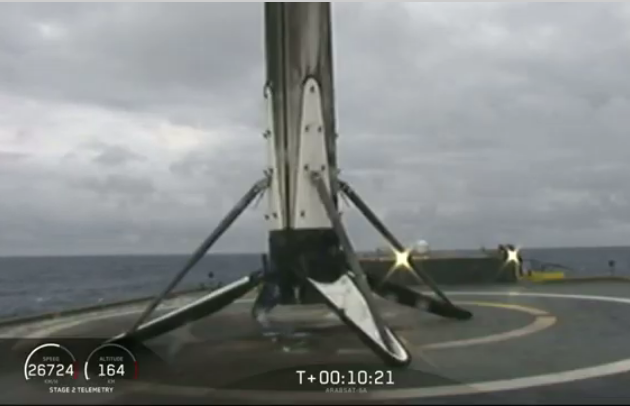
SpaceX claimed in a press release on Tuesday that it had successfully completed a soft splashdown of the first stage of its Falcon 9 rocket in its launch earlier this month.

Video below the fold. The quality is not great because of a buildup of ice on the camera, but it does show they were able to restart the engines twice after separation. It also shows the landing legs deploy just before the stage hovers above the water.
» Read more

Exoplanets with no water

The uncertainty of science: Though planet formation theories said they should have water, in looking for water on three exoplanets astronomers were surprised to discover practically none there.

The three planets, known as HD 189733b, HD 209458b, and WASP-12b, are between 60 and 900 light-years away from Earth and were thought to be ideal candidates for detecting water vapor in their atmospheres because of their high temperatures where water turns into a measurable vapor. These so-called “hot Jupiters” are so close to their star they have temperatures between 1,500 and 4,000 degrees Fahrenheit, however, the planets were found to have only one-tenth to one one-thousandth the amount of water predicted by standard planet-formation theories.

“Our water measurement in one of the planets, HD 209458b, is the highest-precision measurement of any chemical compound in a planet outside our solar system, and we can now say with much greater certainty than ever before that we’ve found water in an exoplanet,” said Nikku Madhusudhan of the Institute of Astronomy at the University of Cambridge, England. “However, the low water abundance we have found so far is quite astonishing.” Madhusudhan, who led the research, said that this finding presents a major challenge to exoplanet theory. “It basically opens a whole can of worms in planet formation. We expected all these planets to have lots of water in them. We have to revisit planet formation and migration models of giant planets, especially “hot Jupiters,” and investigate how they’re formed.”

New Rosetta comet images

New images from Rosetta have a resolution of 100 meters per pixel and are finding that the neck connecting the comet’s two sections is apparently much brighter than the rest of the nucleus.

As earlier images had already shown, 67P may consist of two parts: a smaller head connected to a larger body. The connecting region, the neck, is proving to be especially intriguing. “The only thing we know for sure at this point is that this neck region appears brighter compared to the head and body of the nucleus”, says OSIRIS Principal Investigator Holger Sierks from the Max-Planck-Institute for Solar System Research (MPS) in Germany. This collar-like appearance could be caused by differences in material or grain size or could be a topographical effect.

It looks like this comet is going to turn out to be one of the most fascinating objects any space probe has visited in a long time.

Soviet spacecraft kidnapped by CIA

Stranger than fiction: In 1967 the CIA kidnapped a Soviet spacecraft for 24 hours during a global international exhibition tour.

Because the Lunik was guarded 24/7 by Soviets during the second exhibition, the intelligence agents had to wait until the show was over and the Lunik crated for shipment. Then the CIA agents “arranged to make the Lunik the last truckload of the day to leave the grounds,” Finer says. When the Americans made sure no Soviets were on the road watching the truck with the precious cargo as it made its way to the railroad station, “the truck was stopped at the last possible turn-off, a canvas was thrown over the crate and a new driver took over,” Finer says. “The original driver was escorted to a hotel room and kept there for the night.” In a salvage yard, the American experts poked, prodded and photographed the Lunik. Meanwhile, at the railroad yard where the shipment was expected, the Americans got lucky. The Russian waiting to check in the truckloads evidently grew tired, bored, hungry or all three: He left his post to eat dinner and then headed to his hotel to sleep. By 7 a.m., the Russian was back at his post at the rail yard, none the wiser. There he “found the truck with the Lunik awaiting him.”

Out of the Canyon

We exited the Grand Canyon on schedule at about 1:30 on Thursday. The hike out this year took one hour longer than last year, mostly because we took longer breaks.

As always, the Canyon is a sublime place, hard to describe to those who have never been there and unnecessary to describe for those who have. We hiked in, did an 11 mile hike the one day we were at the bottom, then hiked out today.

Posting will resume but will remain light until I return home on Sunday night.

Islamic terrorism and bigotry for all to see.

The religion of peace: “In a sort of reverse Passover, ISIS activists have marked the homes of Christians with the letter N for “Nassarah,” an Islamic term for Christian, to identify the homes whose inhabitants were to be slaughtered.”

The article also shows, with pictures, the violent nature of the Muslim demonstrations against Israel in France, and the intolerant treatment of Christians by ISIS in Mosul, Iraq.

An exoplanet with an orbit like Mars

Using Kepler astronomers have discovered a Uranus-sized exoplanet with the longest known orbit, 704 days.

Kepler-421b orbits an orange, type K star that is cooler and dimmer than our Sun. It circles the star at a distance of about 110 million miles. As a result, this Uranus-sized planet is chilled to a temperature of -135° Fahrenheit.

As the name implies, Kepler-421b was discovered using data from NASA’s Kepler spacecraft. Kepler was uniquely suited to make this discovery. The spacecraft stared at the same patch of sky for 4 years, watching for stars that dim as planets cross in front of them. No other existing or planned mission shows such long-term, dedicated focus. Despite its patience, Kepler only detected two transits of Kepler-421b due to that world’s extremely long orbital period.

The planet’s orbit places it beyond the “snow line” – the dividing line between rocky and gas planets. Outside of the snow line, water condenses into ice grains that stick together to build gas giant planets.

Posted from Bright Angel Lodge on the rim of the Grand Canyon.

More destroyed evidence at the IRS

Working for the Democratic Party: The IRS now reports that as many as 20 individuals under investigation for the agency’s harassment of Obama’s political opponents have had computer crashes, losing their emails.

IRS Deputy Associate Chief Counsel Thomas Kane said in transcribed congressional testimony that more IRS officials experienced computer crashes, bringing the total number of crash victims to “less than 20,” and also said that the agency does not know if the lost emails are still backed up somewhere.

The new round of computer crash victims includes David Fish, who routinely corresponded with Lois Lerner, as well as Lerner subordinate Andy Megosh, Lerner’s technical adviser Justin Lowe, and Cincinnati-based agent Kimberly Kitchens.

But hey, Lois Lerner says she did nothing wrong!

A question for Israel’s critics?

The article begins quite bluntly:

In light of the murderous actions and intentions of Hamas, what would you like Israel to do?

I wholeheartedly concur that the death of even one unarmed civilian is tragic, let alone the death of scores or of hundreds. And I affirm without hesitation that Arab blood is as precious as Jewish blood.

That being said, since Hamas is sworn to Israel’s destruction, since Hamas initiated the recent hostilities, since Hamas rejected cease fire offers, since Hamas is using civilians, including women and children, as human shields, and since Hamas is actively attempting to infiltrate Israel and murder, kidnap, and maim its people, what do you suggest that Israel does?

Read it all. It is an honest appraisal of the situation.

Was Yutu stopped by rough ground?

One of the designers of the Chinese lunar rover Yutu said in a news interview today that the rocky nature of the Moon’s surface, far rougher than expected, was what caused it to stall.

The rover was tested in Beijing, Shanghai and the desert in northwestern China before its launch, but the terrain of the landing site proved to be much more rugged than expected, said Zhang Yuhua, deputy chief designer of the lunar probe system for the Chang’e-3 mission. “It is almost like a gravel field.”

Data from foreign researchers projected that there would be four stones, each above 20 cm, on average every 100 square meters, but the quantity and size of the stones that Yutu has encountered has far exceeded this expectation, Zhang said in an exclusive interview with Xinhua. “Experts’ initial judgement for the abnormality of Yutu was that the rover was ‘wounded’ by colliding with stones while moving,” she said. [emphasis mine]

The implication of the highlighted quote is that it isn’t their fault, it was the fault of those evil Americans and Russians who incorrectly estimated the roughness of the ground. This article also doesn’t fit the information released when Yutu first stalled, where they explained that their problem was partly an inability to retract equipment in preparation for lunar night. While this story could be true, it isn’t the whole story.

The 707 turns 60

The sixtieth anniversary of Boeing’s 707 passenger jet and how it changed aviation history.

The pictures are cool, but read it for the history. Sixty years ago the ability of ordinary citizens to span the globe quickly and easily suddenly became possible, and that ability has changed the world.

More harrassment of opponents by the Obama administration

How the Obama Justice Department strong-arms banks to harass legal businesses it doesn’t like.

A Justice Department fraud prevention program came under fire Thursday for allegedly morphing into actively pressuring banks to deny financial services to businesses for political reasons.

Operation Choke Point functions as a partnership between the Department of Justice (DOJ) and various other federal agencies which deal with bank regulations, specifically the Treasury and the SEC. The objective of the project is to choke-off fraudulent businesses from accessing financial services, in an effort to protect consumers.

The controversy, however, is over allegations that the DOJ is pressuring financial institutions to decline doing business with so-called “high risk” industries which line up squarely against the political leanings of the current administration. These businesses include ammunition sales, payday loans, pornography, fireworks companies, and others—24 industries in total, as listed by the Federal Deposit Insurance Corporation (FDIC).

Much of the news today and yesterday has been about the Malaysian plane shot down over the Ukraine. Though Obama’s response was pitiful, I find this story above much more significant as it illustrates bluntly this administration’s strong misuse of power for political ends.

Caves on the Moon!

Scientists have now identified more than 200 cave pits on the Moon.

The pits range in size from about 5 meters (~5 yards) across to more than 900 meters (~984 yards) in diameter, and three of them were first identified using images from the Japanese Kaguya spacecraft. Hundreds more were found using a new computer algorithm that automatically scanned thousands of high-resolution images of the lunar surface from LRO’s Narrow Angle Camera (NAC).

This work is essentially the same as that done by James Fincannon and I back in 2011 (see links here, here, here, and here) but with much greater thoroughness.

The first blank Sun since 2011

No sunspots on July 17, 2014

For the first time since August 14, 2011, the Sun showed no sunspots on its surface today. It started the day, July 17, 2014, with one small sunspot, but that spot apparently decayed away by the end of the day, as indicated by the fact that the sunspot number for the day was listed as zero, the first time that has happened since the solar maximum ramp up began in 2011.

This is strong evidence that the ramp down to solar minimum is beginning.

Voyager 1 might not have left the solar system

The uncertainty of science: Two scientists dispute the finding this year that Voyager 1 has entered interstellar space.

Voyager has yet to detect what scientists long predicted would be the calling card of interstellar space: a shift in the direction of the magnetic field. Scientists had expected the probe to encounter particles under the influence of the interstellar magnetic field draped over the outer shell of the heliosphere, inducing an abrupt shift. But the direction has remained stubbornly constant, and researchers can’t explain why. “This whole region is a lot messier than anyone dreamed of,” Christian says.

It’s a bit too messy for George Gloeckler and Lennard Fisk, Voyager scientists at the University of Michigan in Ann Arbor. They wondered whether the magnetic field and particle density conditions measured by Voyager could exist within the heliosphere. In a paper accepted for publication in Geophysical Research Letters, Gloeckler and Fisk argue that the outer heliosphere could allow an influx of galactic particles from beyond the bubble that would explain the density measurements.

The researchers’ analysis includes a way to definitively test the idea: If Voyager 1 is within the heliosphere, Gloeckler and Fisk note, then it should still be at the mercy of the sun’s magnetic field. If that were the case, within a year or so, Voyager should detect a 180-degree flip in the field’s direction, a regular occurrence caused by the sun’s rotation. “If that happens,” Gloeckler says, “Len and I will have a big celebration.”

I suspect that both sides are right, and that the transition into interstellar space is simply very complex. Some data will say the spacecraft is outside the solar system, while other data will say it is inside.

Europe readies its own space plane for test flight

The competition heats up: Europe ‘s Intermediate eXperimental Vehicle (IXV) is undergoing its final tests before it does a suborbital test flight in November.

IXV will be launched into a suborbital trajectory on ESA’s small Vega rocket from Europe’s Spaceport in French Guiana, the vehicle will return to Earth as though from a low-orbit mission. For the first time, it will test and qualify European critical reentry technologies in hypersonic flight, descend by parachute and land in the Pacific Ocean to await recovery and analysis. IXV is manoeuvrable and able to make precise landings—it is the ‘intermediate’ element of Europe’s path to future developments with limited risks. …

When IXV splashes down in the Pacific at the end of its mission it will be recovered by ship and returned to Europe for detailed analysis to assess the performance and condition of the internal and external structures. The actual performance will be compared with predictions to improve computer modelling of the materials used and the spaceplane’s design.

Though exciting, Europe will have to pick up the pace from its normally slow pace on these kinds of projects if it expects to be competitive. In the past, they would stretch out the development as long as they could in order to keep the cash flowing. This won’t work in the increasingly robust aerospace market that exists today.

UrthaCast progress

The competition heats up: UrthaCast has announced the status of the commissioning of its commercial cameras on ISS for viewing the Earth.

The medium resolution camera has been commissioned and is available for commercial imaging. The high resolution camera, however, has a problem with its pointing system which is requiring troubleshooting.

The Bi-axial Pointing Platform (“BPP”), which controls the pointing of the [High Resolution camera (HRC)], is experiencing difficulties in achieving the pointing control precision needed for the HRC to meet image quality specifications. Our engineering team together with RSC Energia believes it has developed a solution to this problem using existing gyroscopes on the HRC to improve the BPP pointing control. This solution has been successfully tested on the ground. The on-orbit implementation of this solution requires software updates and the installation of additional cabling inside the Zvezda module. These new cables need to be delivered to the International Space Station (ISS). As a result, there will be a several month delay in commissioning the HRC.

More forgotten vials of deadly diseases discovered

FDA officials now admit that when they discovered six undocumented vials of smallpox in a facility in Maryland they also found 327 additional vials that contained dengue, influenza and rickettsia.

FDA scientists said they have not yet confirmed whether the newly disclosed vials actually contained the pathogens listed on their labels. The agency is conducting a nationwide search of all cold storage units for any other missing samples.

Investigators destroyed 32 vials containing tissue samples and a non-contagious virus related to smallpox. Several unlabeled vials were sent to the Centers for Disease Control and Prevention for testing and the remaining 279 samples were shipped to the Department of Homeland Security for safekeeping.

The FDA’s deputy director is quoted with what might be the understatement of the year. “The reasons why these samples went unnoticed for this long is something we’re actively trying to understand.” You think so, eh?

Let’s just make a quick list of the alphabet soup of federal agencies that we have discovered in the last few months to be either corrupt, incredibly incompetent, or spendthrifts: FDA, CDC, IRS, VA, HHS, NIH, GAO, DHS, TSA. We can add the State Department for its wonderful work in Benghazi, as well as the Border Patrol for their stellar effort in securing the border. I also know that the management at NASA leaves much to be desired.

We can also be sure that this is a partial list. It suggests something that any reasonably intelligent person should quickly see: The federal government is a corrupt mess, and should be overhauled so aggressively that when we are done we shouldn’t recognize it anymore. Certainly its size should be slashed by half, if only to cut off the excess funds that are being funneled to an uncountable number of corrupt practices.

Another ISEE-3 update

The team trying to resurrect ISEE-3 had very mixed results in its attempt today to get the spacecraft’s propulsion system working.

They managed to get “several instances of thrust,” which suggests there is fuel, the system can function, and that their strategy is on the right track. They did not however get full thrust as hoped, and are not quite sure why the spacecraft only partly responded. They are analyzing the data while they apply to NASA for an extension of their license to transmit to the spacecraft.

This last point is merely a formality. What can NASA do if they continue anyway? Nothing. NASA will say yes, partly because it is good public relations and partly because most of the people at NASA are also fans of this effort.

University of hate

Shades of climategate: An activist has released to the public the correspondence from a Brandeis University listserv devoted to expressing hatred for conservatives, Jews, Christians, and anyone who doesn’t conform to modern leftwing dogmas.

More here. It seems that 92 professors, many from Brandeis but also including academics from other institutions, belong to this listserv and post there regularly. Many also signed the petition that protested Brandeis’s decision, later rescinded, to give Muslim dissident Ayaan Hirsi Ali’s an honorary degree.

Read the articles. The language used by these so-called intellectuals is childish, simple-minded, bigoted, and hateful. It reveals to the world who they are, and what they stand for, and should serve as a warning to anyone thinking of attending Brandeis or who is there now: It is time to find another place to go to college.

House slashes budget of National Security Council

Pushback: The House has approved a one third cut to the budget of the National Security Council in response to its mandate that agencies withhold information from Congress.

As I said yesterday, when an agency of the federal government decides to defy Congress, elected by the people, than the best and most effective action for Congress to take is to use the power of the purse to reduce or eliminate that agency’s funding. Without money their power disappears, and Congress takes control.

It has been decades since Congress used its power in this way. The more it does this now, however, the more it is going to realize how powerful it really is.

White House defies House subpoena

Claiming that White House officials have absolute immunity from testifying to Congress, the administration today ignored a subpoena issued by a House committee investigating violations of the Hatch act.

The White House warned Issa late Tuesday that David Simas, director of the White House Office of Political Strategy and Outreach, would not be appearing. White House Counsel Neil Eggleston wrote that Simas is “immune” from any effort by Congress to compel him to testify. “[T]he committee’s effort to compel Mr. Simas’s testimony threatens longstanding interests of the Executive Branch in preserving the president’s independence and autonomy, as well as his ability to obtain candid advice and counsel to aid him in the discharge of his constitutional duties,” Eggleston wrote. “In light of those principles… Mr. Simas is immune from congressional compulsion to testify on matters relating to his official duties and will not appear at the July 16, 2014 hearing.”

Issa said late Tuesday that he would hold the hearing in the hopes that Simas would appear, and when the hearing started Wednesday morning, Simas was not there. Issa started the hearing by saying he received Eggleston’s “deeply disturbing” letter late Tuesday night, and argued that this decision goes against court rulings that say White House officials are not immune from having to appear before Congress. “A federal judge wrote that senior advisers to the president of the United States are ‘not absolutely immune from congressional process,’ ” Issa said.

Why am I so strongly reminded of Richard Nixon and his claim of executive privilege to prevent his subordinates from being questioned by Congress? As Issa notes correctly, the courts ruled against Nixon, and we eventually found out that executive privilege was merely Nixon’s way of stonewalling the investigation. I suspect this is Obama’s sole reason now for stonewalling.

Lawyer threatened with disbarment because of his political views

Fascists: A South Carolina lawyer has been threatened with disbarment by his state’s legal agencies because they want to prevent him from publishing his political opinions.

Todd [Kincannon] is now reporting that the South Carolina governmental authorities responsible for governing the professional conduct and ethics of attorneys have decided that Todd’s conservative political and religious advocacy on Twitter, and elsewhere, is too offensive to be permitted, and needs to be gagged.

Specifically, Todd has written that the South Carolina Commission on Lawyer Conduct and the South Carolina Office of Disciplinary Counsel have informed him that his political and religious commentary is “unethical” to a degree sufficient to warrant legal sanction to the point of disbarment. … More specifically, Todd writes that these governmental agencies have threatened him with disbarment should he proceed with his planned publication of a book advocating conservative political and religious beliefs.

He has been forced to delay the release of this book, as well as stop posting his opinions on line, while he files a lawsuit to prevent his disbarment.

The UAE wants to go to Mars

The competition heats up: The United Arab Emirates (UAE) announced today that it is creating a space agency to build and launch an unmanned mission to Mars by 2021.

The announcement included this statement by his Highness Sheikh Mohammed bin Rashid Al Maktoum, Vice-President and Prime Minister of the UAE and Ruler of Dubai:

Despite all the tensions and the conflicts across the Middle East, we have proved today how positive a contribution the Arab people can make to humanity through great achievements, given the right circumstances and ingredients. Our region is a region of civilisation. Our destiny is, once again, to explore, to create, to build and to civilise. We chose the epic challenge of reaching Mars because epic challenges inspire us and motivate us. The moment we stop taking on such challenges is the moment we stop moving forward.

I wish them luck, since building spaceships and exploring the heavens is a far better occupation that trying to kill Jews. I remain skeptical however. They will have to show real achievement before I will believe this is something more than a simple feel-good public relations stunt by the UAE’s leaders.

The elusive effort to detect gravitational waves.

After spending more than half a billion dollars and eight years of looking without a single detection, the Laser Interferometer Gravitational-Wave Observatory (LIGO) has gotten a major upgrade.

If commissioning continues to go relatively smoothly, plans call for the first Advanced LIGO observing run to start in late 2015. A second run, with a decent shot of finding a gravitational wave, would occur in the winter of 2016–17. (Weiss likes to point out that a 2016 discovery would be a nice 100th-anniversary commemoration of Einstein’s paper describing gravitational waves.) By the third science run, planned for 2017–18, the machine should be getting sensitive enough to almost certainly nail a detection, says Reitze.

It is hoped that the increased sensitivity, ten times better than before. will allow LIGO to finally make the first detection of a gravitational wave.

1 639 640 641 642 643 938