July 16, 2025 Zimmerman/Batchelor podcast
Embedded below the fold in two parts.
To listen to all of John Batchelor’s podcasts, go here.
» Read more
Embedded below the fold in two parts.
To listen to all of John Batchelor’s podcasts, go here.
» Read more
Russia this week informed regulators at the International Telecommunications Union (ITU) that it now considers all European and American private satellite constellations “legitimate targets to be destroyed” if they provide any help to the Ukraine.
Russia tells ITU that GPS/Galileo/GNSS nav & commercial broadcast sats helping Ukraine militarily should expect interference. Same for EutelsatGroup, OneWeb, Starlink constellations, which Russia has said are ‘legitimate targets to be destroyed.
There is more at the full article, but that is behind a subscription paywall.
Russia’s announcement here is probably in response to Trump’s more bellicose statements recently about Putin and Russia.
It is hard to predict what will happen, especially when you have a dictator like Putin in power where rational thinking can never be relied on and no laws apply. For example, destroying any orbiting satellites in low Earth orbit will create space junk that will threaten ISS, and a situation NOT beneficial to Russia.
I suspect Russia will begin by trying to jam these constellations. Let us hope it does not go farther than that.
Hat tip to BtB’s stringer Jay.
On Christmas Eve 1968 three Americans became the first humans to visit another world. What they did to celebrate was unexpected and profound, and will be remembered throughout all human history. Genesis: the Story of Apollo 8, Robert Zimmerman's classic history of humanity's first journey to another world, tells that story, and it is now available as both an ebook and an audiobook, both with a foreword by Valerie Anders and a new introduction by Robert Zimmerman.
The print edition can be purchased at Amazon or any other book seller. If you want an autographed copy the price is $60 for the hardback and $45 for the paperback, plus $8 shipping for each. Go here for purchasing details. The ebook is available everywhere for $5.99 (before discount) at amazon, or direct from my ebook publisher, ebookit. If you buy it from ebookit you don't support the big tech companies and the author gets a bigger cut much sooner.
"Not simply about one mission, [Genesis] is also the history of America's quest for the moon... Zimmerman has done a masterful job of tying disparate events together into a solid account of one of America's greatest human triumphs."--San Antonio Express-News
An evening pause: From the Bowes Museum in northern England, east of the Lake District.
Hat tip Cotour.
Courtesy of BtB’s stringer Jay. This post is also an open thread. I welcome my readers to post any comments or additional links relating to any space issues, even if unrelated to the links below.
Now available in hardback and paperback as well as ebook!
From the press release: In this ground-breaking new history of early America, historian Robert Zimmerman not only exposes the lie behind The New York Times 1619 Project that falsely claims slavery is central to the history of the United States, he also provides profound lessons about the nature of human societies, lessons important for Americans today as well as for all future settlers on Mars and elsewhere in space.
“Zimmerman’s ground-breaking history provides every future generation the basic framework for establishing new societies on other worlds. We would be wise to heed what he says.” —Robert Zubrin, founder of the Mars Society.
All editions are available at Amazon, Barnes & Noble, and all book vendors, with the ebook priced at $5.99 before discount. All editions can also be purchased direct from the ebook publisher, ebookit, in which case you don't support the big tech companies and the author gets a bigger cut much sooner.
Autographed printed copies are also available at discount directly from the author (hardback $29.95; paperback $14.95; Shipping cost for either: $6.00). Just send an email to zimmerman @ nasw dot org.

A better name might be the “Poison Ivy League”
Good news: A new poll taken of 2,000 registered voters in June 2025 has found that the reputation of the Ivy League universities continues to decline, and has now dropped so much that almost half of those polled had no trust at all in these institutions.
A new poll by the Manhattan Institute found that only 15 percent of voters have a great deal of trust in the elite universities, while 46 percent have little to no trust at all.
Most of those polled said they want to see reforms such as the elimination of diversity, equity, and inclusion and race-based admissions and programs. Additionally, 64 percent “support requiring universities to advance truth over ideology by enforcing rigorous academic standards, controlling for academic fraud, requiring preregistration of scientific studies, and basing decisions on merit,” the poll found.
You can read the poll itself here. Though it covers many other major institutions, such as Congress, big business, the Presidency, public colleges and universities, it is this line item shown in the figure below that I think that stands out most starkly.
» Read more
The largest Mars meteorite found so far on Earth sold yesterday at auction for $5.3 million, a million dollars more than expected.
The 54-pound (25-kilogram) rock named NWA 16788 was discovered in the Sahara Desert in Niger by a meteorite hunter in November 2023, after having been blown off the surface of Mars by a massive asteroid strike and traveling 140 million miles (225 million kilometers) to Earth, according to Sotheby’s. The estimated sale price before the auction was $2 million to $4 million.
The identity of the buyer was not immediately disclosed. The final bid was $4.3 million. Adding various fees and costs, the official bid price was about $5.3 million.
Most Mars’ meteorites found on Earth are scooped up in Antarctica as part of government funded research. Thus, they are not available for sale. This rock was found by a private meteorite hunter, who then owned the rock free and clear and could do with it as he or she liked. It appears the hunting paid off handsomely.
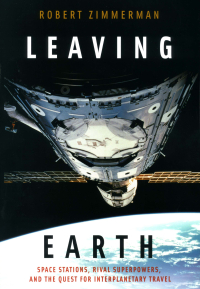
Leaving Earth: Space Stations, Rival Superpowers, and the Quest for Interplanetary Travel, can be purchased as an ebook everywhere for only $3.99 (before discount) at amazon, Barnes & Noble, all ebook vendors, or direct from my ebook publisher, ebookit.
If you buy it from ebookit you don't support the big oppressive tech companies and I get a bigger cut much sooner.
"Leaving Earth is one of the best and certainly the most comprehensive summary of our drive into space that I have ever read. It will be invaluable to future scholars because it will tell them how the next chapter of human history opened." -- Arthur C. Clarke
According to reports today in the India press, the price Axiom charged India’s space agency ISRO for training and then flying its astronaut on the just completed Ax-4 two-week mission to ISS was $59 million.
The expenditure by ISRO includes cost of [Shubhanshu] Shukla’s training for the mission as well as that of a seat on SpaceX’s Dragon spacecraft for the 20-day trip that launched Shukla, and three others — Peggy Whitson from the US, Slawosz Uznanski-Wisniewski of Poland and Tibor Kapu of Hungary — to space.
Earlier reports had suggested Axiom was charging $70 million per ticket. If the $59 million is accurate and applies to the charges Poland and Hungary paid, then Axiom’s revenue for the flight was $177 million. From that it would have to pay SpaceX (for the launch and the use of its Grace capsule) and NASA (for the use of ISS). Based on past history, SpaceX likely charged around $70 million for the launch. The cost for using Grace is unknown. NASA’s fees for a two-week visit to ISS were probably around $10 million plus.
My guess, based on this very limited information, is that Axiom made some profit from the flight, ranging from $20 to $50 million.
Using data gathered by the Solar and Heliospheric Observatory (SOHO) since its launch in 1995, scientists have determined that when the Sun’s corona (its atmosphere) is bright, it acts to slow and even block the ejection of coronal mass ejections (CMEs), which if they impact the Earth’s magnetic field can have a harmful effect on our modern technology.
Using data from NRL’s Large Angle and Spectrometric Coronagraph Experiment (LASCO) on board the joint European Space Agency (ESA)-NASA Solar and Heliospheric Observatory (SOHO), the NRL team [National Research Laboratory] compiled nearly three decades of observations of the solar corona. They studied the extensive dataset to investigate trends in the brightness of the Sun’s corona and compare them to CME velocities over the same period. Their study found a strong correlation between the two datasets, with bright regions of the solar corona appearing to relate to substantially slower CME velocities and, in some cases, perhaps entirely precluding CMEs.
This data will help solar weather observers better predict the arrival of CMEs, should they erupt from the Sun aimed at Earth. It will also allow them to gauge the risk of CMEs even occurring.
It appears the enthusiastic investment response last week to the potential of using Varda’s re-turnable capsule for manufacturing in space (especially of pharmceuticals) has caught SpaceX’s interest. According to a news report yesterday, SpaceX has now begun developing a program to use Starship for the same purpose, delivering the raw materials in orbit for short or long periods while these products are produced automatically and then returning them for sale on Earth.
Under the plan, internally called Starfall, SpaceX’s Starship rocket would bring products such as pharmaceutical components to space in small, uncrewed capsules, said one of the people, who spoke on condition of anonymity because the matter is confidential.
Starship would then deploy the capsules, which would spend time in orbit before reentering the atmosphere, where they could be recovered back on Earth, the person added.
This description by this anonymous source seems inaccurate however. Why even consider using these small separate capsules when the entire operation can be put inside Starship, which can then bring everything home when ready? Moreover, Starship’s ability to put a lot of mass in a large space up into orbit gives it an great advantage over the smaller capsules being developed by companies like Varda.
Either way, the advantages of weightlessness for producing products for profit are finally being realized, after decades of blockage by government intransigence. Since the Challenger accident in 1986 and Reagan’s order that the shuttle would no longer not be used for commercial purposes, NASA has forbidden production on its spacecraft and ISS of any products for sale afterward.
Now that the cost of launch has dropped significantly (Thank you Elon Musk!), many investors and companies are seeing great potential for manufacturing in space. And those profits will help feed a private space industry, making the government agency of NASA even more irrelevant.
SpaceX tonight successfully launched 24 Kuiper satellites for Amazon’s internet constellation, its Falcon 9 rocket lifting off from Cape Canaveral in Florida.
The first stage completed its first launch, landing on a drone ship in the Atlantic. This was the third new stage launched in 2025, and follows the company’s recent pattern of launching between one to three new stages per year. The two fairings completed their 27th and 28th flights respectively. As of posting the satellites had not yet been deployed.
This was SpaceX’s first launch for Amazon, out of an initial contract of three launches. The launch was also Amazon’s third Kuiper satellite launch, the previous two by ULA on its Atlas-5 rocket, launching 27 satellites each. While ULA seems poised to begin regular launches for Amazon, having a contract for 46 launches (with completed two), the contracts for Blue Origin’s New Glenn (27 launches, and ArianeGroup’s Ariane-6 (18 launches) are more uncertain. Neither company has achieved any launches on their contracts, and it is not clear when either company, especially Blue Origin, will ever begin regular launches.
This slow launch pace from these companies is a serious problem for Amazon, which is required by its FCC licence to get 1,600 satellites in orbit by July 2026. For this reason, there are rumors that Amazon might switching more launches to SpaceX, as it has the capability of to launch frequently.
We will have to wait and see.
The leaders in the 2025 launch race:
88 SpaceX
37 China
10 Rocket Lab
8 Russia
SpaceX now leads the rest of the world in successful launches, 88 to 64.
SpaceX this evening successfully placed another 26 Starlink satellites into orbit, its Falcon 9 rocket lifting off from Vandenberg in California.
The first stage completed its fourth flight, landing on a drone ship in the Pacific.
The leaders in the 2025 launch race:
87 SpaceX
37 China
10 Rocket Lab
8 Russia
SpaceX now leads the rest of the world in successful launches, 87 to 64.
SpaceX also has another launch scheduled in just a few hours from Cape Canaveral, launching 24 Kuiper satellites for Amazon. This is SpaceX’s first launch for Amazon, out of contract of three launches. It will also be the third Kuiper satellite launch, the previous two by ULA on its Atlas-5 rocket, launching 27 satellites each.
An evening pause: Performed live c2015.
Hat tip Judd Clark.