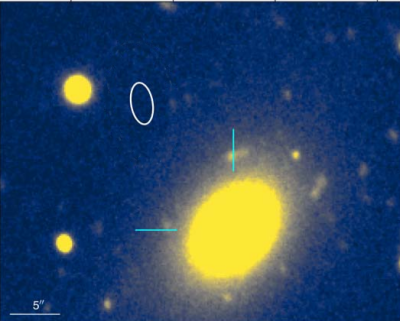
First good image released of interstellar object 3I/Atlas as it plunges through the solar system

First good image of instellator object 3I/Atlas
Click for original image of 3I/Atlas.

Astronomers using the Gemini North Telescope in Hawaii have obtained the first good image of the interstellar object 3I/Atlas, as it plunges within the orbit of Jupiter on its way through the solar system.

That picture is to the right, cropped to post here and overlaid on top of a map showing the interstellar object’s calculated path through the solar system.

The picture clearly shows this is a comet, with central nucleus surrounded by a cloud of dust and gas. The data also suggests its nucleus has a diameter of about twelve miles. That it resembles a comet also suggests it is a dirty snowball, made up of ice and rocky material mixed together.

Because it will never get closer to the Sun then just inside the orbit of Mars, it is not likely it will ever get bright enough for naked eye observations. At the same time, it is large enough and will be close enough to make possible some excellent observations as it zips by and leaves the solar system sometime in the fall. The previous two identified interstellar objects, Oumuamua and Comet 21/Borisov, were either too small or too far away as they flew past to get this kind of good data.

7 comments

July 15, 2025 Quick space links

Courtesy of BtB’s stringer Jay. This post is also an open thread. I welcome my readers to post any comments or additional links relating to any space issues, even if unrelated to the links below.

3 comments

Genesis cover

On Christmas Eve 1968 three Americans became the first humans to visit another world. What they did to celebrate was unexpected and profound, and will be remembered throughout all human history. Genesis: the Story of Apollo 8, Robert Zimmerman's classic history of humanity's first journey to another world, tells that story, and it is now available as both an ebook and an audiobook, both with a foreword by Valerie Anders and a new introduction by Robert Zimmerman.

The print edition can be purchased at Amazon or any other book seller. If you want an autographed copy the price is $60 for the hardback and $45 for the paperback, plus $8 shipping for each. Go here for purchasing details. The ebook is available everywhere for $5.99 (before discount) at amazon, or direct from my ebook publisher, ebookit. If you buy it from ebookit you don't support the big tech companies and the author gets a bigger cut much sooner.


The audiobook is also available at all these vendors, and is also free with a 30-day trial membership to Audible.
 

"Not simply about one mission, [Genesis] is also the history of America's quest for the moon... Zimmerman has done a masterful job of tying disparate events together into a solid account of one of America's greatest human triumphs."--San Antonio Express-News

Another win for a blacklisted professor

Professor Timothy Jackson
Music historian Timothy Jackson

Fight! Fight! Fight! After the public University of North Texas (UNT) blacklisted and dismissed professor Timothy Jackson in 2020 from his job as editor of the music history journal he founded for daring to express some academic conclusions the faculty and students didn’t like, he sued.

After a five year battle, Jackson and the university have now settled out of court, with the terms of the settlement [pdf] largely a big win for Jackson.

First the background: In 2019 woke music theorist Philip Ewell of Hunter College in New York gave a presentation to the Society of Music Theory where he claimed 20th century music theorist Heinrich Schenker was a “virulent racist” whose “racist views infected his music theoretical arguments.”

Jackson, who had devoted his career studying Schenker and had co-founded at the university the Journal of Schenkerian Studies focused expressly on Schenker’s works, knew this was patently untrue. For example, Schenker was also a Jew who was a victim of German anti-Semitism and lost many relatives in the Holocaust, facts that Ewell somehow did not think important to mention. To counter Ewell’s historical slanders, Jackson decided to dedicate the next issue of the journal to this issue, presenting essays from both sides. He even asked Ewell to write an essay.

Ewell did not respond. In Jackson’s own essay he outlined in detail the historical facts — as he knew them as an expert on this subject — that put the lie to Ewell’s claims. As Jackson noted, “Ewell peddled a ‘conspiracy theory’ that is ‘part and parcel of the much broader current of Black anti-semitism.'”

Instead of celebrating this perfect example of free speech, the university immediately moved to punish Jackson.
» Read more

6 comments

The failed MethaneSat climate satellite apparently had problems from launch

According to a detailed New Zealand news report today, the failed MethaneSat climate satellite — funded and operated by the Environmental Defense Fund — apparently had significant problems during its short fifteen month life-span, going into safe mode many times, before failing completely last month.

An earlier report from this same news outlet described more fully the issues — which began in September 2024 only about six months after launch.

The mission’s chief scientist has now said more intense solar activity because of a peak in the sun’s magnetic cycle has been causing MethaneSAT to go into safe mode. The satellite has to be carefully restarted every time.

There has also been a problem with one of the satellite’s three thrusters, which maintain its altitude and steer the spacecraft. MethaneSAT says it can operate fully on two thrusters.

It appears there is a lot of unhappiness in New Zealand for spending $32 million on this project that was designed, built, and operated by an environmental activist organization with little space experience.

What is clear now is that the spacecraft likely got relatively little data during its fifteen month life span.

11 comments

Conscious Choice cover

Now available in hardback and paperback as well as ebook!

From the press release: In this ground-breaking new history of early America, historian Robert Zimmerman not only exposes the lie behind The New York Times 1619 Project that falsely claims slavery is central to the history of the United States, he also provides profound lessons about the nature of human societies, lessons important for Americans today as well as for all future settlers on Mars and elsewhere in space.

 
Conscious Choice: The origins of slavery in America and why it matters today and for our future in outer space, is a riveting page-turning story that documents how slavery slowly became pervasive in the southern British colonies of North America, colonies founded by a people and culture that not only did not allow slavery but in every way were hostile to the practice.  
Conscious Choice does more however. In telling the tragic history of the Virginia colony and the rise of slavery there, Zimmerman lays out the proper path for creating healthy societies in places like the Moon and Mars.


“Zimmerman’s ground-breaking history provides every future generation the basic framework for establishing new societies on other worlds. We would be wise to heed what he says.” —Robert Zubrin, founder of the Mars Society.


All editions are available at Amazon, Barnes & Noble, and all book vendors, with the ebook priced at $5.99 before discount. All editions can also be purchased direct from the ebook publisher, ebookit, in which case you don't support the big tech companies and the author gets a bigger cut much sooner.


Autographed printed copies are also available at discount directly from the author (hardback $29.95; paperback $14.95; Shipping cost for either: $6.00). Just send an email to zimmerman @ nasw dot org.

Webb spots aftermath of collision of two galaxies

colliding galaxies
Click for source.

Using the Webb Space Telescope, astronomers have discovered the collision of two spiral galaxies that appears to have caused a supermassive black hole to collapse in its wake.

The Webb false-color infrared image to the right shows the two galaxies as the red dots, both surrounded by a ring, with the supermassive black hole the bluish spot in between but offset somewhat to the left. Follow-up radio observations suggested that this bluish spot was a supermassive black hole, having a mass of a million suns and sucking up matter from the giant gas cloud that surrounds it.

The team proposes that the black hole formed there via the direct collapse of a gas cloud – a process that may explain some of the incredibly massive black holes Webb has found in the early universe.

This hypothesis however has enormous uncertainties, and requires a lot more observations to confirm. The black hole could simply exist unrelated to the galaxy collision, having come there from elsewhere. Or it could be from a third galaxy in this group that these initial observations have not yet detected.

The image however is quite cool.

0 comments

House follows Senate in canceling most of Trump’s proposed NASA budget cuts

Like pigs at the trough

The House appropriations committee’s draft budget for NASA has followed the Senate appropriations committee in canceling all of Trump’s proposed NASA budget cuts, though it has shifted that funding significantly from science to manned space operations.

The House Appropriations Committee released the draft text of their version of the FY2026 Commerce-Justice-Science bill that funds NASA today. Like their Senate counterpart, the House committee would essentially keep NASA at its current funding level instead of imposing the severe 24.3 percent budget cut proposed by the Trump Administration. The CJS bill also includes almost $2 million for a White House National Space Council even though the Trump Administration has yet to establish one.

Unlike the Senate, which mostly kept the budget the same across all NASA departments, this House draft budget would reduce science and aeronautics spending from about $8.2 billion to $6.8 billion. Trump had requested only $4.5 billion for these departments.

In turn, the House would increase Trump’s request for NASA’s manned operations from $10.8 billion to $11.9 billion. Note that Trump’s proposed budget had already called for an increase here, so the House is clearly shifting funding to manned space in an enthusiastic manner.

At the same time, the House continues funding for the SLS and Orion programs Trump wishes to cancel. Both of these projects are over budget and behind schedule. Neither is very useful in the long run for exploring the solar system. If the House truly wanted to save money, it could easily fund all the cuts in science by cutting the billions spent yearly on these pork projects, and still lower NASA’s budget in total.

Based on the draft budget’s language [pdf], it is unclear whether the House has also funded the Lunar Gateway space station, as the Senate has, another useless pork project that Trump wishes to cancel.

I should note that the appropriations committee’s overall draft budget [pdf] does reduce the federal budget by about 2.8 percent. This is a marked change from past budgets, which often claimed (a lie) to cut spending but really only reduced the rate of budget growth. It appears the House is finally making some effort to shrink the size of the budget, though that effort is quite wimpy.

1 comment

Leaving Earth cover

Leaving Earth: Space Stations, Rival Superpowers, and the Quest for Interplanetary Travel, can be purchased as an ebook everywhere for only $3.99 (before discount) at amazon, Barnes & Noble, all ebook vendors, or direct from my ebook publisher, ebookit.

If you buy it from ebookit you don't support the big oppressive tech companies and I get a bigger cut much sooner.


Winner of the 2003 Eugene M. Emme Award of the American Astronautical Society.

 
"Leaving Earth is one of the best and certainly the most comprehensive summary of our drive into space that I have ever read. It will be invaluable to future scholars because it will tell them how the next chapter of human history opened." -- Arthur C. Clarke

Axiom’s commercial manned mission to ISS splashes down safely

Axiom’s fourth commercial manned mission to ISS successfully splashed down off the coast of California early this morning, returning its astronaut commander, employed by Axiom, and three government passengers from India, Poland, and Hungary after spending two weeks at the space station and eighteen days total in space.

For all three nations this was their second manned flight, and the first in more than four decades. All three had previously flown astronauts on Soviet era Soyuz missions, with Poland and Hungary’s astronauts visiting the Salyut 6 station in 1978 and 1980 respectively, and India’s astronaut visiting the Salyut 7 station in 1984.

The mission also marked the inaugural flight of SpaceX’s new Grace reusable manned Dragon capsule, the fifth such spacecraft in its fleet. SpaceX’s fleet is now larger that NASA’s space shuttle fleet ever was.

If you watch the live stream at the link, it is once again important to note that everyone you see on the screen, except for these three government astronauts, are employees of SpaceX or Axiom. There is no government involvement at all in the splash down procedure. It is entirely commercial and private affair.

In other words, who needs NASA for spaceflight? It clearly is not required.

7 comments

China launches cargo ship to its Tiangong-3 space station

China today successfully launched a new Tianzhou cargo ship to its Tiangong-3 space station, its Long March 7 rocket lifting off from its coastal Wenchang spaceport.

The freighter subsequently docked with the station about three hours later.

The leaders in the 2025 launch race:

86 SpaceX
37 China
10 Rocket Lab
8 Russia

SpaceX still leads the rest of the world in successful launches, 86 to 64.

0 comments

July 14, 2025 Quick space links

Courtesy of BtB’s stringer Jay. This post is also an open thread. I welcome my readers to post any comments or additional links relating to any space issues, even if unrelated to the links below.

6 comments

Renewing the heroic Superman of America

The heroic Superman as envisioned in the 1950s
George Reeves as the heroic Superman as envisioned
in the 1950s television show, emulated later by Richard
Donner in his 1978 movie. Click for show’s opening credits.

Not surprisingly, the newest Hollywood attempt to tell the story of Superman appears by all accounts to be on the verge of another movie disaster, for all the usual reasons. Though the first weekend receipts were acceptable, a closer look suggests they also have feet of clay. When compared with the 2013 attempt to reboot the 1978 classic Richard Donner film, the numbers do not look that good.

Now, look at the number of tickets sold:

Estimated tickets sold opening weekend:
MAN OF STEEL (14.3M)
SUPERMAN (10.7M)

Sometimes a win isn’t quite a win.

The article also notes that the movie is having problems attracting foreign audiences.

The reviews meanwhile have been horrible. Take for example this review:

I’ve seen a lot of superhero movies, and this one — given the level of investment involved, the promotional push, the iconic nature of the character and the importance to the future of DC and Warner Bros. — is by far the worst. I would have left the theater if I hadn’t gone with a friend. There are minor Marvel entries with more to their credit than this. It doesn’t even manage to be fun.

Why should this new movie about the first true American super-hero standing for “truth, justice, and the American way” be having problems at box office? Isn’t the story exactly the kind of thing audiences love and normally consume with eager anticipation?

The problem is that this modern Superman movie is not about “truth, justice, and the American way.” Instead, the film’s director and producer, James Gunn, decided it should instead be about “truth, justice, and the human way,” a statement that is not only meaningless and carrying far less substance, it is a slap in the face of the very noble American ideals of this very American legend.
» Read more

27 comments

A distant globular cluster

A distant globular cluster
Click for original image.

Cool image time! The picture to the right, cropped, reduced, and sharpened to post here, was taken by the Hubble Space Telescope as part of a research project to study globular clusters in galaxies other than the Milky Way.

The data for this image comes from an observing programme comparing old globular clusters in nearby dwarf galaxies — the LMC [Large Magellanic Cloud], the Small Magellanic Cloud and the Fornax dwarf spheroidal galaxy — to the globular clusters in the Milky Way galaxy. Our galaxy contains over 150 of these old, spherical collections of tightly-bound stars, which have been studied in depth — especially with Hubble Space Telescope images like this one, which show them in previously-unattainable detail. Being very stable and long-lived, they act as galactic time capsules, preserving stars from the earliest stages of a galaxy’s formation.

Astronomers once thought that the stars in a globular cluster all formed together at about the same time, but study of the old globular clusters in our galaxy has uncovered multiple populations of stars with different ages. In order to use globular clusters as historical markers, we must understand how they form and where these stars of varying ages come from. This observing programme examined old globular clusters like NGC 1786 [pictured] in these external galaxies to see if they, too, contain multiple populations of stars. This research can tell us more not only about how the LMC was originally formed, but the Milky Way Galaxy, too.

This cluster, discovered in 1835 by John Herschel, is about 160,000 light years away.

2 comments
1 160 161 162 163 164 2,930