
Chad & Jeremy – A Summer Song
An evening pause: Performed live on American Bandstand on November 28, 1964, though the music is almost certainly lip synched.
Hat tip Diane Zimmerman.
An evening pause: Performed live on American Bandstand on November 28, 1964, though the music is almost certainly lip synched.
Hat tip Diane Zimmerman.
Courtesy of BtB’s stringer Jay. This post is also an open thread. I welcome my readers to post any comments or additional links relating to any space issues, even if unrelated to the links below.
That liftoff is scheduled for 9:03 pm (Pacific) tonight. The live stream is here.
Four quick links in connection to Space Pioneer’s static fire test catastrophe yesterday:
I think the company is going to have to explain itself to the Chinese government, which is likely to take a much closer interest in what these pseudo-companies are doing. This will not be to prevent dangerous accidents, but to use this most recent accident as a ploy to gain full control of these pseudo-companies.
The freighter will be launched by a Falcon 9 sometime in August.
It was launched in 2001, and has been in orbit for more than two decades. Nowadays it mostly serves as a communications satellite, relaying data from the rovers/landers back to Earth.
ISRO hopes to launch that module by 2028.

On Christmas Eve 1968 three Americans became the first humans to visit another world. What they did to celebrate was unexpected and profound, and will be remembered throughout all human history. Genesis: the Story of Apollo 8, Robert Zimmerman's classic history of humanity's first journey to another world, tells that story, and it is now available as both an ebook and an audiobook, both with a foreword by Valerie Anders and a new introduction by Robert Zimmerman.
The print edition can be purchased at Amazon or any other book seller. If you want an autographed copy the price is $60 for the hardback and $45 for the paperback, plus $8 shipping for each. Go here for purchasing details. The ebook is available everywhere for $5.99 (before discount) at amazon, or direct from my ebook publisher, ebookit. If you buy it from ebookit you don't support the big tech companies and the author gets a bigger cut much sooner.
"Not simply about one mission, [Genesis] is also the history of America's quest for the moon... Zimmerman has done a masterful job of tying disparate events together into a solid account of one of America's greatest human triumphs."--San Antonio Express-News
Time for my monthly analysis of NOAA’s monthly tracking of the number of sunspots on the Sun’s Earth-facing hemisphere. As always, I have posted NOAA’s updated graph below, adding some details to provide the larger context.
In June the Sun continued the high activity from May, with the sunspot count significantly higher than predicted, 164.2 compared to the prediction of 104.9.
» Read more
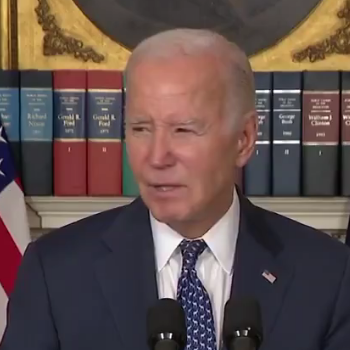
Joe Biden at his February 2024 press conference
after Justice Department special counsel Robert Hur
revealed he could not indict Biden of criminal misuse
of classified materials because Biden was “an elder
man with poor memory.”
In my life I have seen three moments in politics that appeared to change everything. In two of those cases, the appearance turned out to be true. In the third, in the end nothing changed, to the sad detriment of our country.
Last week’s debate between president Joe Biden and former president Donald Trump appears to be another such potential game-changing event. The change however will not be whether Joe Biden will be the candidate when the election finally rolls around in November, or whether even if he will win or lose the election.
The change, should it happen, will be much more funadmental. I come at this from the point of view of a historian, so bear with me as I attempt to explain.
Of the previous three game-changing moments, the first was the Watergate hearings in 1973. For months prior to those hearings, Republican politicians from all levels of government fought aggressively and with some success the accusations that president Richard Nixon had been involved in the Watergate break-in and the planning of the “dirty tricks” campaign against George McGovern leading up to the 1972 election.
The Watergate hearings however were a game-changer. It forced the entire Republican party to end its unqualified support of Nixon. The hearings, which were televised live each day and covered extensively by the press, were seen by everyone, and showed without doubt the extensive nature of Nixon’s dirty trick activity. It also illustrated bluntly the amount of duplicity and lying that Nixon and his cohorts were willing to do to defend themselves.
Unlike today, in the 1970s the American public did not tolerate lying by their politicians. Though the hearings ended in late June 1973, and Nixon held on until August 1974 before resigning, it was those hearings that ended his popularity and creditability. It was also those hearings that destroyed the creditability of the Republican Party at that time. Too many of them had backed Nixon blindly before the hearings, and were exposed themselves by those hearings as sycophants and toadies. The result: The Republican Party was wiped-out in the 1974 elections, with the Democrats gaining 53 seats in the House, 4 seats in the Senate, and 4 additional governorships.
The second game-changer occurred during the Iran-Contra affair in 1987 against Ronald Reagan. » Read more

Now available in hardback and paperback as well as ebook!
From the press release: In this ground-breaking new history of early America, historian Robert Zimmerman not only exposes the lie behind The New York Times 1619 Project that falsely claims slavery is central to the history of the United States, he also provides profound lessons about the nature of human societies, lessons important for Americans today as well as for all future settlers on Mars and elsewhere in space.
“Zimmerman’s ground-breaking history provides every future generation the basic framework for establishing new societies on other worlds. We would be wise to heed what he says.” —Robert Zubrin, founder of the Mars Society.
All editions are available at Amazon, Barnes & Noble, and all book vendors, with the ebook priced at $5.99 before discount. All editions can also be purchased direct from the ebook publisher, ebookit, in which case you don't support the big tech companies and the author gets a bigger cut much sooner.
Autographed printed copies are also available at discount directly from the author (hardback $29.95; paperback $14.95; Shipping cost for either: $6.00). Just send an email to zimmerman @ nasw dot org.
The Spanish rocket startup PLD announced last week that it has invested more than $10 million in developing its own launchpad and assembly facility at France’s French Guiana spaceport, and is targeting 2025 for the first orbital launch of its Miura-5 rocket.
The launcher company PLD Space has announced today an investment of 10 million euros in MIURA 5 Launch Complex at Guiana Space Center (CSG), Europe’s spaceport in Kourou (French Guiana), owned by the French Space Agency (CNES) and the European Space Agency (ESA). With the first launch of its rocket at the end of 2025, PLD Space will become the first non-institutional launch operator that will go to orbit from this historical base.
The company is reconfiguring the launchpad used by France to launch its Diamant rocket back in the 1960s and 1970s. It will include “its own launch zone and a preparation area, comprising an integration hangar, a clean room, a control center, and both commercial and work offices.”
Right now it appears that PLD along with several other European rocket startups are going to bypass a number of American rocket startups that had had a significant headstart, but also appear to be stalled in the last year or so because of a new regulatory framework at the FAA.
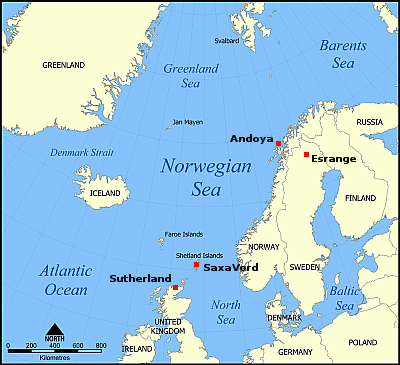
Proposed spaceports surrounding Norwegian Sea
A new Polish suborbital rocket, dubbed “ILR-33 Amber 2K,” and being developed by the Łukasiewicz Institute of Aviation, will do its next test flight from the Andoya spaceport in Norway.
After four consecutive test missions completed successfully in Poland, the next stage of preparations of the ILR-33 AMBER 2K to reach the edge of space will take place this year in July. Polish technology will be tested in Norway where one of the key European space centers for launching space vehicles is located.
According to this report, this rocket has a core stage with a hybrid-fueled engine plus two strap-on solid-fueled boosters, a configuration rare for suborbital rockets. After this test flight it will then begin operational suborbital flights, run by a Polish company Thorium from 2025 to 2027.
This deal is another competitive blow to the Saxaford and Sutherland spaceports in the United Kingdom. Both started commercial operations years ahead of either Andoya or Esrange, but because of red tape nothing has been yet allowed to launch from either. This Polish deal one of several for both the Andoya and Esrange spaceports that might have gone to the UK otherwise.
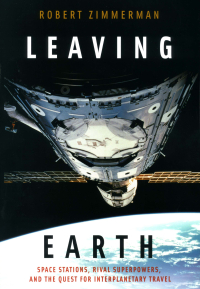
Leaving Earth: Space Stations, Rival Superpowers, and the Quest for Interplanetary Travel, can be purchased as an ebook everywhere for only $3.99 (before discount) at amazon, Barnes & Noble, all ebook vendors, or direct from my ebook publisher, ebookit.
If you buy it from ebookit you don't support the big oppressive tech companies and I get a bigger cut much sooner.
"Leaving Earth is one of the best and certainly the most comprehensive summary of our drive into space that I have ever read. It will be invaluable to future scholars because it will tell them how the next chapter of human history opened." -- Arthur C. Clarke
Because it appears the trunk section of the service module of SpaceX’s Dragon capsules actually survives re-entry, the company is now studying changes to its de-orbit procedures so that it can guarantee that trunk will not crash on land, as has happened now three times in the past two years.
The solution [a NASA official] said NASA and SpaceX are looking at involves changing deorbiting procedures. Currently, the trunk is released before the capsule performs its orbit burn. That means the trunk can remain in orbit for months before making an uncontrolled reentry.
Instead, [that NASA official] said engineers are examining doing the deorbit burn and then releasing the trunk. That would provide more control of where the trunk reenters, ensuring that any debris that survives reentry lands in unpopulated regions.
To make this new procedure work they need to recalculate the fuel requirements for doing the de-orbit burn. It also requires them to figure out when to detach the trunk after the burn. I expect SpaceX to successfully implement these changes before the next Dragon launch, whether manned or unmanned.
The Japanese startup Ispace announced late last week that its second lunar lander, formerly names Hakuto-R2 and now dubbed Resilience, has successfully completed thermal vacuum testing and is on schedule for a launch before the end of this year.
The testing was completed at the Japan Aerospace Exploration Agency (JAXA) Tsukuba Space Center in Tsukuba, Japan, where the agency operates a large testing facility. The flight model was assembled at the facility and all payloads or testing models were integrated into the lunar lander before testing began. All test success criteria were met; ispace engineers are now reviewing the detailed data that RESILIENCE collected during the ten-day testing regime. The results will allow engineers to optimize the spacecraft thermally for spaceflight as well as improve flight operation procedures.
Thermal vacuum testing is conducted in a large chamber that allows the lunar lander to experience conditions similar to what it will face during its journey through outer space including extreme temperatures in a vacuum environment. Initial test results indicated successful operation of power systems, guidance, navigation and control (GNC) equipment, radio communications, and thermal control of the lander while simulating an actual spaceflight. During testing in the chamber, ispace operators utillized the lander’s onboard radio to assess connections, send commands to, and receive telemetry from the lander, further simulating actual flight operations.
This lander will also carry a mini-rover, and will be launched by a Falcon 9 rocket. The company’s press materials don’t name a location for the lunar landing spot, though one must have been chosen. I suspect, as this mission is a precursor to Ispace’s first NASA lunar landing mission set for 2026, it will be sent to the same location as Ispace’s first Hakuto-R1 test mission, which got to within three miles but then crashed because sensors thought it was just above the surface and shut off the engines prematurely.
Japan’s space agency JAXA today successfully completed the second successive launch of its new H3 rocket, placing an Earth observation satellite into orbit.
This was the third launch of the H3, with the first in May 2023 a failure, and the second a success in February 2024.
I have embedded the video of the launch below, cued to T-15 seconds. This was Japan’s third launch in 2024, exceeding last year’s total of two and matching its total from 2024.
The leader board for the 2024 launch race remains unchanged:
69 SpaceX
29 China
8 Russia
8 Rocket Lab
American private enterprise still leads the world combined in successful launches, 80 to 44, while SpaceX by itself still leads the entire world, including other American companies, 69 to 55.
» Read more
The first stage of Chinese pseudo-company Space Pioneer’s new Tianlong-3 rocket, intended for its first launch this summer, crashed and burned today during a static fire test when the equipment holding it down failed.
Video of this spectacular failure is embedded below. The rocket is essentially a copy of SpaceX’s Falcon 9, with that first stage designed to eventually become reusuable in the same way.
This pseudo-company recently announced it had raised $207 million in private investment capital, bringing the total it has raised to $552 million. It was also the first Chinese pseudo-company to launch an orbital rocket using liquid fuels, successfully doing so with its Tianlong-1 rocket in April 2023.
Though static fire engine tests have failed before, this appears to be the very first ever to actually break free and launch itself. Fortunately, according to both government and Space Pioneer officials, no one was hurt.
What impact this will have on China’s pseudo-private rocket industry is unknown. This incident isn’t the first, with a tank test by pseudo-company Landspace in January 2024 injuring three.
Moreover, there are hints that the Chinese government might be repossessing control from these companies (as I have expected from the start). Landspace, as well as two other pseudo-companies, Expace and Ispace, have been testing methane-fueled rockets, with Landspace having completed one orbital launch in December 2023 and all three successfully completing hop tests of their first stages.
Last week however a Chinese government agency successfully completed a 10-kilometer hop test of its own methane-fueled first stage. I wonder how much of its design was developed independently, or taken from these three pseudo-companies by the government. I suspect the latter, since none of these companies are really privately owned. They might seem so, but the communists can confiscate everything they have at any moment, and clearly supervises and dictates what they do, step-by-step.
» Read more
Capitalism in space: France has awarded the French startup Infinite Orbits a contract to launch two robotic satellite servicing missions, one to attach itself to a still-unnamed satellite to extend its life, and a second to test rendezvous and proximity maneuvers near a defunct and thought-to-be tumbling weather satellite.
The key tidbit however is that the contract award is part of a French government program to encourage commercial space:
The France 2030 initiative is a €54 billion investment programme that aims to transform sectors of the French economy with technological innovation.
I was unaware of this French government program. It appears it signals a shift in financial support from the European Space Agency’s commercial entity Arianespace to new competitive French companies. If so, this is a very good sign for its aerospace industry.
Both SpaceX and China completed launches in the past 12 hours. First, SpaceX last night launched a package of National Reconnaissance Office reconnaissance satellites, its Falcon 9 rocket lifting off from Vandenberg in California. The first stage completed its eighth flight, landing on a drone ship in the Pacific. The two fairings completed their seventh and thirteenth flights respectively.
Then, early today China launched a new communications satellite, its new Long March 7A rocket lifting off from its coastal Wenchang spaceport. Video of the liftoff can be seen here.
The leaders in the 2024 launch race:
69 SpaceX
29 China
8 Russia
8 Rocket Lab
American private enterprise still leads the world combined in successful launches, 80 to 43, while SpaceX by itself still leads the entire world, including other American companies, 69 to 54.
Embedded below the fold in two parts.
To listen to all of John Batchelor’s podcasts, go here.
» Read more
An evening pause: From the 1957 musical Funny Face. I only saw this film for the first time last week, and as I watched this scene I was most amused by Astaire’s dance moves in the second half of this number. “Why, Astaire is doing Gene Kelly!” I exclaimed to Diane.
Both men had their own styles. Kelly was into grand film presentations, acrobatics, and the soft shoe. Fred Astaire was into dance, in all its forms. If you are familiar with Kelly’s dance style you will see immediately how Astaire is parodying it, but with great respect.
Astaire’s partner in this number is Kay Thompson, in her only starring movie role. Thompson had an amazing artistic career, from writer (the Eloise children’s books) to vocal coach for Judy Garland and Gene Kelly to recording artist to night club performer. It is a shame we don’t have more films of her singing and dancing.

Our modern intellectual class
Earlier this week a group of sixteen Nobel laureate economists issued a public letter endorsing Joe Biden’s economic agenda and claiming that a return of Donald Trump to the White House would lead to economic ruin.
“We believe that a second Trump term would have a negative impact on the U.S.’s economic standing in the world, and a destabilizing effect on the U.S.’s domestic economy,” the economists write in the letter. “Many Americans are concerned about inflation, which has come down remarkably fast. There is rightly a worry that Donald Trump will reignite this inflation, with his fiscally irresponsible budgets.”
You can read their letter here. It was signed by the following (the date of their Nobel award in parenthesis):
George A. Akerlof (2001), Sir Angus Deaton (2015), Claudia Goldin (2023), Sir Oliver Hart (2016), Eric S. Maskin (2007), Daniel L. McFadden (2000), Paul R. Milgrom (2020), Roger B. Myerson (2007), Edmund S. Phelps (2006), Paul M. Romer (2018), Alvin E. Roth (2012), William F. Sharpe (1990), Robert J. Shiller (2013), Christopher A. Sims (2011), Joseph Stiglitz (2001), and Robert B. Wilson (2020).
What is hilarious about their letter is how it exposes these so-called economic giants as partisan hacks. A dive into their campaign contributions finds that eleven are donors to Joe Biden or the Democrats, while the remaining five have all previously endorsed Biden publicly. Before the 2020 election two of these sixteen economists signed a similar letter, calling for Joe Biden’s election, claiming he would “…build an economy that works for all Americans.” In 2021 thirteen of these same economists then followed up with another letter, endorsing all of Biden’s spending proposals then before Congress (costing an expected $1.9 trillion).
A comparison between the claims in all three letters and what actually happened also reveals how little these economists know about economics. As noted at this City Journal article by James Piereson:
» Read more
Link here. Lots of progress described, all suggesting SpaceX continues to target late July for the next test orbital flight. Very much worth reading.
The article repeatedly suggests the work to prepare the launch tower at Boca Chica to catch a returning Superheavy means the next launch will attempt such a catch, but in truth there is no evidence such a thing is planned, other than a single tweet by Elon Musk. As the article finally admits in its next-to-last paragraph,
Starship can now fly missions that have very similar profiles to Flight 4 with the existing FAA license, but a license modification is needed for any catch attempt. If Flight 5 does indeed proceed with a catch attempt at the tower for Booster 12, additional paperwork will need to be filed for this license modification.
I continue to expect SpaceX to propose such a catch on a later flight. The tower work at Boca Chica could be the company doing the necessary work to prove to the FAA that a amended launch license process should be issued, but not for the next flight.

As part of its effort to promote a long term space industry development plan, Indonesian officials have repeatedly been offering a proposed launch site to SpaceX and others on government land on the island of Biak off the coast of New Guinea.
The map to the right shows the location. First SpaceX and China were offered use of Baik. Neither has accepted. Then,
As recently as 2023, BRIN officials promoted their spaceport plans at the G20 Space Economy Leaders’ Meeting and Asia-Pacific Regional Space Agency Forum. China, Russia, Japan, South Korea and India were invited as potential partners, but none signed on.
Meanwhile, the article says Indonesia hopes to launch 19 satellites in 2025, using a variety of commercial launchers.
We now know the reason why an Arianespace official on June 26th demanded new legislation requiring all European payloads to launch on European rockets. Today it was revealed that the European weather satellite company Eumetsat has canceled a launch contract on an Ariane-6 rocket and instead switched to SpaceX’s Falcon 9.
Late yesterday, French news outlet Le Monde reported that the executive committee of Eumetsat, the European meteorological satellite agency, had asked the agency’s board of directors to cancel a contract it signed with Arianespace four years ago to launch its Meteosat MTG-S1 satellite. The mission would have been flown aboard the third Ariane 6 flight, which is expected to be launched in early 2025. The satellite will now be launched aboard a SpaceX Falcon 9 rocket.
Not surprisingly, another French official today — Philippe Baptiste, the head of France’s CNES space agency — once again demanded action to require European companies to use European rockets. In his whining however he revealed an amazing inability to understand why this decision was made.
“How far will we, Europeans, go in our naivety. … I am impatiently waiting to understand what reasons could have led Eumetsat to such a decision at a time [when] all major European space countries as well as the European Commission are calling for launching European satellites on European launchers.”
The reasons why are quite obvious, and if this guy can’t recognize them then there is little hope the European Ciommision will ever figure out how to compete. Not only is the cost for a Falcon 9 launch likely one third that of an Ariane-6, it is a proven launcher. Ariane-6, four years behind schedule, won’t make its first launch until July 9, 2024, assuming all goes as planned. Eumetsat officials probably decided they couldn’t afford the extra cost and risk.
A Russian inspector satellite dubbed Luch-2 and launched in March 2023 is now maneuvering to make a close approach and surveillance of an eleventh commercial communications satellite in geosynchronous orbit.
The company is forecasting that Luch 2’s next object of interest is the Intelsat 1002 communications satellite. “Luch 2 is expected to perform an additional maneuver to stop its drift near Intelsat 1002 on June 28 if it continues its past pattern of behavior,” Slingshot said. This behavior mirrors that of its predecessor, Luch Olymp-K-1, which has been known for similar intelligence-gathering activities.
The close approaches have ranged from 12 miles to 142 miles, with most getting inside 100 miles distance.
It is unlikely Russia is testing robotic maneuvering technology, as it has had this capability since the 1970s. More likely it is testing the ability to intercept communications from such satellites, though it is unknown whether Luch-2 has done so. Visiting multiple satellites would also permit it to test against a wide variety of technology.
According to China’s state-run press today, its Chang’e-6 sample return mission collected 1,953.2 grams, more than four pounds, from the Aitkin Basin on the far side of the Moon.
Based on preliminary measurement, the Chang’e-6 mission collected 1,935.3 grams of lunar samples, according to the CNSA. “We have found that the samples brought back by Chang’e-6 were more viscous compared to previous samples, with the presence of clumps. These are observable characteristics,” Ge Ping, deputy director of the CNSA’s Lunar Exploration and Space Engineering Center, who is also the spokesperson for the Chang’e-6 mission, told the press at the ceremony.
Researchers will then carry out the storage and processing of the lunar samples as planned and initiate scientific research work.
If all goes as plans, they will be ready to begin distributing samples for study to Chinese researchers in about six months.