
January 3, 2024 Zimmerman/Batchelor podcast
Embedded below the fold in two parts.
To listen to all of John Batchelor’s podcasts, go here.
» Read more
Embedded below the fold in two parts.
To listen to all of John Batchelor’s podcasts, go here.
» Read more
SpaceX today successfully launched a commercial geosynchronous communications satellite, its Falcon 9 rocket lifting off from Cape Canaveral.
The first stage successfully completed its tenth flight, landing back at Cape Canaveral. The fairings completed their ninth and fourteenth flights respectively.
The 2024 launch race:
2 SpaceX
1 India
No one else has launched as yet, though many launches are scheduled through the first ten days of January.

On Christmas Eve 1968 three Americans became the first humans to visit another world. What they did to celebrate was unexpected and profound, and will be remembered throughout all human history. Genesis: the Story of Apollo 8, Robert Zimmerman's classic history of humanity's first journey to another world, tells that story, and it is now available as both an ebook and an audiobook, both with a foreword by Valerie Anders and a new introduction by Robert Zimmerman.
The print edition can be purchased at Amazon or any other book seller. If you want an autographed copy the price is $60 for the hardback and $45 for the paperback, plus $8 shipping for each. Go here for purchasing details. The ebook is available everywhere for $5.99 (before discount) at amazon, or direct from my ebook publisher, ebookit. If you buy it from ebookit you don't support the big tech companies and the author gets a bigger cut much sooner.
"Not simply about one mission, [Genesis] is also the history of America's quest for the moon... Zimmerman has done a masterful job of tying disparate events together into a solid account of one of America's greatest human triumphs."--San Antonio Express-News
An evening pause: Performed live in Central Park, New York, 1971. Wonderful song, but her cynicism about marriage in this song sadly predicts the disaster we are in today, living in a society of children raised in broken homes, created by the 60s Baby Boom generation (mine) that decided to reject the fundamentals of its parents. It was foolish and sad, but most of all it was cruel to the innocent children born of that irresponsibility. Those children are now mindlessly wrecking their revenge.
Hat tip Doug Johnson.
Courtesy of BtB’s stringer Jay. I am probably taking most of the rest of the day off, having just gotten back from cataract surgery on one eye. No problems, but I don’t have a lot of energy right now. If I perk up something might happen, but I can’t say if that will be the case.
Kiko Dontchev is SpaceX’s VP of launch operations. He notes that they must be capable of doing thirteen launches per month to give them margin to meet this twelve-launch-per-month goal.
No dates provided, so we don’t know how long they have already been waiting for approval. The tweet notes optimistically that because their spaceport — Saxavord on the Shetland Islands — now has a spaceport license things will begin moving shortly. We shall see.
It is building a new building to house the shuttle, where it will be put on display in the more dramatic vertical position.
It appears the most recent payment to Terran arrived late. The compnay has a $2.4 billion contract to build Rivada’s 576 satellite constellation, 288 of which must be in orbit by mid-2026 to meet its FCC license requirements.
This is nothing more than simple-minded virtue signalling that does more harm than good. ESA spent forty million euros building the system, even though it is far less efficient than the traditional way. As Jay wrote, “The most efficient way is to inject high pressure steam into methane. There are many ways to get hydrogen, but that is the best way to make large volumes of it.”
It appears that NSIL is essentially telling ISRO, India’s space agency, it no longer has a monopoly on Indian launches, that NSIL and the Modi government mean business in their effort to transition from a Soviet-style government-run space program to a commercial space industry where ISRO is merely one of many customers. I suspect SpaceX had two other advantages over ISRO, price and reliability. Its Falcon 9 is certainly cheaper to use, and ISRO has had some failures on its recent launches of India’s communications satellites.
This will be followed by a third unmanned test mission early in 2025, followed by the manned mission later that year.
Like many of these Chinese pseudo-companies, its plans are not much better than a powerpoint presentation at this point.
It appears it did as it usually does, flying slightly farther for a few seconds more, probably in order to make sure it had a good landing site.
It is presently flying at 128,000 feet. You can follow its journey here.

Now available in hardback and paperback as well as ebook!
From the press release: In this ground-breaking new history of early America, historian Robert Zimmerman not only exposes the lie behind The New York Times 1619 Project that falsely claims slavery is central to the history of the United States, he also provides profound lessons about the nature of human societies, lessons important for Americans today as well as for all future settlers on Mars and elsewhere in space.
“Zimmerman’s ground-breaking history provides every future generation the basic framework for establishing new societies on other worlds. We would be wise to heed what he says.” —Robert Zubrin, founder of the Mars Society.
All editions are available at Amazon, Barnes & Noble, and all book vendors, with the ebook priced at $5.99 before discount. All editions can also be purchased direct from the ebook publisher, ebookit, in which case you don't support the big tech companies and the author gets a bigger cut much sooner.
Autographed printed copies are also available at discount directly from the author (hardback $29.95; paperback $14.95; Shipping cost for either: $6.00). Just send an email to zimmerman @ nasw dot org.
Time for my monthly update on the Sun’s sunspot activity has it proceeds through its eleven-year sunspot cycle. NOAA has released its update of its monthly graph showing the number of sunspots on the Sun’s Earth-facing hemisphere, and I have posted it below, annotated with further details to provide a larger context.
In December sunspot activity increased slightly for the second month in a row, but only by a little bit. The number of sunspots for the month was still significantly below the highs seen in the summer, and continue to suggest that the Sun has already entered solar maximum (two years early), and like the previous two solar maximums in 2001 and 2013, will be double peaked.
» Read more
SpaceX tonight completed its first launch in 2024, its Falcon 9 rocket lifting off from Vandenberg in California and putting six next generation Starlink satellites into orbit.
The first stage completed its first flight, successfully landing on the drone ship in the Pacific. The fairings successfully completed their eleventh and ninth flights, respectively. This was the first new stage introduced since August 2023, and continues SpaceX’s pattern of adding about two new first stage boosters per year.
The six Starlink satellites are designed to work directly with the cell phones that people already use, thus increasing the customer base available for the product. As the first generation of this design, it is expected that there will be upgrades with later launches.
At this moment India and SpaceX are the only two entities to launch in 2024, each once.

Leaving Earth: Space Stations, Rival Superpowers, and the Quest for Interplanetary Travel, can be purchased as an ebook everywhere for only $3.99 (before discount) at amazon, Barnes & Noble, all ebook vendors, or direct from my ebook publisher, ebookit.
If you buy it from ebookit you don't support the big oppressive tech companies and I get a bigger cut much sooner.
"Leaving Earth is one of the best and certainly the most comprehensive summary of our drive into space that I have ever read. It will be invaluable to future scholars because it will tell them how the next chapter of human history opened." -- Arthur C. Clarke
An evening pause: Cover of a song by the German band Rammstein.
Hat tip Alton Blevins.
Courtesy of BtB’s stringer Jay.
The two satellites will work in tandem, simulating an eclipse with one satellite blocking the Sun’s light so the second can observe that atmosphere, called the corona. The launch is set for September ’24.
This will be Angara’s third test launch, all lacking a payload, suggesting Russia now has rocket capacity that exceeds its payload capacity. It certainly no longer has any western satellite customers.


Click for original image.
Cool image time! The picture to the right, cropped, reduced, and sharpened to post here, was taken on September 26, 2023 by the high resolution camera on Mars Reconnaissance Orbiter (MRO). It shows a field of scattered elongated dunes on a flat older surface with craters and what appear to be smaller ripple dunes (in the lower left). The large elongated dunes tend to be oriented in an east-west manner, while the older tiny ripple dunes appear to have a north-south orientation.
Very clearly the larger dunes appear to be traveling across that flat older surface, though whether there is any documented movement is unknown. Generally (though there are exceptions) scientists have found most of the dunes on Mars to be either inactive, or if they are moving because of the wind that movement is very tiny per year. In this case there is one dark spot on the dunes, near the center of the picture, where it appears a collapse might have occurred, suggesting recent change.
On the center right of the picture is the end point of a long ridgeline extending 10 to 12 miles to the east and rising about 7,300 feet, as shown in the overview map above. The small rectangle in the inset shows the area covered by the photograph.
At the base of that ridgeline can be seen a series of terraces descending to the west, suggesting that this hill might be volcanic in nature, with each terrace indicating a separate lava flow. The location is in the dry equatorial regions, so near-surface ice is likely not an explanation.
In the inset the mountain wall to the north is the large mountain chain that bisects this part of Valles Marineris. It overwhelms this small 7,300-foot-high ridge, rising more than 22,000 feet from these dunes with its high point still one or two thousand feet below the rim of Valles Marineris itself.
Once again, the grand scenery of Mars amazes. Imaging hiking a trail along that ridgeline, with the mountains rising far above you to the north and south.
In 2023 the world saw a continuing rise in the global launch industry. As happened in 2021 and 2022, the record for the most launches in a single year was smashed. In 2023 nations and companies managed to complete more than 200 launches for the first time ever, with the number of launch failures so small you could count them on one hand.
Furthermore, if the predictions by several companies and nations come true, 2024 will be an even greater success. These predictions however all depend on everything continuing as it has, and there are many signs this is not going to be the case. More and more it appears the political world will act to interfere with free world of private enterprise, in some cases intentionally, in others indirectly.
Let us begin by taking a look at 2023.
» Read more
An evening pause: I’ve posted McLean singing this song previously, but it is worth watching again. A beautiful song to begin the year. The words that matter:
Now I think I know
What you tried to say to me
And how you suffered for your sanity
And how you tried to set them freeThey would not listen, they’re not listening still
Perhaps they never will
Hat tip Judd Clark.
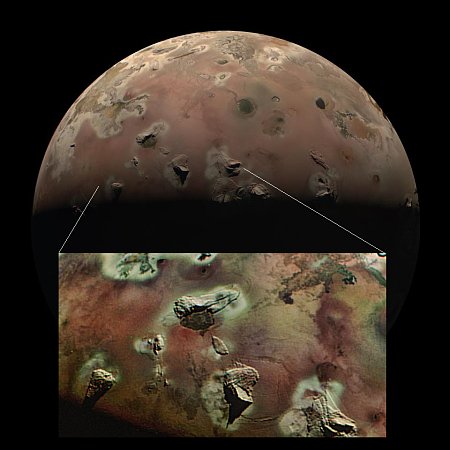
For original global image go here. For original of inset go here.
The first raw Juno images taken of the Jupiter moon Io during its close fly-by on December 30, 2023, the closest in more than twenty years, have been released by the science team and citizen scientists have begun processing them.
The global picture to the right, rotated and reduced to post here, was processed by Kevin Gill. The inset of the volcanic mountains near the terminator was processed by Thomas Thomopoulos. As he notes, to obtain better detail he enhanced the colors and image and then zoomed in.
In the inset, note the northeast flows coming off the two mountains near the center. With the lower mountain, this flow appears to lie on top of a larger flow that extended out almost to the mountain to the right.
Io is a planet of continuous volcanic activity. For example, when the global image above was taken, the plume of a volcano eruption was visible on the right horizon, as shown in this version, its exposure adjusted by Ted Stryk. Catching such eruptions on Io is not unusual, considering its continuous volcanic activity generated by the tidal forces the planet undergoes from its orbit around Jupiter. In fact, the very first plume was imaged in 1979 by Voyager 1 during its short fly-by, and proved a hypothesis of such activity that scientists had only published one week earlier.
India’s space agency ISRO early today completed the first launch of 2024, its PSLV rocket placing an X-ray telescope into orbit along with ten payloads on its fourth stage, which is functioning as an orbital tug. Most appear [pdf] to be experiments that will remain on board, but one is an amateur radio smallsat that might be released.
As this is the only launch so far in 2024, India leads the race. It will certainly not remain the leader.
My annual global launch report for 2023 will be published tomorrow, after the holiday.
China today launched what it described as “a test satellite for satellite internet technologies,” its Long March 2C rocket lifting off from its Jiuquan spaceport in the northwest of China.
No word on where the lower stages crashed, both of which use very toxic hypergolic fuels. Nor was there any additional information about the satellite, though the description suggests this is a prototype satellite for a Starlink-type constellation, several of which China’s government has proposed building.
The leaders in the 2023 launch race:
96 SpaceX
66 China
19 Russia
8 Rocket Lab
7 India
American private enterprise still leads China in successful launches 110 to 66, and the entire world combined 110 to 103. SpaceX in turn trails the rest of the world (excluding other American companies) 96 to 103.
An evening pause: As the New Year will arrive over the weekend, let’s celebrate the New Year now. Happy New Year to all my readers! Thank you all for your support, that in the end made this year the most successful since this website was founded. May the future bring us all joy and happiness, despite the mad ones around us.
Hat tip Alton Blevins.
Courtesy of BtB’s stringer Jay.
The launch is with India’s smaller PSLV rocket. I will assign this launch to 2024, which if successful will put India on top for a short while.
SpaceX today successfully completed static fire tests on both Superheavy and Starship prototypes intended to fly on its next orbital test flight.
The video at the link is four hours long. The Starship engine burn occurs at 1 hour 15 minutes and lasts about five seconds. The Superheavy burn takes place at 2 hours 42 minutes, and lasts about ten seconds. Both burns appeared to operate exactly as planned, though obviously an inspection of the launchpad under Superheavy will have to take place to see if its deluge system operated as intended.
Once again, SpaceX is demonstrating that it will be ready to go for the third orbital test launch of this rocket in mere weeks. Based on these tests today as well as past operations, it seems that all the company needs to do now is stack Starship on top of Superheavy, do another dress rehearsal countdown, and then go.
It won’t however. There is no word from the FAA on when it will issue a launch permit. Based on the previous launch, it will likely not issue the permit when SpaceX says it has completed its investigation of the last launch and is ready to fly again. Instead it will take another month or two writing up its own report (which will essentially reword what SpaceX has told it). Then, once the FAA is finished only then will the Fish and Wildlife Service begin to write up its report (as happened in the fall), causing further delays.
I repeat my prediction from November: No launch until March, at the earliest. The federal government continues to stand in the way of progress, and freedom.
Hat tip to BtB’s stringer Jay.

Failure theater: In their typically impotent attempt to fight the leftist movement that is imposing a new racial bigotry across America, several Republicans in Congress have proposed a new special government office in Washington that will be specifically assigned the job of preventing racial discrimination at universities.
The College Admissions Accountability Act, introduced by Sen. J.D. Vance (R., Ohio) and Rep. Jim Banks (R., Ind.), would establish a special inspector general within the Education Department—separate from the Office of Civil Rights—to probe potential violations of the colorblind standard set forth in Students for Fair Admissions v. Harvard, which ruled that race-conscious admissions programs violate the 14th Amendment. The bill would also bar schools that flout the decision from receiving any form of federal aid.
…The bill, which appropriates $25 million for the new role and is cosponsored by Sens. Ted Budd (R., N.C.), Mike Braun (R, Ind.), Josh Hawley (R., Mo.), Eric Schmitt (R., Mo.), and Marco Rubio (R., Fla.), does include a sunset clause that would terminate the office after 12 years. Republicans seem to be betting that recalcitrant universities will, after a decade of robust enforcement, throw in the towel and evolve colorblind norms.
These senators and congressmen, along with several conservative think tanks, think naively that this office will the place for anyone of any race to go to get justice should a university receiving federal funds create a program that specifically excludes them solely because of their race. The aim will supposedly be to target specifically the new Diversity-Inclusion-Equity programs at universities and in governments that are imposing this new discrimination against whites, Asians, and Jews.
The foolishness of this plan is hard to measure. » Read more

Click for original image.
Cool image time! The picture to the right, cropped, reduced, and enhanced to post here, was taken on December 27, 2023 by the high resolution camera on the Mars rover Curiosity. It shows what is a somewhat typical rock found on the ground as Curiosity climbs Mount Sharp in Gale Crater.
Two features stand out. First, the many layers illustrate again the cyclical nature of Martian geology. Many sedimentary events occurred over a long time to create this rock, each cycle putting down a new layer, with some intervening time periods possibly removing layers as well. Such layering has now become evident in both ground photos taken by rovers as well as orbital images.
Second, the delicate nature of some layers indicates the incredibly slow erosion process on Mars, enhanced by the red planet’s one-third gravity. The atmosphere is incredibly thin, less than 0.1% of Earth’s. Yet given time the wind had been able to wear away the edges of this rock. The thin atmosphere and light gravity has also allowed some material to remain in a delicate manner that would be impossible on Earth.
Thus, for these thin flakes to have formed has required a great deal of time. The very nature of this rock speaks of an ancient terrain, shaped slowly by inanimate processes with no active life around to disturb things.
Using its front and rear hazard avoidence cameras, the Curiosity science team had the rover take two full sets of images looking in one direction for twelve hours straight in order to create two movies of Mars that show an entire day, from dawn to dusk.
I have embedded both movies below. From the press release:
When NASA’s Curiosity Mars rover isn’t on the move, it works pretty well as a sundial, as seen in two black-and-white videos recorded on Nov. 8, the 4,002nd Martian day, or sol, of the mission. The rover captured its own shadow shifting across the surface of Mars using its black-and-white Hazard-Avoidance Cameras, or Hazcams.
Instructions to record the videos were part of the last set of commands beamed up to Curiosity just before the start of Mars solar conjunction, a period when the Sun is between Earth and Mars. Because plasma from the Sun can interfere with radio communications, missions hold off on sending commands to Mars spacecraft for several weeks during this time.
The first looks forward, into Gediz Vallis, where Curiosity will eventually travel. The second looks back down Mt Sharp and out across the rim of Gale Crater.
» Read more