Two launches from China and SpaceX early today

Early this morning both SpaceX and China successfully launched rockets. First, SpaceX completed its sixteenth Transporter mission placing 119 payloads in orbit, its Falcon 9 rocket lifting off from Vandenberg Space Force Base in California.

The first stage completed its 12th flight, landing on a drone ship in the Pacific. A detailed description of the 119 payloads can be found here.

Next, China successfully completed the maiden launch of its Kinetica-2 rocket, lifting off from its Jiuquan spaceport in northwest China and placing three demonstration satellites into orbit. The rocket is built by the pseudo-company CAS Space, which is entirely owned by one of China’s government space agencies.

According to the developers, the rocket stands 53 meters tall, with a core stage diameter of 3.35 meters and a fairing 4.2 meters wide. At liftoff, it weighs 625 tons and produces 753 tons of thrust. It can deliver up to 12 tons to a 200 kilometers low Earth orbit or 8 tons to a 500 kilometers sun-synchronous orbit.

On this launch, the liquid-fueled core stage and two side boosters were expendable, and crashed somewhere in China. China will use this rocket to partly replace its older expendable Long March 2 and Long March 3 rockets that use very toxic hypergolic fuels, thus reducing the risk to its citizens somewhat from crashing lower stages. Eventually the plan is to make the core stage and boosters reusable, so that they no longer crash uncontrolled inside China.

The leaders in the 2026 launch race:

39 SpaceX
16 China
5 Rocket Lab
4 Russia

SpaceX continues to lead the entire world combined in total launches, as it did in both ’24 and ’25.

SpaceX has another Starlink launch scheduled for later today, using a first stage on a record 34th flight.

2 comments

Another rocket startup in India hopes to launch from its own spaceport

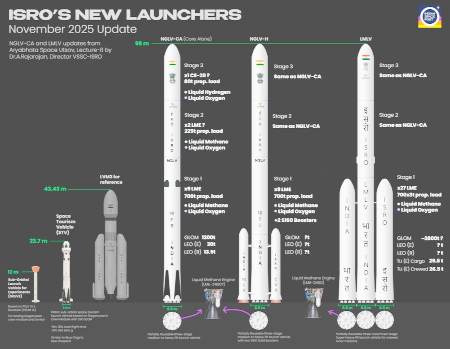
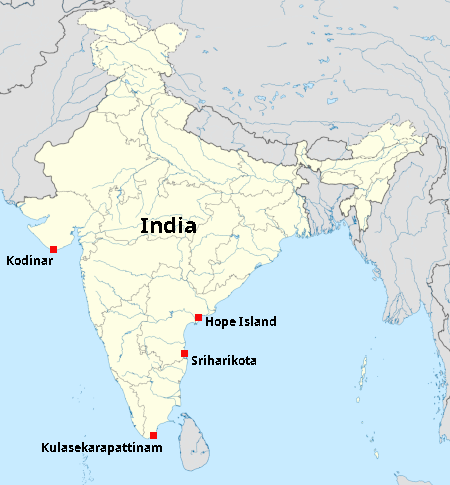
India's spaceports, active, under construction, or proposed
India’s spaceports, active, under construction, or proposed

A new rocket startup in India, dubbed Bharath Space Vehicle (BSV), is not only building a commercial rocket to launch smallsats, it hopes to establish its own private spaceport near the town of Kodinar in western India.

BSV has proposed a launch complex near Kodinar in Gujarat’s Gir Somnath district. Gujarat’s Science and Technology Minister Arjun Modhwadia told the state assembly that IN-SPACe has identified a suitable location between Diu and Kodinar for a satellite launch facility, comparable to Sriharikota.

The coastal location offers open sea access and favourable launch corridors for specialised satellite trajectories. Isro had earlier evaluated a Gujarat site for its SSLV launch complex before Kulasekarapattinam in Tamil Nadu was selected.

Sriharikota has been operated for decades by India’s space agency ISRO. Kulasekarapattinam is a new ISRO spaceport set to begin operations next year, focused on launching its Small Satellite Launch Vehicle (SSLV) for commercial missions. Hope Island is a proposed private and commercial spaceport, under study.

BSV’s rocket is called Agasthya-1 and will use liquid-fueled engines. It appears to be similar in design to SpaceX’s first rocket, the Falcon-1.

Though the company’s founders are all ISRO veterans who helped develop its rockets, its website makes no mention of a launch schedule. At present, India has two rocket startups, Skyroot and Agnikul, that appear close to their first orbital launch.

1 comment

Genesis cover

On Christmas Eve 1968 three Americans became the first humans to visit another world. What they did to celebrate was unexpected and profound, and will be remembered throughout all human history. Genesis: the Story of Apollo 8, Robert Zimmerman's classic history of humanity's first journey to another world, tells that story, and it is now available as both an ebook and an audiobook, both with a foreword by Valerie Anders and a new introduction by Robert Zimmerman.

The print edition can be purchased at Amazon or any other book seller. If you want an autographed copy the price is $60 for the hardback and $45 for the paperback, plus $8 shipping for each. Go here for purchasing details. The ebook is available everywhere for $5.99 (before discount) at amazon, or direct from my ebook publisher, ebookit. If you buy it from ebookit you don't support the big tech companies and the author gets a bigger cut much sooner.


The audiobook is also available at all these vendors, and is also free with a 30-day trial membership to Audible.
 

"Not simply about one mission, [Genesis] is also the history of America's quest for the moon... Zimmerman has done a masterful job of tying disparate events together into a solid account of one of America's greatest human triumphs."--San Antonio Express-News

China’s government strengthens its commitment to space

China's long term launch record
Taken from my 2025 year-end report on the state of
global launch industry.

In the Chinese government’s most recently announced five-year plan, it appears it has increased its commitment to its space program and its government-controlled commercial space sector.

Aviation and aerospace was elevated at the Two Sessions [conference earlier this month] to a ‘pillar industry’—a step up from its previous classification as an emerging sector. For the first time, the 15th 5-year plan (2026–30) explicitly sets the goal of building China into a space power by 2030.

The 5-year plan prioritizes reusable launch vehicles, large-scale satellite constellations, and the commercialization of space applications, with cost reduction cast as central to long-term viability. Satellite internet has been earmarked for rapid development as part of broader ambitions around integrated space-air-ground connectivity. A new ‘Space+’ framing suggests that satellite infrastructure is being treated as part of the broader industrial system, with growing interest in on-orbit computing rather than communications alone.

…But the sector still runs on patient state capital—a funding model that has enabled rapid scaling while deferring any serious test of commercial viability. No domestic launch provider has yet turned a profit, and closing the cost gap with SpaceX on reusable rockets remains the industry’s central challenge.

The report at the link is very detailed. Though it comes from a Chinese-based think tank that almost certainly gets funding and supervision from the Chinese communists, it is definitely worth reading. It notes the areas where China is doing well — its Beidou GPS-type constellation and its manned space program — as well as those areas it has come up short — re-usable rockets and its mega-satellite constellations.

Though the graph to the right illustrates the long-term growth of China as a space power, it has not yet been able to match the U.S. in these two areas, mostly because of SpaceX. Moreover, the inability of China’s pseudo-rocket companies to get its reusable rockets operational is hindering the ability of China’s pseudo-satellite companies to launch their satellites. In both cases this new five-year plan appears to be applying pressure on these pseudo-companies to get moving, or the government will take over.

I must repeat again that the Chinese government’s support for space is deep and widespread, strengthened by that government’s almost two-decade-long policy of using that program as a training ground for its political leaders. Many of its successful space industry managers have been promoted to higher political office, and thus wield great power in deciding policy. Their pro-space roots clearly influence that policy in favor of China’s space effort.

0 comments

Astronaut Mike Fincke finally reveals details of his medical emergency on ISS

Astronaut Mike Fincke, who had an undisclosed medical issue on ISS in January 2026 that forced the early return of his crew, has finally provided details of what happened.

Four-time space flier Mike Fincke said he was eating dinner on Jan. 7 after prepping for a spacewalk the next day when it happened. He couldn’t talk and remembers no pain, but his anxious crewmates jumped into action after seeing him in distress and requested help from flight surgeons on the ground. “It was completely out of the blue. It was just amazingly quick,” he said in an interview with The Associated Press from Houston’s Johnson Space Center.

Fincke, 59, a retired Air Force colonel, said the episode lasted roughly 20 minutes and he felt fine afterward. He said he still does. He never experienced anything like that before or since. Doctors have ruled out a heart attack and Fincke said he wasn’t choking, but everything else is still on the table and could be related to his 549 days of weightlessness. He was 5 ½ months into his latest space station stay when the problem struck like “a very, very fast lightning bolt.”

Fincke hopes he can fly in space again, but I doubt NASA would agree if the cause of this incident is not identified. His other option then would be to get hired by one of the commercial space station companies to fly to their stations, but even they might be reluctant to hire him.

15 comments

Conscious Choice cover

Now available in hardback and paperback as well as ebook!

From the press release: In this ground-breaking new history of early America, historian Robert Zimmerman not only exposes the lie behind The New York Times 1619 Project that falsely claims slavery is central to the history of the United States, he also provides profound lessons about the nature of human societies, lessons important for Americans today as well as for all future settlers on Mars and elsewhere in space.

 
Conscious Choice: The origins of slavery in America and why it matters today and for our future in outer space, is a riveting page-turning story that documents how slavery slowly became pervasive in the southern British colonies of North America, colonies founded by a people and culture that not only did not allow slavery but in every way were hostile to the practice.  
Conscious Choice does more however. In telling the tragic history of the Virginia colony and the rise of slavery there, Zimmerman lays out the proper path for creating healthy societies in places like the Moon and Mars.


“Zimmerman’s ground-breaking history provides every future generation the basic framework for establishing new societies on other worlds. We would be wise to heed what he says.” —Robert Zubrin, founder of the Mars Society.


All editions are available at Amazon, Barnes & Noble, and all book vendors, with the ebook priced at $5.99 before discount. All editions can also be purchased direct from the ebook publisher, ebookit, in which case you don't support the big tech companies and the author gets a bigger cut much sooner.


Autographed printed copies are also available at discount directly from the author (hardback $29.95; paperback $14.95; Shipping cost for either: $6.00). Just send an email to zimmerman @ nasw dot org.

Rocket Lab launches GPS-type demo satellite for Europe

Rocket Lab this morning successfully placed a European Space Agency (ESA) smallsat into orbit, its Electron rocket lifting off from one of its two launchpads in New Zealand.

The smallsat, dubbed Celeste, is the first of two such demo satellites that ESA has contracted Rocket Lab to launch. They are designed to test a low Earth orbit constellation for providing global navigation and location information to users on the ground, similar to the U.S.’s GPS constellation. Celeste will work from low orbit with Europe’s medium orbit Galileo constellation, but being smaller will be cheaper and faster to build and launch.

The leaders in the 2026 launch race:

38 SpaceX
15 China
5 Rocket Lab
4 Russia

SpaceX continues to lead the entire world combined in total launches, as it did in both ’24 and ’25.

4 comments

Leaving Earth cover

Leaving Earth: Space Stations, Rival Superpowers, and the Quest for Interplanetary Travel, can be purchased as an ebook everywhere for only $3.99 (before discount) at amazon, Barnes & Noble, all ebook vendors, or direct from my ebook publisher, ebookit.

If you buy it from ebookit you don't support the big oppressive tech companies and I get a bigger cut much sooner.


Winner of the 2003 Eugene M. Emme Award of the American Astronautical Society.

 
"Leaving Earth is one of the best and certainly the most comprehensive summary of our drive into space that I have ever read. It will be invaluable to future scholars because it will tell them how the next chapter of human history opened." -- Arthur C. Clarke

March 27, 2026 Quick space links

Courtesy of BtB’s stringer Jay. This post is also an open thread. I welcome my readers to post any comments or additional links relating to any space issues, even if unrelated to the links below.

14 comments

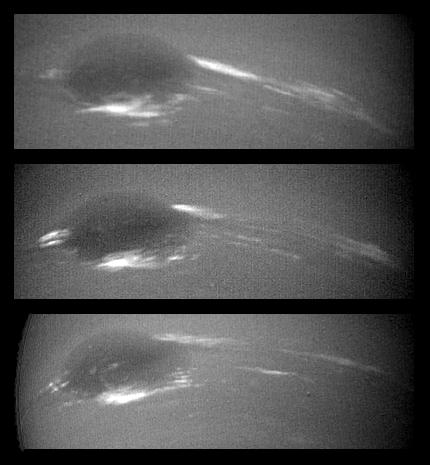
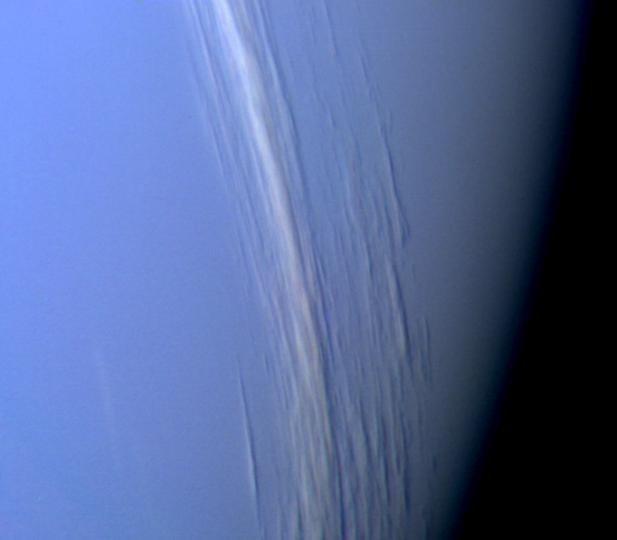
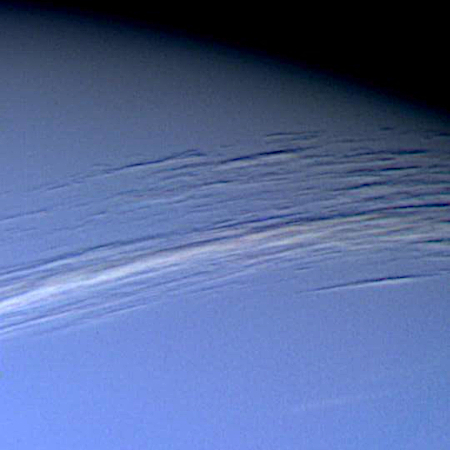
Neptune as seen by Voyager-2 in 1989, four days before closest approach

Neptune as seen by Voyager-2 on approach
Click for original image.

Cool image time! In two earlier posts I highlighted the pictures taken by Voyager-2 of Neptune’s two largest moons, Triton and Proteus, when it made its close fly-by of Neptune in 1989. Other than a very distant low resolution picture of 105-mile-wide Nereid, Voyager-2 took no other good images of Neptune’s other known moons.

So today, let’s begin a tour of some of Voyager-2’s imagery of Neptune itself. The picture to the right, reduced slightly to post here, was taken on August 20, 1989 as the spacecraft was beginning its approach to Neptune. It shows the full daylight hemisphere of the gas giant. From the caption:

The images were taken at a range of 4.4 million miles from the planet, 4 days and 20 hours before closest approach. The picture shows the Great Dark Spot and its companion bright smudge; on the west limb the fast moving bright feature called Scooter and the little dark spot are visible. These clouds were seen to persist for as long as Voyager’s cameras could resolve them. North of these, a bright cloud band similar to the south polar streak may be seen.

Next week I will post some of the other good shots taken of Neptune, as well as one or two close-ups of Triton that need highlighting. Sadly, at that point we will have more or less reviewed most of the best data now available of this distant world. Astronomers have used the Hubble Space Telescope in subsequent years to attempt to track its weather patterns, but even Hubble really can’t provide enough resolution to really make that research substantive.

But stay tuned. The Voyager-2 images to come are worth viewing.

1 comment

China launches “test satellite”

China yesterday afternoon successfully placed what its state-run press merely described as “a test satellite”, its Long March 2C rocket lifting off from its Jiuquan spaceport in northwest China.

That state-run press also provided no information as to where the rocket’s lower stages, using very toxic hypergolic fuels, crashed inside China.

The leaders in the 2026 launch race:

38 SpaceX
15 China
4 Rocket Lab
4 Russia

SpaceX continues to lead the entire world combined in total launches, as it did in both ’24 and ’25.

0 comments

War Department conducts classified suborbital missile test from Cape Canaveral

The War Department yesterday launched an unidentified suborbital missile test from its Cape Canaveral Space Force Station in Florida, providing no public information about the rocket, the purpose of the launch, or who built it.

An unidentified missile launched and zoomed across the Atlantic Ocean Thursday, March 26, from Cape Canaveral Space Force Station, leaving a slim white contrail against the afternoon blue sky. None of the Space Coast’s major rocket-launch providers had missions scheduled on Thursday. The mysterious unannounced launch occurred at roughly 12:30 p.m.

The Pentagon did not respond to media requests for information.

The missile was likely a suborbital hypersonic test, but that is pure speculation. What makes it unusual is the lack of any information about launch provider. In recent years the military has relied entirely on the private sector to build its hypersonic test program. This launch suggests the War Department has moved from testing hypersonic components on private rockets, airplanes, and capsules to building and testing its own final hypersonic missile prototype.

This is also pure speculation. We will have to wait for some clarification from the Pentagon.

0 comments
1 29 30 31 32 33 2,929