March 10, 2023 Zimmerman/Batchelor podcast
Embedded below the fold in two parts.
To listen to all of John Batchelor’s podcasts, go here.
» Read more
Embedded below the fold in two parts.
To listen to all of John Batchelor’s podcasts, go here.
» Read more
An evening pause: Performed live 1968.
Hat tip Judd Clark, who notes, “Nice piece of poetry at the beginning.”
On Christmas Eve 1968 three Americans became the first humans to visit another world. What they did to celebrate was unexpected and profound, and will be remembered throughout all human history. Genesis: the Story of Apollo 8, Robert Zimmerman's classic history of humanity's first journey to another world, tells that story, and it is now available as both an ebook and an audiobook, both with a foreword by Valerie Anders and a new introduction by Robert Zimmerman.
The print edition can be purchased at Amazon or any other book seller. If you want an autographed copy the price is $60 for the hardback and $45 for the paperback, plus $8 shipping for each. Go here for purchasing details. The ebook is available everywhere for $5.99 (before discount) at amazon, or direct from my ebook publisher, ebookit. If you buy it from ebookit you don't support the big tech companies and the author gets a bigger cut much sooner.
"Not simply about one mission, [Genesis] is also the history of America's quest for the moon... Zimmerman has done a masterful job of tying disparate events together into a solid account of one of America's greatest human triumphs."--San Antonio Express-News
Courtesy of BtB’s stringer Jay.
The payloads and (it appears) the upper stage is not yet stacked. The plan is to do some propellant loading tests.
The launch had been planned for the first quarter of this year, but no launch date as yet has been set.
According to the company’s webpage, the rocket, dubbed Miura-1, is suborbital and will be recovered for resuse by parachute after splashing down in the ocean.
They hope to launch in the second quarter of 2023 on a SpaceX Falcon Heavy.

Nicoletta-Solas testifying to Congress
They’re coming for you next: Nicoletta Solas, a Rhode Island mother of a 5-year-old, was harassed by her school board and sued by the National Education Association (NEA), the largest teacher’s union in the nation, for simply requesting her child’s kindergarten curriculum. As she stated bluntly during her testimony at House hearing on March 2, 2023,
If you ask questions about public education, they will come after you. … My school district and my teachers’ union didn’t want to just hide the curriculum from me, they wanted to ruin my life.
Below is video of her full testimony. All she wanted to know was whether the school would be teaching queer theory to her 5-year-old. The ugly and vicious response to this request, by the school, the school board, and the NEA, is striking.
» Read more
Now available in hardback and paperback as well as ebook!
From the press release: In this ground-breaking new history of early America, historian Robert Zimmerman not only exposes the lie behind The New York Times 1619 Project that falsely claims slavery is central to the history of the United States, he also provides profound lessons about the nature of human societies, lessons important for Americans today as well as for all future settlers on Mars and elsewhere in space.
“Zimmerman’s ground-breaking history provides every future generation the basic framework for establishing new societies on other worlds. We would be wise to heed what he says.” —Robert Zubrin, founder of the Mars Society.
All editions are available at Amazon, Barnes & Noble, and all book vendors, with the ebook priced at $5.99 before discount. All editions can also be purchased direct from the ebook publisher, ebookit, in which case you don't support the big tech companies and the author gets a bigger cut much sooner.
Autographed printed copies are also available at discount directly from the author (hardback $29.95; paperback $14.95; Shipping cost for either: $6.00). Just send an email to zimmerman @ nasw dot org.
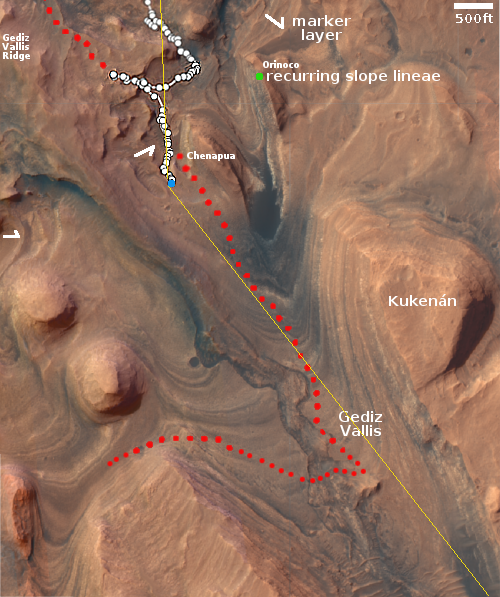
Though the science team has not, as of this posting, added the flight to Ingenuity’s flight log, according to the interactive map showing the positions of both Ingenuity and Perseverance on Mars, the helicopter completed its 47th flight yesterday as planned.
An annotated version of that map is to the right. The larger green dot marks Ingenuity’s new position. The smaller green dot marks its position when the panorama above was taken on February 27, 2023, capturing the helicopter in the distance (as indicated by the arrow). The yellow lines indicate the approximate area covered by that panorama. The blue dot marks Perseverance’s present position.
The flight’s planned distance was to go 1,410 feet to the southwest and “image science targets along the way.” As the helicopter also flew above Perseverance’s planned route, as indicated by the red dotted line, it also provided the rover team information about the ground Perseverance will travel along the way. Since the terrain here is generally not very rough, the information is not critical for route-picking. It might however spot some geological feature that bears a closer look that would not have been noticed by the rover alone.
In releasing its proposed federal budget for 2024 with many major spending increases, the Biden administration has also proposed a significant increase in NASA’s budget. the third year in a row it has done so.
The shortened summary version of the Biden budget proposal [pdf] covers its proposals for NASA in two pages, with the most important proposals as follows:
The last two items will likely be money offered to many new commercial startups.
Though we can expect some resistance by the Republican House to most of the budget increases in the overall Biden budget proposal, expect Congress to rubber stamp the NASA increases, as it has done routinely in recent years. Congress might shift or reject some of these ideas, but generally, when all is said and done, it will only make superficial changes. NASA will likely more money.
Leaving Earth: Space Stations, Rival Superpowers, and the Quest for Interplanetary Travel, can be purchased as an ebook everywhere for only $3.99 (before discount) at amazon, Barnes & Noble, all ebook vendors, or direct from my ebook publisher, ebookit.
If you buy it from ebookit you don't support the big oppressive tech companies and I get a bigger cut much sooner.
"Leaving Earth is one of the best and certainly the most comprehensive summary of our drive into space that I have ever read. It will be invaluable to future scholars because it will tell them how the next chapter of human history opened." -- Arthur C. Clarke
The House Energy and Commerce subcommittee on March 8, 2023 approved five bills affecting the FCC and how it operates.
The first bill [pdf], Satellite and Telecommunications Streamlining Act, is the most significant, as it appears to try to establish legal limitations and rules specifically designed to address the FCC’s recent effort to expand its power and regulatory authority beyond what its legal authority allows. While most of the bill’s language appears to allow the FCC to do what it wants (including limiting or regulating future space stations and setting lifetime limits on all orbiting spacecraft), it also insists that licenses be approved quickly and adds this caveat:
[T]he Commission may not establish performance objectives that conflict with any standard practice adopted by the Secretary of Commerce.
In other words, the FCC cannot grab the regulatory responsibilities of other agencies, especially the Commerce Department, where Congress in recent years has been trying to shift most commercial regulatory authority.
Nonetheless, this bill appears to mostly endorse the FCC ‘s power grab.
The bills still have to be approved by the full committee, then approved by the full House, then approved by the Senate, and then signed by the president.
According to unnamed sources in the Russian press, Roscosmos officials are considering bringing the Soyuz capsule launched on February 23rd to ISS back to Earth in June rather than September, while moving up the launch of the next Soyuz manned mission.
As noted by space journalist Anatoly Zak:
The existence of such plans indicated that specialists had still been concerned about the possibility of a critical leak in the thermal control system of the fresh crew vehicle similar to those that hit two previous transport ships. Such change in schedule would also debunk the official explanation of previous two accidents by Roskosmos and NASA as caused by meteors rather than production defects.
The two previous coolant leaks occurred about three months after launch. Bringing the Soyuz home in June would get it home in about three and a half months, suggesting the Russians are no longer confident their Soyuz and Progress spacecraft can withstand six months in space.
If this plan is adopted it will also put less strain on the crew slated to come home on that Soyuz. Their mission has been planned for six months. Extending it to a full year without any prior preparation risks serious health issues.
China today used its Long March 4C rocket to launch two Earth observation satellites from one of its interior spaceports.
No word on whether the expendable first stage landed near habitable areas. In related news the upper stage of a Long March 2D rocket, launched in June 2022, burned up over Texas on March 8, 2023. Such upper stage uncontrolled de-orbits are not unusual, and the effort by this news outlet to make a big deal about it is just politics. Unlike the lower stages of China’s rockets that hit the ground right after launch, it is very unlikely any pieces reached the surface, and any that did were small and posed a small risk.
The 2023 launch race:
16 SpaceX
8 China
3 Russia
1 Rocket Lab
1 Japan
1 India
American private enterprise still leads China 17 to 8 in the national rankings, and the entire world combined 17 to 13. SpaceX alone still leads the entire world, including American companies, 16 to 14.
An evening pause: Seems to me, this expresses perfectly the level of thoughtfulness seen in many hard rock music videos, only it does it more honestly.
Hat tip Gene Shipp.
Courtesy of BtB’s stringer Jay.
The company plans to list its shares on the Toyko stock exchange, prior to the landing of Hakuto-R1 on the Moon in April.
At present the risk, even if it hit the Earth, is small. The asteroid’s size is estimated roughly to be about 150 feet across, with a less than 1 in 600 chance of a collision even in 2046.
SpaceX today successfully launched another 40 OneWeb satellites, using its Falcon 9 rocket lifting off from Cape Canaveral.
This was SpaceX’s third launch for OneWeb, helping to replace the Russians who broke its contract with OneWeb after its invasion of the Ukraine. The first stage completed its thirteenth flight, landing safely on a landing pad at Cape Canaveral. As amazing as this record is, it is not a record for the most reflights, which presently stands at fifteen. The fairings completed their sixth flight.
As of posting not all of OneWeb’s satellites have been deployed.
The 2023 launch race:
16 SpaceX
7 China
3 Russia
1 Rocket Lab
1 Japan
1 India
American private enterprise now leads China 17 to 7 in the national rankings, and the entire world combined 17 to 12. SpaceX alone leads the entire world combined, including American companies, 16 to 13.
That the Martian surface becomes increasingly icy as one approaches its poles is becoming increasingly evident from orbital images. Today’s cool image provides us another data point.
The picture to the right, rotated, cropped, reduced, and enhanced to post here, was taken on January 4, 2023 by the high resolution camera on Mars Reconnaissance Orbiter (MRO). It is once again another terrain sample image, taken not as part of any particular research project but to fill a gap in the camera’s schedule so as to maintain its temperature. With such pictures, it is hard to predict what will be seen, though the scientists try to find interesting things. In this case the camera team succeeded quite nicely, capturing what appears to me to be a small volcano with two calderas.
This volcano however has almost certainly not spouted lava but mud and water.
» Read more

Texas A&M: abandoning its discriminatory
policies?
Bring a gun to a knife fight: Less than a month after Texas governor Greg Abbott ordered all state agencies to cease considering race and gender in hiring, Texas A&M (TAMU) officials announced they were removing all mention of diversity, equity, and inclusion policies from the university’s hiring and admissions practices.
After receiving the Feb. 6 memo, Texas A&M Chancellor John Sharp immediately ordered all A&M System institutions to review their employment and admission practices and confirm their compliance, according to the university. … Sharp directed all universities and agencies within the TAMU system to remove the DEI statements from their employment or admissions practices. The directive also standardizes faculty and staff applications, limiting them to a cover letter, curriculum vitae, statements about research and teaching philosophies, and professional references. It further instructs universities and agencies to make all websites or printed materials dealing with employment and admission practices compliant with the directive, says TAMU.
Will this change anything? It appears that for now, no, not much. » Read more
Starfish Space, a new entrant into the orbital tug & servicing industry, has successfully raised $14 million in new investment capital, in addition to the $7 million it had raised in a previous fund-raising round.
The company hopes to launch a test satellite later this year, dubbed Otter Pup, which will undock from the orbital tub of another company, Launcher Space, do maneuvers, and then redock.
Starfish’s plan calls for Otter Pup to be sent into orbit this summer as a rideshare payload on SpaceX’s Transporter-8 mission. The spacecraft will be deployed from Launcher Space’s Orbiter space tug, and then will execute a series of maneuvers with a xenon-fueled electric propulsion system to move away from the tug.
If all goes well, the Otter Pup will return to the vicinity of the Orbiter, and then use an electrostatic-based capture mechanism to latch onto a docking target on the space tug. It could take months to test out the Otter Pup’s systems and tweak them as necessary for its test hookups.
Though the company says it will offer tug services once operational, it appears it is mostly aiming for the satellite robotic servicing market. It, like Astroscale, has developed its own docking capture device, which it will try to convince satellite companies to attach to their satellites. It will then use this to dock and service those satellites. Since these capture devices are proprietary, the number that each company gets onboard satellites will determine that company’s future sales.
This orbital servicing industry appears to be growing very quickly, now that launch costs have come down by about 90% since the arrival of SpaceX. For example, the orbital tug company Momentus is getting ready to launch its third mission.
The Space Force has assigned launchpad space at Cape Canaveral to four different new smallsat rocket startup companies, ABL Space Systems, Stoke Space, Phantom Space, and Vaya Space, none of which have yet launched.
There are currently four active launch complexes on the Eastern Range; Launch Complex 37 for ULA Delta rockets; Launch Complex 40 for SpaceX Falcon 9 rockets; Launch Complex 41 for ULA Atlas rockets; and Launch Complex 39A, which is owned by NASA.
ABL Space Systems, which has the RS1 rocket, has been allocated property at Space Launch Complex 15. ABL’s first orbital attempt in January failed. Stoke Space was allocated property at SLC 14. The launcher is based in Washington state and working to develop a fully reusable rocket. And Phantom Space and Vaya Space were allocated space at SLC 13. Phantom Space is developing the Daytona Launch System and executed a successful hot fire test in November.
This article provides a nice overview of the four companies, of which Vaya is the newest entrant into the smallsat rocket industry.
Space Force officials have made it clear they want to maximize use of their facility at the Cape, while helping to energize this private commercial market.
Though a collision was unlikely, Russian engineers fired the engines of a docked Progress freighter on March 6, 2023 to adjust ISS’s orbits in order to guaranteethat an Earth-observation satellite would fly past harmlessly.
At approximately 7:42 a.m. (12:42 GMT), thrusters on the Progress 83 resupply vessel currently docked with the International Space Station (ISS) fired for a little more than six minutes, raising the station’s orbit to prevent the potential collision, NASA said in a blog post (opens in new tab).
The satellite in question appears to have been an Argentinian Earth-observation satellite launched in 2020, according to Sandra Jones, from NASA’s Johnson Space Center. In a tweet, Dr. Jonathan McDowell, astronomer and astrophysicist at the Harvard–Smithsonian Center for Astrophysics, narrowed the possible candidates down to Nusat-17, noting the constellation’s orbital decay.
The article at the link includes a nice graph showing the number of times per year engineers have had to do this since 1999. The number of such maneuvers ranges from 0 to 5 per year, with no clear trend up or down. That lack of a trend suggests the constant howls claiming that space junk is a growing problem might be a bit overstated. This is not to say it isn’t a problem, merely that the problem might not be as severe as some claim.
Embedded below the fold in two parts.
To listen to all of John Batchelor’s podcasts, go here.
» Read more
An evening pause: Performed live 1977.
Hat tip Judd Clark.
Courtesy of BtB’s stringer Jay.
Both suits accuse the company of weeding out older employees, exclusively based on age. I wonder if many of those older workers simply had the knowledge and experience to realize working for Blue Origin was turning out to be a dead end.
This regulation means the core stage of future Long March 5B must be controllable, and will not crash randomly somewhere on Earth. We shall see.
The Soyuz-5 was to replace the Ukraine’s Zenit rocket, but has been plagued by delays. This action by Kazakhstan, as yet unconfirmed, would likely kill the project, as the rocket now has no launchpad.