Two moons of Saturn against its majestic rings

Mimas and second moon against Saturn's rings
Click for original image.

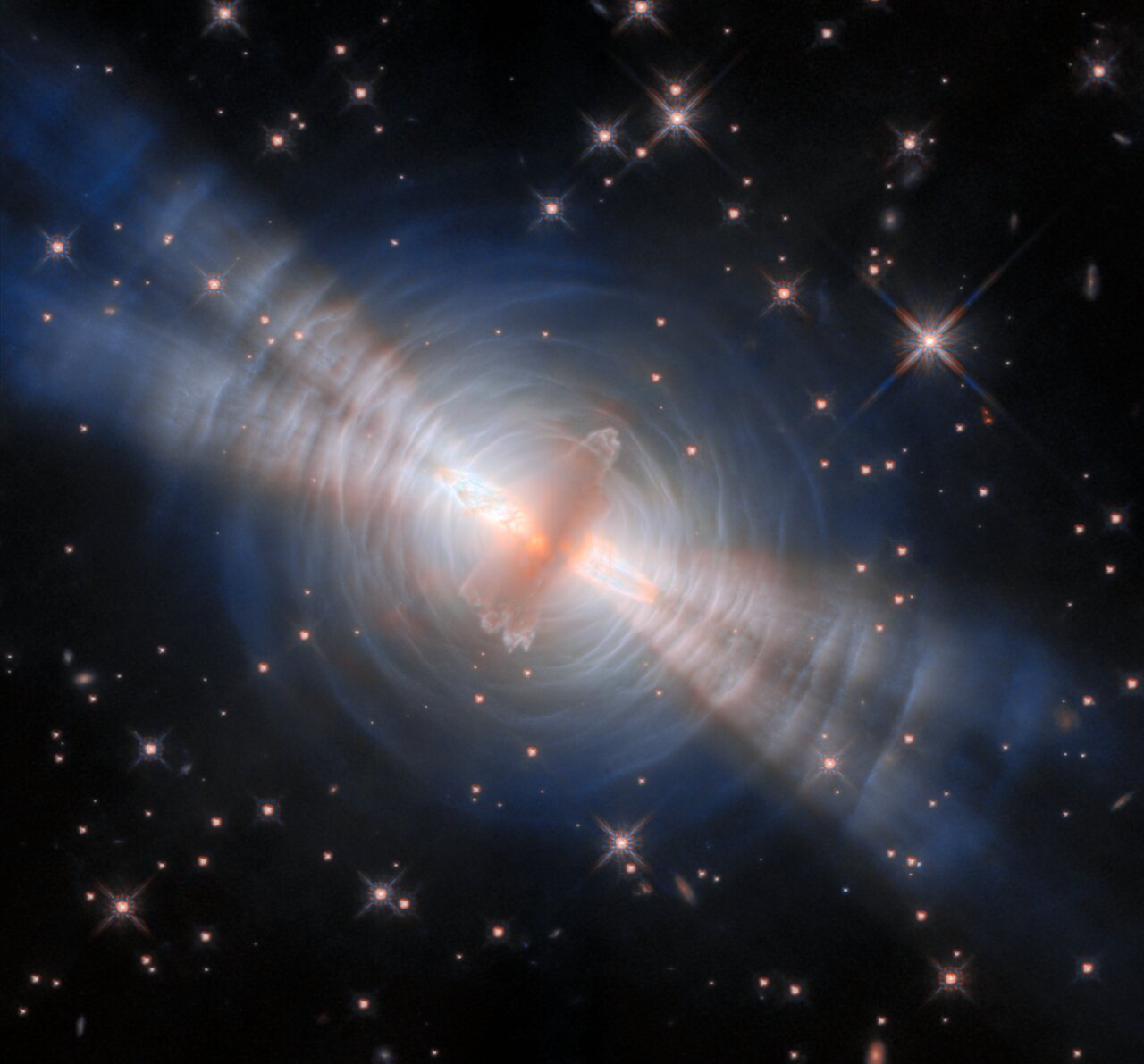
Cool image time! The picture to the right, cropped and enhanced to post here, was taken on December 23, 2005 by Cassini as it orbited Saturn.

The larger cratered moon is Mimas, known best for the single giant crater that dominates one hemisphere. I have not been able to identify the brighter but smaller moon.

Note the pattern within the largest bright central ring in the background. It is possible this is an optical illusion, but it is also possible this pattern is inherent in the ring itself. Other images show similar patterns that scientists have concluded were real.

This image was part of a set of eight images all taken in the space of less than two minutes, as the smaller moon moved from the lower left to the upper right and was eclipsed by Minas as it did so. Below are four of those pictures, showing the sequence.
» Read more

8 comments

Sunspot update: Sunspot activity tumbles in February, including the 1st blank days since ’22

The uncertainty of science! It is the start of the month, and thus time for another sunspot update, using NOAA’s monthly graph of the sunspot activity on the Earth-facing hemisphere, updated by NOAA to include the activity in February but annotated with extra information by me to illustrate the larger scientific context.

Last month I lambasted NOAA’s solar science panel for its consistently failed predictions, and made a tentative prediction of my own, suggesting the ramp down to solar minimum might not be occurring as they had predicted in April 2025.

This month I can lambast myself, because the Sun in February saw a significant drop in sunspots, including three consecutive days in which the Sun was blank of spots, for the first time since 2022. This drop supports the NOAA panel prediction and makes my prediction look foolish, but it also suggests the ramp down is continuing to go faster than predicted.
» Read more

2 comments

Genesis cover

On Christmas Eve 1968 three Americans became the first humans to visit another world. What they did to celebrate was unexpected and profound, and will be remembered throughout all human history. Genesis: the Story of Apollo 8, Robert Zimmerman's classic history of humanity's first journey to another world, tells that story, and it is now available as both an ebook and an audiobook, both with a foreword by Valerie Anders and a new introduction by Robert Zimmerman.

The print edition can be purchased at Amazon or any other book seller. If you want an autographed copy the price is $60 for the hardback and $45 for the paperback, plus $8 shipping for each. Go here for purchasing details. The ebook is available everywhere for $5.99 (before discount) at amazon, or direct from my ebook publisher, ebookit. If you buy it from ebookit you don't support the big tech companies and the author gets a bigger cut much sooner.


The audiobook is also available at all these vendors, and is also free with a 30-day trial membership to Audible.
 

"Not simply about one mission, [Genesis] is also the history of America's quest for the moon... Zimmerman has done a masterful job of tying disparate events together into a solid account of one of America's greatest human triumphs."--San Antonio Express-News

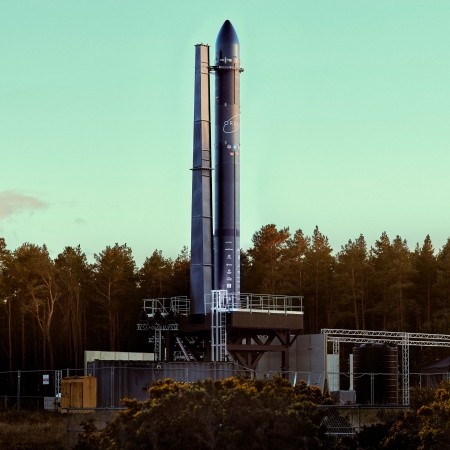
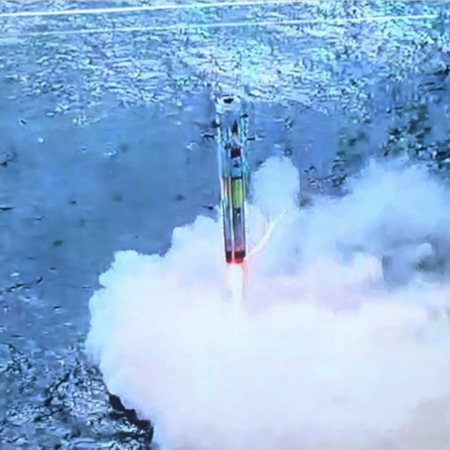
Indian rocket startup Agnikul completes static fire test of three-engine cluster

The Indian rocket startup Agnikul has now released a video of a 40-second static fire test of three-engine cluster it hopes to use on its Agnibaan orbital rocket.

The engines, powered by electric motor-driven pumps, were designed and manufactured in-house at Agnikul’s Rocket Factory-1. All three were fully 3D-printed as single-piece hardware units, reflecting the startup’s focus on advanced manufacturing and indigenous engineering.

Co-founder and chief executive Srinath Ravichandran said that increasing the number of engines improves rocket performance and that a three-engine system is required for commercial missions. The clustered test involved calibrating six pumps and six motors and fine-tuning six independent speed control algorithms to function in synchronisation. The goal was to achieve uniform startup, steady-state operation and shutdown performance across all three engines, a technically complex process given the precision required in semi-cryogenic propulsion systems.

The company has completed one suborbital test launch in May 2024, and in September 2025 said its orbital rocket’s first stage will land vertically and be reused.

Agnikul however has not released any schedule for launch, and based on this static fire test appears years from a first launch. It is making progress, but slowly. At the same time, it says it has raised $500 million in private investment capital, giving it the resources to build the rocket.

Based on testing and published progress, Agnikul appears to be trailing India’s other rocket startup Skyroot, though this could change in the coming year.

0 comments

Rocket Lab completes in-space commissioning of two Escapade Mars orbiters

Built by Rocket Lab for NASA and launched in November 2025, the company has now completed the in-space commissioning of two Escapade Mars orbiters and is about to hand operations over to the University of California Berkeley Space Sciences Laboratory (UC-Berkeley).

With both spacecraft now fully commissioned and successfully operating at the Earth–Sun Lagrange Point 2 (L2), Rocket Lab is preparing to hand over operational control to [UC-Berkeley], who will lead science operations at L2 and prepare the mission for its cruise to Mars.

Under contract from [UC-Berkeley], Rocket Lab was selected to design, build, and provide commissioning operations of the two high delta-V Explorer-class interplanetary spacecraft for ESCAPADE. Rocket Lab moved from concept to launch readiness in just over three years, proving commercial collaboration can deliver important science key to supporting future human and robotic exploration of Mars on ambitious schedules and for significantly smaller budgets than typical interplanetary missions. This speed was made possible through Rocket Lab’s vertically integrated spacecraft production, with key components including solar arrays, reaction wheels, propellant tanks, star trackers, radios, avionics, and flight software designed and built in-house.

Launched from Cape Canaveral Space Force Station in November 2025, the twin ESCAPADE spacecraft, known as Blue and Gold, completed spacecraft commissioning and executed two precise trajectory correction maneuvers, placing both spacecraft into their loiter trajectory near L2, approximately 1.5 million kilometers from Earth.

Both spacecraft will be sent on their way to Mars in December 2026 when orbital mechanics between the Red Planet and Earth are right for the journey. Once in Mars orbit the two orbiters will allow for a three-dimensional study of the interaction between the solar wind and Mars’ atmosphere.

Though this is a NASA-funded mission, note that it was built a commercial company and operated not by NASA but by a university. For this reason, it was not only built fast and at a low cost, it uses an innovative flight path that allowed it to be launched anytime and wait in orbit for the right moment to go to Mars. This last innovation provides for a lot more flexibility.

1 comment

Conscious Choice cover

Now available in hardback and paperback as well as ebook!

From the press release: In this ground-breaking new history of early America, historian Robert Zimmerman not only exposes the lie behind The New York Times 1619 Project that falsely claims slavery is central to the history of the United States, he also provides profound lessons about the nature of human societies, lessons important for Americans today as well as for all future settlers on Mars and elsewhere in space.

 
Conscious Choice: The origins of slavery in America and why it matters today and for our future in outer space, is a riveting page-turning story that documents how slavery slowly became pervasive in the southern British colonies of North America, colonies founded by a people and culture that not only did not allow slavery but in every way were hostile to the practice.  
Conscious Choice does more however. In telling the tragic history of the Virginia colony and the rise of slavery there, Zimmerman lays out the proper path for creating healthy societies in places like the Moon and Mars.


“Zimmerman’s ground-breaking history provides every future generation the basic framework for establishing new societies on other worlds. We would be wise to heed what he says.” —Robert Zubrin, founder of the Mars Society.


All editions are available at Amazon, Barnes & Noble, and all book vendors, with the ebook priced at $5.99 before discount. All editions can also be purchased direct from the ebook publisher, ebookit, in which case you don't support the big tech companies and the author gets a bigger cut much sooner.


Autographed printed copies are also available at discount directly from the author (hardback $29.95; paperback $14.95; Shipping cost for either: $6.00). Just send an email to zimmerman @ nasw dot org.

SpaceX completes its second Starlink launch today; Firefly scrubs launch

SpaceX successfully placed another 29 Starlink satellites in orbit this evening during its second launch today, its Falcon 9 rocket lifting off from Cape Canaveral Space Force Station in Florida.

The first stage completed its 26th launch, landing on a drone ship in the Atlantic.

Firefly meanwhile scrubbed its launch of its Alpha rocket due to high winds. No new launch date as yet been scheduled. This would be Firefly’s first launch since it had a launch failure in April 2025, followed by a static fire test explosion in September 2025. According to the company, this Alpha launch will be the last of this version before it begins flying an upgraded rocket.

The 2026 launch race:

27 SpaceX
8 China
2 Rocket Lab
2 Russia
1 ULA
1 Europe (Arianespace)

As it did in both ’24 and ’25, SpaceX in ’26 so far has more launches than the entire rest of the world combined.

0 comments

SpaceX launches 25 more Starlink satellites

SpaceX early this morning successfully placed another 25 Starlink satellites in orbit, its Falcon 9 rocket lifting off from Vandenberg Space Force Base in California.

The first stage completed its 20th flight, landing on a drone ship in the Pacific.

The 2026 launch race:

26 SpaceX
8 China
2 Rocket Lab
2 Russia
1 ULA
1 Europe (Arianespace)

As it did in both ’24 and ’25, SpaceX in ’26 so far has more launches than the entire rest of the world combined.

Both SpaceX and Firefly have launches scheduled for later today. The Japanese rocket startup Space One has now rescheduled the third launch attempt of its Kairos rocket for March 3, 2026.

2 comments

Leaving Earth cover

Leaving Earth: Space Stations, Rival Superpowers, and the Quest for Interplanetary Travel, can be purchased as an ebook everywhere for only $3.99 (before discount) at amazon, Barnes & Noble, all ebook vendors, or direct from my ebook publisher, ebookit.

If you buy it from ebookit you don't support the big oppressive tech companies and I get a bigger cut much sooner.


Winner of the 2003 Eugene M. Emme Award of the American Astronautical Society.

 
"Leaving Earth is one of the best and certainly the most comprehensive summary of our drive into space that I have ever read. It will be invaluable to future scholars because it will tell them how the next chapter of human history opened." -- Arthur C. Clarke

Cargo Dragon successfully returns to Earth

A cargo Dragon capsule successfully splashed down in the Pacific late Thursday, February 26, 2026, bringing back several thousand pounds of hardware and experiments.

The ship had been docked at ISS for the past six months, during which it used its engines six different times to raise the station’s orbit. That capability has traditionally been done by Russian Progress freighters, but NASA has been testing other options as they are unsure Russia will remain with the station after 2028. Furthermore, there are risks using Progress to do these reboosts, as the burns take place when Progress is docked to its Zvezda module port, and the hull of the Zvezda module has been developing stress fractures in the past five years that could catastrophically fail.

Not only has Dragon now demonstrated this boost capability, so has Northrop Grumman’s Cygnus capsule.

I strongly expect Russia to stick with ISS for as long as it can, mainly because its own proposed new space station is not likely to launch as presently scheduled later this decade. Since the fall of the Soviet Union, Roscosmos has consistently been unable to complete almost any new proposed projects, and the few it has completed launched literally decades late.

Figure 3 from September Inspector General report
Figure 3 from September 2024 Inspector General report, showing Zvezda’s location on ISS, as well as the station’s leak rate at that time. The leaks in Zvezda now appear to have been sealed, but there is no guarantee more stress fractures will not appear as dockings continue at its port.

16 comments

Rocket Lab completes another HASTE suborbital mission

Rocket Lab late yesterday successfully completed its seventh HASTE suborbital mission, using the first stage of its Electron rocket to do a hypersonic test mission for the War Department.

In this case, the test vehicle was from the Australian company Hypersonix, and it lifted off from Rocket Lab’s Electron launchpad at Wallops Island in Virginia.

This was Rocket Lab’s second flight for this particular military agency in the past three months, and its eleventh overall launch from Wallops Island. The company’s quick reconfiguration of Electron for hypersonic suborbital testing made it possible for it to capture a bulk of the military’s suborbital hypersonic testing business that others, such as Stratolaunch, had hoped to win.

2 comments

February 27, 2026 Quick space links

Courtesy of BtB’s stringer Jay. This post is also an open thread. I welcome my readers to post any comments or additional links relating to any space issues, even if unrelated to the links below.

17 comments

Mars’ fast moving gigantic lava floods

A Martian crater broken by flowing lava
Click for original image.

Cool image time! The picture to the right, rotated, cropped, and reduced to post here, was taken on December 12, 2025 by the high resolution camera on Mars Reconnaissance Orbiter (MRO).

The science team labels this a “crater interrupted by flow.” And what a flow! This unnamed 1.4-mile wide crater was not only filled and partly buried by the flow, that flow was so strong it cut through the crater’s rim at two points, refusing to let that rim block it in any way.

The flow in this case is lava, coming down from the Tharsis Bulge where four of Mars’ biggest volcanoes arose. And that flow was quite vast, as the nearest of those volcanoes, Arsia Mons, is almost 800 miles away. Because of Mars’ relative light gravity, about 39% that of Earth’s, lava on Mars can flow across large distances in a very short time. It might have only taken a few weeks for that flow to cover that 800 miles.
» Read more

7 comments
1 43 44 45 46 47 2,928