New asteroid radar images

near-Earth asteroid 2003 SD220

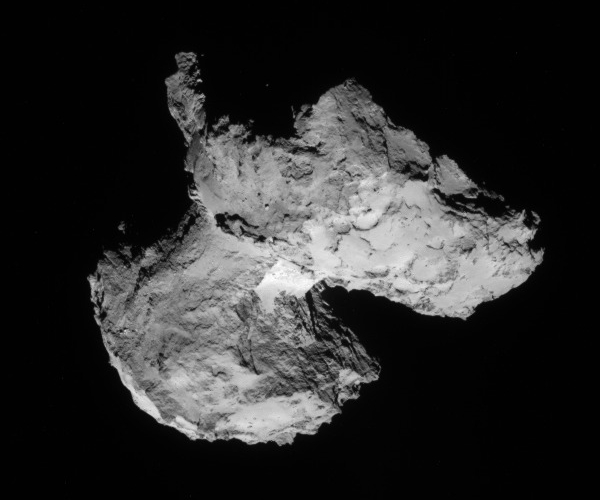
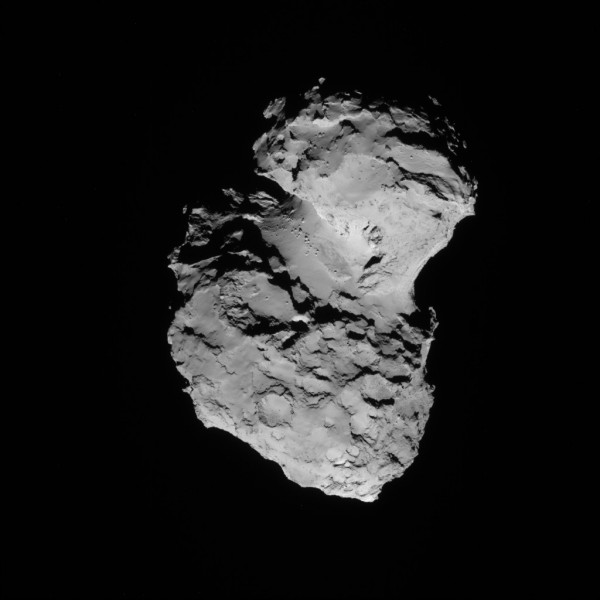
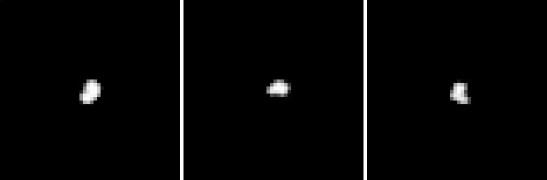
Cool radar images! The set of radar images above of near-Earth asteroid 2003 SD220 were created by combining radar data from three different radar telescopes on Earth, Arecibo in Puerto Rico, Green Bank in West Virginia, and Goldstone in California. As the press release notes:

The asteroid will fly safely past Earth on Saturday, Dec. 22, at a distance of about 1.8 million miles (2.9 million kilometers). This will be the asteroid’s closest approach in more than 400 years and the closest until 2070, when the asteroid will safely approach Earth slightly closer.

The radar images reveal an asteroid with a length of at least one mile (1.6 kilometers) and a shape similar to that of the exposed portion of a hippopotamus wading in a river.

The images have a resolution of 12 feet per pixel, so a close look should be able to reveal any large boulders, should they exist. Instead, I see a soft surface that to me resembles the surface of a sand dune, floating unattached to anything in space.

3 comments

No rotational light curve from Ultima Thule?

Data from New Horizons as it is quickly approaching Ultima Thule has found that even though the object is expected to be oblong or even two objects it has shown absolutely no variation in light as it rotates.

Even though scientists determined in 2017 that the Kuiper Belt object isn’t shaped like a sphere – that it is probably elongated or maybe even two objects – they haven’t seen the repeated pulsations in brightness that they’d expect from a rotating object of that shape. The periodic variation in brightness during every rotation produces what scientists refer to as a light curve.

“It’s really a puzzle,” said New Horizons Principal Investigator Alan Stern, of the Southwest Research Institute. “I call this Ultima’s first puzzle – why does it have such a tiny light curve that we can’t even detect it? I expect the detailed flyby images coming soon to give us many more mysteries, but I did not expect this, and so soon.”

They have several theories, all implausible, to explain this. It could be they are looking at the object’s pole. Or maybe a dust cloud or numerous tumbling moons surround the object and hide the light variation.

Fortunately, we shall have an answer to this mystery in less than two weeks, when New Horizons zips past.

12 comments

Comparing Ryugu and Bennu

Link here. As much as they are alike, which is not surprising as they both come from the same asteroid family, the article notes the surprising differences.


Both asteroids are also liberally strewn with boulders – a challenge to mission planners on each team, who hope to descend close enough to scoop up samples for return to Earth. “It’s certainly more rugged than we had expected,” Lauretta says. 

But while boulders on Ryugu look to be unpleasantly ubiquitous, Bennu’s terrain is more varied, with more-obvious places where a safe touchdown might be possible. And, Lauretta notes, the OSIRIS-REx spacecraft is only recently arrived.

“We have a long time to explore and make the crucial decisions about where to go,” he says.

The biggest difference has to do with water. Even though scientists believe them to be portions of the same parent body, which broke apart between 800 million and one billion years ago, Bennu appears to be water rich, while Ryugu is less so. Within a week of arrival, infrared spectrometers on OSIRIS-REx were finding evidence of water-bearing minerals, and not just in localised patches. “We saw this in every single one of the spectra we have taken to date,” says Amy Simon, of NASA’s Goddard Space Flight Centre in Greenbelt, Maryland. 

One of the reasons Bennu was chosen as OSIRIS-REx’s target, Lauretta says, was the hope it would be rich in water, and possibly in organic compounds.

The similarities and differences in the samples both spacecraft will bring back will be most revealing.

0 comments

New Horizons sees no hazards, will do closest fly-by of Ultima Thule

After three weeks of intense observations and seeing no significant objects orbiting close to the Kuiper Belt object Ultima Thule, the New Horizons team has decided to go for the closest fly-by on January 1, 2019.

After almost three weeks of sensitive searches for rings, small moons and other potential hazards around the object, New Horizons Principal Investigator Alan Stern gave the “all clear” for the spacecraft to remain on a path that takes it about 2,200 miles (3,500 kilometers) from Ultima, instead of a hazard-avoiding detour that would have pushed it three times farther out. With New Horizons blazing though space at some 31,500 miles (50,700 kilometers) per hour, a particle as small as a grain of rice could be lethal to the piano-sized probe.

We should begin to see more detailed images soon. Because of the speed in which New Horizons is traveling, it will not get very close until it is almost on top of Ultima Thule, so the best images will all occur over a very short span of time.

0 comments

Saturn’s rings are dying

Using new ground-based observations, scientists now predict that Saturn’s rings are dying at the fastest predicted rate, and will disappear within 300 million years, at the most.

Dr Tom Stallard, Associate Professor in Planetary Astronomy at the University of Leicester and Dr James O’Donoghue, who studied for his PhD at the University of Leicester, have found that Saturn’s rings are dying at the maximum rate estimated from Voyager 1 and 2 observations made decades ago.

The rings of ice are being pulled into Saturn by gravity as particles of ice under the influence of Saturn’s magnetic field. Dr O’Donoghue, who now works at NASA’s Goddard Space Flight Center in Greenbelt, Maryland said: “We estimate that this ‘ring rain’ drains the equivalent of an Olympic-sized swimming pool from Saturn’s rings in half an hour. The entire ring system will be gone in 300 million years.”

Dr O’Donoghue believes that the rings could even disappear quicker than this. “Add to this the Cassini-spacecraft detected ring-material falling into Saturn’s equator, and the rings have less than 100 million years to live.”

Over the decades I have read numerous papers by scientists saying that rings this bright and large must be a relatively short-lived event, and that we are lucky to have seen them. This research only reinforces this conclusion.

At the same time, we do not yet know the frequency or the cause of the events that give rise such bright rings. It could be that such rings are short-lived, but happen frequently enough that it is still not rare to see them in any solar system. And we won’t know this until we get a more complete census of many solar systems, seen up-close.

6 comments

Astronomers discover most distant solar system object so far

Worlds without end: Astronomers have discovered a dwarf planet about 300 miles in diameter orbiting the Sun at a distance of 120 astronomical units, making it the most distant solar system object discovered so far.

“2018 VG18 is much more distant and slower moving than any other observed Solar System object, so it will take a few years to fully determine its orbit,” said Sheppard. “But it was found in a similar location on the sky to the other known extreme Solar System objects, suggesting it might have the same type of orbit that most of them do. The orbital similarities shown by many of the known small, distant Solar System bodies was the catalyst for our original assertion that there is a distant, massive planet at several hundred AU shepherding these smaller objects.”

“All that we currently know about 2018 VG18 is its extreme distance from the Sun, its approximate diameter, and its color,” added Tholen “Because 2018 VG18 is so distant, it orbits very slowly, likely taking more than 1,000 years to take one trip around the Sun.”

I guarantee there are more of these discoveries to come. Many more.

4 comments

OSIRIS-REx finds evidence of water on Bennu

Bennu from 15 miles

One of OSIRIS-REx’s instruments has now found evidence of water on the rubble-pile asteroid Bennu.

Recently analyzed data from NASA’s Origins, Spectral Interpretation, Resource Identification, Security-Regolith Explorer (OSIRIS-REx) mission has revealed water locked inside the clays that make up its scientific target, the asteroid Bennu.

During the mission’s approach phase, between mid-August and early December, the spacecraft traveled 1.4 million miles (2.2 million km) on its journey from Earth to arrive at a location 12 miles (19 km) from Bennu on Dec. 3. During this time, the science team on Earth aimed three of the spacecraft’s instruments towards Bennu and began making the mission’s first scientific observations of the asteroid. OSIRIS-REx is NASA’s first asteroid sample return mission.

Data obtained from the spacecraft’s two spectrometers, the OSIRIS-REx Visible and Infrared Spectrometer (OVIRS) and the OSIRIS-REx Thermal Emission Spectrometer (OTES), reveal the presence of molecules that contain oxygen and hydrogen atoms bonded together, known as “hydroxyls.” The team suspects that these hydroxyl groups exist globally across the asteroid in water-bearing clay minerals, meaning that at some point, Bennu’s rocky material interacted with water. While Bennu itself is too small to have ever hosted liquid water, the finding does indicate that liquid water was present at some time on Bennu’s parent body, a much larger asteroid.

The image on the right, reduced to show here, was created from 12 images taken on December 2, 2018 from about 15 miles. If you click on the image you can see the full resolution photograph, which is quite incredible. While the asteroid’s shape is approximately what was expected from ground-based observations and computer modeling, the giant boulder on the limb on the bottom right is about four times bigger than expected.

0 comments

New Horizons completes another course correction before flyby

On December 2 New Horizons successfully completed another engine burn to refine its course for its January 1, 2019 flyby of the Kuiper Belt object Ultima Thule.

The maneuver was designed to keep New Horizons on track toward its ideal arrival time and closest distance to Ultima, just 2,200 miles (3,500 kilometers) at 12:33 a.m. EST on Jan. 1. At the time of the burn New Horizons was 4.03 billon miles (6.48 billion kilometers) from Earth and just 40 million miles (64 million kilometers) from Ultima – less than half the distance between Earth and the Sun. From that far away, the radio signals carrying data from the spacecraft needed six hours, at light speed, to reach home.

The team is analyzing whether to conduct up to three other course-correction maneuvers to home in on Ultima Thule.

The distance to Ultima Thule is still too much to produce detailed images. New Horizons however is going very fast, so in the coming three weeks this will change drastically, and for the better.

0 comments

Calculating Bennu’s future

In order to better constrain Bennu’s future fly-bys of the Earth, including the possibility that it could impact the planet, scientists will be using the data sent from OSIRIS-REx to better understand its orbit, its composition, its surface make-up, and its thermal properties, all factors that can influence its future path in space.

This is really important, as Bennu has a good chance of hitting the Earth in the future.

About a third of a mile, or half a kilometer, wide, Bennu is large enough to reach Earth’s surface; many smaller space objects, in contrast, burn up in our atmosphere. If it impacted Earth, Bennu would cause widespread damage. Asteroid experts at the Center for Near-Earth Object Studies (CNEOS) at NASA’s Jet Propulsion Laboratory in Pasadena, California, project that Bennu will come close enough to Earth over the next century to pose a 1 in 2,700 chance of impacting it between 2175 and 2196. Put another way, those odds mean there is a 99.963 percent chance the asteroid will miss the Earth. Even so, astronomers want to know exactly where Bennu is located at all times.

The article provides a good overview of the difficulty of properly calculating Bennu’s orbit into the future, and how the data from OSIRIS-REx will help make those calculations more precise.

4 comments

OSIRIS-REx at Bennu

OSIRIS-REx has successfully completed its last maneuver engine burn to place it in proximity orbit around the asteroid Bennu.

The link takes you to the live NASA stream, which has been a bit hokey. This event is actually not that visually exciting, a bunch of engineers staring at computer screens awaiting data back from the spacecraft indicating that all has occurred as planned. In fact, some felt a bit staged, though the actual event was really happening.

The OSIRIS-REx team has released relatively little data so far, compared to most NASA missions. There will be a press conference in a week when they say they will release more information. I guess we will have to wait until then.

Update: the live stream has shifted to the docking of the manned Soyuz capsule at ISS, which is in itself a more riveting event than OSIRIS-REx’s last engine burn.

0 comments

Bennu from 85 miles

Bennu at 85 miles

The OSIRIS-REx science team today released a new image of Bennu, taken by the spacecraft from only 85 miles on November 16, two weeks ago Its contrast has been increased to bring out the details.

The asteroid continues to remind me of Ryugu, a rubble pile of boulders with few smooth spots. I suspect the OSIRIS-REx engineers are going to struggle as much as the Hayabusa-2 engineers are in an effort to find a safe spot to grab a sample. The advantage however for OSIRIS-REx is that the main body of the spacecraft doesn’t have to get as close to the surface as with Hayabusa-2. They will come down only close enough for the robot arm to touch down.

Rendezvous is set for December 3.

2 comments
1 31 32 33 34 35 78