Hayabusa-2 takes first photos of target asteroid Ryugu

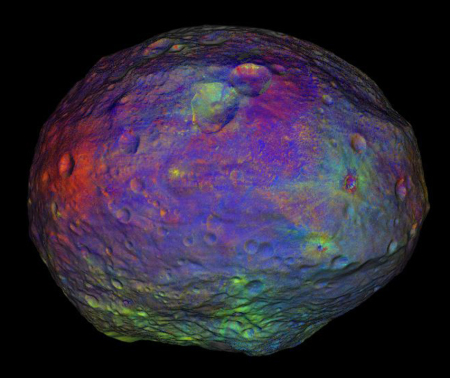
On June 10 Hayabusa-2 took its first photos of Ryugu, the asteroid it will reach later this month.

The Sunday photos were taken when Hayabusa2 was about 930 miles (1,500 kilometers) from Ryugu. Last week, JAXA released a few ONC-T images taken on June 6, when the probe was 1,615 miles (2,600 km) from the space rock.

Hayabusa2, which launched in December 2014, is scheduled to arrive at Ryugu on or around June 27. At that time, the probe will begin orbiting the asteroid at an altitude of about 12 miles (20 km), JAXA officials have said.

Hayabusa2 will then start prepping for a series of complex, up-close studies of the space rock. If all goes according to plan, over the ensuing 12 months, the spacecraft will deploy three rovers and a lander on Ryugu’s surface, gouge out a small crater using an explosives-bearing impactor, and collect samples from the newly created crater.

The spacecraft will depart Ryugu in November or December 2019, and its collected samples will come back to Earth in a special return capsule in late 2020.

The image suggests that the asteroid is “not significantly elongated.”

0 comments

No giant planet needed in Kuiper Belt to shape orbits of outer known planets

Using computer models astronomers have found that the tiny objects in the Kuiper Belt could be sufficient, instead of one giant undiscovered planet, to provide the gravity necessary to explain the orbits of the solar system’s outer planets.

They call theorized giant planet “Planet Nine,” which seems silly since Pluto really still fills that role. Nonetheless, this work also might explain the process that flung some surprisingly large objects so far out into the Kuiper Belt.

They ran supercomputer simulations of how bodies might interact in the outer Solar System far beyond Pluto, in the icy region known as the Kuiper belt. They found that a flock of Moon-sized worlds could do many of the same things as Planet Nine.

Over millions of years, the collective gravity of these smaller worlds would nudge the orbits of distant objects. The worlds would jostle one another like bumper cars and, occasionally, cause an object to move into a very distant orbit. Their simulations suggest that more-massive objects would be flung into the most distant orbits โ€” as some observations have suggested.

We must also remind ourselves that this conclusion is based on a computer model, and is filled with uncertainty. We also do not yet have a full census of objects in the Kuiper Belt, which means this model required many assumptions.

0 comments

Boulder-sized asteroid discovered just before it hit Earth

The Catalina Sky Survey, designed to find asteroid with the potential of hitting the Earth, discovered a boulder-sized such asteroid this past weekend just hours before it burned up in the atmosphere.

Although there was not enough tracking data to make precise predictions ahead of time, a swath of possible locations was calculated stretching from Southern Africa, across the Indian Ocean, and onto New Guinea. Reports of a bright fireball above Botswana, Africa, early Saturday evening match up with the predicted trajectory for the asteroid. The asteroid entered Earth’s atmosphere at the high speed of 10 miles per second (38,000 mph, or 17 kilometers per second) at about 16:44 UTC (9:44 a.m. PDT, 12:44 p.m. EDT,6:44 p.m. local Botswana time) and disintegrated several miles above the surface, creating a bright fireball that lit up the evening sky. The event was witnessed by a number of observers and was caught on webcam video.

When it was first detected, the asteroid was nearly as far away as the Moon’s orbit, although that was not initially known. The asteroid appeared as a streak in the series of time-exposure images taken by the Catalina telescope . As is the case for all asteroid-hunting projects, the data were quickly sent to the Minor Planet Center in Cambridge, Massachusetts, which calculated a preliminary trajectory indicating the possibility of an Earth impact. The data were in turn sent to the Center for Near-Earth Object Studies (CNEOS) at NASA’s Jet Propulsion Laboratory in Pasadena, California, where the automated Scout system also found a high probability that the asteroid was on an impact trajectory. Automated alerts were sent out to the community of asteroid observers to obtain further observations, and to the Planetary Defense Coordination Office at NASA Headquarters in Washington. However, since the asteroid was determined to be so small and therefore harmless, no further impact alerts were issued by NASA.

The video at the link makes it appear that the asteroid has hit the ground, but that is not what happened.

0 comments

The surface properties of 122 asteroids revealed

Using archive data produced by the Wide-field Infrared Explorer telescope (WISE, renamed NEOWISE) astronomers have been able to estimate the surface properties of 122 small asteroids located in the asteroid belt.

“Using archived data from the NEOWISE mission and our previously derived shape models, we were able to create highly detailed thermophysical models of 122 main belt asteroids,” said Hanuลก, lead author of the paper. “We now have a better idea of the properties of the surface regolith and show that small asteroids, as well as fast rotating asteroids, have little, if any, dust covering their surfaces.” (Regolith is the term for the broken rocks and dust on the surface.)

It could be difficult for fast-rotating asteroids to retain very fine regolith grains because their low gravity and high spin rates tend to fling small particles off their surfaces and into space. Also, it could be that fast-rotating asteroids do not experience large temperature changes because the sun’s rays are more rapidly distributed across their surfaces. That would reduce or prevent the thermal cracking of an asteroid’s surface material that could cause the generation of fine grains of regolith. [emphasis mine]

If this conclusion holds, it means that mining these asteroids might be much easier. Dust can be a big problem, as it can clog up equipment and interfere with operations. It also acts to hide the underlying material, making it harder to find the good stuff.

0 comments

Pluto formed from a billion comets?

Scientists have come up with a new theory for the origin of Pluto, based on data from New Horizons and Rosetta, that suggests the planets formed from the accretion of a billion comets or Kuiper Belt objects.

โ€œWeโ€™ve developed what we call โ€˜the giant cometโ€™ cosmochemical model of Pluto formation,โ€ said Dr. Christopher Glein of SwRIโ€™s Space Science and Engineering Division. The research is described in a paper published online today in Icarus. At the heart of the research is the nitrogen-rich ice in Sputnik Planitia, a large glacier that forms the left lobe of the bright Tombaugh Regio feature on Plutoโ€™s surface. โ€œWe found an intriguing consistency between the estimated amount of nitrogen inside the glacier and the amount that would be expected if Pluto was formed by the agglomeration of roughly a billion comets or other Kuiper Belt objects similar in chemical composition to 67P, the comet explored by Rosetta.โ€

This is only a hypothesis, but it is intriguing. It suggests that Pluto’s make-up came only from the outer parts of the solar system, thus constraining how much mixing between the solar system’s inner and outer regions occurred. For scientists trying to understand the formation of the entire solar system, this lack of mixing would be significant. It means that the gas giants, while migrating inward, never migrated outward.

5 comments

Why jets formed on Comet 67P/C-G

Scientists analyzing the data produced by Rosetta while it was flying in formation with Comet 67P/C-G have determined that the comet’s complex topology acted almost like nozzles to encourage evaporating material to form jets.

The new study shows for the first time that mainly the unusual shape and jagged topography of the comet are responsible for this phenomenon. The researchers analyzed images at different observation geometries of the Hapi region located on the “neck” of the comet, the narrow part connecting its two lobes. In computer simulations, they were able to reproduce these images thus gaining a better understanding of the driving processes.

In particular, two effects proved to be decisive. Some regions on the surface are located at lower altitudes or in the shade. The first rays of sunlight reach them later. In contrast, the frost evaporates particularly efficiently from the early and strongly illuminated regions. In addition, pits and other concave structures virtually concentrate gas and dust emissions – much like an optical lens.

This means that predicting the evaporation patterns on other comets will require first obtaining a detailed map of the surface, showing both its topography and make-up. This also means that any future explorers will first have to send a robot scouting mission so that they can plan a safe arrival during active periods.

1 comment

Asteroid that formed in the inner solar system discovered in Kuiper Belt

Astronomers have discovered a carbonaceous asteroid in the distant Kuiper Belt beyond Pluto, even though it likely formed in the inner solar system.

The asteroid’s existence serves to confirm models of the solar system’s formation that say that the orbits of gas giants migrate inward and outward during the formation process, and as they do so they can fling material out of the inner solar system. This asteroid is the first evidence of this process.

At the same time, the data here is quite slim. They have only found one such asteroid. It could be that it was flung into the Kuiper Belt by other processes. If the formation model is correct, many more such Kuiper Belt asteroids will be eventually be found.

0 comments

Diamonds from space!

Researchers have discovered nano-sized diamonds inside a recovered meteorite that suggest a formation process deep within a planet at least the size of Mercury.

The researchers used transmission electron microscopes to determine their composition and morphology, and found that the diamonds contained inclusions (impurities) made of chromite, phosphate and iron-nickel sulfides.

These inclusions are common in diamonds formed underground here on Earth, but this marks the first time they’ve been found in alien rocks. That’s interesting enough on its own, but it has much bigger implications โ€“ the team calculated that these diamonds could only have formed under pressure of more than 20 gigapascals. That means they must have been born inside a planet at least as big as Mercury, and possibly up to the size of Mars.

But there’s still more to the story. The fact these diamonds made it to Earth implies that their home planet, whatever it may have been, is no longer with us, since it would take quite a cataclysm to wrench them out of their birthplace deep underground and fling them into space. Instead, the team believes the diamonds came from a planetary embryo.

Not so fast. Though the researchers themselves, in the released paper, assume that the diamonds could only have formed from inside a now destroyed large planet, this leaves out the possibility that the diamonds formed inside one of the existing terrestrial planets, were moved upward toward the surface by later geological process (as happens to diamonds are here on Earth), and then were thrown from the planet by a later nearby impact. This scenario is just as likely.

Nonetheless, this discovery is fascinating. More than anything, it illustrates the inconceivable amount of time that has passed in creating our solar system. Any of these scenarios requires time, time in quantities that no human can really understand or conceptualize.

2 comments

Star’s close approach 70,000 years ago pinned to cometary orbits

Astronomers now think they have pinned the orbits of about 340 comets to another star’s close approach to our solar system 70,000 years ago.

About 70,000 years ago, when the human species was already on Earth, a small reddish star approached our solar system and gravitationally disturbed comets and asteroids. Astronomers from the Complutense University of Madrid and the University of Cambridge have verified that the movement of some of these objects is still marked by that stellar encounter. At a time when modern humans were beginning to leave Africa and the Neanderthals were living on our planet, Scholz’s star – named after the German astronomer who discovered it – approached less than a light-year from the Sun. Nowadays it is almost 20 light-years away, but 70,000 years ago it entered the Oort cloud, a reservoir of trans-Neptunian objects located at the confines of the solar system.

This discovery was made public in 2015 by a team of astronomers led by Professor Eric Mamajek of the University of Rochester (USA). The details of that stellar flyby, the closest documented so far, were presented in The Astrophysical Journal Letters.

Now two astronomers from the Complutense University of Madrid, the brothers Carlos and Raรบl de la Fuente Marcos, together with the researcher Sverre J. Aarseth of the University of Cambridge (United Kingdom), have analyzed for the first time the nearly 340 objects of the solar system with hyperbolic orbits (very open V-shaped, not the typical elliptical), and in doing so they have detected that the trajectory of some of them is influenced by the passage of Scholzยดs star.

It is likely that the close approach influenced a lot more objects, many of which might not have yet arrived in the inner solar system. Moreover, their computer models suggest that the star might have come closer to the Sun than 0.6 light years.

8 comments

Scientists theorize that Oumuamua came from a binary star system

Based on statistics and computer modeling, some scientists believe that the interstellar object Oumuamau likely came from stellar binary system.

For the new study, published in the journal Monthly Notices of the Royal Astronomical Society, Jackson and his co-authors set about testing how efficient binary star systems are at ejecting objects. They also looked at how common these star systems are in the Galaxy. They found that rocky objects like ‘Oumuamua are far more likely to come from binary than single star systems. They were also able to determine that rocky objects are ejected from binary systems in comparable numbers to icy objects.

Their conclusion does make sense, though any good scientist would retain a gigantic sense of skepticism. While it is statistically reasonable to conclude that a majority of interstellar objects should come from binary systems, there is no guarantee that Oumuamua in particular did so. Even if the odds were one in a million, there is always that one, and the universe often seems prone to fooling us.

1 comment

Dawn finds recent changes on Ceres

New data from Dawn has found at least one spot on Ceres where recent changes appear to have occurred on the surface.

Observations obtained by the visible and infrared mapping spectrometer (VIR) on the Dawn spacecraft previously found water ice in a dozen sites on Ceres. The new study revealed the abundance of ice on the northern wall of Juling Crater, a crater 12 miles (20 kilometers) in diameter. The new observations, conducted from April through October 2016, show an increase in the amount of ice on the crater wall. “This is the first direct detection of change on the surface of Ceres,” said Andrea Raponi of the Institute of Astrophysics and Planetary Science in Rome.

Raponi led the new study, which found changes in the amount of ice exposed on the dwarf planet. “The combination of Ceres moving closer to the sun in its orbit, along with seasonal change, triggers the release of water vapor from the subsurface, which then condenses on the cold crater wall. This causes an increase in the amount of exposed ice. The warming might also cause landslides on the crater walls that expose fresh ice patches.”

There is a certain irony here. For eons, the only alien body that humans were able to get a good look at, the Moon, was also an object where almost nothing changed. Even today, after humans have visited its surface and numerous orbiting spacecraft have photographed its surface in numbing detail, the Moon has generally been found to be stable and unchanging. Though impacts do occur, and the surface does evolve over time, the Moon is probably one of the most static bodies in the solar system.

The irony is that this lunar stability gave us an incorrect impression of the rest of the solar system. Based on the Moon, it was assumed that airless or almost airless bodies like Mercury, Mars, Pluto, the large moons of Jupiter and Saturn, and asteroids like Ceres would also be stable and unchanging. What we have instead found is that the Moon is the exception that proves the rule. Most of these other worlds are unlike the Moon. They show a lot of surface evolution, over relatively short time scales. They change.

0 comments
1 37 38 39 40 41 78