3D image of Comet 67P/C-G

Do you own red-blue 3-D glasses? Get them out and go to this link. Rosetta scientists have created a 3-D image of Comet 67P/C-G, including the jets of material shooting out from its surface.

[C]reating a 3d anaglyph of dynamic events like this is notoriously difficult: often the jets are too faint or their duration is too short to find two high-quality images taken several minutes apart that are suitable to pair together to create this type of view. However, the OSIRIS team got lucky with this particular event, capturing two images separated by about two-and-a-half minutes.

The image shows a bright, collimated jet embedded in a broader emission structure. The three dimensional perspective also reveals the conical shape of the jet and that the collimated feature is emitted towards the observer.
0 comments

Sunlight rolled the rocks on an asteroid

Scientists studying the rounded rocks on the surface of the asteroid 25143 Itokawa, photographed by the Japanese probe Hayabusa, have concluded that sunlight combined with the asteroid’s tiny gravity caused them move and thus erode themselves.

As sunlight bounced off the orbiting boulders, photons provided a tiny push. As they radiated back outward as heat, they triggered a recoil effect that added a gentle spin. Over time, these slowly spinning boulders bumped into each other with enough force to wear their edges into smooth surfaces.

Warning! This is only a model, and thus could very well be wrong. It is reasonable however and worth considering as a factor in studying the early formation history of asteroids.

0 comments

A new map of Ceres

The Dawn science team has released several new false color maps of Ceres, showing the dwarf planet’s topographic and compositional differences.

They have also assigned names to many of the features that Dawn has discovered, including Ysolo Mons for that large peak near the north pole.

0 comments

NASA pulls funding from private asteroid hunter

Because of a failure to meet its developmental deadlines, NASA has cut its ties with the privately funded Sentinel satellite, designed to spot 90% of all near Earth asteroids that might pose a threat to the Earth.

The problem for the B612 Foundation, the private company committed to building Sentinel, is that they haven’t clearly laid out a way any investors could make money from the satellite. Thus, they have so far raised only $1.6 million from private sources. They need almost half a billion to build it, according to their own budget numbers.

1 comment

Changes on the surface of Comet 67P/C-G

In a science paper now accepted for publication, the Rosetta science team have described changes that have occurred on the surface of Comet 67P/C-G from May through July of this year as the comet moved closer to the Sun and activity increased.

The changes were seen in a smooth area dubbed Imhotep.

First evidence for a new, roughly round feature in Imhotep was seen in an image taken with Rosetta’s OSIRIS narrow-angle camera on 3 June. Subsequent images later in June showed this feature growing in size, and being joined by a second round feature. By 2 July, they had reached diameters of roughly 220 m and 140 m, respectively, and another new feature began to appear.

By the time of the last image used in this study, taken on 11 July, these three features had merged into one larger region and yet another two features had appeared.

Be sure to click on the link to see the images. The changes look like a surface layer is slowing evaporating away.

1 comment

Rivers and lakes on Pluto?

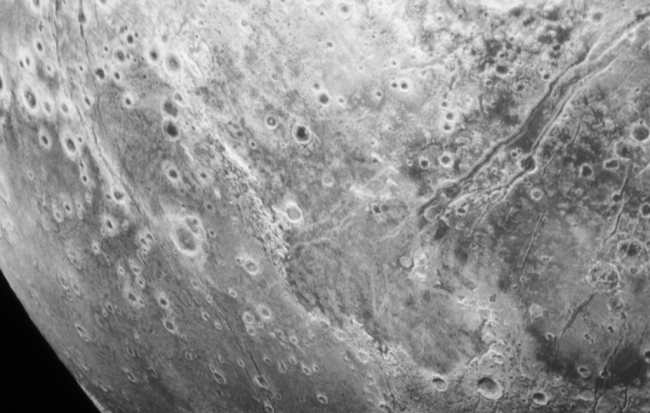
Cool image time! Though the New Horizons science team will likely not issue their next press release until Friday, they appear to be posting new images on their website on a daily basis. From those images I pulled out the one below, which to fit I have cropped and reduced slightly in size. Be sure to go to the full image.

Do you see what I see? It appears that there are meandering braided dry streambeds on Pluto, draining into what appears to be a large basin.

Rivers and lakes on Pluto?

Assuming my guess of what this is is correct, this is obviously not a streambed created by water. Earlier images showed nitrogen ice flows and glacier-like geology. It is possible this new image is observing evidence of past nitrogen riverbeds and nitrogen lakes.

Expect a very interesting press release from New Horizons later this week.

0 comments

Closing in on Ceres’s bright spots

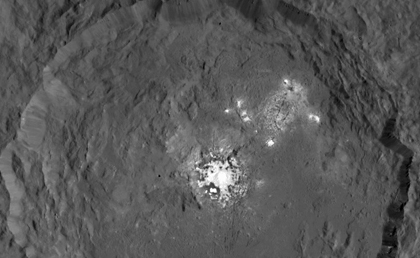
Ceres's bright spots

Cool image time! The Dawn science team has released a new close-up of Ceres’s Double Bright Spot.

The new up-close view of Occator crater from Dawn’s current vantage point reveals better-defined shapes of the brightest, central spot and features on the crater floor. Because these spots are so much brighter than the rest of Ceres’ surface, the Dawn team combined two different images into a single composite view — one properly exposed for the bright spots, and one for the surrounding surface.

They have also released a detailed topographic map of the crater as well as a fly-around video, which I have posted below the fold. The interesting take-away from this new data is that, while the bright spots look at first glance remarkably like the snow-cap on a mountain-top, they are actually at the low spots in the crater. This suggests that they are instead material that has either bubbled up from below, or flowed downward to the crater bottom.

Be sure you click on the link and look at the full resolution image.
» Read more

0 comments

Data from New Horizons does not match what is seen from Earth

The uncertainty of science: Planetary geologists are presently baffled by a conflict in the atmospheric data between New Horizons and data gathered from Earth.

On 29 June, a few weeks before the fly-by, Young organized astronomers across New Zealand and Australia to watch Pluto as it passed in front of a distant star. Tracking how the star’s light faded during the passage provided information on how much gas is in Pluto’s atmosphere. Using the same method, planetary scientists have seen the atmosphere grow denser since 1988 — and analysis of the 29 June observations shows that the trend remains intact. Young calculates that the current atmospheric pressure at Pluto’s surface is 22 microbars (0.022 pascals), or 22-millionths the pressure at sea level on Earth.

But on 14 July, New Horizons measured Pluto’s surface pressure as much lower than that ­— just 5 microbars. “How we link the two, we’re still working on,” says Cathy Olkin, a deputy project scientist for New Horizons at SwRI.

The difference could simply be that Pluto’s atmosphere is not smooth, that some regions are dense while others are thin, and New Horizons happened to look at a thin place. The Earth observations don’t have the resolution to separate the two.

There are other proposals to explain the problem. Regardless, the answer is likely hidden in the data from New Horizons that has still not been downloaded back to Earth. In a few months, all might very well become clear.

Or not, as is the natural state of science.

0 comments

New Horizons team picks its next Kuiper Belt target

The New Horizons science team has picked its next Kuiper Belt fly-by target beyond Pluto.

New Horizons will perform a series of four maneuvers in late October and early November to set its course toward 2014 MU69 – nicknamed “PT1” (for “Potential Target 1”) – which it expects to reach on January 1, 2019. Any delays from those dates would cost precious fuel and add mission risk. “2014 MU69 is a great choice because it is just the kind of ancient KBO, formed where it orbits now, that the Decadal Survey desired us to fly by,” said New Horizons Principal Investigator Alan Stern, of the Southwest Research Institute (SwRI) in Boulder, Colorado. “Moreover, this KBO costs less fuel to reach [than other candidate targets], leaving more fuel for the flyby, for ancillary science, and greater fuel reserves to protect against the unforeseen.”

The press release includes some silly gobbly-gook about how the science team can’t announce this as its official target because they still have to write up a proposal to submit to NASA, which then must ponder their decision and decree it valid. We all know this is ridiculous. Will NASA sit and ponder and make them miss their target? I doubt it.

The fly-by itself will be really exciting, because this object will truly be the most unusual we will have ever gotten a close look at, as it has spent its entire existence far out in the dim reaches of the solar system.

7 comments

New sharp images of Ceres from Dawn

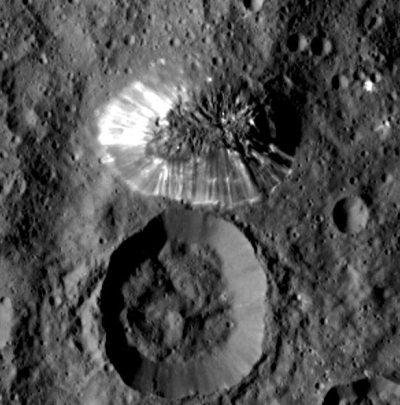
The Lonely Mountain on Ceres/>

Cool image time! The Dawn science team has released new images of Ceres, including one of a single mountain they have dubbed the Lonely Mountain.

The mountain, located in the southern hemisphere, stands 4 miles (6 kilometers) high. Its perimeter is sharply defined, with almost no accumulated debris at the base of the brightly streaked slope with bright streaks. The image was taken on August 19, 2015. The resolution of the image is 450 feet (140 meters) per pixel.

I have cropped the image and posted it on the right. Be sure to look at the full resolution version. Not only does the mountain have no debris at its base, it truly is lonely. There are no similar features anywhere near it. It almost looks like someone took a shovel of material out of the ground to create the crater immediately to the south and then dumped that material to create the mountain.

Note that the mountain is more like a mesa, with a flat top, which suggests it is the remains of a higher elevation surface that eroded away in the distant past. The geological processes that could have done this however remain quite puzzling at this point.

10 comments

Haze spotted over Ceres’ double bright spot

Dawn, in orbit around Ceres, has detected a haze above the dwarf planet’s double bright spot, suggesting that the tiny asteroid/planet is still geologically active.

Haze on Ceres would be the first ever observed directly in the asteroid belt. In 2014, researchers using the European Space Agency’s Herschel Space Observatory reported seeing water vapour spraying off Ceres, which suggested that it was geologically active1. At least one-quarter of Ceres’s mass is water, a much greater proportion than seen in most asteroids.

Bright spots pepper Ceres’s surface, but the haze has so far been seen in only one location — a crater named Occator, which has a large bright area at its centre and several smaller spots nearby. Mission scientists have been trying to work out whether the bright spots are made of ice, evaporated salts or other minerals, or something else entirely.

Some team members had been leaning towards the salt explanation, but the discovery of haze suggests the presence of sublimating ice. “At noontime, if you look at a glancing angle, you can see what seems to be haze,” Russell says. “It comes back in a regular pattern.” The haze covers about half of the crater and stops at the rim.

0 comments
1 46 47 48 49 50 78