New studies struggle to explain the origin of the Moon

The uncertainty of science: Three new studies on the mystery of the origin of the Moon all appear to better confirm the theory that it was created when the Earth collided with a Mars-sized planet.

It is important to be aware of the uncertainties here. All these studies were done to try to address problems with the impact theory, and though they kind of answer the questions, they leave behind some important doubts.

0 comments

ALMA captures the rotation of the large asteroid Juno

The large ground-based telescope ALMA has captured a series of images of the large asteroid Juno, allowing scientists to estimate its rotation and overall shape.

Linked together into a brief animation, these high-resolution images show the asteroid rotating through space as it shines in millimeter-wavelength light. “In contrast to optical telescopes, which capture the reflected light from the Sun, the new ALMA images show the actual millimeter-wavelength light emitted by the asteroid,” said Todd Hunter, an astronomer with the National Radio Astronomy Observatory (NRAO) in Charlottesville, Va.

…The complete ALMA observation, which includes 10 separate images, documents about 60 percent of one rotation of the asteroid. It was conducted over the course of four hours on 19 October 2014 when Juno was approximately 295 million kilometers from Earth. In these images, the asteroid’s axis of rotation is tilted away from the Earth, revealing its southern hemisphere most prominently.

0 comments

Dawn’s chief engineer gives us a detailed update

Link here. Chief engineer Marc Rayman loves to write about Dawn, and his posts on the Dawn blog are probably the most information-packed of any spacecraft blog I have ever read. Key quote this time:

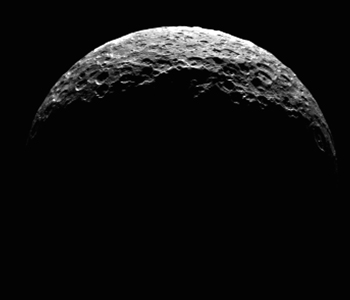
Dawn’s extensive photographic coverage of the sunlit terrain in early May will include these bright spots. They will not be in view, however, when Dawn spies the thin crescent of Ceres in its next optical navigation session, scheduled for April 10.

The orientation of the spacecraft and asteroid now are such that there is no point taking pictures, as most of the asteroid is in darkness.

Read it all, however. He gives a masterful overview of what is going to happen in the coming months.

1 comment

NASA has decided to grab an asteroid rock rather than bag an asteroid

Rather than try to bag an entire small asteroid with an unmanned probe and bring that back to Earth, NASA has decided to send an unmanned probe into orbit around an asteroid and use it to grab one of the asteroid’s boulders.

The $1.25 billion mission, which is planned to launch in December 2020, would send a robotic spacecraft for a rendezvous with an asteroid in 2022. After touching down on the asteroid’s surface, the spacecraft would snatch a boulder several meters across. The spacecraft would then orbit the asteroid for up to 400 days, testing out an idea for defending Earth from a catastrophic asteroid impact: using the spacecraft’s own gravitational field to subtly alter the asteroid’s orbit. Next, the spacecraft would bring the snatched rock back to Earth’s vicinity in 2025. Finally, as part of preparations for a possible mission to Mars, astronauts would visit and examine the rock for some 25 days, using the planned Orion spacecraft to make the trip.

From both a science perspective as well as a manned space perspective, the unmanned part of this plan is a very good idea. Whether it will get funded depends upon Congress, since its roots go back to President Obama’s April 2010 commitment to send astronauts to an asteroid by 2025. Such a commitment was never really realistic, so it has devolved to capturing a rock and sending astronauts to visit it, thus meeting Obama’s commitment in a Potemkin Village sort of way.

Much better to bring the rock back to Earth orbit where it can be captured and brought to ISS by any number of vehicles and studied there. Whether Congress will fund this in the manner proposed in order to help Obama meet his commitment however remains very doubtful.

Posted from Santa Barbara, California.

3 comments

Water ice volcanoes on Ceres

Data collected by Dawn since it entered orbit around Ceres on March 6 now strongly suggests that the bright spots on the surface are produced by venting water,

Andreas Nathues, principal investigator for Dawn’s framing camera, says the feature has spectral characteristics that are consistent with ice. Intriguingly, the brightness can be seen even when the spacecraft is looking on edge at the crater rim, suggesting that the feature may be outgassing water vapor above the rim and into space. “Ceres seems to be indeed active,” he says. The feature brightens through the course of the day, and then shuts down at night. Nathues says the behavior is similar to that of comets.

More here. By mid-April Dawn should finally settle this with high resolution images.

0 comments

Dawn bears down on Ceres

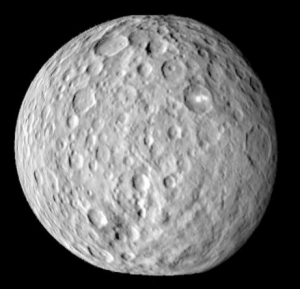
Ceres' cratered surface

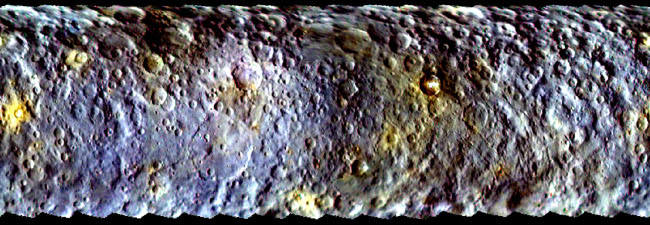
More cool images! As Dawn moves in on Ceres and prepares to enter orbit on March 6, it has managed to assemble enough images to produce a global map of the almost spheroid-shaped giant asteroid.

The bright spots however remain a mystery which cannot be answered until we get higher resolution images from much closer. Hopefully, Dawn will be able to do this once it is in orbit.

0 comments

Earth’s other moon

Link here.

What you might not know is that the moon is not the Earth’s only natural satellite. As recently as 1997, we discovered that another body, 3753 Cruithne, is what’s called a quasi-orbital satellite of Earth. This simply means that Cruithne doesn’t loop around the Earth in a nice ellipse in the same way as the moon, or indeed the artificial satellites we loft into orbit. Instead, Cruithne scuttles around the inner solar system in what’s called a “horseshoe” orbit.

2 comments
1 48 49 50 51 52 78