
Japan wants you to name Hayabusa-2’s target asteroid!
Japan’s space agency JAXA is now accepting proposals from the public to name the target asteroid of its Hayabusa-2 sample return mission.
Japan’s space agency JAXA is now accepting proposals from the public to name the target asteroid of its Hayabusa-2 sample return mission.
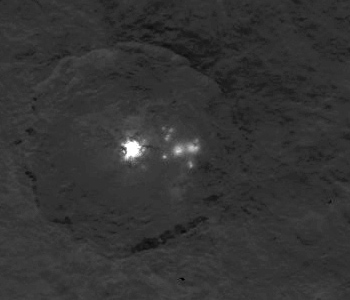
Cool image time! In a new press release, the Dawn science team has unveiled a new close-up of Ceres’ double bright spot, shown on the right.
At least eight spots can be seen next to the largest bright area, which scientists think is approximately 6 miles (9 kilometers) wide. A highly reflective material is responsible for these spots — ice and salt are leading possibilities, but scientists are considering other options, too.
In other words, they still have not confirmed through spectroscopy, that these bright spots are ice.
Note also that they have reduced the image’s brightness so that the bright spots do not over expose as much as in past images. This not only allows more details to come out, but it portrays Ceres’ very dark surface more accurately. Even so, the image still shows that surface as brighter than it actually is.
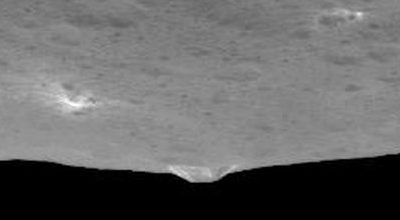
The press release also described a second image, showing a single lonely mountain on the planet’s horizon, rising up three miles from the planet’s surface, shown in the cropped image to the left. Overall this image, as well as the others, suggest that the surface of Ceres is generally far less rough than we should expect.
Another science mystery to unravel!
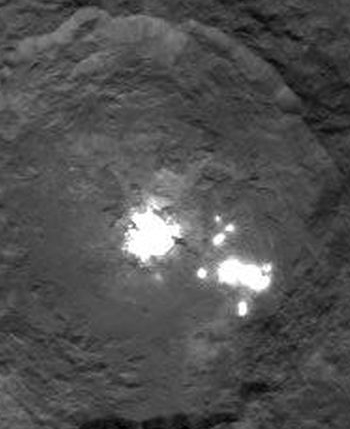
Cool image time! The Dawn science team has released a some new close-up images of Ceres, including a much higher resolution image of the dwarf planet’s double bright spot, which now resolves itself into a cluster of two larger spots with a half dozen smaller spots scattered nearby.
The region with the brightest spots is in a crater about 55 miles (90 kilometers) across. The spots consist of many individual bright points of differing sizes, with a central cluster. So far, scientists have found no obvious explanation for their observed locations or brightness levels.
“The bright spots in this configuration make Ceres unique from anything we’ve seen before in the solar system. The science team is working to understand their source. Reflection from ice is the leading candidate in my mind, but the team continues to consider alternate possibilities, such as salt. With closer views from the new orbit and multiple view angles, we soon will be better able to determine the nature of this enigmatic phenomenon,” said Chris Russell, principal investigator for the Dawn mission based at the University of California, Los Angeles.
To my eye, these bright areas resemble a wide flat caldera of a volcano. Instead of being at the top of a peak, the caldera is like a lava pool, almost like a large lake. In this case, the large spots are lakes of frozen ice that periodically melt and flow. The smaller spots are likely smaller vents where water can bubble up from below during active periods. When not active, the water will be frozen. Since ice is white and Ceres is very dark, the pools and vents appear extremely bright in these images.
I am speculating however. We will have to wait for much better images to know for sure.
In a heist reminiscent of a Hollywood movie, two thieves in hooded jumpers and white masks stole a 25 pound meteorite the size of a soccer ball on Monday.
The only value of such a meteorite is among collectors, but to sell such a large and unique meteorite without being noticed would be impossible. It is theorized that the thieves might chop it up and sell the pieces to collectors instead.
Cool image time! Using images that Dawn has accumulated since it entered orbit around Ceres, scientists have created an animation showing the dwarf planet as it rotates.
Video below the fold. Note that this is an animation. They have filled in the gaps between images to make the rotation smooth, exaggerated the scale two times to bring out details, and added a background of stars that is not visible in the original images. Even so, this video is scientifically useful, as it shows Ceres in its entirety. It is also very spectacular.
» Read more
Rather than simply turn off the spacecraft when its funding runs out at the end of 2015, Rosetta’s science team have proposed that the mission get a nine month extension, during which they will slowly spiral into the comet and gently land.
Their proposal is similar to what American scientists did with their NEAR spacecraft, which hadn’t been designed to land on an asteroid but was successfully eased onto the surface of Eros, where it operated for a very short time.
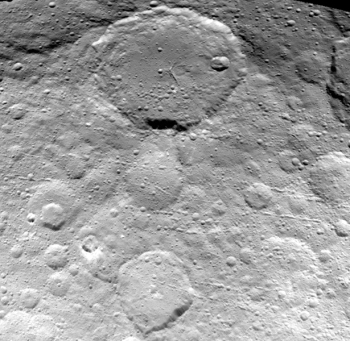
Cool image time! Dawn has now swooped down to 3,200 miles, and provided a very nice image of the cratered surface of Ceres. Though it does appear to resemble the Moon, there are some differences that come to mind if you take a close look at the full resolution image. The surface appears smoother. All of the craters appear worn or eroded or less rugged. Also, there are no mountains. The terrain resembles the Moon’s lowlands or maria, but more so.
Note that the region in this picture is tantalizingly close to the double bright spot, but does not include it. Because Dawn is still easing its way into its first survey orbit of 2,700 miles elevation, it only takes pictures when it stops firing its ion engine, which it is doing almost all the time to get where it wants to be. Thus, they apparently only had time for this image.
The spacecraft enters its mapping orbit on June 3. Expect some cool images, including the first good images of the double bright spots, shortly thereafter.
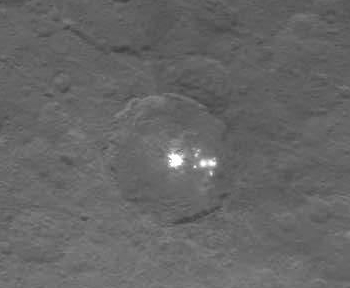
Cool image time! Dawn’s science team has released a much closer image of the double bright spots on Ceres.
The spots can now be resolved into a half-dozen spots of varying size, all of which suggest material with a high reflectivity, likely ice. They look so bright because the rest of the dwarf planet’s surface is so dark.
New Horizons has now been able to image all of Pluto’s known moons.
Pluto’s five known satellites are Charon, Hydra, Nix, Kerberos and Styx. At 648 miles (1,043 km) in diameter, Charon is nearly half as wide as Pluto itself, but the other four moons are minuscule. Kerberos and Styx, for example, are thought to be just 4 to 13 miles (7 to 21 km) and 6 to 20 miles (10 to 32 km) wide, respectively.
That the spacecraft has been able to spot them all this soon bodes well for what it will see when if flies past Pluto in July.
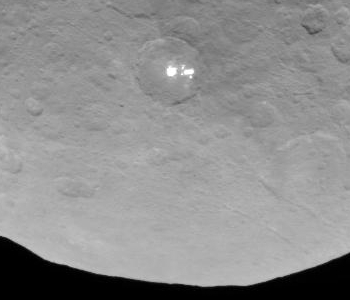
Cool image time! Dawn has released a new animation made from images taken in early May, showing more details of the dwarf planet’s double bright spot.
As they note at the link, the double spot is now “revealed to be composed of many smaller spots.” As they also add, “Their exact nature remains unknown.”
Dawn’s engineers are now beginning to ease the spacecraft down to its survey orbit, about 2,700 miles above the surface.
In the heat of competition: Because of a combination of increased competition, launch failures, political decisions, and quality control questions, the rocket company Aerojet Rocketdyne could lose almost all of its rocket customers in the next few years.
Link fixed! (Once again caused by trying to post while sitting in the passenger seat of the car and typing on a tiny tablet.)
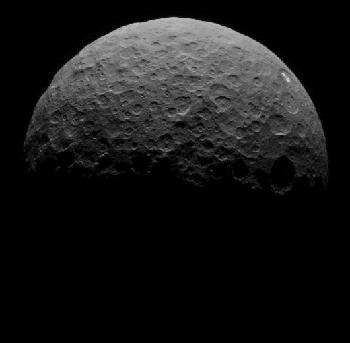
Cool image time! As Dawn’s orbit around Ceres has slowly brought the spacecraft up over its north pole and towards its daylight side, it has now become possible to once again spot the giant asteroid’s bright spots.
The science team has also released a very short animation that shows Ceres rotating below it with these bright spots coming into view.