
New Rosetta comet images

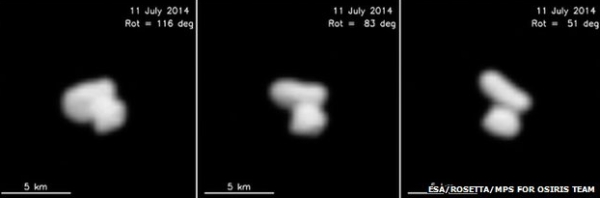
New images from Rosetta have a resolution of 100 meters per pixel and are finding that the neck connecting the comet’s two sections is apparently much brighter than the rest of the nucleus.

As earlier images had already shown, 67P may consist of two parts: a smaller head connected to a larger body. The connecting region, the neck, is proving to be especially intriguing. β€œThe only thing we know for sure at this point is that this neck region appears brighter compared to the head and body of the nucleus”, says OSIRIS Principal Investigator Holger Sierks from the Max-Planck-Institute for Solar System Research (MPS) in Germany. This collar-like appearance could be caused by differences in material or grain size or could be a topographical effect.

It looks like this comet is going to turn out to be one of the most fascinating objects any space probe has visited in a long time.
0 comments

More images from Rosetta

67P

The comet that Rosetta will orbit is getting stranger and stranger, with new images suggesting that it is really two objects stuck together.

The pictures show that 67P/Churyumov-Gerasimenko appears to be not one but two objects joined together. It is what scientists call a “contact binary”. How the comet came to take this form is unknown. It is possible that 67P suffered a major fracture at some point in its past; it is also possible the two parts have totally different origins.

What is clear is that the European Space Agency (Esa) mission team now has additional and unexpected considerations as it plans how to land on the comet later this year – not least, which part of the comet should be chosen for contact?

1 comment

Rosetta snaps more comet pictures

rotating comet nucleus

Rosetta’s new images of Comet 67P/Churyumov-Gerasimenko show the very irregular shape and rotation of its nucleus.

These images were taken on July 4 from a distance of only 23,000 miles. The rendezvous is expected in early August, with the touchdown of Rosetta’s landing probe Philae sometime in November after they have done a reconnaissance of the nucleus to pick a landing spot.

0 comments

Hubble to search for Kuiper Belt targets for New Horizons

After completing a preliminary search for potential Kuiper Belt objects which the Pluto probe New Horizons might visit, scientists have decided to use the space telescope for a deeper more complete search.

As a first step, Hubble found two KBOs drifting against the starry background. They may or may not be the ideal target for New Horizons. Nevertheless, the observation is proof of concept that Hubble can go forward with an approved deeper KBO search, covering an area of sky roughly the angular size of the full Moon. The exceedingly challenging observation amounted to finding something no bigger than Manhattan Island, and charcoal black, located 4 billion miles away.

More here.

1 comment

The astronomers who allocate time on the Hubble Space Telescope have decided to devote a large block for finding a Kuiper Belt object that the probe New Horizons might fly past.

The astronomers who allocate time on the Hubble Space Telescope have decided to devote a large block for finding a Kuiper Belt object that the probe New Horizons might fly past.

This allocation is still contingent upon a test observation to see if Hubble will be able to spot enough objects to make the long observations worthwhile.

0 comments

A new analysis of Apollo lunar rocks provides strong new evidence for the theory that the Moon was formed when the Earth was hit by a Mars’ sized planet.

A new analysis of Apollo lunar rocks provides strong new evidence for the theory that the Moon was formed when the Earth was hit by a Mars’ sized planet.

The abstract from this just released science paper summarizes the scientific problem.

Earth formed in a series of giant impacts, and the last one made the Moon. This idea, an edifice of post-Apollo science, can explain the Moon’s globally melted silicate composition, its lack of water and iron, and its anomalously large mass and angular momentum. But the theory is seriously called to question by increasingly detailed geochemical analysis of lunar rocks. Lunar samples should be easily distinguishable from Earth, because the Moon derives mostly from the impacting planet, in standard models of the theory. But lunar rocks are the same as Earth in O, Ti, Cr, W, K, and other species, to measurement precision. Some regard this as a repudiation of the theory; others say it wants a reformation. Ideas put forward to salvage or revise it are evaluated, alongside their relationships to past models and their implications for planet formation and Earth.

The new analysis has found that lunar rocks do differ from Earth in certain ways. Not surprisingly, however, the results have uncertainties.

0 comments

The predicted new meteor shower last night was less than hoped but intriguing nonetheless.

The predicted new meteor shower last night was less than hoped but intriguing nonetheless.

Based on a few reports via e-mail and my own vigil of two and a half hours centered on the predicted maximum of 2 a.m. CDT (7 UT) Saturday morning the Camelopardalid meteor shower did not bring down the house. BUT it did produce some unusually slow meteors and (from my site) one exceptional fireball with a train that lasted more than 20 minutes.

1 comment

According to a new study, Chelyabinsk-scale meteorite impacts happen more often than we have been aware.

According to a new study, Chelyabinsk-scale meteorite impacts happen more often than we have been aware.

The bright flare of the Russian meteor was hard to miss, and left 1,200 people injured in February 2013. What the human eye missed was two separate high-altitude explosions that occurred over Argentina and the North Atlantic Ocean just months later. That’s according to data from an infrasound network used to track nuke tests, released Tuesday by the B612 Foundation.

The data shows that there were 26 comparable events since 2000.

0 comments

Red tape appears to be preventing the U.S. military from releasing meteorite data obtained by its nuclear test monitoring system.

Red tape appears to be preventing the U.S. military from releasing meteorite data obtained by its nuclear test monitoring system.

Details of atmospheric meteor explosions, as recorded by U.S. military spacecraft sensors, were posted on a publicly accessible NASA website run by the Jet Propulsion Laboratory (JPL) in Pasadena, Calif. In fact, the military-civil cooperation was spurred by the details of the February 2013 fireball explosion over Chelyabinsk, Russia β€” termed a “superbolide” event. The website postings are designed to assist the scientific community’s investigation of bolides, or exceptionally bright fireballs.

However, multiple scientists noted that the JPL website had not been updated recently. That presumably meant that there was some sort of delay, as some fairly big events were detected by infrasound in the last year. “Because of budget and personnel reductions on our military partner, they ran into workforce issues to accomplish this task,” said Lindley Johnson, NEO program executive within the Planetary Science Division of NASA’s Science Mission Directorate in Washington, D.C.

In other words, it looks like everyone in the military is saying “Ain’t my job, man!” so it doesn’t get done. They need to assign someone the job and be done with it.

0 comments
1 53 54 55 56 57 78