
Construction of Angara launchpad at Vostochny delayed

In order to complete construction of the Soyuz rocket launchpad at Russia’s new spaceport in Vostochny as quickly as possible, Russian managers have decided to delay completion by one year of the launchpad for the new Angara rocket.

I would not conclude from this decision that the construction at Vostochny is lagging. Instead, it appears that the Russian government continues to give it a high priority, and is merely beginning to structure that priority as effectively as possible. The Soyuz rocket is already in operation and will be ready to fly as soon as Vostochny is operational. Angara meanwhile is still under development. I suspect a delay in getting its launchpad ready will have no effect in the overall schedule of that rocket, as they need to do several additional test flights before it will be ready to be declared operational.
0 comments

Another moon for Earth

Astronomers have discovered an asteroid whose solar orbit is almost identical to Earth’s, and has it hovering so near the Earth that it is almost another moon.

Based on orbital data the scientists estimate that the asteroid, between 300 to 1000 feet in diameter, has been hovering near Earth for the past 775 years, and it will only drift away in about 165 years from now.

Correction: Engineer and regular reader James Fincannon emailed me to note that this asteroid really doesn’t have an orbit “almost identical to the Earth.” As he wrote, “Seems to go between Venus and Mercury and then all the way out to Mars! It seems to pass by Earth occasionally.” Thus, this recent period of closeness is only a temporary one.

7 comments

Dawn’s arrival at Ceres delayed one month

Though engineers have solved the problems caused when a radiation blast disabled Dawn’s ion engine and put it into safe mode for a week, the fix will cause a one month delay in its arrival at the asteroid Ceres.

Controllers discovered Dawn was in safe mode Sept. 11 after radiation disabled its ion engine, which uses electrical fields to “push” the spacecraft along. The radiation stopped all engine thrusting activities. The thrusting resumed Monday (Sept. 15) after controllers identified and fixed the problem, but then they found another anomaly troubling the spacecraft.

Dawn’s main antenna was also disabled, forcing the spacecraft to send signals to Earth (a 53-minute roundtrip by light speed) through a weaker secondary antenna and slowing communications. The cause of this problem hasn’t been figured out yet, but controllers suspect radiation affected the computer’s software. A computer reset has solved the issue, NASA added. The spacecraft is now functioning normally.

1 comment

Management problems at NASA’s asteroid hunting program

An inspector general report today criticized NASA’s program to find potentially hazardous asteroids, finding it disorganized and poorly managed.

The report faulted the NEO Program’s lack of structure, and said its resources are inadequate for handling its growing agenda. In addition to the program’s Washington-based executive, Lindley Johnson, NASA funding goes to support six employees at the Minor Planet Center in Massachusetts and six more at the Jet Propulsion Laboratory in California, the inspector general’s office said.

The report said the program’s executive fell short when it came to overseeing progress in the asteroid-tracking effort. What’s more, there were no formal partnerships with the Defense Department or the National Science Foundation, or with international space agencies. Those groups could make significant contributions to the effort, the report said.

I do not doubt that this program has management problems. What government agency today doesn’t? And any that are managed well are the exception to the rule. However, the report’s conclusion that “resources are inadequate for handling its growing agenda” is typical Washington-speak for “Give us more money!” which almost never solves the management problems that made the program a failure in the first place.

6 comments

Philae’s landing site chosen

Philae's primary landing site

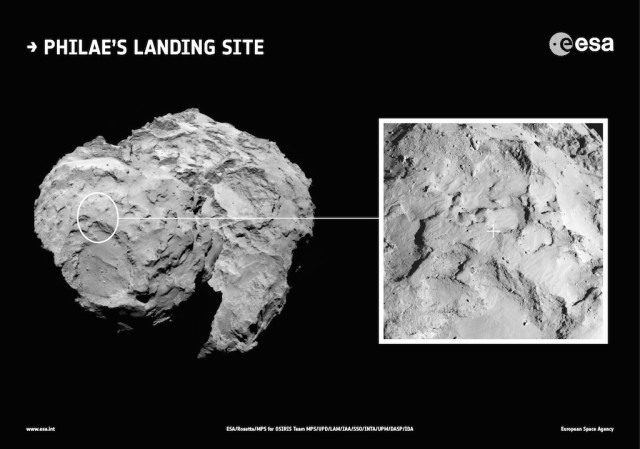
The Rosetta science team has chosen the primary landing site on Comet 67P/C-G for its Philae probe.

Site J is on the ‘head’ of the comet, an irregular shaped world that is just over 4 km across at its widest point. The decision to select Site J as the primary site was unanimous. The backup, Site C, is located on the ‘body’ of the comet. The 100 kg lander is planned to reach the surface on 11 November, where it will perform indepth measurements to characterise the nucleus in situ, in a totally unprecedented way.

This site is, located in the outside center of the nucleus’s smaller lobe, was picked unanimously because it appears to be the easiest to reach while also providing good science.

The descent to the comet is passive and it is only possible to predict that the landing point will place within a ‘landing ellipse’ typically a few hundred metres in size.

A one square kilometre area was assessed for each candidate site. At Site J, the majority of slopes are less than 30º relative to the local vertical, reducing the chances of Philae toppling over during touchdown. Site J also appears to have relatively few boulders, and receives sufficient daily illumination to recharge Philae and continue science operations on the surface beyond the initial battery-powered phase.

Provisional assessment of the trajectory to Site J found that the descent time of Philae to the surface would be about seven hours, a length that does not compromise the on-comet observations by using up too much of the battery during the descent.

I have put a close-up of the landing site below the fold.
» Read more

0 comments

Rosetta gets closer

If all goes well with maneuvers today, Rosetta will creep inward to an orbit only 16 miles from Comet 67P/C-G.

From this position the probe will begin gathering a global map of the comet nucleus. Nor is this the closest they will get. Over the next month they will move in again and again in weekly increments.

0 comments

Hayabusa ready for launch

In a press photo op the Japanese have unveiled the completed Hayabusa 2, ready for its journey to an asteroid.

Hayabusa 2 will deploy one of five target markers that it will use to guide itself into landing and collecting a sample. It will deploy a European-built lander named MASCOT and three (count them, three) “rovers” called MINERVA-II. I put “rovers” in quotes because I think these are not wheeled rovers but rather bouncy hoppers like Hayabusa 1’s MINERVA (which was deployed but sadly missed Itokawa). Then it will do an experiment like Deep Impact’s, releasing an impactor to make a crater on the asteroid’s surface. But because Hayabusa 2’s impactor won’t have much kinetic energy, they made it explosive. The mothership will have to hide in the shadow of the asteorid as the explosion happens, so they have also added the deployable DCAM3 to try to get a view of the crater’s formation.

Rendezvous is set for around 2018 with the spacecraft’s sample return to Earth sometime in 2020.

1 comment

Nothing for New Horizons after Pluto

As New Horizons begins its final shake-down in advance of its July 2015 flyby of Pluto, scientists have so far failed to find any Kuiper Belt objects in the right place for it to fly past after Pluto.

They haven’t given up hope, however. The search continues. As for the Pluto flyby,

The hibernating spacecraft will send weekly status beacons back to Earth, with wakeup scheduled for Dec. 7 to begin the final phase of its approach to Pluto. New Horizons will stay awake for two years to prepare for the encounter, fly by Pluto, and downlink science data. The craft’s appointment with Pluto is set for July 14, 2015, when it will zoom about 6,200 miles from the icy world’s unmapped surface for a one-shot chance to explore Pluto’s geology and atmosphere.

0 comments
1 51 52 53 54 55 78