Spitzer spots asteroid collision

A monitoring program of a young star by the Spitzer Space Telescope has paid off with evidence of a major collision between asteroids in the debris disk that surrounds the star.

Scientists had been regularly tracking the star, called NGC 2547-ID8, when it surged with a huge amount of fresh dust between August 2012 and January 2013. “We think two big asteroids crashed into each other, creating a huge cloud of grains the size of very fine sand, which are now smashing themselves into smithereens and slowly leaking away from the star,” said lead author and graduate student Huan Meng of the University of Arizona, Tucson.

While dusty aftermaths of suspected asteroid collisions have been observed by Spitzer before, this is the first time scientists have collected data before and after a planetary system smashup. The viewing offers a glimpse into the violent process of making rocky planets like ours.
0 comments

Did Stardust capture stardust?

Scientists now believe that the spacecraft Stardust captured seven particles from interstellar space during its seven year journey.

Inside the canister, a tennis racket-like sample collector tray captured the particles in silica aerogel as the spacecraft flew within 149 miles (about 240 kilometers) of a comet in January 2004. An opposite side of the tray holds interstellar dust particles captured by the spacecraft during its seven-year, three-billion-mile journey.

Scientists caution that additional tests must be done before they can say definitively that these are pieces of debris from interstellar space. But if they are, the particles could help explain the origin and evolution of interstellar dust. The particles are much more diverse in terms of chemical composition and structure than scientists expected. The smaller particles differ greatly from the larger ones and appear to have varying histories. Many of the larger particles have been described as having a fluffy structure, similar to a snowflake. [emphasis mine]

It appears that for these seven particles, the scientists conclude they are likely interstellar particles because of the speed in which they were traveling when captured as well as their make-up. Both suggest an origin outside the solar system.

However, we should be cautious about this. The data still remains tenuous and preliminary. More work obviously needs to be done to pin this down definitively. More information here.

0 comments

It ain’t gravity holding this asteroid together

Astronomers have discovered that near Earth asteroid 1950DA is spinning so fast that gravity can’t hold it together. Instead, it is kept whole by cohesive forces called van der Waals forces, predicted but never detected before on an asteroid.

This is the coolest factoid from the article, however:

“We found that 1950 DA is rotating faster than the breakup limit for its density,” said Rozitis. “So if just gravity were holding this rubble pile together, as is generally assumed, it would fly apart. Therefore, interparticle cohesive forces must be holding it together.”

In fact, the rotation is so fast that at its equator, 1950 DA effectively experiences negative gravity. If an astronaut were to attempt to stand on this surface, he or she would fly off into space unless he or she were somehow anchored.

The important take away from this discovery is that it will be very easy to break this kind of asteroid up, turning a large and big threat into a collection of small but harmless rocks.

1 comment

Rosetta detects its first dust grains

67P/C-G on August 12, 2014

The Rosetta science team announced today that the spacecraft’s Grain Impact Analyser and Dust Accumulator (GIADA) has captured its first dust grains from Comet 67P/C-G.

Earlier this month, GIADA detected the first four dust grains in its Impact Sensor. The first detection was made on 1 August, when Rosetta was 814 km from 67P/C-G, and about 543 million kilometres from the Sun. Further impacts from three more dust grains were detected on 2, 4, and 5 August, at distances of 603, 286, and 179 km from the comet, respectively.

There is still too little data to come to any firm conclusions about the density and make-up of the coma, but this announcement confirms that the instrument is working as designed. When the comet zips past the Sun at its closest point on August 13, 2015, this instrument will then be able to give us a very good assessment of this particular comet’s behavior as it slowly evaporates.

Meanwhile, the images keep coming. The picture at the top of the post was taken on August 12 from about 64 miles.

0 comments

Another Rosetta closeup of 67P/C-G

67P on August 8

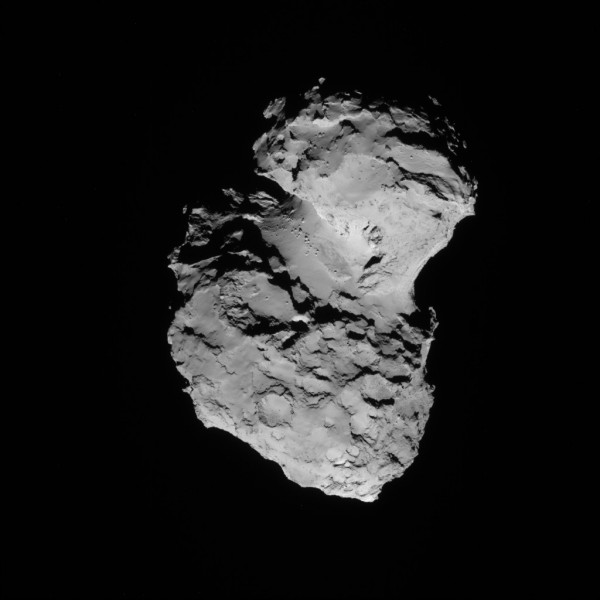
The above image is not the most recent daily image from Rosetta, but it is the most interesting of the last three.

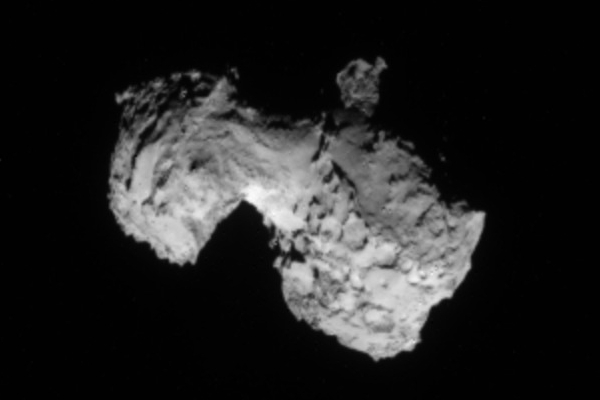
It shows the side of the comet nucleus that has not been featured in most images, as the topographical differences between its two sections is not as distinctly highlighted. What is highlighted is the neck that connects the two sections, lighter colored and thus likely made up of less dusty ice.

Also of interest here is the circular features on the larger bottom section. These certainly resemble craters, and are likely remnants of early impacts that are now been corroded away as the nucleus’s ice particles evaporate off the surface. The scientific question here is this: Why are crater features more evident on this side and section of the comet nucleus than on other areas of its surface?

0 comments

Rosetta arrives

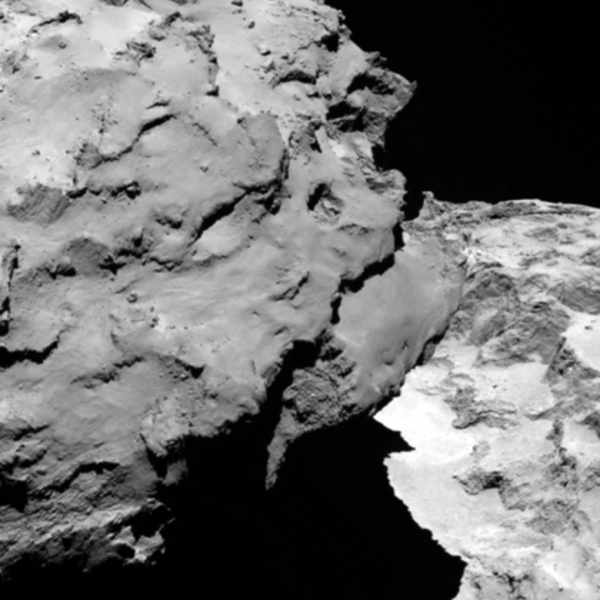
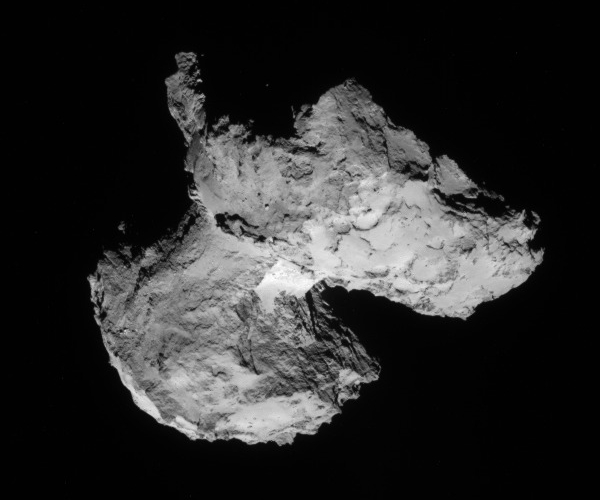
Rosetta has successfully achieved orbit around Comet 67P/C-G and has transmitted its first close up images. More information here and here about the rendezvous and what science the mission scientists plan to do as they orbit the comet.

The image below is looking down and past the comet’s smaller component as it casts a shadow on the neck and the larger component beyond. As with the earlier images, the comet’s pitted and corroded surface, lacking any obvious craters, is reminiscent to me of a pile of dirty snow that has been dissolving away. In fact, when I lived in New York I would see this kind of look every winter. When the city would get a big snowfall snowplows would push it into large mounds on the side of the road. As time passed these piles would get dirty from the city’s soot and grime, and also slowly melt away. After several weeks it would look almost exactly like the surface of Comet 67P/C-G.

The images and data that will come down from Rosetta over the next year and half as it orbits the comet in its journey around the Sun will be most fascinating. Stay tuned!

67P/C-G up close

12 comments

67P from less than 200 miles

67P on August 3

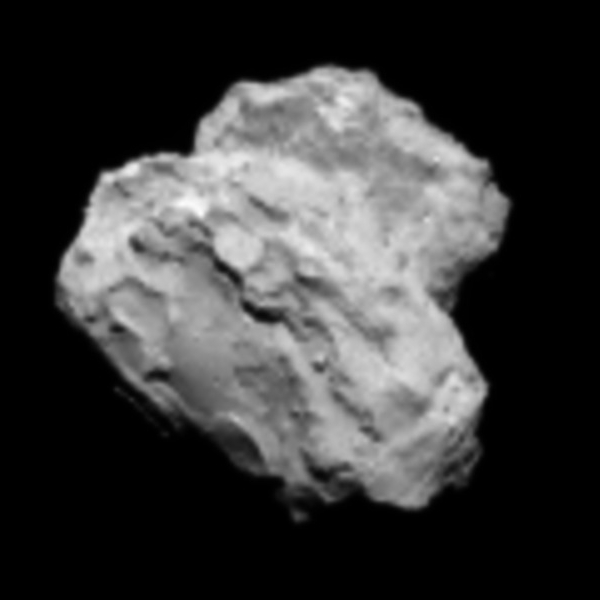
Today’s Rosetta image of Comet 67P, shown above, gives us a different angle of the comet. The spacecraft was only 186 miles (300 kilometers) away when it snapped the picture, and this side view emphasizes the nucleus’s jagged shape.

I am reminded of what happens to a block of ice when you spray warm water on it. It begins to melt away, but very randomly and unevenly, producing very weird shapes and the surface evaporates off. In the case of Comet 67P, the nucleus is a dirty ball of ice, and the Sun’s rays have been causing its surface to evaporate off every time it approaches the Sun. Thus, we get a very weird shape.

0 comments

Today’s Comet 67P image

Comet 67P on August 2

The image above was taken on August 2 using Rosetta’s navigation camera. It has been processed by the science team to bring out the details. I have also rotated it to match the August 1 image taken at a distance of 620 miles that was taken by Rosetta’s OSIRIS narrow angle camera, designed to do the actual science.

You can see that the navigation camera does a pretty good job on its own of capturing the comet’s nucleus. Both images show that the instruments are working perfectly, and thus tell us that the next few months will be quite spectacular after Rosetta goes into orbit in three days, followed in November by the landing of Philae somewhere on the comet’s surface.

If you download both images and then switch back and forth between them you can get a better feel for the geometry of the surface features.

0 comments

Comet 67P from 1000 k

67P from 1000 kilometers

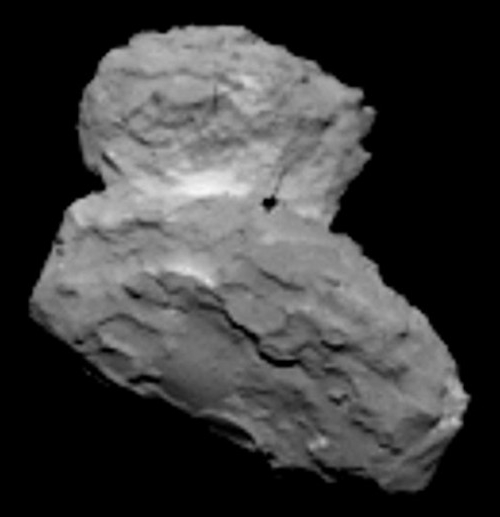
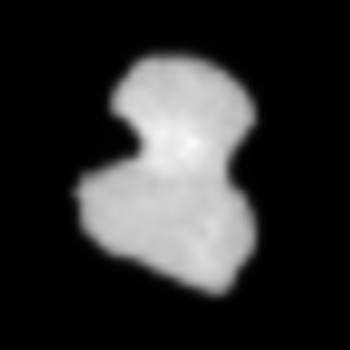
Above is a new image of Comet 67P as seen from about 1000 kilometers, or about 620 miles, released by the Rosetta science team today. The image was taken on August 1 and has been processed somewhat to bring out the details. The black spot near the junction between the nucleus’s two sections is not real but an artifact of the camera’s CCD.

This image is the first real clear and sharp look at the nucleus, and what it shows us is a surface quite different from the many other asteroids that science probes have imaged close-up in the past. From this angle there are far few craters visible then is normally seen on asteroids, and the surface has complex roughness and pitted look that I suspect the planetary geologists are right now scratching their heads about and waving their arms trying to explain. My first guess, which no one should take too seriously, is that as material vents off the comet when it gets close to the Sun it leaves behind these scars.

One more thing: If you go here you can see a number of additional image releases in the last 24 hours, all fascinating. This link explains that the features that looked like craters in earlier images were actually artifacts from the camera’s CCD.

0 comments
1 52 53 54 55 56 78