New stars shaped by old stars

New stars shaped by old stars
Click for original image.

Cool image time! The picture to the right, cropped, reduced, and sharpened to post here, was taken by the Hubble Space Telescope as part of a study focused on looking at star formation in nearby galaxies. From the caption:

Evidence of star formation is scattered all around NGC 1637, if you know where to look. The galaxy’s spiral arms are dotted with what appear to be pink clouds, many of which are accompanied by bright blue stars. The pinkish colour comes from hydrogen atoms that have been excited by ultraviolet light from young, massive stars. This contrasts with the warm yellow glow of the galaxy’s centre, which is home to a densely packed collection of older, redder stars.

The stars that set their birthplaces aglow are comparatively short-lived, and many of these stars will explode as supernovae just a few million years after they’re born. In 1999, NGC 1637 played host to a supernova, pithily named SN 1999EM, that was lauded as the brightest supernova seen that year. When a massive star expires as a supernova, the explosion outshines its entire home galaxy for a short time. While a supernova marks the end of a star’s life, it can also jump start the formation of new stars by compressing nearby clouds of gas, beginning the stellar lifecycle anew.

This galaxy is one worth keeping an eye on for supernovae, since every one of those blue stars has the potential of erupting.

1 comment

Hubble vs Webb, or why the universe’s secrets can only be uncovered by looking at things in many wavelengths

Hubble view of Sombrero galaxy
Click for original image.

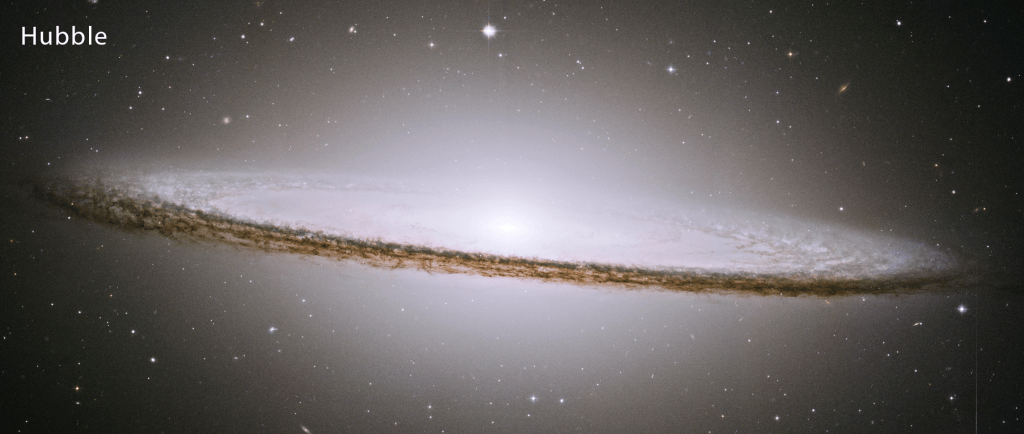
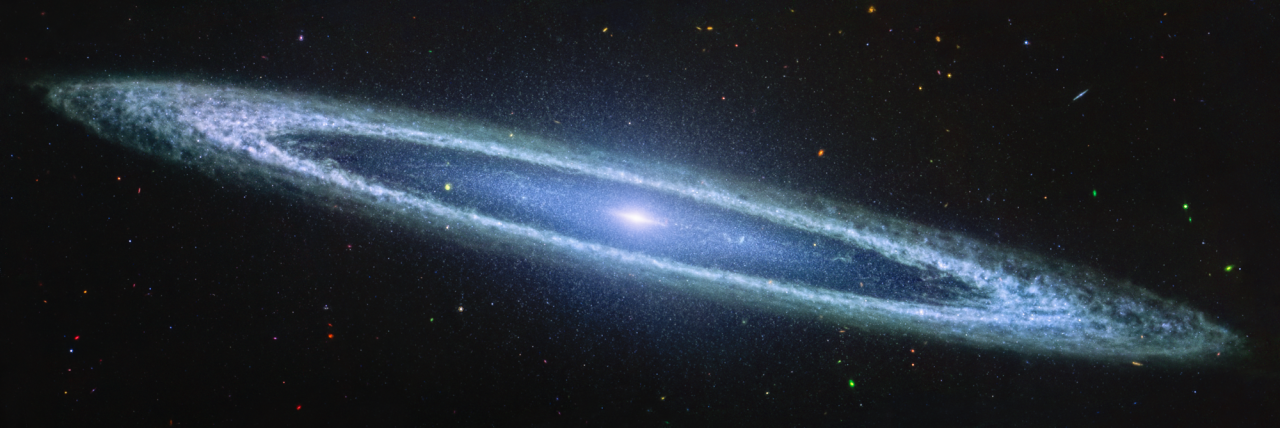
Time for two cool images of the same galaxy! The picture above shows the Sombrero Galaxy as taken by the Hubble Space Telescope in 2003. The picture below is that same galaxy as seen by the Webb Space Telescope in the mid-infrared using false colors. From the press release:

In Webb’s mid-infrared view of the Sombrero galaxy, also known as Messier 104 (M104), the signature, glowing core seen in visible-light images does not shine, and instead a smooth inner disk is revealed. The sharp resolution of Webb’s MIRI (Mid-Infrared Instrument) also brings into focus details of the galaxy’s outer ring, providing insights into how the dust, an essential building block for astronomical objects in the universe, is distributed. The galaxy’s outer ring, which appeared smooth like a blanket in imaging from NASA’s retired Spitzer Space Telescope, shows intricate clumps in the infrared for the first time.

Researchers say the clumpy nature of the dust, where MIRI detects carbon-containing molecules called polycyclic aromatic hydrocarbons, can indicate the presence of young star-forming regions. However, unlike some galaxies studied with Webb … the Sombrero galaxy is not a particular hotbed of star formation. The rings of the Sombrero galaxy produce less than one solar mass of stars per year, in comparison to the Milky Way’s roughly two solar masses a year. Even the supermassive black hole, also known as an active galactic nucleus, at the center of the Sombrero galaxy is rather docile, even at a hefty 9-billion-solar masses. It’s classified as a low luminosity active galactic nucleus, slowly snacking on infalling material from the galaxy, while sending off a bright, relatively small, jet.

In infrared the galaxy’s middle bulge of stars practically vanishes, exposing the weak star-forming regions along galaxy’s disk.

Both images illustrate the challenge the universe presents us in understanding it. Basic facts are often and in fact almost always not evident to the naked eye. We always need to look deeper, in ways that at first do not seem obvious. This is why it is always dangerous to theorize with certainty any explanation too soon, as later data will always change that explanation. You can come up with an hypothesis, but you should always add the caveat that you really don’t know.

By the way, this concept applies not just to science. Having absolute certainty in anything will almost always cause you to look like a fool later. Better to always question yourself, because that will make it easier for you to find a better answer, sooner.

We need only look at the idiotic “mainstream press” during the months leading up to the November election to have an example of someone with certainty who is now exposed as an obvious fool.

The Sombrero Galaxy as seen by Webb
Click for original image.

4 comments

A new geologic map of one of the Moon’s largest impact basins

Orientale Basin on the Moon
Click for original image.

Using data from Lunar Reconnaissance Orbiter (LRO), scientists have now produced a high resolution geological map of Orientale Basin, one of the largest impact basins on the Moon — at about 600 miles across — and located just on the edge of the Moon’s visible near side.

That map is to the right, reduced and sharpened to post here. You can read the paper here [pdf]. From the press release:

Planetary Science Institute Research Scientist Kirby Runyon is a lead author on a paper published in the Planetary Science Journal containing a new high-resolution geologic map of Orientale basin that attempts to identify original basin impact melt. The hope is that future researchers use this map to target sample return missions and pin down impact dates for this and other impact basins.

“We chose to map Oriental basin because it’s simultaneously old and young,” Runyon said. “We think it’s about 3.8 billion years old, which is young enough to still have its impact melt freshly exposed at the surface, yet old enough to have accumulated large impact craters on top of it as well, complicating the picture. We chose to map Orientale to test melt-identification strategies for older, more degraded impact basins whose ages we’d like to know.”

The map’s prime purpose is to pin down locations where material from the actual impact exist and can be returned to Earth for precise dating, thus helping to create a more accurate timeline of the Moon’s formation as well as the entire solar system’s accretion rate.

0 comments

A spiral galaxy as seen from the side

A spiral galaxy seen from the side
Click for original image.

Cool image time! The picture to the right, reduced to post here, was taken by the Hubble Space Telescope of what is believed to be a spiral galaxy seen edge-on. The galaxy itself is estimated to be 150 million light years away, and this view highlights two major features, the dust lanes that run along the galaxy’s length and its distinct central nucleus, bulging out from the galaxy’s flat plain.

The way this image was produced however is intriguing on its own:

Like most of the full-colour Hubble images released by ESA/Hubble, this image is a composite, made up of several individual snapshots taken by Hubble at different times and capturing different wavelengths of light. … A notable aspect of this image is that the two sets of Hubble data used were collected 23 years apart, in 2000 and 2023! Hubble’s longevity doesn’t just afford us the ability to produce new and better images of old targets; it also provides a long-term archive of data which only becomes more and more useful to astronomers.

All told, four Hubble data sets were used to produce the picture.

0 comments

Astronomers call for the FCC to halt all launches of satellite constellations

In a letter [pdf] sent to the FCC on October 24, more than one hundred astronomers demanded a complete halt of all launches of low-Earth satellite constellations until a complete environmental review can be done.

The environmental harms of launching and burning up so many satellites aren’t clear. That’s because the federal government hasn’t conducted an environmental review to understand the impacts. What we do know is that more satellites and more launches lead to more damaging gasses and metals in our atmosphere. We shouldn’t rush forward with launching satellites at this scale without making sure the benefits justify the potential consequences of these new mega-constellations being launched, and then re-entering our atmosphere to burn up and or create debris This is a new frontier, and we should save ourselves a lot of trouble by making sure we move forward in a way that doesn’t cause major problems for our future.

Under this premise, Americans would forever be forbidden from doing anything without first having detailed environmental reviews by federal government agencies. Ponder that thought for a bit.

The astronomers’ argument of course is intellectually dishonest and disingenuous, on multiple levels. It is more than evident that these launches and satellites will cause little serious harm to the atmosphere or the environment. What the astronomers really want is to block these constellations so that their ground-based telescopes will be able to continue to see the heavens unhindered.

To hell with everyone else! We need to gaze at the stars and we are more important!

What these Chicken Littles should really do is give up on ground-based astronomy entirely, and start building space-based telescopes of all kinds, and fast. They would not only bypass the satellite constellations, they would get far better data as they would also bypass the atmosphere to get sharp images of everything they look at.

Whether the FCC listens to this absurd demand depends entirely on who wins the election. A Harris administration might easily go along, shutting down not only SpaceX’s Starlink constellation (thus getting political revenge on Elon Musk for daring to campaign against Democrats) but Amazon’s Kuiper constellation as well. Such an action would likely exceed the FCC’s statutory authority, but that won’t matter to these power-hungry thugs.

Trump in turn would almost certainly shut down much of the administrative state’s mission creep into areas of regulation it has no legal business.

17 comments

WISE/NEOWISE burns up in the atmosphere

NASA’s Wide-field Infrared Survey Explorer (WISE, later renamed NEOWISE) has ended its fifteen years in orbit, burning up in the atmosphere on November 1, 2024.

In its initial mission it did an infrared survey of the sky, discovering millions of black holes, many of the most luminous galaxies, and numerous brown dwarfs. It was then repurposed to survey the sky for near Earth objects, asteroids that have the potential to impact the Earth, discovering more than two hundred new asteroids while tracking more precisely another 3,000. It did this by repeating its survey over and over so that moving objects could be spotted.

0 comments

A 2017 supernova as spotted by Hubble

Before and after of galaxy with supernova
Click for original image.

Cool image time! The pictures to the right were both compiled from photos taken by the Hubble Space Telescope, with the bottom annotated to indicate the location of a 2017 supernova that was not visible in the earlier 2005 picture.

In this collage two images of the spiral galaxy NGC 1672 are compared: one showing supernova SN 2017GAX as a small green dot, and the other without. The difference between the images is that both have been created by processing multiple individual Hubble images, each taken to capture a specific wavelength of visible light, and combining them to make a full-colour image. In one of those filtered frames, taken in 2017, the fading supernova is still visible

NGC 1672 is considered a barred spiral galaxy. Located an estimated 52 million light years away, the 2017 supernovae was not the last detected within it. In 2022 a second supernovae occurred. That’s two supernovae within five years. Meanwhile the Milky Way has not seen a supernova in more than four centuries.

0 comments

Scientists use Hubble and Webb to confirm there are as yet no planets forming in Vega’s accretion disk

Hubble and Webb images of Vega's accretion disk
Click for original image.

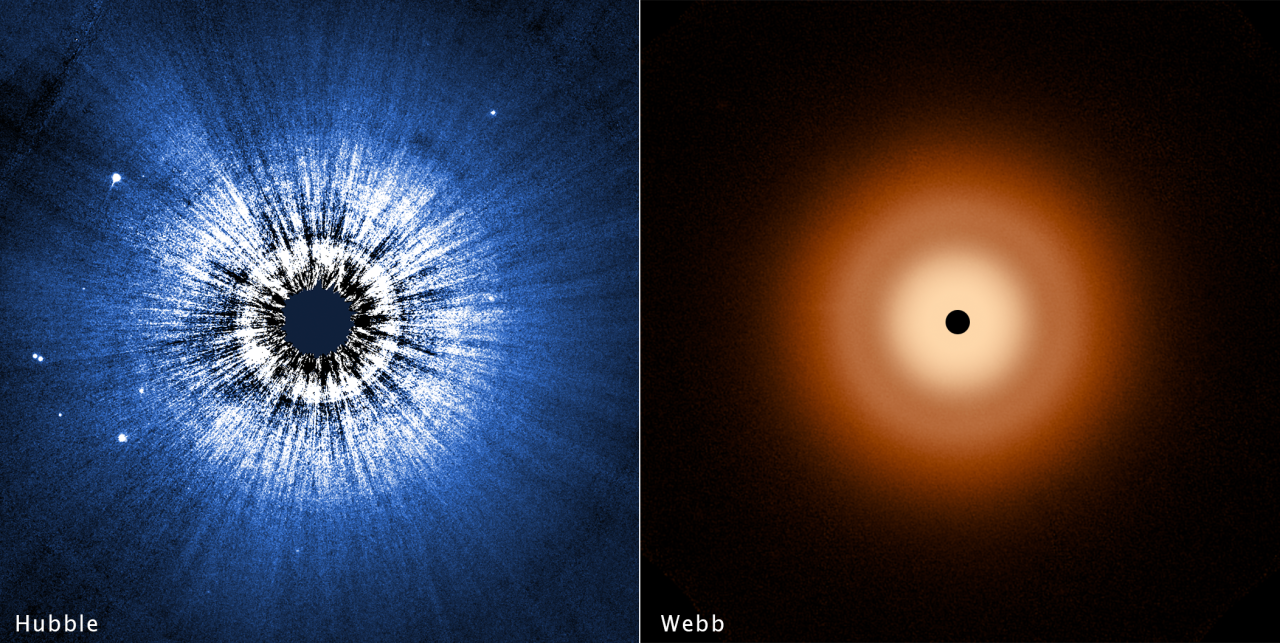
Using both the Hubble and Webb space telescopes, scientists have now confirmed, to their surprise, that the accretioni disk that surrounds the nearby star Vega is very smooth with almost no gaps, and thus apparently has not new exoplanets forming within it.

The two pictures to the right, cropped and reduced to post here, come from two different papers. The Hubble paper is here [pdf] while the Webb paper is here [pdf]. From the press release:

Webb sees the infrared glow from a disk of particles the size of sand swirling around the sizzling blue-white star that is 40 times brighter than our Sun. Hubble captures an outer halo of this disk, with particles no bigger than the consistency of smoke that are reflecting starlight.

The distribution of dust in the Vega debris disk is layered because the pressure of starlight pushes out the smaller grains faster than larger grains. “Different types of physics will locate different-sized particles at different locations,” said Schuyler Wolff of the University of Arizona team, lead author of the paper presenting the Hubble findings. “The fact that we’re seeing dust particle sizes sorted out can help us understand the underlying dynamics in circumstellar disks.”

The Vega disk does have a subtle gap, around 60 AU (astronomical units) from the star (twice the distance of Neptune from the Sun), but otherwise is very smooth all the way in until it is lost in the glare of the star. This shows that there are no planets down at least to Neptune-mass circulating in large orbits, as in our solar system, say the researchers.

At the moment astronomers consider the very smooth accretion disk surrounding Vega to be rare and exception to the rule, with most debris disks having gaps that suggest the presence of newly formed exoplanets within them. That Vega breaks the rule however suggests the rule might not be right in the first place.

1 comment

Post-collision images of two galaxies

Post-collision imagery by Hubble and Webb
Click for original image.

Using both the Hubble and Webb space telescopes, astronomers have now produced multi-wavelength images of the galaxies NGC 2207and IC 2163, as shown to the right.

Millions of years ago the smaller galaxy, IC 2163, grazed against the larger, NGC 2207, resulting today in increased star formation in both galaxies, indicated by blue in the Hubble photo. From the caption of the combined images:

Combined, they are estimated to form the equivalent of two dozen new stars that are the size of the Sun annually. Our Milky Way galaxy forms the equivalent of two or three new Sun-like stars per year. Both galaxies have hosted seven known supernovae, each of which may have cleared space in their arms, rearranging gas and dust that later cooled, and allowed many new stars to form.

The two images to the left leaves the Hubble and Webb separate, making it easier to see the different features the different wavelengths reveal. From this caption:

In Hubble’s image, the star-filled spiral arms glow brightly in blue, and the galaxies’ cores in orange. Both galaxies are covered in dark brown dust lanes, which obscure the view of IC 2163’s core at left. In Webb’s image, cold dust takes centre stage, casting the galaxies’ arms in white. Areas where stars are still deeply embedded in the dust appear pink. Other pink dots may be objects that lie well behind these galaxies, including active supermassive black holes known as quasars.

The largest and brightest pink area in the Webb image, on the bottom right and a blue patch in the Hubble image, is where a strong cluster of star formation is presently occurring.

6 comments

Arecibo telescope collapsed because of a surprising engineering failure that inspections still should have spotted

Illustration of cable failure at Arecibo

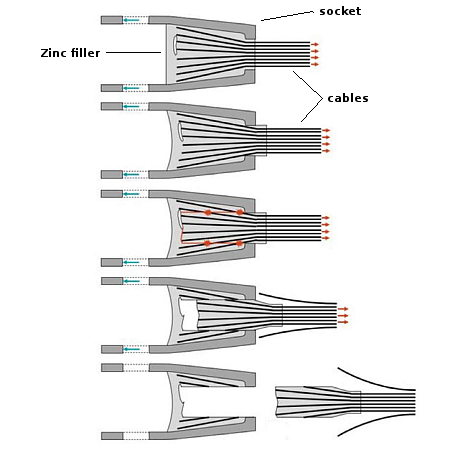
According to a new very detailed engineering analysis into the causes of the collapse of the Arecibo radio telescope in Puerto Rico in 2020, the failure was caused first by a surprising interaction between the radio electronics of Arecibo and the traditional methods used to anchor the cables, and second by a failure of inspections to spot the problem as it became obvious.

The surprising engineering discovery is illustrated to the right, taken from figure 2-6 of the report. The main antenna of Arecibo was suspended above the bowl below by three main cables. The figure shows the basic design of the system used to anchor the cable ends to their sockets. The end of the cable bunches would be inserted into the socket, spread apart, and then zinc would be poured in to fill the gap and then act as a plug and glue to hold the cables in place. According to the report, this system has been used for decades in many applications very successfully.

What the report found however was at Arecibo over time the cable bunch and zinc plug slowly began to pull out of the socket, what the report labels as “zinc creep.” This was noted by inspectors, but dismissed as a concern because they still believed the engineering margins were still high enough to prevent failure at this point. In fact, this is exactly where the structure failed in 2020, with the first cable separating as shown in August 2020. The second cable did so in a similar manner in November 2020.

The report concluded that the “only hypothesis the committee could develop that provides a plausible but unprovable answer to all these questions and the observed socket failure pattern is that the socket zinc creep was unexpectedly accelerated in the Arecibo Telescope’s uniquely powerful electromagnetic radiation environment. The Arecibo Telescope cables were suspended across the beam of ‘the most powerful radio transmitter on Earth.'”

The report however also notes that the regular engineering inspections of the telescope had spotted this creep, which was clearly unusual and steadily becoming significant, and did not take action to address the issue when it should have. It also noted the slow response of the bureaucracy, not only to the damage caused earlier to the facility by Hurriane Maria in 2017, but to obtaining the funding for any repairs.

Ray Lugo [the principal investigator for Arecibo] described to the committee how months of his time during 2018 were spent writing, resubmitting, and justifying repair funding proposals. Repairs had to go through the traditional “bid and proposal” process, described in more detail below, which added years of delay.

We can forgive the inspectors somewhat for not noting the creep when they should, as its cause appears to be very unusual, still uncertain and rare, but the red tape that prevented proper and quick repair effort after the hurricane is shameful. Had the telescope gotten the proper support on time, the creep itself might have even been addressed, because the resources would have been there to deal with it.

6 comments

Using spectroscopic data, astronomers create 3D map of ancient supernova remnant

Supernova 1181
Click for original image.

Astronomers have now createdsdft a 3D map of the remnant formed by a supernova that occurred in 1181, using detailed spectroscopic data to determing which remnant filaments are moving towards us and which are moving away.

The picture to the right is from figure 1 of their paper, and shows how the filaments radiate out from the center in straight lines, something that is unusual for such remnants. It was taken in 2023 by a ground-based telescope at Kitt Peak in Hawaii. From simple optical data it is impossible however to determine which filaments are in the rear, expanding away from us, and which are in the front, expanding towards us.

To probe the three-dimensional structure of the supernova remnant, the astronomers turned to KCWI, an instrument that can capture multiwavelength, or spectral, information for every pixel in an image. This is like breaking apart the light captured in every pixel into a rainbow of colors. The spectral information enabled the team to measure the motions of the filaments poking out from the center of the explosion and ultimately create a 3D map of the structure. The filament material that is flying toward us shifted toward the blue higher-energy portion end of the visible spectrum (blue-shifted), while light from material moving away from us shifted toward the red end of the spectrum (red-shifted).

…The results showed that the filament material in the supernova is flying outward from the site of the explosion at approximately 1,000 kilometers per second. “We find the material in the filaments is expanding ballistically,” says Cunningham. “This means that the material has not been slowed down nor sped up since the explosion. From the measured velocities, looking back in time, you can pinpoint the explosion to almost exactly the year 1181.”

The 3D information also revealed a large cavity inside the spindly, spherical structure in addition to some evidence that the supernova explosion of 1181 occurred asymmetrically.

Using this data, they were able to create that 3D map, shown below in a coarse animation video.
» Read more

3 comments

The uncertainty of science: New research suggests first image in ’22 of Milky Way’s central black hole is likely not accurate

Sagittarius A*
The original interpretation. Click for full image.

The new interpretaion
The new asymmetrical interpretation. Click for original image.

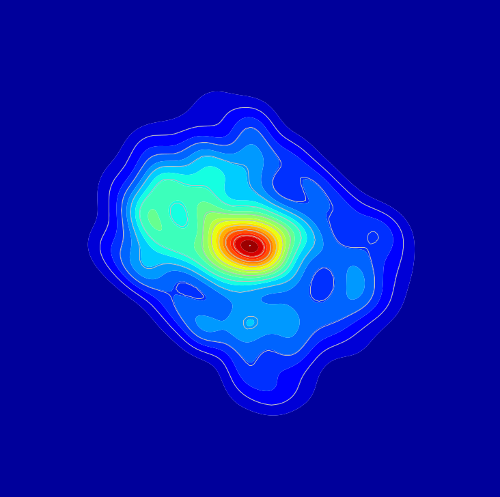
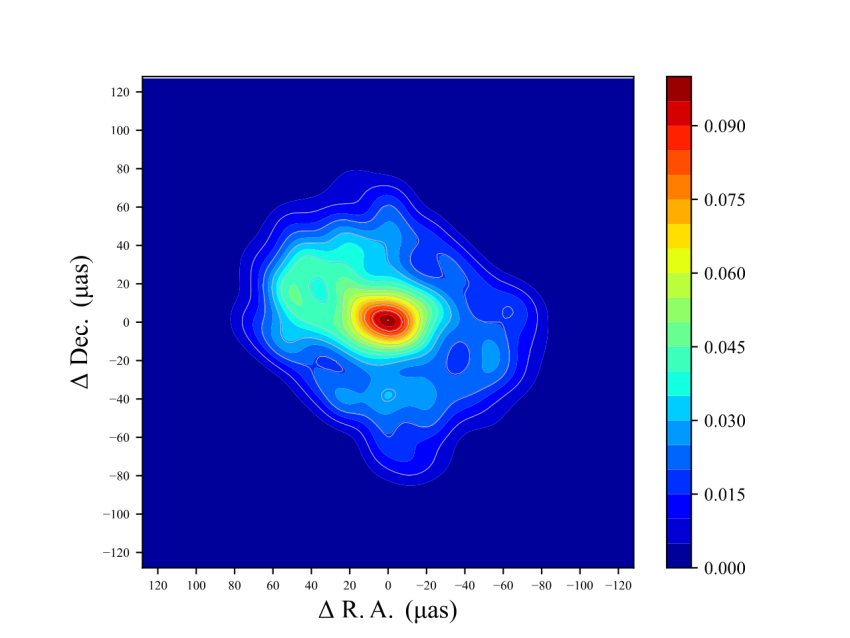
Surprise, surprise! A new analysis of the data behind the 2022 false-color radio image of the supermassive black hole at the center of the Milky Way, posted to the right, suggests that image was not accurately interpreted from the data.

Astronomers led by the National Astronomical Observatory of Japan (NAOJ) say their analysis points at Sagittarius A* having an elongated accretion disk, as opposed to the ring-like “doughnut” image released in 2022 by an international team called the Event Horizon Telescope (EHT) collaboration.

The EHT image shows a central dark region where the hole resides, circled by the light coming from super-heated gas accelerated by immense gravitational forces.

But a new paper published today in Monthly Notices of the Royal Astronomical Society suggests that part of this appearance may actually be an artefact because of the way the image was put together. … Assistant professor Miyoshi Makoto, of the NAOJ, said: “Our image is slightly elongated in the east-west direction, and the eastern half is brighter than the western half. We think this appearance means the accretion disk surrounding the black hole is rotating at about 60 per cent of the speed of light.” He added: “Why, then, did the ring-like image emerge? Well, no telescope can capture an astronomical image perfectly. We hypothesise that the ring image resulted from errors during EHT’s imaging analysis and that part of it was an artefact, rather than the actual astronomical structure.”

It must be noted that this false color radio image was assembled from eight different radio telescopes across the globe, and to bring the data together required a great deal of massaging. While most astronomers appear to favor the top picture, it is just as likely that the bottom picture is a better representation. Either way, both must be considered in any future studies of Sagittarius A*’s environment and structure.

2 comments

SpaceX asks FCC for license revision for launching nearly 30,000 Starlink satellites

SpaceX on October 11, 2024 submitted a request to the FCC to revise its Starlink satellite license to cover a revised plan for its second generation satellites that includes a request to place 29,988 Starlink satellites in orbit.

SpaceX first requests several amendments to the orbital parameters of its Gen2 system between 340 km and 365km altitude to keep pace with rapidly evolving global demand for high-quality broadband. First,SpaceX amends the inclination of its orbital shell at a nominal altitude of 345 km from 46 degrees to 48 degrees. SpaceX also amends its pending Gen2 application to seek authority to operate satellites in its Gen2 system in two additional orbital shells — at 355 km altitude in a 43-degree inclination and at 365 km altitude in a 28- or 32-degree inclination. The total number of operational satellites will remain 29,988 satellites across the amended Gen2 system.

With the exception of its polar shell at 360 km, which will remain unchanged, SpaceX also amends its application to more flexibly distribute satellites in its shells between 340 km and 365 km than requested in its pending application, specifically, in up to 72 planes per shell and up to 144 satellites per plane. While this reconfiguration will result in two additional shells and a higher maximum number of orbital planes and satellites per plane for all but one shell between 340 km and 365 km, the total number of operational satellites in the Gen2 system will remain 29,988 satellites.

In the company’s previous request for this number of satellites, the FCC had approved only 7,500, the full request still pending. We can expect objections from the other big satellite constellations to this request. The FCC’s response remains unclear. There could be legitimate reasons to limit SpaceX request, but it is also possible politics will enter the decision as well, for illegitimate reasons.

Meanwhile, astronomers are already whining about the problems these Starlink satellites will cause to their ground-based telescopes. It seems these so-called brilliant scientists can’t get it through their heads that astronomy from Earth will become increasingly difficult in the coming years — with hundreds of thousands of satellites planned from many satellite constellations, not just SpaceX — while astronomy from space has always been a better choice anyway. Rather than demand regulation or restrictions on these new satellite constellations, they should be pushing hard to developing new orbiting telescopes, now, for launch as quickly as possible.

8 comments

A galaxy squashed as it plows its way through the intergalactic medium

A galaxy squashed by a vacuum
Click for original image.

Time for another cool image on this relatively slow day in the space news business. The picture to the right, cropped, reduced, and sharpened to post here, was taken by the Hubble Space Telescope and released today by the European Space Agency’s press department. From the caption:

Appearances can be deceiving with objects so far from Earth — IC 3225 itself [the galaxy to the right] is about 100 million light-years away — but the galaxy’s location suggests some causes for this active scene, because IC 3225 is one of over 1300 members of the Virgo galaxy cluster. The density of galaxies in the Virgo cluster creates a rich field of hot gas between them, the so-called ‘intracluster medium’, while the cluster’s extreme mass has its galaxies careening around its centre in some very fast orbits. Ramming through the thick intracluster medium, especially close to the cluster’s centre, places an enormous ‘ram pressure’ on the moving galaxies that strips gas out of them as they go.

IC 3225 is not so close to the cluster core right now, but astronomers have deduced that it has undergone this ram pressure stripping in the past. The galaxy looks as though it’s been impacted by this: it is compressed on one side and there has been noticeably more star formation on this leading edge, while the opposite end is stretched out of shape. Being in such a crowded field, a close call with another galaxy could also have tugged on IC 3225 and created this shape. The sight of this distorted galaxy is a reminder of the incredible forces at work on astronomical scales, which can move and reshape even entire galaxies!

What makes the impact on this galaxy of that intercluster medium so astonishing is that medium is so relatively empty of material. The space between galaxies in the Virgo cluster is in all intents and purposes a vacuum far more empty than any that we can create in a chamber on Earth. And yet it was enough to distort this galaxy and cause star formation on the galaxy’s leading edge.

5 comments

A water sprinkler in space

A sprinkler in space

Cool image time! The picture to the right, cropped, reduced, and sharpened to post here, was taken by the Hubble Space Telescope as part of a long term program to monitor changes in the R Aquarii binary star system, located about 700 light years away.

R Aquarii belongs to a class of double stars called symbiotic stars. The primary star is an aging red giant and its companion is a compact burned-out star known as a white dwarf. The red giant primary star is classified as a Mira variable that is over 400 times larger than our Sun. The bloated monster star pulsates, changes temperature, and varies in brightness by a factor of 750 times over a roughly 390-day period. At its peak the star is blinding at nearly 5,000 times our Sun’s brightness.

When the white dwarf star swings closest to the red giant along its 44-year orbital period, it gravitationally siphons off hydrogen gas. This material accumulates on the dwarf star’s surface until it undergoes spontaneous nuclear fusion, making that surface explode like a gigantic hydrogen bomb. After the outburst, the fueling cycle begins again.

This outburst ejects geyser-like filaments shooting out from the core, forming weird loops and trails as the plasma emerges in streamers. The plasma is twisted by the force of the explosion and channeled upwards and outwards by strong magnetic fields. The outflow appears to bend back on itself into a spiral pattern. The plasma is shooting into space over 1 million miles per hour – fast enough to travel from Earth to the Moon in 15 minutes! The filaments are glowing in visible light because they are energized by blistering radiation from the stellar duo.

The press release likens these filaments to the spray thrown out by a water sprinkler, and I must say that’s an apt description.

Since 2014 scientists have taken regular pictures of R Aquarii, and found that the central structures have been changing in a perceptible manner, despite their gigantic size. Below is a movie created from five photos taken from 2014 to 2023.
» Read more

0 comments

ESA releases first section of grand mosaic of the sky to be produced by Euclid

Euclid's first released mosaic
For original images, go here, here, and here.

The European Space Agency (ESA) yesterday released the first mosaic section of a grand atlas of the sky that its recently launched Euclid space telescope was designed to produce.

The image to the right, assembled from several images but of very low resolution to post here, will give my readers an idea of Euclid’s capabilities. The top image shows this first mosaic in green, made up of 260 photos, laid on top of the sky atlases produced by the Gaia and Plank orbiting telescopes. As you can see, it covers only about 12% of the sky, but was also produced in only the last six months, since science observations began in February. When complete, the Euclid atlas will cover one third of the sky, and provide very high resolution data for that entire area.

The middle image provides a close-up of that mosaic, albeit in very low resolution.

This first piece of the map already contains around 100 million sources: stars in our Milky Way and galaxies beyond. Some 14 million of these galaxies could be used to study the hidden influence of dark matter and dark energy on the Universe. “This stunning image is the first piece of a map that in six years will reveal more than one third of the sky. This is just 1% of the map, and yet it is full of a variety of sources that will help scientists discover new ways to describe the Universe,” says Valeria Pettorino, Euclid Project Scientist at ESA.

The bottom image, once again at low resolution to post here, zooms into only one small section of that mosaic, and illustrates the high level of detail each Euclid image will contain. Though the details in this photo seem a bit fuzzy, at full resolution they remain remarkably sharp. To get an idea of how good that resolution is, see an earlier Euclid close-up photo released in May.

Euclid doesn’t take pictures with the quite the resolution of Hubble (its primary mirror at 1.2 meters diameter is half the width). While Hubble was designed to zoom in at specific objects and do so over and over if desired, Euclid will instead provide a high resolution snapshot of the entire sky, at a resolution almost as good, in both optical and infrared wavelengths.

2 comments

Viewing Comet Tsuchinshan-ATLAS when it enters the evening sky

Link here. For those living in the northern hemisphere, Comet Tsuchinshan-ATLAS will be bright and visible to the naked eye just after sunset beginning tomorrow.

“As soon as October 11th, ambitious comet spotters may pick up the comet during twilight just above the western horizon,” says Sky & Telescope Contributing Editor Bob King. “Binoculars will help you see the comet throughout its appearance.”

About 40 minutes after sunset on Friday, find a spot with a good view down to the western horizon. The first thing that will catch your eye will be the bright planet Venus, the Evening Star — that’s your starting point. Hold your fist out at arm’s length; the comet is about 2½ fists to Venus’s right. The comet will still look tiny in Friday’s twilight — like a hazy star with a small tail — and will set while twilight is still in progress.

Comet Tsuchinshan-ATLAS (pronounced choo-cheen-SHAHN) will remain visible for the next ten days, with the best viewing likely from October 13th to October 16th.

5 comments

Jupiter’s Great Red Spot appears to jiggle like Jello on a 90-day cycle

Jupiter as seen by Hubble over time
Click for original image.

Using the Hubble Space Telescope to photograph Jupiter’s Great Red Spot repeatedly over a four month period from December 2023 to March 2024 scientists have detected a 90-day cycle in which the spot oscillated in shape, shaking like Jello.

“While we knew its motion varies slightly in its longitude, we didn’t expect to see the size oscillate. As far as we know, it’s not been identified before,” said Amy Simon of NASA’s Goddard Space Flight Center in Greenbelt, Maryland, lead author of the science paper published in The Planetary Science Journal. “This is really the first time we’ve had the proper imaging cadence of the GRS. With Hubble’s high resolution we can say that the GRS is definitively squeezing in and out at the same time as it moves faster and slower. That was very unexpected, and at present there are no hydrodynamic explanations.”

The four images to the right are some of those observations. For a full movie showing the changes over ninety days, go here.

The scientists also predict that though the spot has been shrinking for decades, they expect that shrinkage to stop once the spot size no longer extends beyond the jet stream band within which it sits. At that point the different jet streams in the upper and lower bands will hold the spot in place and its size will stabilize.

0 comments

Astronomers find another galaxy that shouldn’t be there in the early universe

REBELS-25
Click for original image.

The uncertainty of science: Using ground-based telescopes, astronomers have identified a galaxy only 700 million years after the Big Bang that is far more organized and coherent in shape and structure than thought possibly that soon after the theorized creation of the universe.

The galaxy in question is dubbed REBELS-25. It is at a red shift of z=7.31, which means that it is from a time when the universe was only 700 million years old. The earliest galaxies ever seen are only a few hundred million years older.

REBELS by name rebel by nature. This odd galaxy has stumped astronomers because it shows evidence of an ordered structure and rotation. It may even have a central elongated bar and spiral arms, though further observation is needed to confirm these structures.

This is in contrast to the small, messy, lumpy and chaotic norm for galaxies of a similar age. “According to our understanding of galaxy formation, we expect most early galaxies to be small and messy looking,” says co-author Jacqueline Hodge, an astronomer at Leiden University in the Netherlands.

You can read the published paper here [pdf]. The picture to the right shows this galaxy as seen by the Atacama Large Millimeter/submillimeter Array (ALMA) in Chile.

The consensus view of the early universe said there would not have been enough time for such a structured galaxy to form. And yet as astronomers use the improved astronomical instrumentation of our time to look deeper and deeper at that early universe, they keep finding things — like this galaxy — that defy that consensus view.

The answer to this mystery remains unknown, and is likely not yet answerable with the data we presently have. The data we do have however is beginning to suggest that scientists might have to begin looking at fundamentally different theories as to the inital formation of the universe. The Big Bang might still work, but if so it might require a major rewrite.

6 comments

Scientists confirm theory that thunderstorms on Earth also produce gamma ray bursts

Prior to the 1990s, the origin of gamma ray bursts (GRBs) was uttlerly known. First detected by satellites in the early 1970s, astronomers has no idea what caused them because without a parallel detection in optical light they had no way to determine their distance. Theories suggested the bursts could be coming from billions of light years away, from within the Milky Way, from inside the solar system, and from even the Earth’s upper atmosphere.

In the 1990s it was finally proven that GRBs almost all come from very distant cosmic events, billions of light years away, each signaling the formation of a black hole.

Now researchers have confirmed the theory that GRBs are also occuring within the Earth’s atmosphere, though these GRBs have no resemblance to the astronomical ones.

During thunderclouds, two different hard radiation phenomena have so far been known to originate: Terrestrial Gamma-ray Flashes (TGFs) and gamma-ray glows. This third phenomenon, observed and named FGFs by Østgaard et al. [2024] resembles the other two, while at the same time revealing certain characteristics separating FGFs from the others. Most noteworthy may be that FGFs are pulses of gamma-rays not associated with any detectable optical or radio signals.

“We think that FGFs could be the missing link between TGFs and gamma-ray glows, whose absence has been puzzling the atmospheric electricity community for two decades”, says lead author and Professor Nikolai Østgaard at the University of Bergen.

More information on this research can be found here. The research not only confirms the early theories as well as later detections, it adds significant nuance to the data. As noted at this second link:

“The dynamics of gamma-glowing thunderclouds starkly contradicts the former quasi-stationary picture of glows, and rather resembles that of a huge gamma-glowing boiling pot both in pattern and behavior,” said Martino Marisaldi, professor of physics and technology at the University of Bergen.

Given the size of a typical thunderstorm in the tropics, which get much larger than storms at other latitudes, this suggests that more than half of all thunderstorms in the tropics are radioactive. The researchers postulate that this low-level production of gamma radiation acts like steam boiling off a pot of water and limits how much energy can be built up inside.

This data will help refined the computer models that attempt to predict weather patterns, as it appears the phenomenon impacts the formation of thunderstorms.

5 comments
1 9 10 11 12 13 113