Webb infrared spectroscopy detects differences between morning and evening on tidally-locked exoplanet

Webb spectroscopic data
Click for original image.

Astronomers using Webb Space Telescope’s infrared spectroscopy have now detected distinct differences in the morning and evening atmosphere of a tidally-locked gas giant exoplanet.

The graph, cropped, reduced, sharpened, annotated to post here, shows the differences. From the caption:

Researchers using NASA’s James Webb Space Telescope have finally confirmed what models have previously predicted: An exoplanet has differences between its eternal morning and eternal evening atmosphere. WASP-39 b, a giant planet with a diameter 1.3 times greater than Jupiter, but similar mass to Saturn that orbits a star about 700 light-years away from Earth, is tidally locked to its parent star. This means it has a constant dayside and a constant nightside—one side of the planet is always exposed to its star, while the other is always shrouded in darkness.

Using Webb’s NIRSpec (Near-Infrared Spectrograph), astronomers confirmed a temperature difference between the eternal morning and eternal evening on WASP-39 b, with the evening appearing hotter by roughly 300 Fahrenheit degrees (about 200 Celsius degrees). They also found evidence for different cloud cover, with the forever morning portion of the planet being likely cloudier than the evening.

The actual temperatures of each terminator are quite hot, approximately 1,150 and 1450 degrees Fahrenheit respectively. Computer modeling suggests “the prevailing winds are likely moving from the night side across the morning terminator, around the dayside, across the evening terminator and then around the nightside,” with wind speeds thousands of miles per hour.

1 comment

Radar detects tiny moon of asteroid

Binary asteroid
Click for original image.

Using the Goldstone radar dish, part of NASA’s Deep Space Network normally used to communicate with planetary missions, scientists have taken radar imageray of an asteroid that flew past the Earth at a distance of about 4.1 million miles on June 27, 2024, and discovered that it has its own tiny moon.

The series of radar images are above, reduced and cropped to post here.

Passing Earth on June 27, 2024, the asteroid was discovered in 2011 by the NASA-funded Catalina Sky Survey, in Tucson, Arizona. This marked the first time it came close enough to Earth to be imaged by radar. While the nearly mile-wide object is classified as being potentially hazardous, calculations of its future orbits show that it won’t pose a threat to our planet for the foreseeable future.

In addition to determining the asteroid is roughly spherical, scientists at NASA’s Jet Propulsion Laboratory discovered that it’s a binary system: A smaller asteroid, or moonlet, orbits it from a distance of about 1.9 miles.

It is intriguing that as their ability to make high resolution images of asteroids improves, scientists are discovering that such binary asteroid systems appear to be less and less rare, and might even be quite normal. If so, these facts will reshape all theories on the initial formation processes of the solar system.

0 comments

A penguin and egg, as seen by Webb and Hubble

A penquin and egg compared
Click for original images.

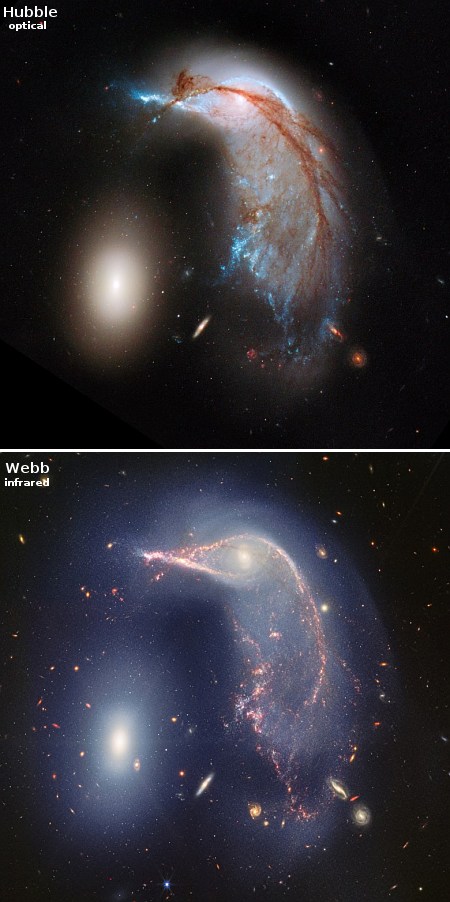
Cool image time! The two pictures to the right, cropped, reduced, and sharpened to post here, were taken by both the Webb and Hubble space telescopes of the same unusual galactic object, officially called Arp 142 but nicknamed by astronomers the Penquin and the Egg.

Both of these objects are galaxies. The Penquin’s strange shape is caused by the presence of the Egg, which is an elliptical galaxy that is twisting and distorting the Penquin’s original spiral galaxy whirlpool as it flies past. From the caption:

Like all spiral galaxies, the Penguin is still very rich in gas and dust. The galaxies’ “dance” gravitationally pulled on the Penguin’s thinner areas of gas and dust, causing them to crash in waves and form stars. Look for those areas in two places: what looks like a fish in its “beak” and the “feathers” in its “tail.”

Surrounding these newer stars is smoke-like material that includes carbon-containing molecules, known as polycyclic aromatic hydrocarbons, which Webb is exceptional at detecting. Dust, seen as fainter, deeper orange arcs also swoops from its beak to tail feathers.

In contrast, the Egg’s compact shape remains largely unchanged. As an elliptical galaxy, it is filled with aging stars, and has a lot less gas and dust that can be pulled away to form new stars. If both were spiral galaxies, each would end the first “twist” with new star formation and twirling curls, known as tidal tails.

Another reason for the Egg’s undisturbed appearance: These galaxies have approximately the same mass or heft, which is why the smaller-looking elliptical wasn’t consumed or distorted by the Penguin.

The differences between the two pictures also reveal many aspects of the Penguin. The Hubble optical image at the top captures the lanes of dust in the foreground, while the Webb infrared image at the bottom looks right through this dust to better trace the now-distorted spiral arms where star formation is presently taking place.

Astronomers estimate that these two galaxies are about 100,000 light years apart, comparable to the width of the Milky Way. In comparison, the Andromeda galaxy is around 2.5 million light years away, and will not begin interacting with our galaxy in this manner for an estimated four billion years. The Egg and Penguin however began their warped dance about 50 million years ago.

4 comments

Astronomers: A black hole weighing 8,200 solar masses likely sits at the center of the Milky Ways’ largest globular cluster

Omega Centauri
Click for original image.

By analyzing the motion of seven fast moving stars at the center of the globular cluster Omega Centauri, the largest such cluster in the Milky Way and located about 18,000 light years away, astronomers now think they have detected evidence of an intermediate-sized black hole weight at least 8,200 solar masses.

You can read the published paper here. [pdf] The picture of Omega Centauri to the right, reduced and sharpened to post here, was created from more than 500 images taken over two decades by the Hubble Space Telescope. The inset, figure 1b of the paper, shows those seven fast-moving stars in pink, each having an arrow indicating the distance they are expected to move in a 100 years. The dashed circle marks the region where the black hole is believed to reside, with the dark blue cross in its upper left quadrant the most likely position of the black hole based on calculations.

From the caption for the larger Omega Centauri Hubble image:

Omega Centauri is visible from Earth with the naked eye and is one of the favourite celestial objects for stargazers in the southern hemisphere. Although the cluster is 17 700 light-years away, lying just above the plane of the Milky Way, it appears almost as large as the full Moon when seen from a dark rural area.

Though such intermediate-sized black holes have been theorized as existing inside globular clusters, I think this is the first real evidence of one.

9 comments

Webb: An exoplanet in the habitable zone with a possible nitrogen/CO2 atmosphere and water ocean

Using the Webb Space Telescope, astronomers have obtained new transiting spectroscopy of a “mini-Neptune-sized” exoplanet that circles in the habitable zone a red dwarf star about 48 light years away and have concluded that it appears to have a nitrogen/carbon dioxide atmosphere and even a water ocean.

While it is still only a tentative result, the presence of a nitrogen-rich atmosphere on LHS 1140 b would suggest the planet has retained a substantial atmosphere, creating conditions that might support liquid water. This discovery favors the water-world/snowball scenario as the most plausible.

Current models indicate that if LHS 1140 b has an Earth-like atmosphere, it would be a snowball planet with a vast “bull’s-eye” ocean measuring about 4,000 kilometers in diameter, equivalent to half the surface area of the Atlantic Ocean. The surface temperature at the centre of this alien ocean could even be a comfortable 20 degrees Celsius [68 degrees Fahrenheit]. [emphasis mine]

You can read the preprint of the paper here [pdf].

The highlighted phrase must be noted. These results contain a lot of uncertainties and assumptions. However, the data is tantalizing, to say the least, and justify more observations using Webb. The scientists argue in their paper that because there are only about eight transits of the exoplanet per year — requiring several years of observations to pin down this data more precisely — and because Webb has a limited life expectancy as an infrared observatory, this star should get observational priority.

2 comments

Webb: Hot Jupiter exoplanet has atmosphere with the smell of rotten eggs

Using spectroscopy from the infrared Webb Space Telescope, astronomers have measured some of the molecules in exoplanet HD 189733 b, one of the first hot Jupiter exoplanets ever discovered, and found it has an atmosphere rich in hydrogen sulfide, which emits a smell like rotten eggs.

In addition to detecting hydrogen sulfide, the team analyzed the planet’s oxygen and carbon content, pinpointing water, carbon dioxide and carbon monoxide as major components of the planetary atmosphere. Measuring these heavy elements allows astronomers to compare the composition of exoplanets to that of gas giants in our solar system like Jupiter and Uranus.

The exoplanet, about 64 light years away, has an orbit lasting only about two Earth days, with atmospheric temperatures has hot as 1,700 degrees Fahrenheit.

1 comment

Can you spot the supernova?

Supernova 2022zut
Click for original image.

Cool image time! The picture to the right, reduced and sharpened to post here, was taken using the Hubble Space Telescope and was done as part of a larger research project studying what astronomers call Type 1a supernovae.

NGC 3810, the galaxy featured in this image, was the host of a Type Ia supernova in 2022. In early 2023 Hubble focused on this and a number of other galaxies to closely examine recent Type Ia supernovae. This kind of supernova results from a white dwarf exploding, and they all have a very consistent brightness. That allows them to be used to measure distances: we know how bright a Type Ia supernova should be, so we can tell how far away it must be from how dim it appears.

One uncertainty in this method is that intergalactic dust in between Earth and a supernova blocks some of its light. How do you know how much of the reduction in light is caused by distance, and how much by dust? With the help of Hubble, there’s a clever workaround: take images of the same Type Ia supernovae in ultraviolet light, which is almost completely blocked by dust, and in infrared light, which passes through dust almost unaffected. By carefully noting how much light comes through at each wavelength, the relationship between supernova brightness and distance can be calibrated to account for dust. Hubble can observe both these wavelengths of light in great detail with the same instrument. That makes it the perfect tool for this experiment, and indeed, some of the data used to make this beautiful image of NGC 3810 were focused on its 2022 supernova. You can see it as a point of light just below the galactic nucleus, or in the annotated image here.

Can you spot the supernova? If you can’t without checking the annotated or original image, don’t be disappointed. It is there but hard to distinguish unless you know where to look.

This supernova however does illustrate the advances in astronomical observational capabilities in the past two decades, resulting not from the giant big ground-based telescopes that cost a fortune and take decades to build nor from the space telescopes like Hubble and Webb that get all the press. These new capablities come from sophisticated smaller telescopes designed to do daily surveys of the entire sky, combined with software that can quickly compare images each day and identify anything that changed.

For example, this 2022 supernova was the 18,142nd discovered that year. That total exceeds the entire number of supernovae that had been discovered in all history prior to this century.

2 comments

Webb takes false-color infrared image of bi-polar protostar nebula

Hourglass nebula as seen in infrared by Webb
Click for original image.

Scientists using the Webb Space Telescope have now produced a new false-color infrared image of the bi-polar hour-glass-shaped protostar nebula dubbed L1527.

That image is to the left, created from data from Webb’s MIRI (Mid-Infrared Instrument) and cropped, reduced, and sharpened to post here. While it is not quite a pretty as a prevous Webb infrared image taken in 2022 by its NIRCam (Near-Infrared Camera), it provides new information about the make-up of materials within this nebula. From the caption:

The areas colored here in blue, which encompass most of the hourglass, show mostly carbonaceous molecules known as polycyclic aromatic hydrocarbons. The protostar itself and the dense blanket of dust and a mixture of gases that surround it are represented in red. (The sparkler-like red extensions are an artifact of the telescopes’s optics). In between, MIRI reveals a white region directly above and below the protostar, which doesn’t show as strongly in the NIRCam view. This region is a mixture of hydrocarbons, ionized neon, and thick dust, which shows that the protostar propels this matter quite far away from it as it messily consumes material from its disk.

Previous to Webb, this object had mostly been studied in 2012 using radio and submillimeter wavelengths (see the papers here and here), but those papers determined this is possibly the youngest known protostar, less than 100,000 years old.

0 comments

Astronomers see a quiet galaxy become active for the first time

Using a number of space- and ground-based telescopes, astronomers have for the first time seen in real time what had previously been a very inactive and quiet galaxy become active and energetic, suggesting a major event at the galaxy’s center had taken place to change its behavior.

From the abstract of the paper [pdf]:

We conclude that the variations observed in SDSS1335+0728 could be either explained by a ∼ 10 6 M ⊙ AGN [a one million solar mass black hole] that is just turning on or by an exotic tidal disruption event (TDE). If the former is true, SDSS1335+0728 is one of the strongest cases of an AGN observed in the process of activating. If the latter were found to be the case, it would correspond to the longest and faintest TDE ever observed (or another class of still unknown nuclear transient). Future observations of SDSS1335+0728 are crucial to further understand its behaviour.

As noted in the press release:

Some phenomena, like supernova explosions or tidal disruption events — when a star gets too close to a black hole and is torn apart — can make galaxies suddenly light up. But these brightness variations typically last only a few dozen or, at most, a few hundreds of days. SDSS1335+0728 is still growing brighter today, more than four years after it was first seen to ‘switch on’. Moreover, the variations detected in the galaxy, which is located 300 million light-years away in the constellation Virgo, are unlike any seen before.

If the central black hole is switching from being quiet to active, this galaxy is providing astronomers critical information for understanding such changes. This is particularly important to us here in the Milky Way, which has a very inactive central supermassive black hole weighing about 4 million solar masses. It would be very useful to understand what would cause it to become active, especially because such an event might even have an impact — possibly negative — throughout our entire galaxy.

5 comments

Scientists release first image from Hubble in one-gyro mode

First Hubble image in one-gyro mode
Click for original image.

The Hubble science team today released the first image from the Hubble Space Telescope produced in its new one-gyro mode.

That image it so the right, cropped, reduced, and sharpened to post here, and shows NGC 1546, a nearby galaxy in the constellation Dorado about 52 million light years away. The inset shows at full resolution the small red galaxy near the top, to give some sense of the telescope’s capabilities in this one-gyro mode.

The details astonish me, and prove my pessimism about this new mode to have been wrong. I expected future images to be more fuzzy, with Hubble’s ability to take sharp images largely limited. The resolution here is excellent, and bodes well for future science observations.

Nonetheless, the telescope is still working under major limitations:

Although one-gyro mode is an excellent way to keep Hubble science operations going, it does have limitations, which include a small decrease in efficiency (roughly 12 percent) due to the added time required to slew and lock the telescope onto a science target.

As previously noted, prior to the use of the fine guidance sensors, fixed head star trackers position Hubble’s pointing closer to the target. If Earth or the moon block two of the fixed head star trackers’ fields of view, Hubble must move further along in its orbit until the star trackers can see the sky and its stars again. This process encroaches upon science observation time. Second, the additional time the fine guidance sensors take to further search for the guide stars adds to the total time the sensors use to complete the acquisition.

Third, in one-gyro mode Hubble has some restrictions on the science it can do. For example, Hubble cannot track moving objects that are closer to Earth than the orbit of Mars. Their motion is too fast to track without the full complement of gyros. Additionally, the reduced area of sky that Hubble can point to at any given time also reduces its flexibility to see transient events or targets of opportunity like an exploding star or an impact on Jupiter.

When combined, these factors may yield a decrease in productivity of roughly 20 to 25 percent from the typical observing program conducted in the past using all three gyros.

It really is time for the astronomical community to get its act together and begin work on developing and launching more large optical telescopes into space. Hubble has shown us the potential of in-space optical astronomy. That astronomers have not flocked in the last three decades to build more such telescopes is puzzling beyond belief.

7 comments

Once again, the first known binary of two supermassive black holes flares as predicted

The predicted orbit of OJ287

Using a variety of space telescopes astronomers have successfully predicted and then observed a major flare that occurred on November 12, 2021 from OJ287, the first known binary of two supermassive black holes located 3.5 billion light years away at the center of a very active galaxy dubbed a blazar.

On Nov. 12, 2021, TESS detected OJ 287 brightening by about two magnitudes for about 12 hours, as it released as much energy in that short burst as 100 average galaxies would release in the same time. This flare was attributed to a jet from the second black hole; observations from the other telescopes supported that result as well, with Fermi in particular detecting a significant outburst of gamma rays.

The figure to the right comes from the published paper [pdf], and shows the orbit of the smaller supermassive black hole — weighing 150 million solar masses — as it circled the larger central supermassive black hole — weighing 18 billion solar masses — from 2000 to 2021.

This was not the first time such a flare from OJ287 had been predicted and observed. Astronomers also did it in 2019. These observations now strongly confirm the predicted orbit of the small black hole, as shown in the figure.

1 comment

Webb produces false color infrared image of the Crab Nebula

The Crab Nebula as in infrared by Webb
Click for original image.

The false-color infrared picture to the right, reduced and sharpened to post here, was taken by the Webb Space Telescope of the Crab Nebula, located 6,500 light years away and created when a star went supernova in 1054 AD, in order to better understand its make-up and origins. From the caption:

The supernova remnant is comprised of several different components, including doubly ionized sulfur (represented in green), warm dust (magenta), and synchrotron emission (blue). Yellow-white mottled filaments within the Crab’s interior represent areas where dust and doubly ionized sulfur coincide.

The spectroscopic data from this infrared observation has in fact increased the puzzle of the Crab’s origin. Previously the data suggested the supernova that caused it was one type of supernova. This data now suggests it could have been a different type, without precluding the possibility of the first.

“Now the Webb data widen the possible interpretations,” said Tea Temim, lead author of the study at Princeton University in New Jersey. “The composition of the gas no longer requires an electron-capture explosion, but could also be explained by a weak iron core-collapse supernova.”

You can read the published science paper here [pdf].

0 comments

Evidence of giant asteroid collision in debris disk surrounding the star Beta Pictoris

Data difference between Spitzer and Webb
Click for original figure.

Scientists comparing infrared data collected twenty years apart — first by the Spitzer Space Telescope and then by the Webb Space Telescope — think they have detected evidence of a gigantic asteroid collision in the debris disk that surrounds the very young star Beta Pictoris, located 63 light years away.

The graph to the right shows the change found between the observations. From the caption:

Scientists theorize that the massive amount of dust seen in the 2004–05 image from the Spitzer Space Telescope indicates a collision of asteroids that had largely cleared by the time the James Webb Space Telescope captured its images in 2023.

…When Spitzer collected the earlier data, scientists assumed something like small bodies grinding down would stir and replenish the dust steadily over time. But Webb’s new observations show the dust disappeared and was not replaced. The amount of dust kicked up is about 100,000 times the size of the asteroid that killed the dinosaurs, Chen said.

It is believed by scientists that the debris disk that surrounds Beta Pictoris is comparable to the early solar system when the planets first started to form. This collision could be similar to the kind of collision that is thought to have formed the Moon, when a large Mars-sized object smashed into the early Earth.

6 comments

Webb detects carbon in early galaxy, far earlier than expected

The uncertainty of science: Astronomers using the Webb Space Telescope have detected evidence of carbon in a galaxy estimated to exist only 350 million years after the Big Bang, much sooner than any theory had predicted such an element could have developed.

“We were surprised to see carbon so early in the universe, since it was thought that the earliest stars produced much more oxygen than carbon,” said Maiolino. “We had thought that carbon was enriched much later, through entirely different processes, but the fact that it appears so early tells us that the very first stars may have operated very differently.”

According to some models, when the earliest stars exploded as supernovas, they may have released less energy than initially expected. In this case, carbon, which was in the stars’ outer shell and less gravitationally bound than oxygen, could have escaped more easily and spread throughout the galaxy, while a large amount of oxygen fell back and collapsed into a black hole.

The paper is available here.

The scientists are struggling to explain this result in the context of the Big Bang theory itself, and have come up with scenarios where it will work. However, the fact that Webb has found another data point suggesting the early universe was more complicated than any model predicted increases the difficulty in producing Big Bang models that will work.

All in all, there remains great uncertainty here. This particular observation required 65 hours of observation time. Pulling real data from these very distant points of light remains quite challenging.

8 comments

Telescope removed from Mauna Kea on Big Island as local Hawaiian council rejects new telescopes on Haleakala on Maui

Even as a local Hawaiian authority on the Big Island has completed the removal of the first of three telescopes on the top of Mauna Kea, a local council on the island of Maui have voted 9-0 to oppose an Air Force project to build new telescopes on top of Haleakala.

The proposed new facility is called AMOS STAR, which is an acronym for Air Force Maui Optical and Supercomputing Site Small Telescope Advanced Research. It would feature six telescopes enclosed in ground-mounted domes and one rooftop-mounted domed telescope.

The county’s resolution urged the military to heed community calls to cease their development efforts. It urged the National Park Service, Federal Aviation Administration and the Hawaii Department of Land and Natural Resources to deny the project permits.

At this time it appears that Hawaiians desended from the original indigenous population are opposed to all western technology, even as they rely on it. These new telescopes are proposed by the Air Force because it needs better capilities to track the tens of thousands of new satellites being launched by numerous companies and governments. This information will help prevent collisions in space.

As for their claims that these peaks are “considered wao akua, or ‘realm of the gods,’ and [places] of deep spirituality for Native Hawaiians to engage in some of these traditional practices,” as stated in the council’s resolution, I have some doubts. For almost three-quarters of a century such religious concerns and objections were never mentioned by anyone. If they existed indigenous Hawaiians appeared to have no problem “engaging in traditional practices” right next to telescopes. Only when some activists appeared in the past decade, looking to insert themselves in the process (thus obtaining positions of power and money) did the peaks become so important religiously.

15 comments

Hubble goes to one-gyro mode, limiting the telescope’s observational capabilities; NASA rejects private repair mission

Story Musgrave on the shuttle robot arm during the last spacewalk of the 1993 Hubble repair mission
Story Musgrave on the shuttle robot arm during
the last spacewalk of the 1993 Hubble repair mission

After the third safe mode event in six months, all caused by issues with the same gyroscope, engineers have decided to shift the Hubble Space Telescope to what they call one-gyro mode, whereby the telescope is pointed using only one gyroscope, and the remaining working gyro is kept in reserve.

The spacecraft had six new gyros installed during the fifth and final space shuttle servicing mission in 2009. To date, three of those gyros remain operational, including the gyro currently experiencing problems, which the team will continue to monitor. Hubble uses three gyros to maximize efficiency but can continue to make science observations with only one gyro. NASA first developed this plan more than 20 years ago, as the best operational mode to prolong Hubble’s life and allow it to successfully provide consistent science with fewer than three working gyros. Hubble previously operated in two-gyro mode, which is negligibly different from one-gyro mode, from 2005-2009. One-gyro operations were demonstrated in 2008 for a short time with no impact to science observation quality.

While continuing to make science observations in one-gyro mode, there are some expected minor limitations. The observatory will need more time to slew and lock onto a science target and won’t have as much flexibility as to where it can observe at any given time. It also will not be able to track moving objects closer than Mars, though these are rare targets for Hubble.

This NASA press release is carefully spun to hide the simple fact that in one-gyro mode, the telescope will simply not be able to take sharp pictures. » Read more

21 comments

Hubble once again in safe mode due to gyro problem

On May 24, 2024 the Hubble Space Telescope once again paused its science operations and entered in safe mode, apparently due to gyroscope problem.

The telescope automatically entered safe mode when one of its three gyroscopes gave faulty telemetry readings. Hubble’s gyros measure the telescope’s slew rates and are part of the system that determines and controls precisely the direction the telescope is pointed. NASA will provide more information early the first week of June.

It is not clear if this is the same gyroscope that caused the last two safe mode events.

With each such event the telescope gets closer and closer to having only two gyroscopes. At that point it will shift to one-gyro mode, using only one and holding the second in reserve. From then on it will no longer be able to take perfectly sharp pictures. Science will still be possible, but not like before.

9 comments

Astronomers find another record-setting most distant galaxy

The uncertainty of science: Using the Webb Space Telescope, astonomers have identified another record-setting most distant galaxy, believed to exist only 300 million years after the Big Bang and once again far more massive and developed than expected that early in the universe.

The galaxy was actually one of two very early galaxies identified that lie close to each other on the sky but are not linked in any way.

The two record-breaking galaxies are called JADES-GS-z14-0 and JADES-GS-z14-1, the former being the more distant of the two. In addition to being the new distance record holder, JADES-GS-z14-0 is remarkable for how big and bright it is. “The size of the galaxy clearly proves that most of the light is being produced by large numbers of young stars,” said Eisenstein, a Harvard professor and chair of the astronomy department, “rather than material falling onto a supermassive black hole in the galaxy’s center, which would appear much smaller.”

The combination of the extreme brightness and the fact that young stars are fueling this high luminosity makes JADES-GS-z14-0 the most striking evidence yet found for the rapid formation of large, massive galaxies in the early Universe.

All the early galaxies that Webb has found so far have been far more massive and developed than cosmologists had predicted. The expectation had been that there wouldn’t have been enough time after the Big Bang for such galaxies to develop. Yet they have, suggesting something is not right with our theories about the beginning of the universe.

5 comments

The “Vulcan” exoplanet discovered in 2018 now refuted

In 2018 astronomers had thought they had detected an exoplanet orbiting the star 40 Eridani A — which is where in Star Trek the home world Mr. Spock was supposed to be located.

That discovery has now been refuted by much more precise observations.

[T]he planet signal is really the flickering of something on the star’s surface that coincides with a 42-day rotation – perhaps the roiling of hotter and cooler layers beneath the star’s surface, called convection, combined with stellar surface features such as spots and “plages,” which are bright, active regions.

In other words, this exoplanet does not exist. For once at least life did not imitate art.

4 comments

Dry ice and carbon monoxide detected on asteroids beyond Neptune

Based on new infrared observations by the Webb Space Telescope, scientists have detected for the first time carbon dioxide and carbon monoxide on asteroids beyond Neptune. From the abstract of their paper:

Out of 59 [trans-Neptunian objects] and centaur [asteriods] observed by the James Webb Space Telescope and the NIRSpec Integral Field Unit as part of the DiSCo-TNOs project, we report the widespread detection of CO2 ice in 95% of the sample and CO ice in 47% of the sample.

It appears dry ice is ubiquitous in the outer solar system. Since it is believed these asteroids are very primitive, this data suggests there was a lot of it in the early solar system when the planets were forming.

The discovery of so much carbon monoxide is however more puzzling, as it is expected to sublimate away even in the very cold environment so far from the Sun and is therefore likely not from the early solar system. The scientists posit that it might have been produced when radiation transformed the other carbon-bearing ices.

0 comments
1 11 12 13 14 15 113