Ground-breaking ceremony for Thirty Meter Telescope cancelled because of protesters

A ground-breaking ceremony on Mauna Kea, which would have included a blessing from native Hawaiians, was cancelled Tuesday when protesters showed up trying to block the telescope’s construction.

There were also small numbers of protesters at other locations that are also connected to the telescope project.

With previous similar protests of other telescope projects, the protesters seem to always disappear when the projects agree to give them money. Makes me wonder if their religious fervor is much shallower than the news stories of this protest would lead us to believe.

2 comments

A giant black hole in a tiny galaxy

The uncertainty of science: Astronomers have unexpectedly discovered a supermassive black hole in the center of a nearby tiny galaxy, comprising almost 18% of the galaxy’s entire mass.

To weigh the beast, the researchers measured the velocity of stars whipping about the galaxy’s centre using an infrared spectrometer on the Gemini North telescope atop Mauna Kea in Hawaii. The high velocity of the stars is best explained by a central black hole that tips the scales at 21 million times the Sun’s mass, concluded Seth’s team. That is more than five times heavier than the black hole at the centre of the Milky Way — even though M60-UCD1 has an estimated diameter of about one-six-hundredth that of our home galaxy.

Previously astronomers had believed that the size of a galaxy would predict the size of its central black hole, and that a galaxy this small would not house such a supermassive object. This find upsets those theories.

1 comment

Dawn’s arrival at Ceres delayed one month

Though engineers have solved the problems caused when a radiation blast disabled Dawn’s ion engine and put it into safe mode for a week, the fix will cause a one month delay in its arrival at the asteroid Ceres.

Controllers discovered Dawn was in safe mode Sept. 11 after radiation disabled its ion engine, which uses electrical fields to “push” the spacecraft along. The radiation stopped all engine thrusting activities. The thrusting resumed Monday (Sept. 15) after controllers identified and fixed the problem, but then they found another anomaly troubling the spacecraft.

Dawn’s main antenna was also disabled, forcing the spacecraft to send signals to Earth (a 53-minute roundtrip by light speed) through a weaker secondary antenna and slowing communications. The cause of this problem hasn’t been figured out yet, but controllers suspect radiation affected the computer’s software. A computer reset has solved the issue, NASA added. The spacecraft is now functioning normally.

1 comment

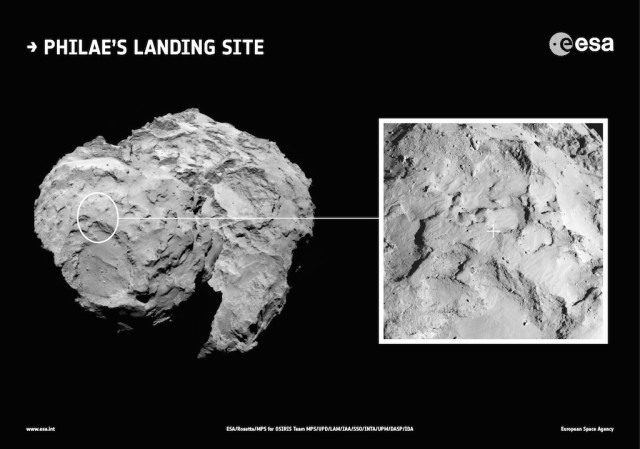
Philae’s landing site chosen

Philae's primary landing site

The Rosetta science team has chosen the primary landing site on Comet 67P/C-G for its Philae probe.

Site J is on the ‘head’ of the comet, an irregular shaped world that is just over 4 km across at its widest point. The decision to select Site J as the primary site was unanimous. The backup, Site C, is located on the ‘body’ of the comet. The 100 kg lander is planned to reach the surface on 11 November, where it will perform indepth measurements to characterise the nucleus in situ, in a totally unprecedented way.

This site is, located in the outside center of the nucleus’s smaller lobe, was picked unanimously because it appears to be the easiest to reach while also providing good science.

The descent to the comet is passive and it is only possible to predict that the landing point will place within a ‘landing ellipse’ typically a few hundred metres in size.

A one square kilometre area was assessed for each candidate site. At Site J, the majority of slopes are less than 30º relative to the local vertical, reducing the chances of Philae toppling over during touchdown. Site J also appears to have relatively few boulders, and receives sufficient daily illumination to recharge Philae and continue science operations on the surface beyond the initial battery-powered phase.

Provisional assessment of the trajectory to Site J found that the descent time of Philae to the surface would be about seven hours, a length that does not compromise the on-comet observations by using up too much of the battery during the descent.

I have put a close-up of the landing site below the fold.
» Read more

0 comments

Universal Big Bang lithium deficit confirmed

The uncertainty of science: New data from a globular cluster in nearby dwarf galaxy has confirmed that the deficit of lithium that astronomers have found in the Milky Way also exists in other galaxies.

According to the Big Bang theory, the amount of lithium in the universe should be two or three times more than it is. This result shows that the deficit exists outside the Milky Way, which suggests strongly that something significant is wrong with the Big Bang theory.

14 comments

Nothing for New Horizons after Pluto

As New Horizons begins its final shake-down in advance of its July 2015 flyby of Pluto, scientists have so far failed to find any Kuiper Belt objects in the right place for it to fly past after Pluto.

They haven’t given up hope, however. The search continues. As for the Pluto flyby,

The hibernating spacecraft will send weekly status beacons back to Earth, with wakeup scheduled for Dec. 7 to begin the final phase of its approach to Pluto. New Horizons will stay awake for two years to prepare for the encounter, fly by Pluto, and downlink science data. The craft’s appointment with Pluto is set for July 14, 2015, when it will zoom about 6,200 miles from the icy world’s unmapped surface for a one-shot chance to explore Pluto’s geology and atmosphere.

0 comments

Spitzer spots asteroid collision

A monitoring program of a young star by the Spitzer Space Telescope has paid off with evidence of a major collision between asteroids in the debris disk that surrounds the star.

Scientists had been regularly tracking the star, called NGC 2547-ID8, when it surged with a huge amount of fresh dust between August 2012 and January 2013. “We think two big asteroids crashed into each other, creating a huge cloud of grains the size of very fine sand, which are now smashing themselves into smithereens and slowly leaking away from the star,” said lead author and graduate student Huan Meng of the University of Arizona, Tucson.

While dusty aftermaths of suspected asteroid collisions have been observed by Spitzer before, this is the first time scientists have collected data before and after a planetary system smashup. The viewing offers a glimpse into the violent process of making rocky planets like ours.

0 comments

Did Stardust capture stardust?

Scientists now believe that the spacecraft Stardust captured seven particles from interstellar space during its seven year journey.

Inside the canister, a tennis racket-like sample collector tray captured the particles in silica aerogel as the spacecraft flew within 149 miles (about 240 kilometers) of a comet in January 2004. An opposite side of the tray holds interstellar dust particles captured by the spacecraft during its seven-year, three-billion-mile journey.

Scientists caution that additional tests must be done before they can say definitively that these are pieces of debris from interstellar space. But if they are, the particles could help explain the origin and evolution of interstellar dust. The particles are much more diverse in terms of chemical composition and structure than scientists expected. The smaller particles differ greatly from the larger ones and appear to have varying histories. Many of the larger particles have been described as having a fluffy structure, similar to a snowflake. [emphasis mine]

It appears that for these seven particles, the scientists conclude they are likely interstellar particles because of the speed in which they were traveling when captured as well as their make-up. Both suggest an origin outside the solar system.

However, we should be cautious about this. The data still remains tenuous and preliminary. More work obviously needs to be done to pin this down definitively. More information here.

0 comments
1 119 120 121 122 123 188