A star has gone supernova and astronomers get to see it from the very beginning, and even earlier!

A star has gone supernova and astronomers get to see it from the very beginning, and even earlier!

The star had erupted several times before but had not produced a real supernova explosion. On September 26 it finally did so. Moreover, astronomers have images of the star prior to any eruption, information that until recently was not available for any supernovae.

0 comments

Astronomers have discovered a star that circles the supermassive black hole at the center of the Milky Way in only 11.5 years.

Dizzy: Astronomers have discovered a star that circles the supermassive black hole at the center of the Milky Way in only 11.5 years.

This newly discovered star joins another that is 15 times brighter and has a 16 year orbit. The combined orbital data from both will allow astronomers to measure precisely the size of the black hole while also measuring the distortion of space caused by its intense gravitational field.

0 comments

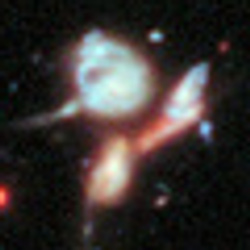
Using data from the Spitzer Space Telescope astronomers have narrowed the universe’s rate of expansion to about 74.3 kilometers per second per megaparsec.

The uncertainty of science: Using data from the Spitzer Space Telescope astronomers have narrowed the universe’s rate of expansion to about 74.3 kilometers per second per megaparsec.

The importance of this number, also called the Hubble Constant, is that it allows astronomers to extrapolate more precisely backward to when they believe the Big Bang occurred, about 13.7 billion years ago. It also is a crucial data point in their effort to understand dark energy, in which this expansion rate is actually accelerating on vast scales.

Back in 1995 a team led by Wendy Freedman, the same scientist leading the work above, announced that they had used the Hubble Space Telescope to determine the expansion rate as 80 kilometers per second per megaparsec. Then, the margin of error was plus or minus 17 kilometers. Now the margin of error has been narrowed to plus or minus 2.1 kilometers.

Do I believe these new numbers? No, not really. Science has nothing to do with belief. I do think this is good science, however, and that this new estimate of the Hubble constant is probably the best yet. I would also not be surprised if in the future new data eventually proves this estimate wrong.

0 comments

The solar maximum has already occurred in the Sun’s northern hemisphere, according to new observations.

The solar maximum has already occurred in the Sun’s northern hemisphere, according to one scientist’s research.

Moreover, the data also suggests that the maximum in the Sun’s southern hemisphere will not occur until early in 2014. This asymmetry between the hemispheres also suggests the strong possibility of a Grand Minimum to follow.

2 comments

The Hubble Space Telescope has taken its deepest image yet.

Hubble Extreme Deep Field inset

The Hubble Space Telescope has taken its deepest image yet.

This long exposure picture of a tiny patch of sky in the constellation Fornax spotted about 5,500 galaxies from the very beginning of the universe. Take a close look, because you will see that these early galaxies are often strange looking. I have cropped out one just example to the left to give you an idea.

0 comments

The next great comet?

Amateur astronomer Jason Lewis sent me an email today describing how the amateur astronomy community is abuzz with the discovery of a new comet, presently dubbed C/2012 S1, that is due to make its dive around the Sun in late November 2013 and pass closest to the Earth in January 2014 at a distance of about 37 million miles. Based on the preliminary numbers, this comet might be one of the brightest in years, almost certainly a naked eye object and visible to everyone from both the northern and southern hemispheres.

To quote the comments from one astronomy forum:
» Read more

2 comments

Astronomers using the Chandra X-Ray Observatory have found that the Milky Way is surrounded by a halo of hot gas.The uncertainty of science: Astronomers using the Chandra X-Ray Observatory have found that the Milky Way is surrounded by a halo of hot gas.

The uncertainty of science: Astronomers using the Chandra X-Ray Observatory have found that the Milky Way is surrounded by a halo of hot gas.

This is the key quote:

The estimated mass of the halo is comparable to the mass of all the stars in the galaxy. If the size and mass of this gas halo is confirmed, it also could be an explanation for what is known as the “missing baryon” problem for the galaxy.

“Missing baryon” is another way to say “dark matter.” In other words, this discovery might prove that it isn’t necessary to invent exotic unknown particles of physics, such as the Weakly Interacting Massive Particles (WIMPs) to explain the missing matter. The missing matter might simply be this hot gas, previously undetected.

11 comments
1 146 147 148 149 150 188