
More delays for the James Webb Space Telescope?
More delays for the James Webb Space Telescope?
More delays for the James Webb Space Telescope?
Mysterious bubble of light, caused by military suborbital rocket, captured by Hawaii telescopes.
Astronomers have found the most distant quasar ever, and are baffled by its existence.
The light from the quasar started its journey toward us when the universe was only 6% of its present age, a mere 770 million years after the Big Bang, at a redshift of about 7.1 [3]. “This gives astronomers a headache,” says lead author Daniel Mortlock, from Imperial College London. “It’s difficult to understand how a black hole a billion times more massive than the Sun can have grown so early in the history of the universe. It’s like rolling a snowball down the hill and suddenly you find that it’s 20 feet across!”
Want to send a probe to another planet? Do it cheaply, as these scientists did.
Cassini has directly sampled the plumes from Enceladus and discovered a salty ocean-like spray.
The new paper analyzes three Enceladus flybys in 2008 and 2009 with the same instrument, focusing on the composition of freshly ejected plume grains. The icy particles hit the detector target at speeds between 15,000 and 39,000 mph (23,000 and 63,000 kilometers per hour), vaporizing instantly. Electrical fields inside the cosmic dust analyzer separated the various constituents of the impact cloud.
The data suggest a layer of water between the moon’s rocky core and its icy mantle, possibly as deep as about 50 miles (80 kilometers) beneath the surface. As this water washes against the rocks, it dissolves salt compounds and rises through fractures in the overlying ice to form reserves nearer the surface. If the outermost layer cracks open, the decrease in pressure from these reserves to space causes a plume to shoot out. Roughly 400 pounds (200 kilograms) of water vapor is lost every second in the plumes, with smaller amounts being lost as ice grains. The team calculates the water reserves must have large evaporating surfaces, or they would freeze easily and stop the plumes.
Citizen astronomers: Help pick the Kuiper Belt targets that New Horizons will visit after it flies past Pluto.
The Roman emperor Hadrian built his country estate with the buildings aligned with the sun.
For centuries, scholars have thought that the more than 30 buildings at Hadrian’s palatial country estate were oriented more or less randomly. But De Franceschini says that during the summer solstice, blades of light pierce two of the villa’s buildings.
In one, the Roccabruna, light from the summer solstice enters through a wedge-shaped slot above the door and illuminates a niche on the opposite side of the interior (see image). And in a temple of the Accademia building, De Franceschini has found that sunlight passes through a series of doors during both the winter and summer solstices.
The Pan-STARRS Telescope has found a comet that might provide us all a show in 2013.
An X-ray deep field image taken over a six week period by Chandra had found that massive black holes are common in early universe.
These results imply that between 30% and 100% of the distant galaxies contain growing supermassive black holes. Extrapolating these results from the relatively small field of view that was observed to the full sky, there are at least 30 million supermassive black holes in the early Universe. This is a factor of 10,000 larger than the estimated number of quasars in the early Universe.
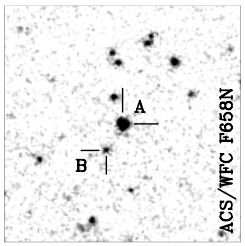
The progenitor star that produced the May supernovae in the Whirlpool Galaxy (also known as M51) has been identified, and it isn’t what scientists predicted.
In a preprint paper published today on the Los Alamos astro-ph website, astronomers describe the star that exploded as a yellow supergiant, not a red supergiant or Wolf-Rayet star, as predicted by the theory explaining this particular type of supernova. Moreover, though theory also favors the star being a member of a binary system, the progenitor of 2011dh appears to be a lone star, not even a member of a cluster.
» Read more
Europe has decided to shrink the design of the gigantic Extremely Large Telescope (yes, that’s really its name) by 13% to save money.