Oxygen molecules detected in star-forming region
Oxygen molecules have been detected for the first time in space, and they were found in the Orion nebula, a giant molecular cloud where stars are being born. More here.
Oxygen molecules have been detected for the first time in space, and they were found in the Orion nebula, a giant molecular cloud where stars are being born. More here.
Astronomers have spotted the first Trojan asteroid to the Earth.
The asteroid is roughly 1,000 feet (300 meters) in diameter. It has an unusual orbit that traces a complex motion near a stable point in the plane of Earth’s orbit, although the asteroid also moves above and below the plane. The object is about 50 million miles (80 million kilometers) from Earth. The asteroid’s orbit is well-defined and for at least the next 100 years, it will not come closer to Earth than 15 million miles (24 million kilometers).
The Herschel space telescope has discovered that the water expelled from the tiger stripes on Enceladus eventually rains down on Saturn.
Enceladus expels around 250 kg of water vapour every second, through a collection of jets from the south polar region known as the Tiger Stripes because of their distinctive surface markings. These crucial observations reveal that the water creates a doughnut-shaped torus of vapour surrounding the ringed planet. The total width of the torus is more than 10 times the radius of Saturn, yet it is only about one Saturn radius thick. Enceladus orbits the planet at a distance of about four Saturn radii, replenishing the torus with its jets of water.
The Russian orbiting radio telescope Spektr-R has successfully unfurled its 10 meter dish.
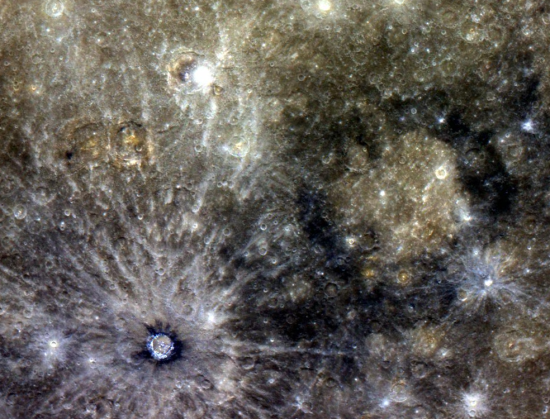
The Messenger spacecraft has now been in orbit around Mercury since the end of March, almost four months. During that time the probe has sent back many fascinating images, showcasing a hot, alien planet whose surface was formed by impacts, volcanic activity, and some processes that no one as yet understands.
Most of the released images, however, have been in black and white, which at first glance makes one think that Mercury is not unlike the Moon. This week the Messenger team released a color image, demonstrated clearly how false this assumption is. The image below shows two very different craters, a dark-haloed crater named Basho at the bottom left of the image, and a very bright crater, Kalidasa crater, near the top left. On the right of the image is a dark haloed Tolstoj basin. For an uncropped full resolution version go here.
A new image of Vesta from Dawn.
Hubble has discovered a fourth moon orbiting Pluto.
The dying NASA astrophysics program.
With support from President Barack Obama, the agency’s Earth science budget is at an all-time high. Over the next four months, the planetary science division is due to launch three major missions: to the Moon, to Mars and to Jupiter. And the heliophysics division plans to send a probe plunging into the blistering atmosphere of the Sun, closer than ever before. But because the overall NASA science budget is relatively flat, something had to give. Since 2008, astrophysics funding has plunged relative to other NASA science and relative to physics and astronomy funding at other agencies.
Some good news: Dawn has returned its first sharp close-up image of Vesta.
The image to below the fold is to me a relief, as it shows that the spacecraft’s camera is fine and that my engineering friends were correct in telling me so. Forgive me for being a skeptical and nervous reporter.
» Read more
The Russians yesterday successfully launched their first space telescope since the fall of the Soviet Union. Here is a Google translation of a Russian article describing Spektr-R’s research goals:
[Spektr-R is] designed to study galaxies and quasars in the radio, the study of black holes and neutron stars in the Milky Way, as well as the regions immediately adjacent to the massive black holes. In addition, using the observatory, scientists expect to receive information about pulsars and the interstellar plasma. It is planned that the “Spektr-R” will work in orbit for at least 5 years.
Though this particular space telescope is probably not going to rewrite the science of astrophysics, its launch is historically significant. It indicates that Russia has just about recovered from the seventy-plus years of bankrupt communist rule that ended in 1990.
» Read more