Webb takes infrared false-color image of supernova remnant Cassiopeia A

Cass A in infrared
Click for original image.

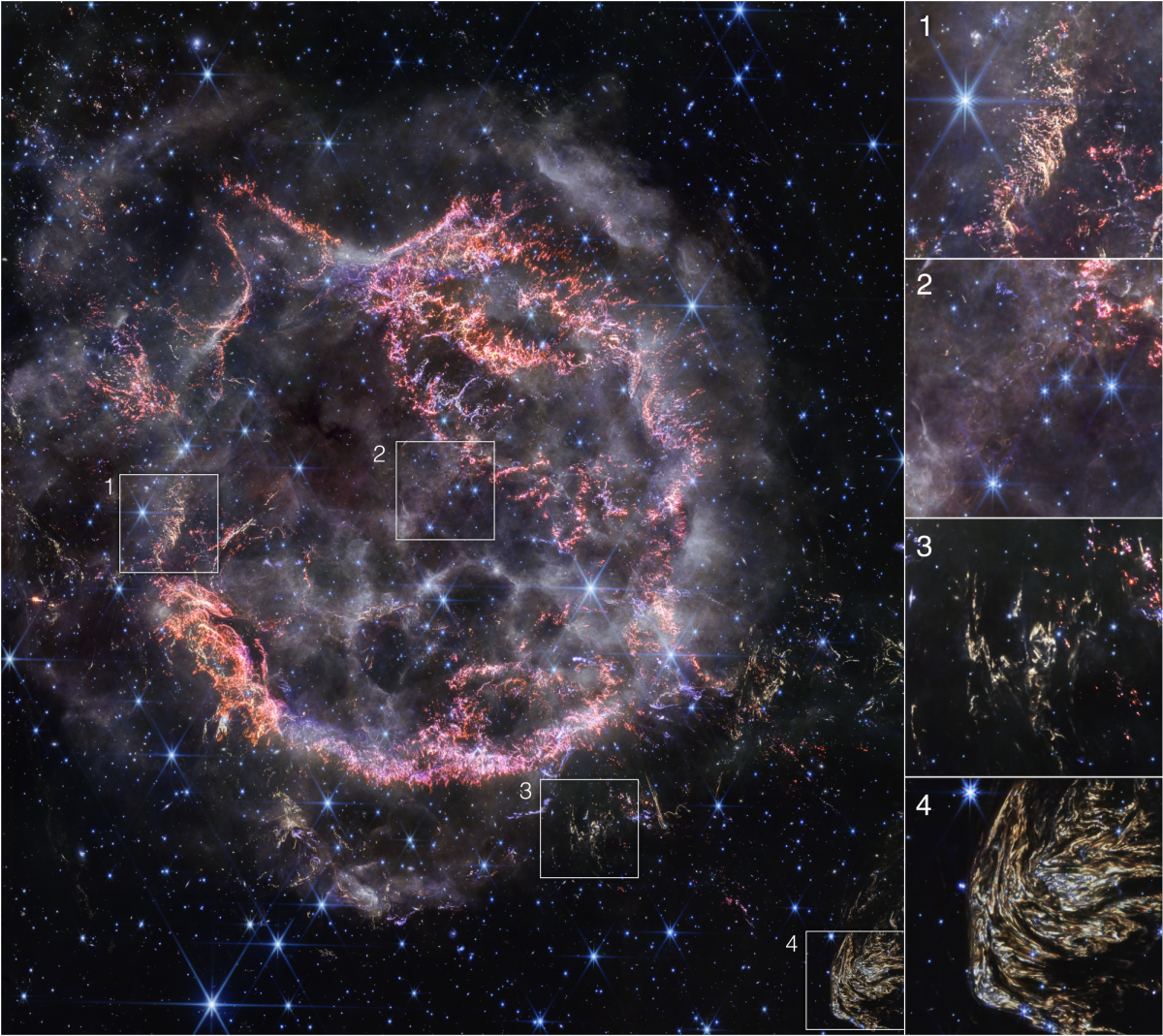
Using the Webb Space Telescope, astronomers have obtained the first wide full infrared view of the supernova remnant Cassiopeia A, the remains of a supernova that occurred about 11,000 years ago. That image is to the right, reduced to post here.

The most noticeable colors in Webb’s newest image are clumps represented in bright orange and light pink that make up the inner shell of the supernova remnant. Webb’s razor-sharp view can detect the tiniest knots of gas, comprised of sulfur, oxygen, argon, and neon from the star itself. Embedded in this gas is a mixture of dust and molecules, which will eventually become components of new stars and planetary systems. Some filaments of debris are too tiny to be resolved by even Webb, meaning they are comparable to or less than 10 billion miles across (around 100 astronomical units). In comparison, the entirety of Cas A spans 10 light-years across, or 60 trillion miles.

…When comparing Webb’s new near-infrared view of Cas A with the mid-infrared view, its inner cavity and outermost shell are curiously devoid of color. The outskirts of the main inner shell, which appeared as a deep orange and red in the MIRI image, now look like smoke from a campfire. This marks where the supernova blast wave is ramming into surrounding circumstellar material. The dust in the circumstellar material is too cool to be detected directly at near-infrared wavelengths, but lights up in the mid-infrared.

The four rectangles mark specific features of particular interest, with #4, dubbed by the scientists Baby Cas, the most intriguing.

This is a light echo, where light from the star’s long-ago explosion has reached and is warming distant dust, which is glowing as it cools down. The intricacy of the dust pattern, and Baby Cas A’s apparent proximity to Cas A itself, are particularly intriguing to researchers. In actuality, Baby Cas A is located about 170 light-years behind the supernova remnant.

By comparing this infrared view with Hubble’s optical and Chandra’s X-ray views, astronomers will be able to better decipher Cas A’s make-up and geometry.

0 comments

Hubble to resume science operations using three gyros

Engineers have apparently figured out the issues with one of the Hubble Space Telescope’s three gyroscopes, and plan to resume science operations today using all three gyros.

After analyzing the data, the team has determined science operations can resume under three-gyro control. Based on the performance observed during the tests, the team has decided to operate the gyros in a higher-precision mode during science observations. Hubble’s instruments and the observatory itself remain stable and in good health.

This is excellent news. If it had been determined that the funky gyro was no longer functional, the telescope would have shifted into what the engineers call “one-gyro mode.” By using only one of the two remaining gyros, Hubble’s life could be extended. However, while it would allow the telescope to point and continue observations, the images would no longer be as sharp.

9 comments

Astronomers: A solar system with six Earth-sized planets orbiting in perfect resonance

The resonances of this exo-solar system
Click for original image.

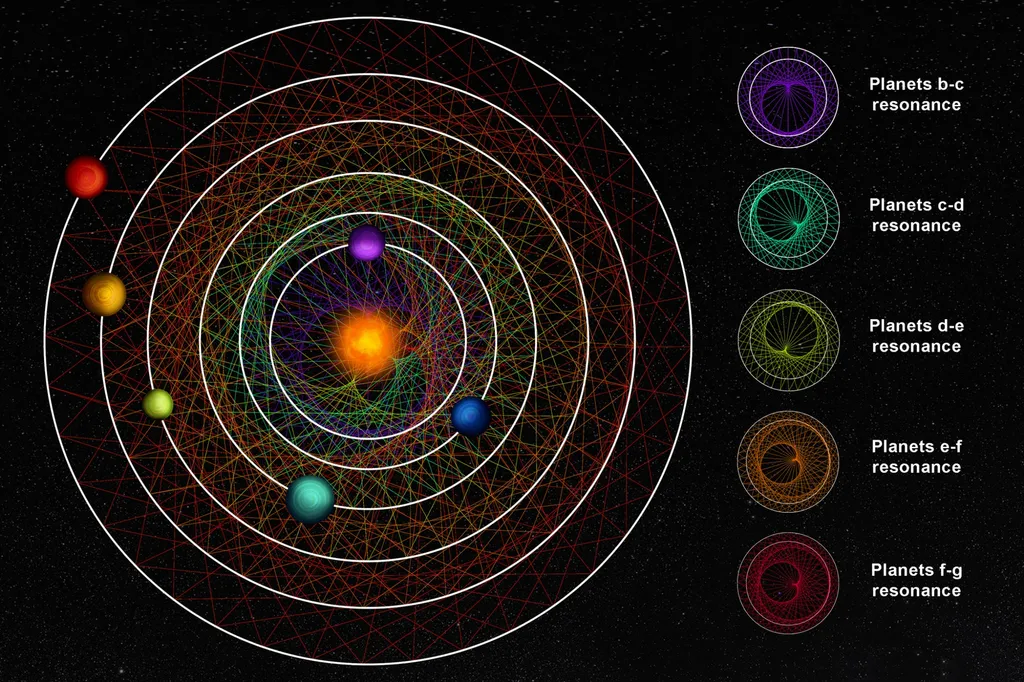
Astronomers today announced the discovery of a solar system with six Earth-sized exoplanets that orbit their Sun-like star in a synchronized manner, their orbits in a gravitational lock-step called resonance.

The graphic to the right illustrates that pattern. From the press release:

While multi-planet systems are common in our galaxy, those in a tight gravitational formation known as “resonance” are observed by astronomers far less often. In this case, the planet closest to the star makes three orbits for every two of the next planet out – called a 3/2 resonance – a pattern that is repeated among the four closest planets.

Among the outermost planets, a pattern of four orbits for every three of the next planet out (a 4/3 resonance) is repeated twice. And these resonant orbits are rock-solid: The planets likely have been performing this same rhythmic dance since the system formed billions of years ago. Such reliable stability means this system has not suffered the shocks and shakeups scientists might typically expect in the early days of planet formation – smash-ups and collisions, mergers and breakups as planets jockey for position. And that, in turn, could say something important about how this system formed. Its rigid stability was locked in early; the planets’ 3/2 and 4/3 resonances are almost exactly as they were at the time of formation. More precise measurements of these planets’ masses and orbits will be needed to further sharpen the picture of how the system formed.

All the planets have orbits less than 55 days long, and though all have masses less than six Earth-masses, data suggests they more resemble Neptune because of their expanded gaseous make-up caused by the close orbits to the star.

Future observations are planned, most especially with Webb because its infrared capability will detect much of the chemistry of this system.

9 comments

Hubble in safe mode due to gyroscope problem

One of the three working gyroscopes (three have already failed0 on the Hubble Space Telescope experienced repeated problems in mid-November, and has now put the telescope in safe mode while engineers trouble-shoot the problem.

Hubble first went into safe mode Nov. 19. Although the operations team successfully recovered the spacecraft to resume observations the following day, the unstable gyro caused the observatory to suspend science operations once again Nov. 21. Following a successful recovery, Hubble entered safe mode again Nov. 23.

The team is now running tests to characterize the issue and develop solutions. If necessary, the spacecraft can be re-configured to operate with only one gyro. The spacecraft had six new gyros installed during the fifth and final space shuttle servicing mission in 2009. To date, three of those gyros remain operational, including the gyro currently experiencing fluctuations. Hubble uses three gyros to maximize efficiency, but could continue to make science observations with only one gyro if required.

The long term plan when the telescope only has two working gyros, assuming no improvised maintenance mission is flown to Hubble to give it new gyroscopes, is to work with only one (treating the second as a back-up) in order to extend the telescope’s life as long as possible.

And though it is true that Hubble could continue to do science with only one gyro, images from that point will likely not be as sharp, and thus will end more than three decades of imagery that changed our perception of the universe.

The Chinese 2-meter Xuntian optical space telescope, now scheduled for launch in 2025, will likely then replace Hubble as the world’s top optical telescope. American astronomers better start learning Chinese, assuming China even allows them access. They will not have a right to complain, however, as it was their decision to not build a Hubble replacement, in their 2000, 2010, and 2020 decadal reports.

2 comments

British scientists get their own Bennu sample to study

The British History Museum has now received a small sample of material from the asteroid Bennu, brought back to Earth by the planetary probe OSIRIS-REx.

The first two years of research at the Natural History Museum will focus on non-destructive tests, such as X-ray diffraction and electron microscopy to learn about Bennu’s mineral composition and structure. The largest grains in the sample are on the order of millimetres wide, while the smallest are mere dust particles. “It doesn’t sound like a lot of material, but it’s plenty to work with,” King said.

The museum is home to one of the world’s leading meteorite collections, and the staff are well-used to handling small amounts of extremely precious materials from outer space. Unlike meteorites that have been baked and battered on their fiery passage through Earth’s atmosphere, the dust and rocky fragments from Bennu were brought to Earth in pristine condition, allowing scientists a rare glimpse of the unaltered asteroid.

The last sentence says it all. Up until recently, researchers have had a distorted view of the overall make-up of asteroids because the oldest kinds, carbonaceous chondrite, are the most delicate and get significantly changed by their passage through the Earth’s atmosphere. The samples from Bennu and Ryugu are changing this, and will eventually revolutionize the understanding scientists have of our present solar system.

0 comments

China delays till ’25 the launch of its Hubble-class optical space telescope

China today revealed that it is delaying the the launch of its Xuntian space telescope from early next year to 2025.

Zhan Hu, project scientist of Xuntian space telescope system, revealed that the delay was necessary for the team to finalize a preflight “engineering qualification model.” This model will undergo rigorous performance tests early next year. Despite the setback, China is making significant strides by domestically developing all five instruments for Xuntian, a first for the country, Scientific American reported.

The optical telescope, designed to somewhat comparable to Hubble, is intended to fly close to China’s Tiangong-3 space station where astronauts will periodically fly over to do maintenance and repair. Its primary mirror, two meters in diameter, is only slightly smaller than Hubble’s 2.4 meter mirror.

The article says the launch was supposed to happen before the end of this year, but that is incorrect. The launch has been targeting the spring of 2024 since February.

4 comments

Webb: Needles scattered near the center of the Milky Way

Needles in space
Click for original image.

Scientists today released a new false-color infrared image taken by the Webb Space Telescope of a region about 300 light years from the center of the Milky Way, dubbed Sagittarius-C. That picture is to the right, cropped, reduced and sharpened to post here. The blue or cyan regions are ionized hydrogen clouds, and with this image were revealed to be much more extensive than expected. The orange blob near the center is a densely packed cluster of protostars, the starlight blocked by the cloud of material.

The most interesting feature however are the needle-like structures within that ionized hydrogen, oriented in all directions in a manner that looks completely random. Though such needles have been seen previously, the data here is far more detailed, and might eventually help astronomers figure out what the heck these features are and what caused them.

5 comments

Gamma ray burst 1.9 billion light years away was powerful enough to affect Earth’s atmosphere

One of the most powerful gamma ray bursts (GRBs) ever detected was so powerful that despite occurring about 1.9 billion light years away it was powerful enough to affect Earth’s atmosphere.

On 9 October 2022, for 7 minutes, high energy photons from a gigantic explosion 1.9 billion light-years away toasted one side of Earth as never before observed. The event, called a gamma ray burst (GRB), was 70 times brighter than the previous record holder. But what astronomers dub the “BOAT”—the brightest of all time—did more than provide a light show spanning the electromagnetic spectrum. It also ionized atoms across the ionosphere, which spans from 50 to 1000 kilometers in altitude, researchers say. The findings highlight the faint but real risk of a closer burst destroying Earth’s protective ozone layer.

“It was such a massive event, it affected all levels of the atmosphere,” says solar physicist Laura Hayes of the European Space Agency (ESA).

None of these consequences were harmful or even noticeable to any life on Earth, but the data proved without question that a GRB close by within the Milky Way could have been the cause of one or more of the past extinction events. It also proved that a future such nearby explosion could do the same again.

At present astronomers think that GRBs are caused either by the collapse of a massive star into a black hole, during a supernovae event, or by the merger of two neutron stars. Neither conclusion is proved as yet, though the evidence has eliminated most other theories.

For astronomers this GRB was significant because its strength allowed many different telescopes and detectors to record it, in many different wavelengths. Having such a wealth of information helps them better figure out what happened when the burst occurred.

2 comments

Scientists: More evidence cosmic rays come from nearby supernova remnants

The uncertainty of science: According to high energy data from an instrument on ISS, astronomers found more evidence that the cosmic rays that enter our solar system likely come from nearby supernova remnants.

Current theory posits that the aftermath of supernovae (exploding stars), called supernova remnants, produce these high energy electrons, which are a specific type of cosmic ray. Electrons lose energy very quickly after leaving their source, so the rare electrons arriving at CALET with high energy are believed to originate in supernova remnants that are relatively nearby (on a cosmic scale), Cannady explains.

The study’s results are “a strong indicator that the paradigm that we have for understanding these high-energy electrons—that they come from supernova remnants and that they are accelerated the way that we think they are—is correct,” Cannady says. The findings “give insight into what’s going on in these supernova remnants, and offer a way to understand the galaxy and these sources in the galaxy better.”

The results however do not prove this. Nor do they eliminate the possibility that cosmic rays might also come from other sources outside our galaxy. At present the data is simply too uncertain.

0 comments

Galaxies within galaxies within galaxies

Galaxies within galaxies
Click for original image.

Time another cool galaxy image! The picture to the right, cropped, reduced, sharpened, and annotated to post here, was taken by the Hubble Space Telescope as part of a survey project of galaxies where past supernovae had occurred. From the caption:

The location of this faded supernova was observed as part of a study of multiple hydrogen-rich supernovae, also known as type II supernovae, in order to better understand the environments in which certain types of supernovae take place.

Though the picture’s resolution was reduced to post here, I have also included insets at the full released resolution of three of background galaxies, one of which (on the uppermost right) appears to have a second smaller galaxy either associated with it or is another background galaxy even farther away. Such background galaxies are always seen Hubble images, which starkly tell us that the universe is far vaster than we can imaging, with more stars than we can conceive.

The galaxy featured here is interesting in its own right. Though it appears to be a spiral galaxy, its arms are very indistinct, suggesting that is sits between that of an elliptical galaxy (no arms, just a cloud of stars) and a spiral (with well-defined arms).

3 comments

Chandra X-rays a giant hand in space

A cosmic hand
Click for original image.

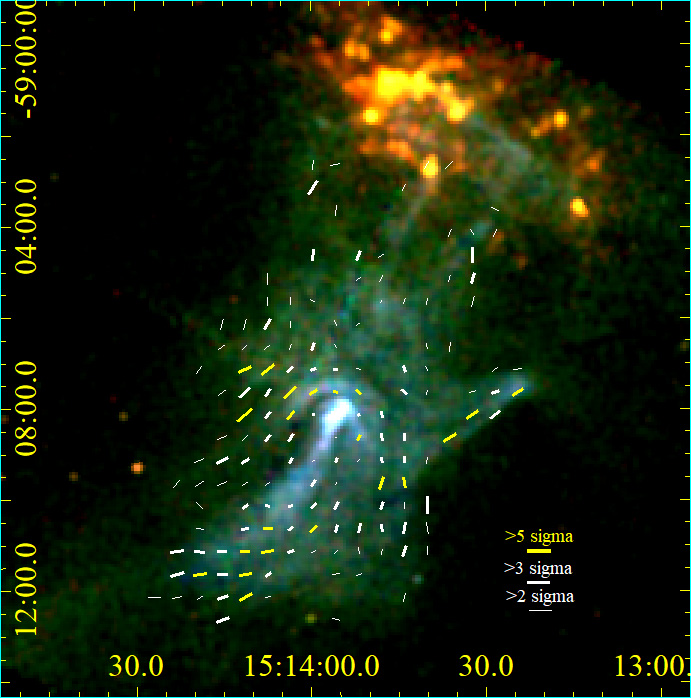
Cool image time! The picture to the right, cropped, reduced, and sharpened to post here, was taken by the Chandra X-ray Observatory, with data from the orbiting IXPE producing the lines that indicate the orientation of the magnetic field lines.

The image was part of research studying what the scientists call Pulsar Wind Nebulae (PWNe).

[E]arly-on when the new-born pulsar is still deep in its parent supernova remnant, or at late times after it has escaped to the relatively uniform interstellar medium, the pulsar wind is often uniform around the pulsar spin or velocity axis. In projection on the sky such structures have bilateral symmetry, that is, the two halves mirror each other. This makes them look (vaguely) like animals. This has led to many PWNe collecting animal monikers (‘The Mouse’, ‘The Dragonfly’, ‘The Rabbit’ – we are guilty of some of these…).

In between these early and late phases, the story is often more complex and the PWN interaction with the supernova shock wave leads to complicated morphologies. One of the prime examples is the PWN in the supernova remnant RCW 89 (also known as MSH 15-5(2)). Here the complex interactions form the PWN into the `Cosmic Hand’. Wanting to map the magnetic fields which structure this hand, the IXPE team took a long hard stare at MSH 15-5(2) and its central pulsar.

The scientists admit that the match between IXPE’s data and the structure of the hand is not really a surprise, but confirming the match was necessary if they are ever going to figure out the fundamental laws that govern magnetic fields, laws that presently are not well understood, at all.

0 comments

A spiral galaxy giving birth to a lot of stars

A spiral galaxy giving birth to a lot of stars
Click for original image.

Time for another cool galaxy image! The picture to the right, reduced and sharpened to post here, was taken by the Hubble Space Telescope, and shows what some informally refer to as the “‘Spanish Dancer Galaxy’ because the “vivid and dramatic swirling lines of its spiral arms … evoke the shapes and colours of a dancer’s moving form. ”

Though this galaxy’s two main arms cause it to resemble a barred galaxy, it lacks a central bar, suggesting it is young. The numerous reddish and pink regions in the arms, all of which are thought to be star-forming regions, also suggest the galaxy is young, still giving birth to many stars.

It is located about 60 million light years away, and is part of what scientists label the Doradus galaxy group, which contains less than a hundred galaxies. In comparison, a galaxy cluster is much larger, containing hundreds to thousands of galaxies.

1 comment

An infrared view of the Crab Nebula by Webb

Webb's image of the Crabb compared to Hubble's
Click for original image.

Using the Webb Space Telescope astronomers have taken the first detailed infrared image of the Crab Nebula, the remnant from a supernova that occurred in 1054 AD.

The two pictures on the right compare Webb’s false color infrared view with a natural light Hubble image in optical wavelengths, taken in 2005. From the press release:

The supernova remnant is comprised of several different components, including doubly ionized sulfur (represented in red-orange), ionized iron (blue), dust (yellow-white and green), and synchrotron emission (white). In this image, colors were assigned to different filters from Webb’s NIRCam and MIRI: blue (F162M), light blue (F480M), cyan (F560W), green (F1130W), orange (F1800W), and red (F2100W).

In comparing the images, it appears the scientists chose colors for the Webb image to more or less match those of Hubble’s natural color picture. However, as the press release notes:

Additional aspects of the inner workings of the Crab Nebula become more prominent and are seen in greater detail in the infrared light captured by Webb. In particular, Webb highlights what is known as synchrotron radiation: emission produced from charged particles, like electrons, moving around magnetic field lines at relativistic speeds. The radiation appears here as milky smoke-like material throughout the majority of the Crab Nebula’s interior.

This feature is a product of the nebula’s pulsar, a rapidly rotating neutron star. The pulsar’s strong magnetic field accelerates particles to extremely high speeds and causes them to emit radiation as they wind around magnetic field lines. Though emitted across the electromagnetic spectrum, the synchrotron radiation is seen in unprecedented detail with Webb’s NIRCam instrument.

The release also notes this remarkable but somewhat unfortunate fact:

Scientists will have newer Hubble data to review within the next year or so from the telescope’s reimaging of the supernova remnant. This will mark Hubble’s first look at emission lines from the Crab Nebula in over 20 years, and will enable astronomers to more accurately compare Webb and Hubble’s findings.

In 2005 repeated Hubble images of the Crab revealed that its filaments and radiation were stormy, with constant activity. The scientists actually produced a movie of those changes. It was expected that new images would be taken at regular intervals to track that activity. Apparently it was not, either because no scientist was interested or the committee that assigns time on Hubble decided this wasn’t important enough reseach.

0 comments

Is a recently discovered near Earth asteroid a piece from the Moon?

The uncertainty of science: Researchers now think they have enough information to claim that a recently discovered near Earth asteroid, dubbed Kamo`oalewa, could actually be a piece of the Moon, flung from it during a asteroid impact in the past few million years.

The 2021 study found that Kamo`oalewa’s spectrum was unlike that of other near-Earth asteroids but matched most closely that of the moon. Based on this, the team hypothesized that the asteroid could have been ejected from the lunar surface as a result of a meteoroidal impact.

In the new study, Malhotra and her team wanted to determine the feasibility for a knocked-off piece of the moon to get into this quasi-satellite orbit – a phenomenon that is quite unlikely, Malhotra said. Moon fragments that have enough kinetic energy to escape the Earth-moon system also have too much energy to land in the Earth-like orbits of quasi-satellites, she said.

With numerical simulations that accurately account for the gravitational forces of all the solar system’s planets, Malhotra’s group found that some lucky lunar fragments could actually find their way to such orbits. Kamo`oalewa could be one of those fragments created during an impact on the moon in the past few million years, according to the study.

The scientists add that the asteroid’s solar orbit, which keeps its flying in relative formation with the Earth for millions of years, strengthens this hypothesis.

It must be noted that this remains an unconfirmed hypothesis. A spacecraft would have to visit Kamo’oalewa and obtain samples to study to confirm it.

3 comments

New data better maps the supernova remnant SN1006

SN1006, as seen in X-rays
Click for original image.

Using data from both the Chandra X-ray Observatory and the Imaging X-ray Polarimetry Explorer (IXPE), scientists have now better mapped the magnetic field and the remnant from the supernova that occurred in 1006 AD.

The false color image to the right shows this data. From the caption:

The red, green, and blue elements reflect low, medium, and high energy X-rays, respectively, as detected by Chandra. The IXPE data, which measure the polarization of the X-ray light, is show in purple in the upper left corner, with the addition of lines representing the outward movement of the remnant’s magnetic field.

From the press release:

Researchers say the results demonstrate a connection between the magnetic fields and the remnant’s high-energy particle outflow. The magnetic fields in SN 1006’s shell are somewhat disorganized, per IXPE’s findings, yet still have a preferred orientation. As the shock wave from the original explosion passes through the surrounding gas, the magnetic fields become aligned with the shock wave’s motion. Charged particles are trapped by the magnetic fields around the original point of the blast, where they quickly receive bursts of acceleration. Those speeding high-energy particles, in turn, transfer energy to keep the magnetic fields strong and turbulent.

At present scientists really do not understand the behavior of stellar-sized magnetic fields. It is very complex, involving three dimensional movements that are hard to measure, as well as electromagnetic processes that are not well understood. While this new data doesn’t provide an explanation, it does tell us better what is actually happening. The theories will follow.

1 comment

Swirling galactic-sized streams surrounding a pair of supermassive black holes

Swirling galactic arms surrounding two supermassive black holes

Time for another galactic cool image! The picture to the right, reduced and sharpened to post here, was released today by the Gemini South ground-based telescope in Chile. It shows the streams of gas and stars that swirl around a pair of supermassive black holes at the center of this galaxy, located only 90 million light years away.

The image reveals vast swirling bands of interstellar dust and gas resembling freshly-spun cotton candy as they wrap around the merging cores of the progenitor galaxies. From the aftermath has emerged a scattered mix of active starburst regions and sedentary dust lanes encircling the system.

What is most noteworthy about NGC 7727 is undoubtedly its twin galactic nuclei, each of which houses a supermassive black hole, as confirmed by astronomers using the European Southern Observatory’s Very Large Telescope (VLT). Astronomers now surmise the galaxy originated as a pair of spiral galaxies that became embroiled in a celestial dance about one billion years ago. Stars and nebulae spilled out and were pulled back together at the mercy of the black holes’ gravitational tug-of-war until the irregular tangled knots we see here were created.

The black holes themselves are 154 and 6.3 million solar masses respectively, and are presently about 1,600 light years apart. Scientists calculate that they will merge in about 250 million years. Each once formed the center of its own galaxy. Now both galaxies have merged, creating this three-dimensional whirlpool of arms.

6 comments

A dance of three galaxies

Three galaxies merging
Click for original image.

Cool image time! The picture to the right, cropped, reduced, and sharpened to post here, was taken by the Hubble Space Telescope. Though it appears to show two galaxies interacting with each other, other spectroscopic data proves there are actually three large galaxies in the picture. From the caption:

The two clearly defined galaxies are NGC 7733 (smaller, lower right) and NGC 7734 (larger, upper left). The third galaxy is currently referred to as NGC 7733N, and can actually be spotted in this picture if you look carefully at the upper arm of NGC 7733, where there is a visually notable knot-like structure, glowing with a different colour to the arm and obscured by dark dust. This could easily pass as part of NGC 7733, but analysis of the velocities (speed, but also considering direction) involved in the galaxy shows that this knot has a considerable additional redshift, meaning that it is very likely its own entity and not part of NGC 7733.

All three galaxies are quite close to each other, which means they are in the long process of merging together into one larger galaxy.

1 comment

Scientists: The activity at the few known fast radio bursts suggests they resemble earthquakes

By analyzing 7,000 fast radio bursts (FRBs) detected from the three known FRBs, two scientists have found that the behavior appears to resemble the main quake and aftershocks seen in earthquakes.

The duo found that the arrival times of bursts from FRB20121102A showed a high degree of correlation, with many more bursts arriving within a second of each other than would be expected if the generation of bursts were completely random. This correlation faded away at longer timescales, with bursts separated by over a second arriving completely at random.

They drew similarities with this behaviour to how earthquakes produce secondary aftershocks in the hours or days following a tremor, but then become completely unpredictable once an episode of aftershocks passes. Moreover, they found that the rate of these FRB “aftershocks” follows the same Omori-Utsu law that characterises the occurrence of earthquake aftershocks on Earth. The law states that shortly after a large earthquake, the rate of aftershocks remains constant over a brief period of minutes to hours, after which the aftershock rate drops, decaying as roughly the inverse of the time since the main shock.

As always there is uncertainty about this conclusion. The magnitudes of the main quake and the pre- and after-shocks do not follow the curve pattern of earthquakes. Instead pre- and after-shocks can be as powerful.

The present theory is that FRBs are quakes in the crust of neutron stars, though this remains unconfirmed.

2 comments

Astronomers detect what they think is the most distant known fast radio burst yet

The uncertainty of science: Using ground-based radio and optical telescopes, astronomers think they have detected the most distant known fast radio burst yet, coming from a galaxy thought to be eight billion light years away.

On 10 June 2022, CSIRO’s ASKAP radio telescope on Wajarri Yamaji Country was used to detect a fast radio burst, created in a cosmic event that released, in milliseconds, the equivalent of our Sun’s total emission over 30 years.

“Using ASKAP’s array of dishes, we were able to determine precisely where [in the sky] the burst came from,” says Dr Ryder, the first author on the paper. “Then we used the European Southern Observatory (ESO) Very Large Telescope (VLT) in Chile to search for the source galaxy, finding it to be older and further away than any other FRB source found to date, and likely within a small group of merging galaxies.”

Note that the scientists have not actually measured the distance of this burst. They assume it sits at the same distance of the group of merging galaxies that surround it. Only about fifty fast radio bursts have so far been detected. As yet there is no accepted explanation as to what causes them, though knowing their assumed distance helps narrow the possibilities significantly.

The scientists also think they can use the energy from this burst to measure the intervening matter between it and Earth, and thus get a better estimate of the mass of the universe.

0 comments
1 16 17 18 19 20 113