Webb: Infrared data sees neutron star remaining after 1987 supernova, the nearest in more than 4 centuries

Webb's infrared view of Supernova 1987a
Click for original image.

Using the Webb Space Telescope, astronomers have obtained infrared data that confirms the existence of a neutron star at the location of Supernova 1987a, located in the Large Magellanic Cloud, the nearest such supernova in more than four centuries and the only one visible to the naked eye since the invention of the telescope.

Indirect evidence for the presence of a neutron star at the center of the remnant has been found in the past few years, and observations of much older supernova remnants โ€” such as the Crab Nebula โ€” confirm that neutron stars are found in many supernova remnants. However, no direct evidence of a neutron star in the aftermath of SN 1987A (or any other such recent supernova explosion) had been observed, until now.

…Spectral analysis of the [Webb] results showed a strong signal due to ionized argon from the center of the ejected material that surrounds the original site of SN 1987A. Subsequent observations using Webbโ€™s NIRSpec (Near-Infrared Spectrograph) IFU at shorter wavelengths found even more heavily ionized chemical elements, particularly five times ionized argon (meaning argon atoms that have lost five of their 18 electrons). Such ions require highly energetic photons to form, and those photons have to come from somewhere.

That “somewhere” has to be a neutron star, based on present theories. The image above shows three different Webb views of Supernova 1987a, with the one on the lower right suggesting the existence of a point source at the center of the supernova remnant. In the left image the circular ring of bright spots is an older ring of dust and material that has been lit up by the crash of the explosive material (as indicated in blue at the center) flung out from the star when it went supernova and collapsed into a neutron star. That wave of explosive material took several decades to reach the ring and enflame it.

1 comment

Astronomers: a 9,000-light-year-long stream of gas and dust ripples like a wave due to the Milky Way’s gravity

According to an analysis of data from the space telescope Gaia, astronomers now believe that a 9,000-light- year-long stream of gas and dust that is only 500 light years away from the Sun at its nearest point ripples up and down like a wave, due to the Milky Way’s gravity.

Dubbed the Radcliffe Wave after the institute in which the astronomers were based who first discovered it, the scientists determined its wavelike behavior by mapping the motions of the star clusters along its length. Apparently, over time they are moving up and down, not unlike fans at a stadium doing the wave.

The data also includes these intriguing results:

“It turns out that no significant dark matter is needed to explain the motion we observe,” Konietzka said. โ€œThe gravity of ordinary matter alone is enough to drive the waving of the Wave.”

In addition, the discovery of the oscillation raises new questions about the preponderance of these waves both across the Milky Way and other galaxies. Since the Radcliffe Wave appears to form the backbone of the nearest spiral arm in the Milky Way, the waving of the Wave could imply that spiral arms of galaxies oscillate in general, making galaxies even more dynamic than previously thought. “The question is, what caused the displacement giving rise to the waving we see?,” Goodman said. โ€œAnd does it happen all over the galaxy? In all galaxies? Does it happen occasionally? Does it happen all the time?”

That no dark matter is involved causes a lot of problems for the hypothesis that such material exists, causing the motions of stars in the outer regions all galaxies to orbit the galaxy faster than they should. Why would dark matter cause that increased rotation, but have no impact on this wave? It is a paradox that is not easily resolved.

0 comments

Orbital perturbations caused by passing stars might very well have caused past extinctions

According to new computer simulations, scientists now think that any calculations of the long term changes in the orbits of the planets in our solar system must include the orbital perturbations caused by passing stars, perturbations that might very well have caused past extinctions. From their paper’s introduction:

Simulations of the long-term orbital evolution of the Sun’s planets have nearly always modeled the solar system as an isolated system. For many purposes, this is a very good approximation, but the solar system is of course part of the Milky Way Galaxy. Consequently, it occasionally suffers close encounters with other field stars, and solar neighborhood kinematic studies predict an average of โˆผ20 stellar passages within 1 [parsec] of the Sun each [million years].

Because the solar system cross section scales with the square of heliocentric distance, the large majority of these encounters will be distant and inconsequential to the planets’ dynamics, but this is not guaranteed. In fact, there is a โˆผ0.5% chance that a field star passage will trigger the loss of one or more planets over the next 5 [billion years], and such passages may actually guarantee the disruption of the planets’ orbits many [billion years] after the Sun becomes a white dwarf. Yet, encounters need not trigger an instability for them to have dynamical consequences for the planets. For instance, it has been suggested that โˆผone-third of Neptune’s modern eccentricity has been generated through past stellar encounters, but many of the long-term dynamical effects of stellar passages remain unknown.

Their simulations as well as other data suggest that for computer models to have any chance of accurately calculating the orbital evolution of the solar system’s planets, those models must include the passing of nearby stars.

Or to put it in more blunt terms, the uncertainties here are so great that it is unlikely any computer model will ever be able to reconstruct our solar system going back further than 50 million years.

7 comments

A galaxy with a tail of star-forming clusters

A galaxy with a tail of newborn stars
Click for original image.

Cool image time! The picture to the right, reduced and sharpened to post here, was taken by the Hubble Space Telescope as part of a survey of twelve different galaxies that have long tails. In this case, the galaxy is named Arp-Madore 1054-325, and the tail that trails off in the upper left is caused by the gravity of the nearby neighboring galaxy, which I think is the patch of stars just below it. Within it are many star clusters where new stars are forming. From the caption:

A team of astronomers used a combination of new observations and archival data to get ages and masses of tidal tail star clusters. They found that these clusters are very young โ€” only 10 million years old. And they seem to be forming at the same rate along tails stretching for thousands of light-years. “It’s a surprise to see lots of the young objects in the tails. It tells us a lot about cluster formation efficiency,” said lead author Michael Rodruck of Randolph-Macon College in Ashland, Virginia.

Before the mergers, the galaxies were rich in dusty clouds of molecular hydrogen that may have simply remained inert. But the clouds got jostled and bumped into each other during the encounters. This compressed the hydrogen to the point where it precipitated a firestorm of star birth.

In some ways this galaxy portends one possible future of the Milky Way, after it collides with the nearby Andromeda galaxy in the far future.

2 comments

A soft but dim spiral

A soft but dim spiral
Click for original image.

Cool image time! The picture to the right, cropped, reduced, and sharpened to post here, was taken by the Hubble Space Telescope as part of a survey of nearby galaxies in which supernovae had previously been detected.

This softly luminous galaxy โ€” lying in the constellation Hercules, about 110 million light-years from Earth โ€” seems outshone by the sparkling foreground stars that surround it. The type II supernova which took place in this galaxy in 2019, while no longer visible in this image, definitely outshone the galaxy at the time!

What amazes me about this somewhat dim spiral galaxy is its beautiful structure, its two spiral arms coiling outward in perfect symmetry. And yet, we are looking at a object that is almost entirely empty space, hundreds of thousands of light years across. Somehow the almost infinitesimal force of gravity at those distances is still able to shape the arms, and the spirals.

3 comments

Another exoplanet found in habitable zone

Astronomers using both space- and ground-based telescopes have confirmed the existence of another rocky exoplanet inside the habitable zone of its star.

The star is a red dwarf 137 light years away. The exoplanet, dubbed TOI-175 b, is estimated to be larger than Earth, with a diameter 1.5 times that of our home planet. It orbits its star every nineteen days. Even more intriguing, the data suggests this star has a second exoplanet even better positioned in the habitable zone that would be the smallest habitable-zone exoplanet so far found, about the size of Earth.

The second planet however is not yet confirmed.

This discovery is no longer very unique. In the past few years astronomers have discovered a plethora of Earth-sized exoplanets, many in the habitable zone.

1 comment

The dark matter in the Milky Way is not behaving as its supposed to

The uncertainty of science: Scientists using precise data of the motions of the outer stars of the Milky Way from the Gaia orbiting telescope have found they do not rotate the galaxy’s center as fast as expected, based on the theory of the existence of dark matter.

Dark matter was proposed to explain why in other galaxies the speed of rotation of outer stars does not appear to decline with distance (as seen for example with the planets in our solar system) but remains the same, no matter how far out you go. That extra speed suggests there must be unseen matter pulling on the stars.

[N]ew results that combine Gaia measurements with those from APOGEE (Apache Point Observatory Galactic Evolution Experiment), performed on a ground-based telescope in New Mexico, USA, and which measures the physical properties of stars to better judge their distance, have indeed measured the Milky Way’s rotation curve for stars out farther than ever before, to about 100,000 light years. “What we were really surprised to see was that this curve remained flat, flat, flat out to a certain distance, and then it started tanking,” says Lina Necib, who is an assistant professor of physics at MIT, said in a statement. “This means the outer stars are rotating a little slower than expected, which is a very surprising result.”

…The decline in orbital velocity at these distances implies that there is less dark matter in the center of our galaxy than expected. The research team describe the galaxy’s halo of dark matter as having been “cored,” somewhat like an apple. The crew also says there’s not enough gravity from what dark matter there seems to exist there, to reach all the way out to 100,000 light years and keep stars moving at the same velocity.

The rotation data of other galaxies, while somewhat robust, also includes a number of assumptions might be fooling us into thinking that the speeds are higher than expected. The more precise data gathered nearby, in the Milky Way, is now suggesting those assumptions and that distant data must be questioned.

Or to put it more bluntly, dark matter remains an ad hoc solution to a mystery that astronomers really don’t understand, or have sufficient data to explain. It might very well be a wild goose chase that has made them miss the real answer, whatever that might be.

17 comments

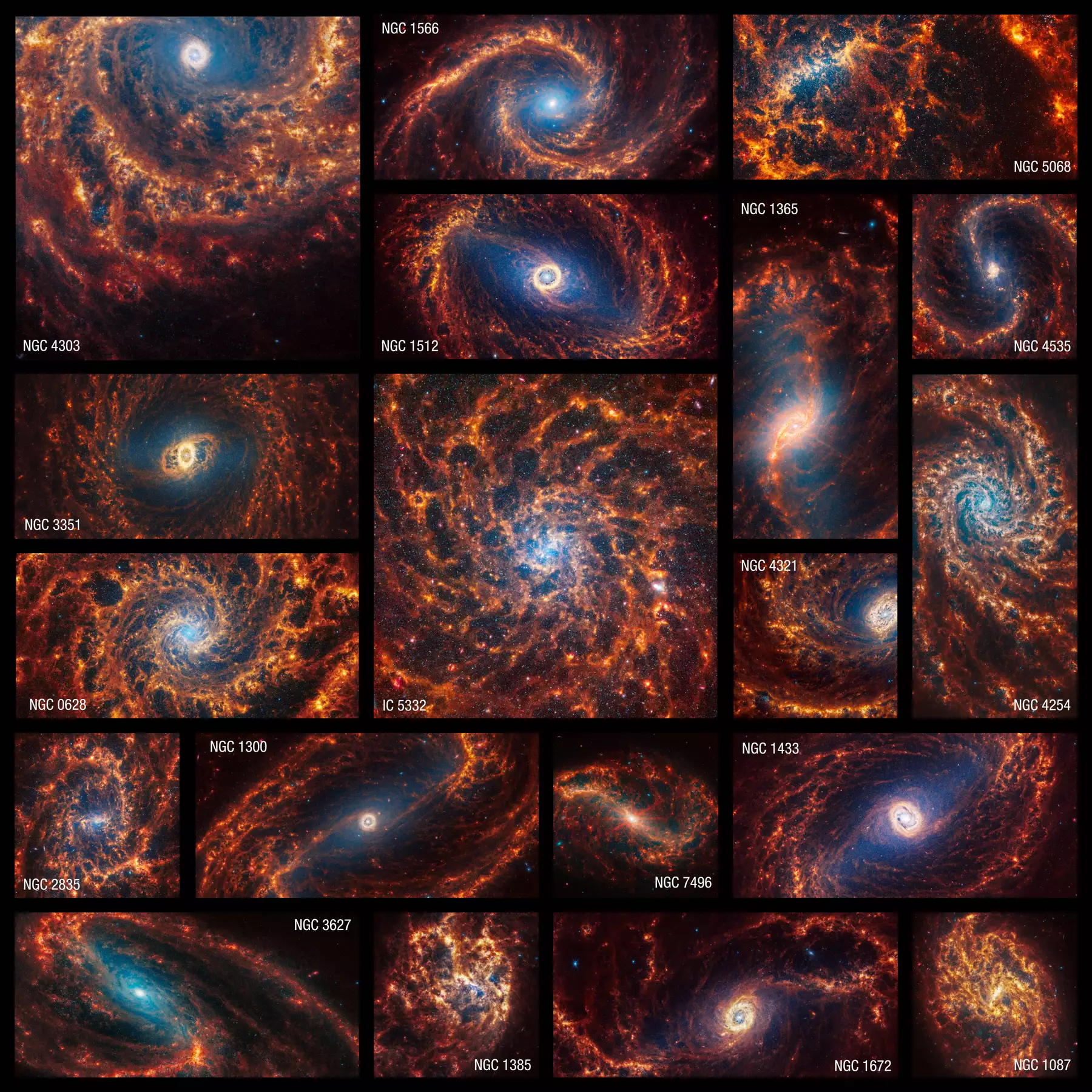
The internal structure of 19 galaxies, as seen in the infrared by Webb

The internal structure of 19 galaxies, as seen by Webb
Click for original image.

Scientists using the Webb Space Telescope today released false color infrared images of nineteen different spiral galaxies, each showing the complex internal structure that traces of spiral arms, but not always.

A compliation of those infrared images is to the right, reduced and sharpened to post here.

[Webb]โ€™s NIRCam (Near-Infrared Camera) captured millions of stars in these images, which sparkle in blue tones. Some stars are spread throughout the spiral arms, but others are clumped tightly together in star clusters.

The telescopeโ€™s MIRI (Mid-Infrared Instrument) data highlights glowing dust, showing us where it exists behind, around, and between stars. It also spotlights stars that have not yet fully formed โ€“ they are still encased in the gas and dust that feed their growth, like bright red seeds at the tips of dusty peaks. โ€œThese are where we can find the newest, most massive stars in the galaxies,โ€ said Erik Rosolowsky, a professor of physics at the University of Alberta in Edmonton, Canada.

The data suggests, not unexpectedly, that the central parts of each galaxy are older, formed first, with starbirth occurring later in the outer regions. A lot of further analysis however will be required to understand all the patterns exhibited in these images and their larger significance in connection with galaxy formation.

1 comment

The future of astronomy, as seen by PBS News in 1991

An evening pause: Today is the 75th anniversary of the moment astonomers took the lens cap off the Hale Telescope at Palomar, what astronomers call “first light.” In honor of this anniversary, tonight’s evening pause is a somewhat well-done news piece produced by PBS in 1991, describing the state of ground-based astronomy at that time, which was actually another key moment in the history of astronomy. After decades of no advancement following the Hale telescope, the field was about to burst out with a whole new set of telescopes exceeding it significantly, based on new technologies. We today have become accustomed to those new telescopes, but in 1991 they were still incomplete or on the drawing board.

This was also after the launch of Hubble but before it was fixed, so this moment was also a somewhat dark time for astronomy in general. Watching this news piece gives you a sense of history, as seen by those living at that time. It also lets you see some good examples of the standard tropes of reporters as well as some astronomers. They always say this new telescope (whatever and whenever it is) is going to allow us to discover the entire history of the universe, even though it never can, and never will.

Hat tip Mike Nelson.

15 comments

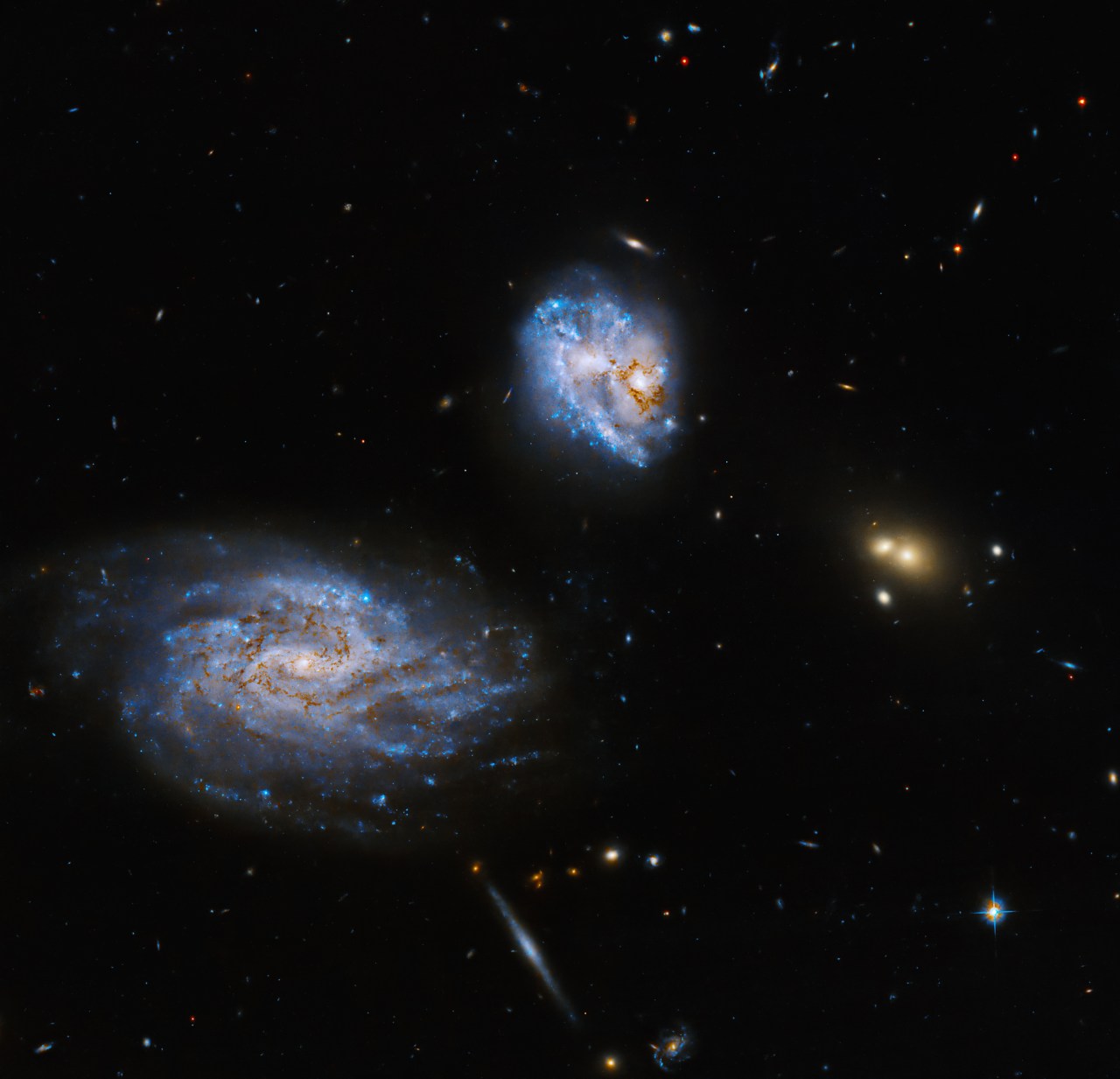
Merging galaxies

Merging galaxies
Click for original image.

Time for another cool image from the Hubble Space Telescope. The picture to the right, cropped, reduced, and sharpened to post here, was taken by Hubble to study “the overall physical characteristics of galaxies and their star formation.”

What the picture however reveals best is the ongoing merger of three galaxies.

Arp 300 consists of two interacting galaxies, UGC 05028 (the smaller face-on spiral galaxy) and UGC 05029 (the larger face-on spiral). Likely due to its gravitational dance with its larger partner, UGC 05028 has an asymmetric, irregular structure, which is not as visible from ground-based telescopes but is quite distinct in this new image from NASAโ€™s Hubble Space Telescope. The bright knot visible to the southeast of the center of UGC 05028 may be the remnant of another small galaxy that is in the process of merging with that galaxy.

As always with Hubble galaxy images, there are a plethora of other background galaxies scattered about, including what appears to be another merger in the center right of two elliptical galaxies. In fact, except for one star in the lower right (with the four spikes), every other object in this photo is a galaxy of many shapes and distances.

0 comments

Astronomical high-altitude balloon flight now exceeds two weeks

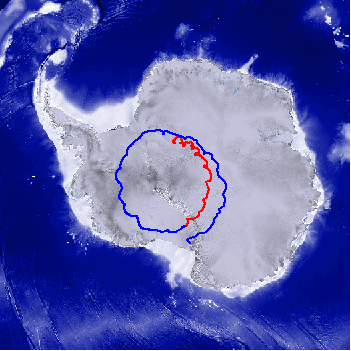
GUSTO's flight path as of January 18, 2024

A high-altitude stratospheric balloon, dubbed GUSTO and designed to study the interstellar medium, has now been circling the south pole over Antarctica for fifteen days.

The map to the right shows its full flight path since its launch on December 31, 2023. From the press release:

GUSTO is mapping a large portion of the Milky Way galaxy and Large Magellanic Cloud to help scientists study the interstellar medium. The observatory is transmitting the data it collects back to watchful teams on the ground as it steadily circumnavigates the South Pole around 120,000+ feet.

GUSTO is flying on a 39 million cubic-foot zero-pressure scientific balloon, which is so large it could easily fit 195 blimps inside of it. The balloon is used to fly missions for long periods of time during the Austral Summer over Antarctica. GUSTO is aiming for a NASA record of 55+ days in flight to achieve its science goals.

You can follow GUSTO’s flight in real time here.

1 comment

Webb confirms the unusual shape of early galaxies as seen by Hubble

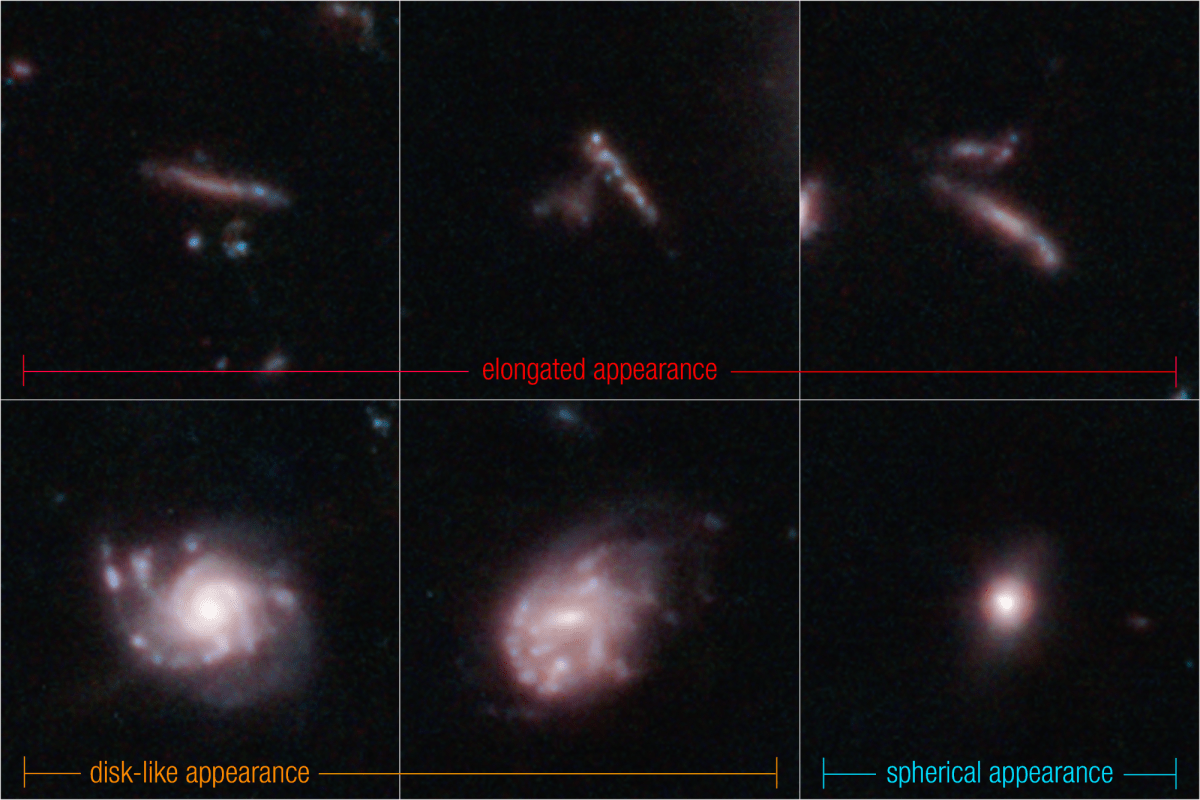
Earth galaxies shapes, as seen by Webb in infrared
Click for original image.

The uncertainty of science: The infrared view of the Webb Space Telescope appears to have confirmed and even underlined the unusual shapes of many early galaxies as previously seen by the Hubble Space Telescope.

Researchers analyzing images from NASAโ€™s James Webb Space Telescope have found that galaxies in the early universe are often flat and elongated, like surfboards and pool noodles โ€“ and are rarely round, like volleyballs or frisbees. โ€œRoughly 50 to 80% of the galaxies we studied appear to be flattened in two dimensions,โ€ explained lead author Viraj Pandya, a NASA Hubble Fellow at Columbia University in New York. โ€œGalaxies that look like pool noodles or surfboards seem to be very common in the early universe, which is surprising, since they are uncommon nearby.โ€

The team focused on a vast field of near-infrared images delivered by Webb, known as the Cosmic Evolution Early Release Science (CEERS) Survey, plucking out galaxies that are estimated to exist when the universe was 600 million to 6 billion years old.

While most distant galaxies look like surfboards and pool noodles, others are shaped like frisbees and volleyballs. The โ€œvolleyballs,โ€ or sphere-shaped galaxies, appear the most compact type on the cosmic โ€œoceanโ€ and were also the least frequently identified. The frisbees were found to be as large as the surfboard- and pool noodle-shaped galaxies along the โ€œhorizon,โ€ but become more common closer to โ€œshoreโ€ in the nearby universe.

The galaxies also appear generally far less massive than galaxies in the near universe, which fits with the Big Bang theory that says they had less time to grow.

The press release notes that the sample size is still very small, and further observations will be required to confirm whether these shapes are common in the early universe.

0 comments

A new plan to send a probe to interstellar object Oumuamua

Project Lyra about to rendezvous with Oumuamua
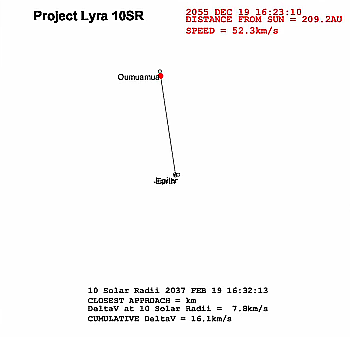
Click to watch the animation.

Scientists have proposed a project to send an unmanned probe to Oumuamua, using the Earth, Jupiter, and then the Sun to slingshot onto a path that would catch up with the interstellar object on its journey leaving the solar system in the mid-2050s.

The project, dubbed Lyra, was first proposed in 2023. The scientists have now revised the plan to account for the greater speeds needed to catch up with Oumuamua as it continues to move away from us. It is still within the solar system, but it is moving away very fast.

The graphic to the right, a screen capture of an animation at the link, shows the spacecraft as it finally approaches the interstellar object in 2055. To get there it would launch in the early 2030s, slingshot past the Earth to reach Jupiter, which would then slow it down so that it would fall back to the Sun, passing it by less than 450,000 miles, which would slingshot it out to Oumuamua (with the help of an additional engine burn). To survive the close solar approach it would use the same technology used by the Parker Solar Probe, which has already successfully flown that close to the Sun.

It seems this is an entirely worthwhile project, since Oumuamua continues to baffle scientists as to its nature. While most belief it is a natural but very unusual interstellar asteroid, none can dismiss the possibility that it instead an alien spacecraft. The data precludes nothing. Getting close to it seems worthwhile, no matter what.

For me, that rendezvous will happen when I would be 102 years old. I don’t think I’ll be here to see it.

21 comments

Webb infrared data detects unexpected structure inside debris disk of Beta Pictoris

Beta Pictoris debris disk
Click for original image.

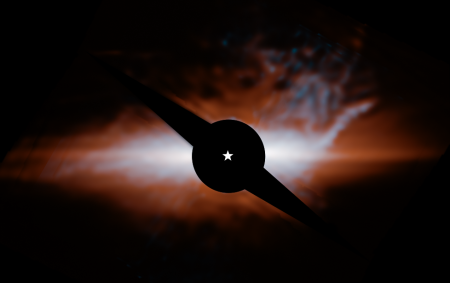
A new false color infrared image from the Webb Space Telescope has revealed an unexpected structure extending out from the two debris disks that surround the near-by star Beta Pictoris, with computer modeling suggesting might this structure have been the result of a large collision as recently as only 100 years ago.

That false-colr image is the right, with this newly discovered structure, described by the scientists as resembling “a cat’s tail”, on the right side. The infrared light of the star has been blocked in the center in order to see the details of the disk.

Webbโ€™s mid-infrared data also revealed differences in temperature between Beta Picโ€™s two disks, which likely is due to differences in composition. โ€œWe didnโ€™t expect Webb to reveal that there are two different types of material around Beta Pic, but MIRI clearly showed us that the material of the secondary disk and catโ€™s tail is hotter than the main disk,โ€ said Christopher Stark, a co-author of the study at NASAโ€™s Goddard Space Flight Center in Greenbelt, Maryland. โ€œThe dust that forms that disk and tail must be very dark, so we donโ€™t easily see it at visible wavelengths โ€” but in the mid-infrared, itโ€™s glowing.โ€

To explain the hotter temperature, the team deduced that the dust may be highly porous โ€œorganic refractory material,โ€ similar to the matter found on the surfaces of comets and asteroids in our solar system. For example, a preliminary analysis of material sampled from asteroid Bennu by NASAโ€™s OSIRIS-REx mission found it to be very dark and carbon-rich, much like what MIRI detected at Beta Pic.

In an attempt to explain the cat’s tail, the scientists used computer models, which suggested it might have been caused by an event that produced a lot of dust, such as a collision between two large objects in the debris disk, and that event could have happened as recently as a hundred years ago.

This hypothesis remains unconfirmed, with much more data required before a final explanation can be accepted.

0 comments

Another giant star undergoes dimming

The changes seen in RW Cephei
Click for original image.

Astronomers have detected another giant star dimming in a manner similar to the dimming that Betelgeuse experienced around 2019.

Old stars display light variations that are related to changes in their outer layers. The changes are usually small, so scientists were amazed when astronomers Wolfgang Vollmann and Costantino Sigismondi announced in 2022 that RW Cephei had faded dramatically over the previous few years. By December 2022, RW Cephei had faded to about one third of its normal brightness, an unprecedented drop.

You can read the published paper here. The researchers believe the dimming was caused by the release of dust from the star, blocking its light, much as what is believed happened with Betelgeuse.

RW Cephei, like Betelgeuse, is like a giant gas bag that fluctuates in shape like blob of water in weightlessness. This blob however so big that if placed where the Sun is its surface would be about the orbit of Jupiter. As shown in the two pictures to the right taken by this research team, the shape changed during this dimming.

The star however is much farther away, 16,000 light years compared to Betelgeuse’s 550 light years. Because of Betelgeuse’s size and nearness, until recently it was the only star outside of the Sun whose actual disk had been imaged. That astronomers can now get images of a star as far away as RW Cephei illustrates the incredible improvement in astronomical technology in the past three decades.

0 comments

China launches X-ray space telescope

China early today successfully used its Long March 2C rocket to launch its new Einstein X-ray space telescope, built in partnership with the European Space Agency (ESA). The rocket lifted off from the Xichang spaceport in the southwest of China.

Astronomers will use the telescope to study the high energy released by during supernovae. It will also be used to study black holes and other high energy deep space phenomenon.

Meanwhile, the lower stages of the rocket, which use toxic hypergolic fuels, fell somewhere in China. No word if they landed anywhere near habitable areas.

The 2023 launch race:

3 SpaceX
2 China
1 India
1 ULA

2 comments

One spiral galaxy eating another

One spiral galaxy eating another
Click for original image.

Cool image time! The picture to the right, cropped, reduced, and sharpened to post here, was taken by the Hubble Space Telescope as part of an on-going survey of known pecular-looking galaxies. This pair is believed to be 570 million light years away. From the caption:

Galaxies are composed of stars and their solar systems, dust and gas. In galactic collisions, therefore, these constituent components may experience enormous changes in the gravitational forces acting on them. In time, this completely changes the structure of the two (or more) colliding galaxies, and sometimes ultimately results in a single, merged galaxy. That may well be what results from the collision pictured in this image. Galaxies that result from mergers are thought to have a regular or elliptical structure, as the merging process disrupts more complex structures (such as those observed in spiral galaxies). It would be fascinating to know what Arp 122 will look like once this collision is complete . . . but that will not happen for a long, long time.

From our viewpoint, the spiral galaxy at the top appears warped by the gravitational pull of the face-on spiral at the bottom, as if it is being sucked into the bottom galaxy. In truth, both galaxies are pulling on each other. If we could circle around and see them in three dimensions we would almost certainly see distortions in the bottom spiral as well.

10 comments

Hubble detects changes in atmosphere of exoplanet

Using data from collected in 2016, 2018, and 2019 combined with computer simulations, scientists now believe they have detected changes in the atmosphere of the exoplanet WASP-121b, also nicknamed Tylos.

The Jupiter-sized planet orbits a star about 880 light years away.

WASP-121 b is so close to its parent star that the orbital period is only 1.27 days. This close proximity means that the planet is tidally locked so that the same hemisphere always faces the star, in the same way that our Moon always has the same side pointed at Earth. Daytime temperatures approach 3,450 degrees Fahrenheit (2,150 degrees Kelvin) on the star-facing side of the planet.

The team used four sets of Hubble archival observations of WASP-121 b. The complete data-set included observations of WASP-121 b transiting in front of its star (taken in June 2016); WASP-121 b passing behind its star, also known as a secondary eclipse (taken in November 2016); and the brightness of WASP-121 b as a function of its phase angle to the star (the varying amount of light received at Earth from an exoplanet as it orbits its parent star, similar to our Moon’s phase-cycle). These data were taken in March 2018 and February 2019, respectively.

A computer model was then used to fill in the gaps and provide a simulation of the hot temperatures of that exoplanet’s atmosphere over time. Two videos of that simulation are available at the link.

There of course is a lot of uncertainty in this result, though the fundamental discovery of changes is important. This data proves there is weather on such alien planets, even if that weather is so alien we really don’t understand it in the slightest based on the available data on hand.

2 comments

The uncertainty of science as proven by the Webb Space Telescope

A long detailed article was released today at Space.com, describing the many contradictions in the data coming back from the Webb Space Telescope that seriously challenge all the theories of cosmologists about the nature of the universe as well as its beginning in a single Big Bang.

The article is definitely worth reading, but be warned that it treats science as a certainty that should never have such contradictions, as illustrated first by its very headline: “After 2 years in space, the James Webb Space Telescope has broken cosmology. Can it be fixed?”

“Science” isn’t broken in the slightest. All Webb has done is provide new data that does not fit the theories. As physicist Richard Feynman once stated bluntly in teaching students the scientific method,

โ€œIt doesnโ€™t make a difference how beautiful your guess is, it doesnโ€™t make a difference how smart you are, who made the guess, or what his name is. If it disagrees with experiment, itโ€™s wrong.โ€

Cosmologists for decades have been guessing in proposing their theories about the Big Bang, the expansion of the universe, and dark matter, based on only a tiny amount of data that had been obtained with enormous assumptions and uncertainties. It is therefore not surprising (nor was it ever surprising) that Webb has blown holes in their theories.

For example, the article spends a lot of time discussing the Hubble constant, describing how observations using different instruments (including Webb) have come up with two conflicting numbers for it — either 67 or 74 kilometers per second per megaparsec. No one can resolve this contradiction. No theory explains it.

To me the irony is that back in the 1990s, when Hubble made its first good measurements of the Hubble constant, these same scientists were certain then that the number Hubble came up with, around 90 kilometers per second per megaparsec, was now correct.

They didn’t really understand reality then, and they don’t yet understand it now.

What cosmologists must do is back away from their theories and recognize the vast areas of ignorance that exist. Once that is done, they might have a chance to resolve the conflict between the data obtained and the theories proposed, and come up with new theories that might work (with great emphasis on the word “might”). Complaining about the paradoxes will accomplish nothing.

7 comments

Galaxies galore, near and far

Galaxies galore, and near and far

Cool image for the day after Christmas! The picture to the right, reduced and sharpened to post here, was taken by the Hubble Space Telescope, and shows a cluster of galaxies that all seem near each other. However, as the caption notes,

[W]hilst NGC 1356 [the largest spiral] and LEDA 95415 [close by its left] appear to be so close that they must surely be interacting, the former is about 550 million light-years from Earth and the latter is roughly 840 million light-years away, so there is nearly a whopping 300 million light-year separation between them. That also means that LEDA 95415 is likely nowhere near as [small] as it appears to be.

On the other hand, whilst NGC 1356 and IC 1947 [farthest to the left] seem to be separated by a relative gulf in this image, IC 1947 is only about 500 million light-years from Earth. The angular distance apparent between them in this image only works out to less than four hundred thousand light-years, so they are actually much much closer neighbours in three-dimensional space than NGC 1356 and LEDA 95415!

The two galaxies farthest apart in this image are actually close enough together to interact significantly. Though this picture doesn’t have the resolution to see it, there is likely a stream of stars between the two.

Note also the numerous tiny other galaxies scatterered throughout the picture. In fact, except for three stars (the objects with the north-south-east-west spikes), every object is a galaxy holding stars too numerous to count.

1 comment
1 15 16 17 18 19 114