Extremely Large Telescope in Chile marks halfway point in construction

The Extremely Large Telescope (ELT) has now celebrated the halfway point in its construction, with completion targeting 2028 when its 39-meter mirror will make it by far the largest telescope in the world.

The 39-meter diameter, or 127 feet or 1,535 inches, is about four times larger than the largest telescope that presently exists, the 10-meter telescope in the Canary Islands. By the time ELT begins operations however the 21-meter Giant Magellan Telescope (GMT) in Chile should also be in operation.

Sadly, the Thirty Meter Telescope (TMT) in Hawaii will likely not exist, even though it had intended to begin construction before ELT and GMT and be operational now. Leftist opponents in Hawaii have shut construction down now for almost eight years, with little signs of it ever proceeding.

Not that any of this really matters. In the near term, ground-based astronomy on Earth is going to become increasingly impractical and insufficient, first because of the difficulties of making good observations though the atmosphere and the tens of thousands of satellites expected in the coming decades, and second because new space-based astronomy is going to make it all obsolete. All it will take will be to launch one 8-meter telescope on Starship and ELT will become the equivalent of a buggy whip.

4 comments

Final close-out of all science research at Arecibo

The National Science Foundation (NSF) is proceeding with the final close-out of all science research at the now shuttered Arecibo radio telescope, ending all funding for the remaining science instruments that still function and letting go all scientists on staff as of August 14th.

In October 2022, NSF announced it would not rebuild the giant telescope, saying it was following community recommendations for the best use of scarce research dollars. It is now shutting down most of the smaller instruments as well. As scientists depart, “all the expertise associated with instruments is leaving,” Brisset says. Olga Figueroa-Miranda, director of the observatory, says people from UCF, Puerto Rico’s Metropolitan University, and Yang Enterprises, an engineering firm, will be let go, including herself. She has yet to find a new position.

The NSF has budgeted money to turn the telescope’s visitor center into a science education facility, but this is not likely to be very successful, as there will be no scientists at this somewhat remote location, which will in itself discourage any traffic.

5 comments

Scientists claim discovery of most distant supermassive black hole yet

The overwhelming uncertainty of some science: Using data from the infrared Webb Space Telescope, scientists are now claiming they have discovered most distant supermassive black hole yet, sitting at the center of an active galaxy only about a half billion years after the Big Bang. From the press release:

The galaxy, CEERS 1019, existed just over 570 million years after the big bang, and its black hole is less massive than any other yet identified in the early universe. Not only that, they’ve easily “shaken out” two more black holes that are also on the smaller side, and existed 1 and 1.1 billion years after the big bang. Webb also identified eleven galaxies that existed when the universe was 470 to 675 million years old. The evidence was provided by Webb’s Cosmic Evolution Early Release Science (CEERS) Survey, led by Steven Finkelstein of the University of Texas at Austin. The program combines Webb’s highly detailed near- and mid-infrared images and data known as spectra, all of which were used to make these discoveries.

CEERS 1019 is not only notable for how long ago it existed, but also how relatively little its black hole weighs. This black hole clocks in at about 9 million solar masses, far less than other black holes that also existed in the early universe and were detected by other telescopes. Those behemoths typically contain more than 1 billion times the mass of the Sun – and they are easier to detect because they are much brighter. (They are actively “eating” matter, which lights up as it swirls toward the black hole.) The black hole within CEERS 1019 is more similar to the black hole at the center of our Milky Way galaxy, which is 4.6 million times the mass of the Sun. This black hole is also not as bright as the more massive behemoths previously detected. Though smaller, this black hole existed so much earlier that it is still difficult to explain how it formed so soon after the universe began.

I have great doubts about this research, especially because the press release makes no effort to explain how the black holes were identified. Black holes emit no light, and were only first confirmed by watching the orbits of stars or objects near them over long periods of time. More distant supermassive black holes in the center of galaxies were later guessed at by what appears to be the relationship between the size of a galaxy’s nucleus and the presence of a black hole. Astronomers also assume that a very active and energetic galaxy (such as a quasar) is a sign a supermassive black hole exists at the center.

These primitive galaxies have only been observed at most a handful of times. They are so distant that they only are at most a few pixels wide. Spectra from these objects can tell us roughly how far away they are, and thus how close to the Big Bang they are thought to be, but it is impossible to say with any certainty that there is a black hole there.

I am made even more skeptical by this press release claim: “Webb’s data are practically overflowing with precise information that makes these confirmations so easy to pull out of the data.” Such language makes me suspicious that there is an underlying effort to justify Webb’s expense with this release by overstating its capabilities.

The press release provides links to the research. Take a look. I’d be glad if someone could clearly show me why I’m wrong to be so doubtful.

5 comments

Scientists: Quasar data shows time running five times slower in the early universe

The uncertainty of science: According to new research using data from almost 200 quasars collected over the two decades, scientists now believe they have detected the difference between the rate of time now and as we see it in the early universe.

“Looking back to a time when the universe was just over a billion years old, we see time appearing to flow five times slower,” said lead author of the study, Professor Geraint Lewis from the School of Physics and Sydney Institute for Astronomy at the University of Sydney. “If you were there, in this infant universe, one second would seem like one second – but from our position, more than 12 billion years into the future, that early time appears to drag.”

…Professor Lewis worked with astro-statistician Dr Brewer to examine details of 190 quasars observed over two decades. Combining the observations taken at different colours (or wavelengths) – green light, red light and into the infrared – they were able to standardise the ‘ticking’ of each quasar. Through the application of Bayesian analysis, they found the expansion of the universe imprinted on each quasar’s ticking.

“With these exquisite data, we were able to chart the tick of the quasar clocks, revealing the influence of expanding space,” Professor Lewis said.

These results further confirm Einstein’s picture of an expanding universe but contrast earlier studies that had failed to identify the time dilation of distant quasars. [emphasis mine]

I have highlighted the word “exquisite” because it is a favorite buzzword of scientists when they are trying to oversell conclusions that carry many uncertainties. As good as this data might be, it is still incredibly sparse, and the interpretation of it requires many assumptions.

Nonetheless, these results are likely correct, in some manner, because they match well with Einstein’s predictions. It is also most likely that there are many errors and incorrect aspects to those results that the scientists do not yet understand. Above all, confirmation bias remains a concern.

3 comments

More evidence found suggesting supernovae occurred near the solar system during its formation

Scientists have now detected more evidence that suggests a supernovae occurred very close to our solar system during its early period of formation.

Astronomers have for decades found such evidence inside meteorites. Small spherical inclusions called chondrules are thought by some to have formed when the heat of a nearby supernova caused melting. The new study finds more evidence in isotopes also found in primitive meteorites dubbed short-lived radionuclides (SLRs).

While SLRs probably existed in the part of the filament where the Sun and Solar System formed, the meteorite samples contained too much of a particular aluminum isotope for the interstellar medium to have been the Solar System’s only SLR source. Cosmic rays, which can convert stable isotopes to radioactive ones, had a better chance of explaining the number of isotopes found in the meteorites. However, it would have taken too long for this process to produce the levels of SLRs found in the early Solar System.

It is most likely that such high SLR levels could have come from either very intense stellar winds, which would have occurred during massive star formation, or from what was left after one of the massive stars went supernova.

You can read the published paper here.

If true, this data adds weight to the possibility that our solar system is somewhat unique, which in turn suggests finding just another like it — with life — might be difficult.

3 comments

A spiral galaxy as seen by Hubble

A spiral galaxy as seen by Hubble
Click for original image.

Cool image time! The picture to the right, cropped, reduced, and sharpened to post here, was taken as part of a research project to use the Hubble Space Telescope to photograph galaxies where supernovae had recently occurred. From the caption:

UGC 11860 lies around 184 million light-years away in the constellation Pegasus, and its untroubled appearance can be deceiving; this galaxy recently played host to an almost unimaginably energetic stellar explosion.

A supernova explosion — the catastrophically violent end of a massive star’s life — was detected in UGC 11860 in 2014 by a robotic telescope dedicated to scouring the skies for transient astronomical phenomena; astronomical objects which are only visible for a short period of time. Two different teams of astronomers used Hubble’s Wide Field Camera 3 to search through the aftermath and unpick the lingering remnants of this vast cosmic explosion.

This Hubble image once again illustrates the vastness of the universe. Note that every single dot surrounding UGC 11860 in this picture is another far more distant galaxy. As much as UGC 11860 is in our local intergalactic neighborhood, it is still so distant that this field of view is small enough that it contains no stars.

2 comments

Galaxies at the dawn of time

Link here. The article takes a quick look at six galaxies found by Webb’s infrared view that all less than 650 million years after the Big Bang is thought to have occurred.

None disprove the Big Bang. All however raise serious questions about the cosmological theories that posit that event and the subsequent evolution of the universe. Take a look. It is worthwhile reading.

1 comment

Webb takes infrared (heat) image of Saturn

Saturn in infrared
Click for original image.

Using the Webb Space Telescope, scientists on June 25, 2023 took the wonderful false color infrared (heat) image of Saturn above, cropped to post here, as part of a research project [pdf] to take a number of long exposures of the ringed planet in order to test Webb’s ability to see its small moons. From the press release:

Saturn itself appears extremely dark at this infrared wavelength observed by the telescope, as methane gas absorbs almost all of the sunlight falling on the atmosphere. However, the icy rings stay relatively bright, leading to the unusual appearance of Saturn in the Webb image.

…This new image of Saturn clearly shows details within the planet’s ring system, along with several of the planet’s moons – Dione, Enceladus, and Tethys. Additional deeper exposures (not shown here) will allow the team to probe some of the planet’s fainter rings, not visible in this image, including the thin G ring and the diffuse E ring. Saturn’s rings are made up of an array of rocky and icy fragments – the particles range in size from smaller than a grain of sand to a few as large as mountains on Earth.

The picture also shows differences between Saturn’s northern and southern hemispheres, caused by the seasonal differences between the two.

1 comment

Using pulsars scientists detect background signal of the universe’s gravitational waves

The uncertainty of science: Using the variations in the precise radio pulses sent out by many pulsars over a fifteen year year astronomers think they have detected the background signal produced by many gravitational waves over time throughout the universe.

Astrophysicists using large radio telescopes to observe a collection of cosmic clocks in our Galaxy have found evidence for gravitational waves that oscillate with periods of years to decades, according to a set of papers published today in The Astrophysical Journal Letters. The gravitational-wave signal was observed in 15 years of data acquired by the North American Nanohertz Observatory for Gravitational Waves (NANOGrav) Physics Frontiers Center (PFC), a collaboration of more than 190 scientists from the US and Canada who use pulsars to search for gravitational waves. International collaborations using telescopes in Europe, India, Australia and China have independently reported similar results.

Imagine that each wave is a single wave on the ocean. This detection is the rough equivalent of looking at the ocean’s overall surface and measuring the general roughness of all the waves.

The press is making a big deal about this discovery. It is good science, and will over time provide valuable insights into evolution and merger of black holes, but it is not that big a deal, especially because this research carries with it many assumptions and uncertainties that good scientists recognize. They thus remain somewhat skeptical about the data. Mainstream journalists however consider gravitational waves cool, and so they hype any press release about them, sometimes to the point of absurdity.

3 comments

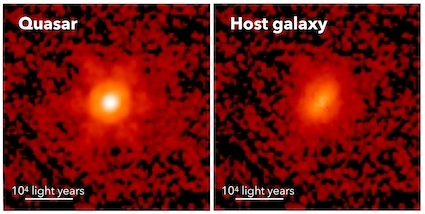
Host galaxies for two quasars in early universe detected for the first time

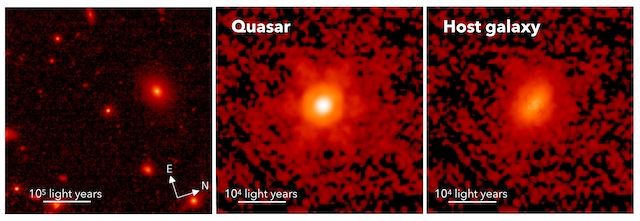
Quasar and host galaxy
One of the quasars, with its light subtracted on the right,
revealing the host galaxy. Click for original image.

The uncertainty of science: Using data from both the infrared Webb Space Telescope and the Subaru optical telescope in Hawaii, astronomers have observed for the first time the host galaxies of two quasars that formed less than a billion years after the Big Bang.

Just a few months after JWST started regular operations, the team observed two quasars, HSC J2236+0032 and HSC J2255+0251, at redshifts 6.40 and 6.34 when the universe was approximately 860 million years old, both of which were discovered using Subaru Telescope’s deep survey program. The relatively low luminosities of these quasars made them prime targets for measuring the properties of their host galaxies.

The images of the two quasars were taken at infrared wavelengths of 3.56 and 1.50 microns with JWST’s NIRCam instrument, and the host galaxies became apparent after carefully modeling and subtracting glare from the accreting black holes. The stellar signature of the host galaxy was also seen in a spectrum taken by JWST’s NIRSPEC for J2236+0032, further supporting the detection of the host galaxy.

Photometric analyses found that these two quasar host galaxies are massive, measuring 130 and 34 billion times the mass of the Sun, respectively. Measuring the speed of the turbulent gas in the vicinity of the quasars from the NIRSPEC spectra suggests the black holes that power them are also massive, measuring 1.4 and 0.2 billion times the mass of the Sun. The ratio of the black hole to host galaxy mass is similar to those of galaxies in the more recent past, suggesting that the relationship between black holes and their hosts was already in place 860 million years after the Big Bang. [emphasis mine]

Normally, quasars are so bright the host galaxy is obscured. Computer modeling that subtracted the quasar’s light produced the host galaxy image on the right.

The highlighted sentence raises intriguing questions again about the Big Bang. Webb is once again finding evidence that the early universe quickly became like today’s universe, much faster than expected by cosmologists.

3 comments

Webb makes first detection of one particular carbon molecule

The uncertainty of science: Using the Webb Space Telescope, astronomers have made the first detection of methyl cation (pronounced cat-eye-on) (CH3+) in space, located in a baby solar system the star-forming region of the Orion nebula about 1,350 light years away.

While the star in d203-506 is a small red dwarf, the system is bombarded by strong ultraviolet (UV) light from nearby hot, young, massive stars. Scientists believe that most planet-forming disks go through a period of such intense UV radiation, since stars tend to form in groups that often include massive, UV-producing stars.

Typically, UV radiation is expected to destroy complex organic molecules, in which case the discovery of CH3+ might seem to be a surprise. However, the team predicts that UV radiation might actually provide the necessary source of energy for CH3+ to form in the first place. Once formed, it then promotes additional chemical reactions to build more complex carbon molecules.

Broadly, the team notes that the molecules they see in d203-506 are quite different from typical protoplanetary disks. In particular, they could not detect any signs of water. [emphasis mine]

In the next day or so we shall likely see a number of stories in the mainstream press shouting some variation of “Webb finds key element of life!” Webb has done no such thing. It has found a carbon molecule not seen previously, which simply provides scientists another small data point in trying to understand the development of complex solar systems.

The highlighted sentences make clear the uncertainty in this field and the general shallow amount of knowledge. For example, why carbon molecules but no water, which is made up of hydrogen and oxygen, both ubiquitous throughout the universe and found in large amounts in star-forming regions?

5 comments

More direct images released of exoplanet 87.5 light years away

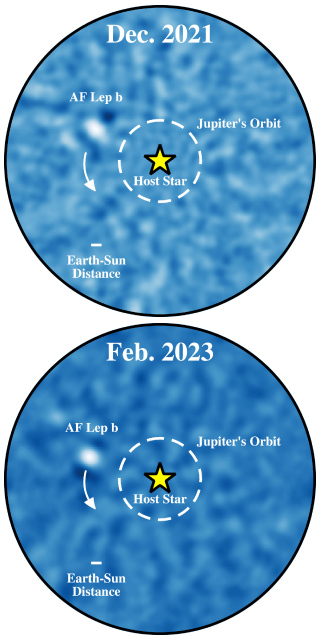
Keck images of exoplanet over time

The Keck Observatory in Hawaii has now released its own image of the exoplanet AF Leporis b, following up the images produced by the Very Large Telescope (VLT) released in February.

The direct images Franson’s team captured revealed that AF Lep b is about three times the mass of Jupiter and orbits AF Leporis, a young Sun-like star about 87.5 light-years away. They took a series of deep images of the planet starting in December 2021; two other teams also captured images of the same planet since then.

What make the Keck observations most interesting is that they captured over time the motion of the exoplanet as it orbited its star. The two images to the right show this motion.

The paper, available here, was published today in Astrophysical Journal Letters. This particular star also has a debris disk surrounding it, suggesting it is a young solar system still in the process of forming. From the paper’s conclusion:

AF Lep joins other young planet hosts with debris disks such as β Pic, HR 8799, HD 206893, and HD 95086, reinforcing indications of a higher frequency of long-period planets orbiting stars hosting debris disks.

0 comments

Astronomers detect vaporized elements in atmosphere of hot Jupiter-sized exoplanet

Using the Gemini telescope in Hawaii, astronomers have detected several elements in atmosphere of hot Jupiter-sized exoplanet, dubbed WASP-76b, that would normally be found in rocks, but here are vaporized because the exoplanet orbits so close to its star.

In 2020 and 2021, using Gemini North’s MAROON-X (a new instrument specially designed to detect and study exoplanets), Pelletier and his team observed the planet as it passed in front of its host star on three separate occasions. These new observations uncovered a number of rock-forming elements in the atmosphere of WASP-76b, including sodium, potassium, lithium, nickel, manganese, chromium, magnesium, vanadium, barium, calcium, and, as previously detected, iron.

Due to the extreme temperatures of WASP-76b’s atmosphere, the elements detected by the researchers, which would normally form rocks here on Earth, are instead vaporized and thus present in the atmosphere in their gaseous forms. While these elements contribute to the composition of gas giants in our Solar System, those planets are too cold for the elements to vaporize into the atmosphere making them virtually undetectable.

The data not only suggests such elements exist in the solar system’s gas giants, but that such elements are common in solar systems elsewhere. That possibility increases the chances of other planets like Earth, capable of sustaining life as we know it, in addition to sustaining life as we don’t know it.

2 comments

A faint irregular cloud of stars

A faint irregular cloud of stars
Click for original picture.

Cool image time! The picture to the right, cropped, reduced, and sharpened to post here, was released today by the science team of the Hubble Space Telescope. It shows an irregular galaxy thought to be about 44 million light years away.

Alongside its hazy shape, NGC 7292 is remarkably faint. As a result, astronomers classify NGC 7292 as a low surface brightness galaxy, barely distinguishable against the backdrop of the night sky. Such galaxies are typically dominated by gas and dark matter rather than stars.

Astronomers directed Hubble to inspect NGC 7292 during an observational campaign studying the aftermath of Type II supernovae. These colossal explosions happen when a massive star collapses and then violently rebounds in a catastrophic explosion that tears the star apart. Astronomers hope to learn more about the diversity of Type II supernovae they have observed by scrutinising the aftermath and remaining nearby stars of a large sample of historical Type II supernovae.

NGC 7292’s supernova was observed in 1964 and accordingly given the identifier SN 1964H. Studying the stellar neighbourhood of SN 1964H helps astronomers estimate the initial mass of the star that went supernova, and could uncover surviving stellar companions that once shared a system with the star that would become SN 1964H.

I searched but was unable to locate any 1964 images of this galaxy when the supernova was still visible, so I could not pinpoint its location in the picture. It has long since faded away.

Note that the reddish smudges scattered throughout the picture are likely galaxies so far distant that their light has shifted entirely into the reddish spectrum. This likely places them one to several billions of light years away, not millions.

2 comments

Astronomers admit new satellite constellations “are not a threat” to Hubble

In a June 5, 2023 press release from the Space Telescope Science Institute (STScI) that operates both the Hubble and Webb space telescopes, astronomers admitted that the increased number of orbiting satellites from SpaceX and OneWeb have had little impact on Hubble’s observations, and even that impact has been reduced by new software tools.

Stark applied the new tool, based on the image analysis technique known as the Radon Transform, to identify satellite trails across Hubble’s camera with the widest field of view, the Advanced Camera for Surveys (ACS). In 2002 the satellite streaks were present in five percent of ACS exposures, with many of those too faint to discern easily. This rose to ten percent by 2022, although the typical brightness of the detected trails remained unchanged.

…”To date, these satellite trails have not had a significant impact on research with Hubble,” said Tom Brown, Head of STScI’s Hubble Mission Office. “The cosmic rays that strike the telescope’s detectors are a bigger nuisance.”

Radiation from space hits the ACS electronic detectors on every exposure, leaving streaks. These are easy to identify from exposure to exposure. The same holds true for artificial satellites. “The average width I measured for satellites was 5 to 10 pixels. The ACS’ widest view is 4,000 pixels across, so a typical trail will affect less than 0.5% of a single exposure. So not only can we flag them, but they don’t impact the majority of pixels in individual Hubble images. Even as the number of satellites increases, our tools for cleaning the pictures will still be relevant,” said Stark. [emphasis mine]

In other words, the claims by many astronomers that the increase in satellites is a threat to astronomy have been exaggerated. The new satellites might have a greater impact on ground-based telescopes, but based on these numbers (which would be comparable if not better for the giant 8-meter-plus big telescopes on Earth), that impact should be as easily mitigated.

I am gob-smacked that STScI issued this press release, since it undercuts the entire political narrative of the astronomical community that demands these new satellite constellations be either regulated, limited, or even banned, because otherwise all astronomy will be impossible. Based on the information presented here, none of those regulations are justified, at all, and that narrative is an utter lie.

9 comments

X-ray telescope on ISS develops light leak

The NICER X-ray telescope on ISS has developed a light leak that now limits its use during daylight hours.

The team suspects that at least one of the thin thermal shields on NICER’s 56 X-ray Concentrators has been damaged, allowing sunlight to reach its sensitive detectors.

Pending any repair attempts, observations during the daytime are now restricted to objects in the sky opposite the Sun. Night observations remain unaffected.

2 comments

Scientists claim to identify cause of Sun’s fast solar wind

The uncertainty of science: Using data from the Parker Solar Probe, scientists now believe they have identified the cause of Sun’s fast solar wind that streams from the magnetic regions on the Sun that are dubbed coronal holes.

In a paper published June 7, 2023 in the journal Nature, a team of researchers used data from NASA’s Parker Solar Probe to explain how the solar wind is capable of surpassing speeds of 1 million miles per hour. They discovered that the energy released from the magnetic field near the sun’s surface is powerful enough to drive the fast solar wind, which is made up of ionized particles—called plasma—that flow outward from the sun.

The results depend a great deal on computer modeling, based on our presently limited understanding of magnetic field processes in environments like stars. It will need to be confirmed by more data from Parker as well as later probes.

1 comment

Webb’s first deep field infrared image reveals hundreds of very early galaxies

The uncertainty of science: Using the Webb Space Telescope to take a 32-day-long infrared exposure, scientists have obtained the deepest deep field picture of the universe’s earliest time period, within which they have found more than 700 galaxies, 717 to be exact.

The initial survey of these galaxies appear to reveal several facts.

About a sixth of early galaxies in the JADES sample are in the throes of star formation of a kind we don’t see in the nearby universe, Endsley explains, marked by extremely bright emission at certain wavelengths. “Stars within very early galaxies are forming in these super-compact clumps,” he adds, “forming hundreds, perhaps thousands of these very massive, young stars all at once, basically within the span of a couple millions of years.”

But they weren’t “on” all the time. The low fraction of galaxies with such emission suggests that individual clumps would suddenly light up with new stars and then rest for some time. This “bursty” mode of star formation could explain the unexpectedly bright galaxies announced by other astronomers — they were simply looking at the galaxies fired up with unexpectedly intense star formation.

However, while these findings explain too-bright galaxies, they don’t explain the too-massive galaxies, another early, albeit controversial find from JWST data. Endsley explains that even as hot, massive newborn stars light up their galaxy, they’re not necessarily associated with all that much mass. “We’re not really finding evidence of these over-massive objects within our JADES sample,” he states.

In other words, this data appears to contradict earlier data from Webb that other researchers said revealed galaxies that were too massive and developed to have formed that soon after the Big Bang.

All of this data remains somewhat uncertain, and is based on only tiny tidbits of information, gleaned from mere smudges of red-shifted infrared light. Much more research will be required, some not possible by Webb, before we have any solid answers, and even then there is going to be a lot of uncertainty.

4 comments

Gemini telescope in Hawaii fixed, captures nearby supernova

Gemini North image of supernova in Pinwheel Galaxy
Click for original image.

The Gemini telescope in Hawaii, which was damaged in 2022 during normal maintenance operations, has now been fixed and resumed observations, beginning with a spectacular image of the newly discovered supernova in the Pinwheel Galaxy, only 20 million light years away.

The Gemini North telescope, one half of the International Gemini Observatory operated by NSF’s NOIRLab, has returned from a seven-month hiatus literally with a bang, as it has captured the spectacular aftermath of a supernova, a massive star that exploded in the large, face-on, spiral Pinwheel Galaxy (Messier 101). The supernova, named SN 2023ixf [as indicated by the arrow], was discovered on 19 May by amateur astronomer Koichi Itagaki.

Since its discovery, observers around the globe have pointed their telescopes toward Messier 101 to get a look at the burst of light. Over the coming months, Gemini North will allow astronomers to study how the light from the supernova fades and how its spectrum evolves over time, helping astronomers better understand the physics of such explosions.

As one of the closest supernova to occur in years, SN 2023ixf has become a major target by astronomers. This type of supernova signals the collapse and death of a star 8 to 10 times the mass of the Sun. Since the life cycle of such massive stars is not yet fully understood, this nearby supernova provides a great opportunity for astronomers to learn more.

2 comments

Hubble snaps picture of another jellyfish galaxy

Another jellyfish galaxy
Click for original image.

Astronomers today released another picture of a jellyfish galaxy taken by the Hubble Space Telescope, with that picture to the right, cropped, reduced, and sharpened to post here. From the caption:

The jellyfish galaxy JO206 trails across this image from the NASA/ESA Hubble Space Telescope, showcasing a colourful star-forming disc surrounded by a pale, luminous cloud of dust. A handful of bright stars with criss-cross diffraction spikes stand out against an inky black backdrop at the bottom of the image. JO206 lies over 700 million light-years from Earth in the constellation Aquarius.

This image is the sixth and final such photograph in this survey. You can view all of these images here. The study has found that star formation does not seem to be significantly different inside the galaxy versus the tentacles that stretch out beyond due to pressure from the intergalactic material. This suggests that the influence of this intergalactic material on the formation of stars is relatively minor.

0 comments
1 19 20 21 22 23 113