A nearby aging galaxy with an active supermassive black hole at its center

aging galaxy
Click for original image.

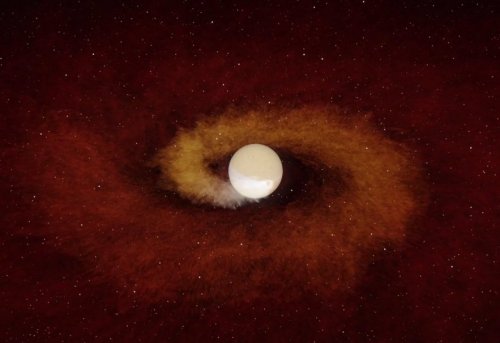
Cool image time! The picture to the right, reduced and sharpened to post here, was taken by the Hubble Space Telescope and released today. It shows a galaxy only 30 million light years away, making almost our neighbor. From the caption:

NGC 3489 has an active galactic nucleus, or AGN. The AGN sits at the center of the galaxy, is extremely bright, and emits radiation across the entire electromagnetic spectrum as the black hole devours material that gets too close to it.

This lenticular galaxy is a Seyfert galaxy, which is a class of AGN that is dimmer than other types of AGNs. They generally don’t outshine the rest of the galaxy, so the galaxy surrounding the black hole is clearly visible. Other types of AGNs emit so much radiation that it is almost impossible to observe the host galaxy.

That active nucleus is the bright dominate sphere at the galaxy’s center, large enough to overwhelm a large percentage of the rest of the galaxy. Its existence and dominance suggests that this galaxy is aging, and is beginning the transition from a spiral to an elliptical. In fact, its arms have already mostly vanished, and there is at present little star-formation on-going.

2 comments

Galaxies without end

Galaxies without end
Click for full image.

Cool image time! The picture to the right has been significantly reduced but also significantly sharpened to post here. It was taken by the Hubble Space Telescope as part of a recent survey of “jellyfish” galaxies, galaxies located in galaxy clusters where there is a large concentration of galaxies whose combined gravity and intergalactic environment acts to pull material or “tendrils” out from the galaxy.

Rather than crop the image to focus on that single large central jellyfish galaxy, I have instead sharpened the much-reduced full photo to bring out clearly the number of surrounding galaxies. There is only one Milky Way star in this picture, the object with the four diffraction spikes in the lower-right. Every other dot is a galaxy, many of which can be seen to be very strangely shaped in the original full resolution image. In fact, I strongly recommend you click on the picture to explore that original image, just to see the variety of galaxy shapes.

The point of this picture today however is not to illustrate the wide variety of galaxies that can exist, but to underline the vast and largely incomprehensible scale of the universe. The large galaxy is thought to be 650 million light years away, which means it took light traveling at 186,000 miles per second that many years to get here. The surrounding galaxies are also all tens to hundreds of millions of light years from each other. Yet, their combined gravity, almost infinitesimal in strength, is enough to warp the shape of each.

We understand these numbers and facts intellectually, but do we understand them in reality? I think it is difficult, even if you work hard to come up with a scaled comparison. For example, it took nine years for the New Horizons spacecraft to get from Earth to Pluto, a distance of about 4.5 light hours. And New Horizons was the fastest traveling probe ever launched, moving at 36,400 miles per hour when it left Earth. Yet, this distance is nothing compared to the distance between these galaxies.

The vastness of existence really is beyond our comprehension. That we try to comprehend it speaks well of the human desire to achieve the impossible.

4 comments

Astronomers discover 25 more repeating fast radio bursts, doubling the number known

Using a ground-based radio telescope in Canada that scans the northern sky each night, astronomers have discovered another 25 repeating fast radio bursts (FRBs), doubling the number that was previously known.

One surprising aspect of this new research is the discovery that many repeating FRBs are surprisingly inactive, producing under one burst per week during CHIME’s observing time. Pleunis believes that this could be because these FRBS haven’t yet been observed long enough for a second burst to be spotted.

The cause of FRBs still remains unsolved. The knowledge of specific repeating FRBs however will go a long way to figuring out this mystery, because other telescopes will be able to better observe later bursts, knowing when they are expected to occur.

0 comments

Experimental NASA high altitude balloon circles Antarctica in ten days

Overview map
Click for original image.

An experimental NASA high altitude balloon has successfully circled the continent of Antarctica in only ten days, flying at an average elevation of 107,000 feet.

The overview map to the right, annotated for posting here, shows its flight path so far.

“The balloon is performing exactly the way it was engineered to do, maintaining its shape and flying at a stable altitude despite the heating and cooling of the day-night cycle,” said Debbie Fairbrother, NASA’s Scientific Balloon Program chief. “As we continue to test, validate, and qualify this technology for future flights we’re also performing some cutting-edge science.”

The balloon is flying the Super Pressure Balloon Imaging Telescope (SuperBIT) payload, which has already returned brilliant research images from this flight.

Weather permitting, the balloon can be seen from the ground, especially at sunrise and sunset, as it continues on its globetrotting journey. People can track the real-time location of NASA’s super pressure balloon at this website: https://www.csbf.nasa.gov/map/balloon10/flight728NT.htm

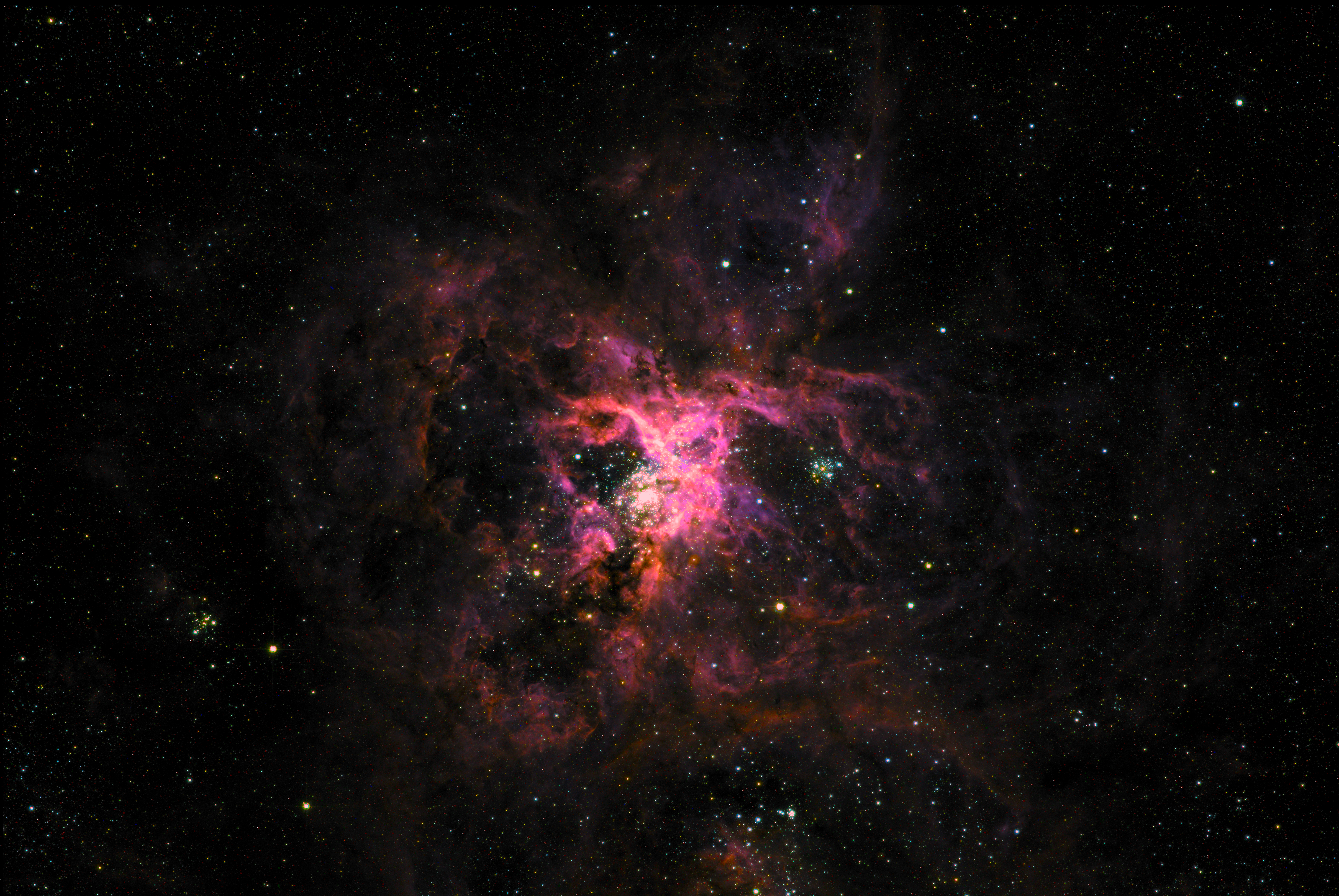
The images have so far been of astronomical objects, such as the Antennae galaxy and the Tarantula nebula. Being so high above the atmosphere, the pictures are sharper than ground-based telescopes and have a much wider field of view.

The press release did not state how long this flight will last, but it did mention a second balloon mission is planned, flying a European cosmic-ray detector.

4 comments

The inexplicable tail of the asteroid Phaethon is from sodium, not dust

For years astronomers have puzzled over the strange behavior of the asteroid Phaethon, which though rocky would still produce a tail like a comet whenever its orbit took it close to the Sun.

New research by astronomers using several space telescopes designed to study the Sun has determined that this tail is made of sodium, not dust as previously believed, which also suggests that many of the other “comets” these solar telescopes have detected close to the Sun might instead be asteroids like Phaeton.

Hoping to find out what the tail is really made of, Zhang looked for it again during Phaethon’s latest perihelion in 2022. He used the Solar and Heliospheric Observatory (SOHO) spacecraft — a joint mission between NASA and the European Space Agency (ESA) – which has color filters that can detect sodium and dust. Zhang’s team also searched archival images from STEREO and SOHO, finding the tail during 18 of Phaethon’s close solar approaches between 1997 and 2022.

In SOHO’s observations, the asteroid’s tail appeared bright in the filter that detects sodium, but it did not appear in the filter that detects dust. In addition, the shape of the tail and the way it brightened as Phaethon passed the Sun matched exactly what scientists would expect if it were made of sodium, but not if it were made of dust.

Knowing these new facts, it might make it possible to map the asteroids that orbit very close to the Sun but are hard to detect optically using standard telescopes because of the Sun’s brightness. Instead, astronomers might be able to map them using these solar telescopes.

1 comment

New research expands lethal zone around supernovae

According to data collected from a number of orbiting space X-ray telescopes, astronomers now believe that the lethal zone for nearby habitable planets when a supernova explodes is much larger than previously thought, as great as almost 200 light years.

The calculations in this latest study are based on X-ray observations of 31 supernovae and their aftermath mostly obtained from Chandra, NASA’s Swift and NuSTAR missions, and ESA’s (European Space Agency’s) XMM-Newton. The analysis of these observations shows that there can be lethal consequences from supernovae interacting with their surroundings, for planets located as much as about 160 light-years away. “If a torrent of X-rays sweeps over a nearby planet, the radiation would severely alter the planet’s atmospheric chemistry,” said Ian Brunton of the University of Illinois at Urbana-Champaign who led the study. “For an Earth-like planet, this process could wipe out a significant portion of ozone, which ultimately protects life from the dangerous ultraviolet radiation of its host star.”

You can read the paper here [pdf], which includes a figure that suggests in certain circumstances the lethal zone can be 200 light years across. As the scientists note:

Perhaps the most interesting results are the distances at which the X-ray emission can impose lethal effects on an Earth-like biosphere. This larger range of influence has consequences for the Galactic habitable zone, such as the harmful implications for recently discovered exoplanets that would be susceptible to nearby [supernovae].

In other words, this data suggests the galaxy is far less hospitable to the development of life. It takes a lot of time for life to evolve, billions of years, and during that time a solar system traveling through the galaxy has now a much higher chance of passing too close to a supernova explosion.

9 comments

A classic spiral galaxy

A classic spiral galaxy
Click for original image.

Cool image time! The photo to the right, cropped, reduced, and sharpened to post here, was taken by the Hubble Space Telescope and released today as the European Space Agency’s (ESA) Hubble picture of the week.

A large spiral galaxy. It has many narrow arms that are tightly-twisted in the centre, but at the ends they point out in different directions. The galaxy’s core glows brightly, while its disc is mostly faint, but with bright blue spots throughout the arms. A few smaller spiral galaxies at varying angles are visible in front, and it is surrounded by other tiny stars and galaxies, on a black background.

This galaxy is believed to be 260 million light years away, and was home to a supernova in 2020. This image was taken as a follow-up to that explosion.

0 comments

Museum offers $25k for recovery of meteorite that landed in Maine April 8th

Meteorite landing track

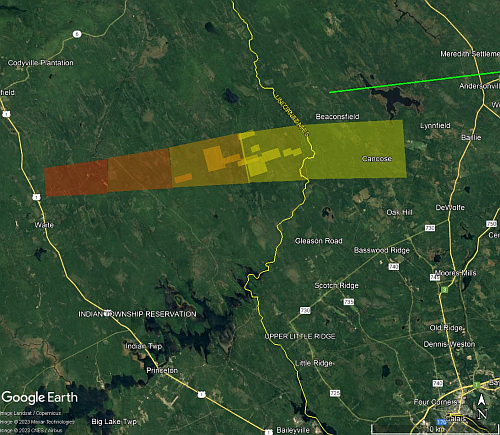
Because a instrument operated by NOAA picked up radar data of an asteroid fall over Maine on April 8, 2023, it has been possible for NASA scientists to publish a track, shown to the right, of where any pieces of the meteorite might have landed.

As a result, the Maine Mineral and Gem Museum has offered a $25k reward to anyone who turns in the first piece weighing more than one kilogram.

The $25,000 reward is only for the first kilogram, but Pitt said that the museum will also buy other fireball pieces that are found. “Depending upon the type of meteorite this is, specimens could easily be worth their weight in gold,” he said.

The American Meteor Society received six witness reports of Saturday’s fireball, half of which were in northeast Maine. One of the witnesses described the meteorite as having a “long glowing tail (but no smoke).” Another said that it was “bright red” while the tail was “very white.”

The museum also emphasized that any meteorite hunters must get landowner permission before entering private land.

1 comment

Webb snaps infrared picture of Uranus

Uranus as seen in the infrared by Webb
Click for original Webb false-color image.

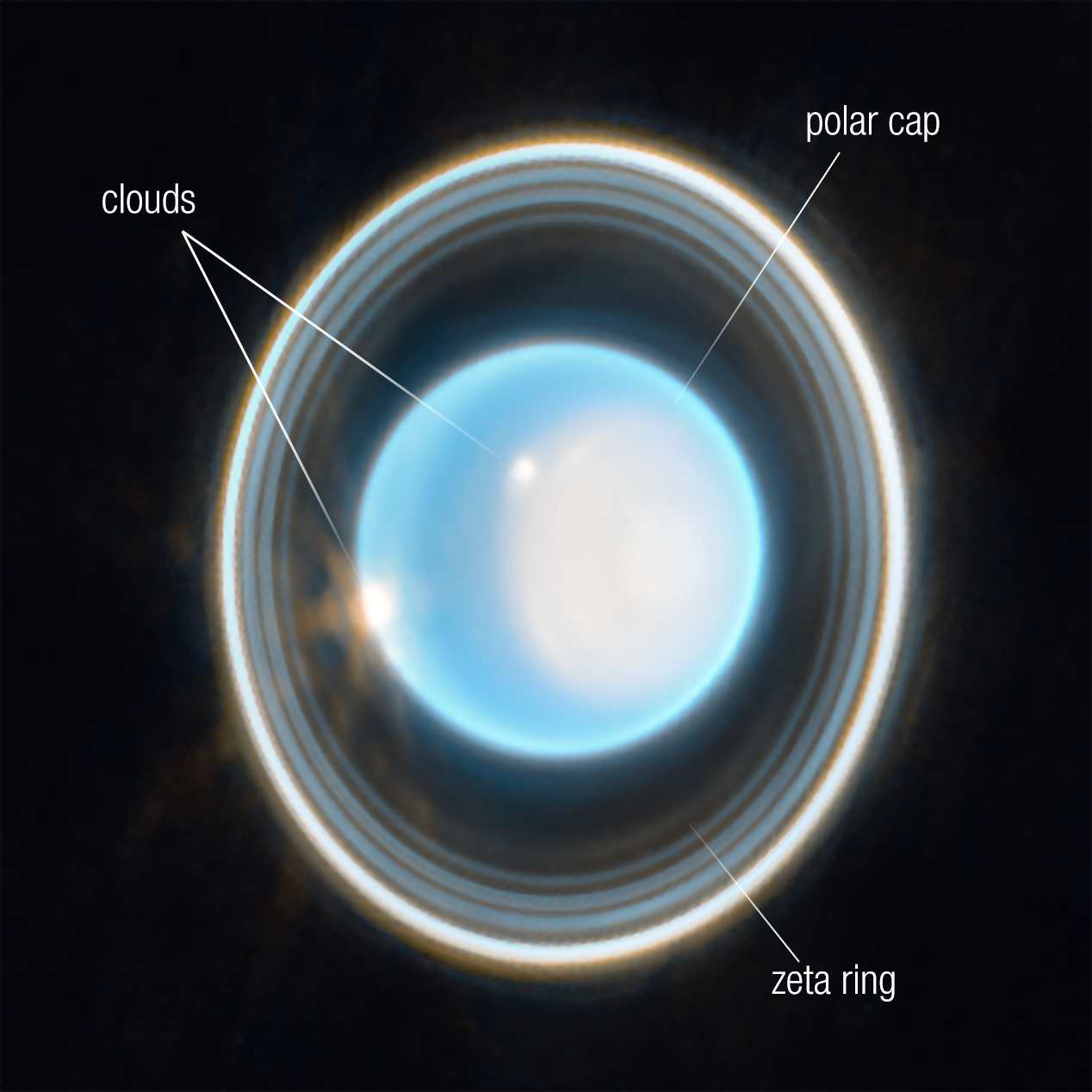
In a follow-up to a recent Hubble Space Telescope optical image of Uranus, scientists have now used the Webb Space Telescope to take a comparable picture in the infrared of the gas giant.

Both pictures are to the right, with the Webb picture at the top including the scientists’ annotations.

On the right side of the planet there’s an area of brightening at the pole facing the Sun, known as a polar cap. This polar cap is unique to Uranus – it seems to appear when the pole enters direct sunlight in the summer and vanish in the fall; these Webb data will help scientists understand the currently mysterious mechanism. Webb revealed a surprising aspect of the polar cap: a subtle enhanced brightening at the center of the cap. The sensitivity and longer wavelengths of Webb’s NIRCam may be why we can see this enhanced Uranus polar feature when it has not been seen as clearly with other powerful telescopes like the Hubble Space Telescope and Keck Observatory.

At the edge of the polar cap lies a bright cloud as well as a few fainter extended features just beyond the cap’s edge, and a second very bright cloud is seen at the planet’s left limb. Such clouds are typical for Uranus in infrared wavelengths, and likely are connected to storm activity.

The Webb image also captures 11 of Uranus’s 13 rings, which appear much brighter in the infrared than in the optical.

Unlike all other planets in the solar system, Uranus’s rotation is tilted so much that it actually rolls as it orbits the Sun, a motion that is obvious by comparing these pictures with Hubble’s 2014 optical picture.

3 comments

First binary quasar found

Double quasar as seen by the Hubble Space Telescope

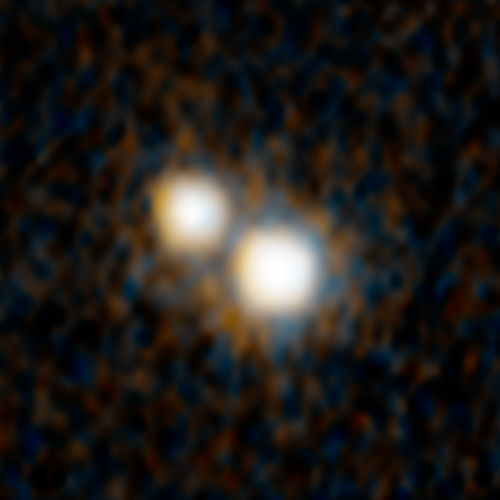
Using a suite of telescopes on the ground and in orbit, astronomers have found the first galaxy made up of two quasars, supermassive black holes that are very active in eating material from around them.

ESA’s (European Space Agency) Gaia space observatory first detected the unresolved double quasar, capturing images that indicate two closely aligned beacons of light in the young universe. Chen and his team then used NASA’s Hubble Space Telescope to verify the points of light were in fact coming from a pair of supermassive black holes.

Multi-wavelength observations followed; using Keck Observatory’s second generation Near-Infrared Camera (NIRC2) paired with its adaptive optics system, as well as Gemini North, NASA’s Chandra X-ray Observatory, and the Very Large Array network of radio telescopes in New Mexico, the researchers confirmed the double quasar was not two images of the same quasar created by gravitational lensing.

The two quasars are estimated to be only about 10,000 light years apart. Scientists estimate that this galaxy is about ten billion light years away, and exists in this state only about three billion years after the Big Bang.

0 comments

Scientists try to model what would happen if Ryugu hit Earth

Ryugu's northen hemisphere
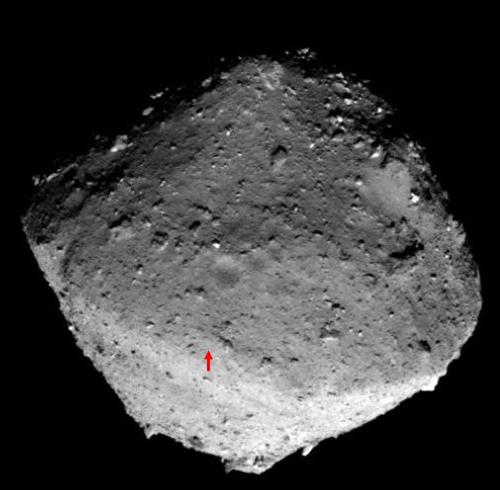
Ryugu’s northen hemisphere. The arrow marks the spot Hayabusa-2
gathered samples

Scientists, using the data and rock samples gathered by the Japanese probe Hayabusa-2, have attempted to predict what what would happen if the rubble-pile asteroid Ryugu hit the Earth.

Without diversion intervention, Tanaka explained, if the Ryugu asteroid was heading to Earth and entered the planet’s atmosphere at an angle of 45 degrees and at a speed of around 38,000 miles per hour (17 kilometers per second), the rubble pile asteroid would break up at an altitude of around 25 to 21 miles (40 to 35 km) over the surface of the planet.

This would result in an “airburst” similar to that seen over Russia in February 2013 when the Chelyabinsk meteor erupted at an altitude of around 19 miles (30 kilometers) over Earth. The result of the Chelyabinsk blast was a bright flash of light and an atmospheric blast equivalent to the detonation of 400–500 kilotons of TNT. This is as much as 33 times the energy released by the atomic bomb that devastated Hiroshima at the end of the Second World War.

The Chelyabinsk meteor caused about 1,500 injuries, mostly from people injured by glass thrown out by breaking windows when it suddenly and unexpectedly exploded during re-entry. With Ryugu this would not be a surprise, so these injuries could be reduced, though not eliminated. The damage and injuries from pieces that survived the breakup and hit the ground remains unknown because scientists don’t know how much of the asteroid would survive the break up.

Ryugu of course poses no threat, because it is not on a collision course with Earth. Whether an asteroid like Ryugu could be diverted however remains unknown, since any such diversion must not cause the asteroid to break apart as well.

7 comments

The chaos between galaxies following their head-on collision

The chaos between galaxies following their head-on collision
Click for original image.

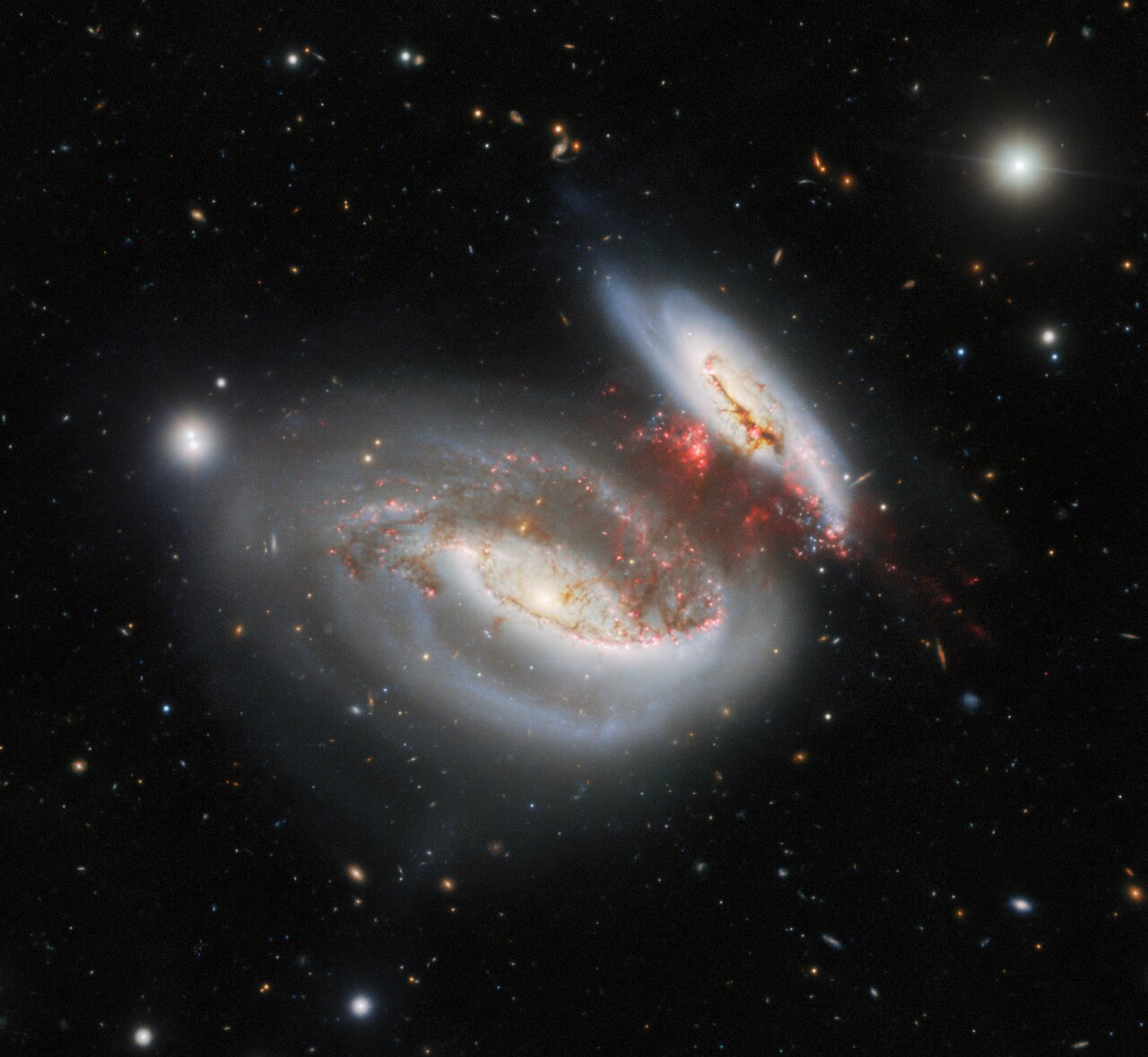
Cool image time! The picture to the right, cropped, reduced, and sharpened to post here, was taken using the Gemini North ground-based 8-meter telescope in Hawaii. It shows two spiral galaxies about 180 million light years away following a head-on collision about 25 million years ago, in which the smaller spiral moved through the larger from the bottom to the top.

Upon exiting, the smaller spiral trailed behind it the reddish stream of material, while its outside arms on the right were bent downward. That trailing material is why astronomers have dubbed these the “Taffy Galaxies.” Imagine pulling two clumps of taffy apart. The stretched material linking the two clumps is the bridge of trailing material between these two galaxies. From the caption:

When the Taffy Galaxies’ collided, their galactic disks and gaseous components smashed right into each other. This resulted in a massive injection of energy into the gas, causing it to become highly turbulent. As the pair emerged from their collision, high-velocity gas was pulled from each galaxy, creating a massive gas bridge between them. The turbulence of the stellar material throughout the bridge is now prohibiting the collection and compression of gas that are required to form new stars.

The evolution of galaxies is incredibly slow, from the perspective of human existence. For example, this first collision 25 million years ago seems like it took a long time, but it will likely be followed by many more over the next billion years, eventually resulting in a single spherical elliptical galaxy. On the time scale of the universe, collisions every 100 million years or so means galaxies like this can mix and collide many times, and do so well within the existence of the theorized lifespan of the universe itself.

To us short-lived humans, however, this process just seems so slow it can’t possibly happen as described. But it does.

Sidebar: It appears this image was released to herald the repair of Gemini North’s primary mirror, which was damaged in two places on its edge during a recoating operation on October 20, 2022. Since then the telescope has been shut down as repair operations were undertaken. That repair is now complete, and it is expected the telescope will resume science observations in a few weeks.

2 comments

Webb finds Earth-sized exoplanet likely too hot to have atmosphere

The uncertainty of science: Using the infrared Webb Space Telescope, scientists have measured the temperature of the Earth-sized exoplanet, dubbed Trappist-1b, and found its temperature is probably too hot to have atmosphere.

The red dwarf star Trappist-1is about 40 light years from Earth, and in 2017 was found to have a solar system of seven exoplanets, all rocky terrestrial planets like the inner planets of our solar system. Trappist-1b is the innermost exoplanet. To measure its temperature, Webb observed the star while the planet was eclipsed by the star as well as when it was not, and measured the tiny difference in infrared light.

The team analyzed data from five separate secondary eclipse observations. “We compared the results to computer models showing what the temperature should be in different scenarios,” explained Ducrot. “The results are almost perfectly consistent with a blackbody made of bare rock and no atmosphere to circulate the heat. We also didn’t see any signs of light being absorbed by carbon dioxide, which would be apparent in these measurements.”

As this was the innermost of the star’s solar system, it is also the one most likely to lack an atmosphere. Webb’s observations of the system continue, so there is a chance that data about the other exoplanets will eventually tell us more about them.

1 comment

A multitude of strange galaxies

A multitude of strange galaxies
Click for original image.

Cool image time! The picture to the right, reduced and sharpened to post here, was taken by the Hubble Space Telescope and released today. From the caption:

Z 229-15 is one of those interesting celestial objects that, should you choose to research it, you will find defined as several different things: sometimes as an active galactic nucleus (an AGN); sometimes as a quasar; and sometimes as a Seyfert galaxy. Which of these is Z 229-15 really? The answer is that it is all of these things all at once, because these three definitions have significant overlap.

All three classifications involve galaxies with nuclei that are brighter, more energetic, and more massive than the rest of the galaxy. Z229-15 itself is estimated to be 390 million light years away.

Normally I would have cropped the image to center on Z229-15. However, I was struck by the number of other strange galaxies in the distance and on the periphery of the picture. Near the top is a trio of three, none of which appear spiral- or elliptical-shaped. On the right is a galaxy that could be a standard spiral seen edge-on, but its red nucleus is very unusual. And scattered across the bottom half of the image are a number of weirdly shaped galaxies of all types, none of which appear typical.

Be sure to look at the high resolution original. There are more weird galaxies visible there.

1 comment

Hubble spots long term seasonal changes on Uranus

Uranus as seen by Hubble in 2014 and 2022
Click for original image.

Using images of Uranus taken eight years apart by the Hubble Space Telescope, astronomers have detected significant seasonal changes in the atmosphere of the gas giant, caused by its unusual sideways rotation.

The two pictures to the left, realigned and reduced to post here, show the changes. If you look closely you can see the planet’s ring system and its shift to almost face on at present.

[top] — This is a Hubble view of Uranus taken in 2014, seven years after northern spring equinox when the Sun was shining directly over the planet’s equator, and shows one of the first images from the OPAL program. Multiple storms with methane ice-crystal clouds appear at mid-northern latitudes above the planet’s cyan-tinted lower atmosphere. Hubble photographed the ring system edge-on in 2007, but the rings are seen starting to open up seven years later in this view. At this time, the planet had multiple small storms and even some faint cloud bands.

[bottom] — As seen in 2022, Uranus’ north pole shows a thickened photochemical haze that looks similar to the smog over cities. Several little storms can be seen near the edge of the polar haze boundary. Hubble has been tracking the size and brightness of the north polar cap and it continues to get brighter year after year. Astronomers are disentangling multiple effects – from atmospheric circulation, particle properties, and chemical processes – that control how the atmospheric polar cap changes with the seasons. At the Uranian equinox in 2007, neither pole was particularly bright.

To really understand the long term climate of Uranus will likely take centuries, since its year lasts 84 Earth years. Since the beginning of space exploration, we have only had now about forty years of good imagery of the planet, and even that has been sporadic and very incomplete.

8 comments

Samples from Ryugu found to contain uracil, one of the four nucleobases in RNA

Japanese researchers analyzing the samples returned by Hayabusa-2 from the rubble-pile asteroid Ryugu have identified the molecule uracil, one of the four nucleobases that form the molecule RNA.

Hayabusa 2 collected 5.4 grams from two spots on Ryugu and delivered them to Earth on December 6, 2020. Early studies showed the samples contained many organic compounds. That led Oba’s group to analyze two 10-milligram samples using the same sensitive technique they had used earlier on meteorites. The technique can detect nucleic acid bases at levels down to parts per trillion in small samples.

Now, they report in Nature Communications that uracil is present at a level of parts per billion in both Ryugu samples. While this concentration is different than they’d previously found in meteorites, Oba says that might be because the parent bodies of the meteorites and of Ryugu underwent different levels of aqueous alteration and other processes. They also detected niacin (vitamin B3) as well as other organic molecules, but they didn’t find any other nucleobases.

RNA is formed from four nucleobases, uracil, adenine, cytosine, and guanine. To form DNA, the fundamental building block of life, uracil is replaced by thymine.

This data reinforces other data that suggests the formation of these essential molecules for life is relatively common and easy, at least in our solar system.

0 comments

Dimorphus is dry, based on data obtained before and after DART hit it

Data collected by the ground-based Very Large Telescope (VLT) in Chile before and after the impact by the DART probe in September 2022 has revealed that the rubble-pile asteroid Dimorphos is very dry, with little or no water.

[The astronomers] observed the Didymos–Dimorphos system on 11 occasions, from just before the impact to about a month afterwards. MUSE [one of VLT’s instruments] is able to split the light from the double-asteroid into a spectrum, or rainbow, of colors, to look for emission at specific wavelengths that corresponds to specific molecules. In particular, Opitom’s team searched the ejecta for water molecules and for oxygen that could have come from the break-up of water molecules by the impact. However, no evidence of water was detected. Dimorphos, at least, seems to be a dry asteroid.

You can read the paper here.

Some theories prior to DART’s impact suggested that there could be ice within some inner solar system asteroids. Finding none instead suggests that inner solar system asteroids are very distinct and different from the icy comets and asteroids either coming from or orbiting in the outer solar system.

0 comments

Webb detects “hot sand clouds” in atmosphere of exoplanet

Using the Webb Space Telescope, astronomers have detected “hot sand clouds” in atmosphere of exoplanet 40 light years away, along with evidence of water, methane, carbon monoxide, carbon dioxide, sodium, and potassium.

You can read the paper here [pdf]. The exoplanet itself appears to have some features that resemble that of a brown dwarf, or failed star, instead of an exoplanet.

Although VHS 1256 b is more on the heavier side of the known exoplanets, its gravity is relatively low compared to more massive brown dwarfs. Such very low-mass stars can only burn deuterium for a relatively short duration. Consequently, the planet’s silicate clouds can appear and remain higher in its atmosphere, where the JWST can detect them. Another reason its skies are so turbulent is the planet’s age. In astronomical terms, it is pretty young. Only 150 million years have passed since it formed. The planet’s heat stems from the recent formation process – and it will continue to change and cool over billions of years.

The sand clouds are hot, in the range of 1,500 degrees Fahrenheit.

These results were obtained as part of an early-release program from Webb, and illustrate the potential of the infrared space telescope for learning many specific details about brown dwarfs and exoplanets.

0 comments

Blobs and jellyfish in space

Blobs and Jellyfish
Click for original image.

Cool image time! The picture to the right, cropped and reduced to post here, was taken by the Hubble Space Telescope and released today.

The galaxy JW100 features prominently in this image from the NASA/ESA Hubble Space Telescope, with streams of star-forming gas dripping from the disc of the galaxy like streaks of fresh paint. These tendrils of bright gas are formed by a process called ram pressure stripping, and their resemblance to dangling tentacles has led astronomers to refer to JW100 as a ‘jellyfish’ galaxy. It is located in the constellation Pegasus, over 800 million light-years away.

Ram pressure stripping occurs when galaxies encounter the diffuse gas that pervades galaxy clusters. As galaxies plough through this tenuous gas it acts like a headwind, stripping gas and dust from the galaxy and creating the trailing streamers that prominently adorn JW100. The bright elliptical patches in the image are other galaxies in the cluster that hosts JW100.

The image was part of a research project studying star formation in the tendrils of jellyfish galaxies.

The blob near the top of the image is another galaxy in this same galaxy cluster. It is an elliptical galaxy that also happens to have two central nuclei, caused when two smaller galaxies merged. The central regions of each have not yet merged into one.

5 comments

Hubble looks at a nearby dwarf galaxy

A nearby dwarf galaxy
Click for original image.

Cool image time! The photo to the right, cropped, reduced, and sharpened to post here, was taken by the Hubble Space Telescope as part of a continuing project to capture high resolution images of every nearby galaxy, which in this particular case the caption describes as follows:

UGCA 307 hangs against an irregular backdrop of distant galaxies in this image from the NASA/ESA Hubble Space Telescope. The small galaxy consists of a diffuse band of stars containing red bubbles of gas that mark regions of recent star formation, and lies roughly 26 million light-years from Earth in the constellation Corvus. Appearing as just a small patch of stars, UGCA 307 is a diminutive dwarf galaxy without a defined structure — resembling nothing more than a hazy patch of passing cloud.

The red regions of star formation are significant, as they indicate that even in a tiny galaxy like this it is possible for there to be enough gas and dust to coalesce into new stars.

Astronomers living on a world inside this galaxy have an advantage over astronomers on Earth. There is no large galaxy like the Milky Way blocking their view of the cosmos in one direction. They can see it all, even in directions looking through UGCA 307.

11 comments
1 21 22 23 24 25 113