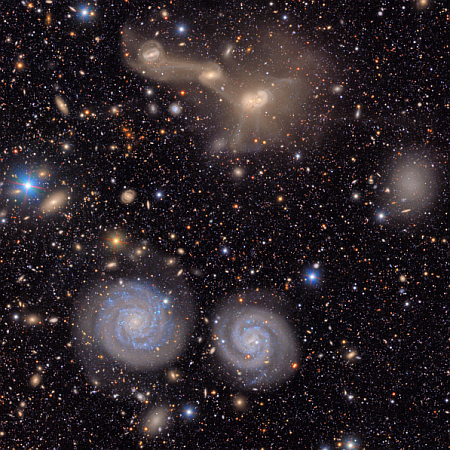
New calculations suggest Andromeda might not collide with Milky Way

The uncertainty of science: Scientists using new data from the Hubble Space Telescope as well as Europe’s Gaia space telescope, combined with many computer models, have determined that the 2012 prediction that the Andromeda galaxy would collide with Milky Way in five billion years was much more uncertain. From the abstract of the paper:

[W]e consider the latest and most accurate observations by the Gaia and Hubble space telescopes, along with recent consensus mass estimates, to derive possible future scenarios and identify the main sources of uncertainty in the evolution of the Local Group over the next 10 billion years. We found that the next most massive Local Group member galaxies — namely, M33 and the Large Magellanic Cloud—distinctly and radically affect the Milky Way — Andromeda orbit. Although including M33 increases the merger probability, the orbit of the Large Magellanic Cloud runs perpendicular to the Milky Way–Andromeda orbit and makes their merger less probable.

In the full system, we found that uncertainties in the present positions, motions and masses of all galaxies leave room for drastically different outcomes and a probability of close to 50% that there will be no Milky Way–Andromeda merger during the next 10 billion years. Based on the best available data, the fate of our Galaxy is still completely open.

The press release at the first link above makes it sounds as the previous prediction of a collision had been fully accepted as certain by the entire astronomical community, and that is balder-dash. It was simply the best guess at the time, highly uncertain. This new prediction — that we really don’t know what will happen based on the data available — is simply the newest best guess.

This new analysis however is certainly more robust and honest.

4 comments

Trump budget proposes putting a final end to the delayed and blocked Thirty Meter Telescope

There is a lot more to report, and I will do so in a day or so, but I thought it worthwhile to quickly note the the proposed science cuts in the proposed Trump budget for 2026 includes the elimination of all funds for Thirty Meter Telescope (TMT) in Hawaii.

In the budget request, NSF [National Science Foundation]… says it will back only one of the two $3 billion optical telescopes that the astrophysics community wants to build. That honor goes to the Giant Magellan Telescope already under construction in Chile. Its competitor, the Thirty Meter Telescope (TMT), “will not advance to the Final Design Phase and will not receive additional commitment of funds from NSF,” according to the budget request.

The NSF has never had enough money to finance both telescopes. The fact that TMT has been blocked for more than a decade by DEI protesters in Hawaii, with the aid of the state government (controlled entirely by Democrats), makes funding it pointless, and a waste of the taxpayers’ money. It long past time to pull the plug.

As I say, there is a lot more details to report in this budget proposal, including its effort to slash a lot of science government spending, but that will have to wait for later essays. I can promise you one thing, however: I will not do what the rest of the press does, and write a knee-jerk propaganda piece in support of that spending. The science mafia at NASA and the NSF and other agencies has funded a lot of junk in the last few decades. It is time for a reckoning.

8 comments

Webb spots a new record-setting galaxy, only 280 million years after the Big Bang

MoM Z14
The galaxy MoM z14, as seen in the infrared
by Webb. Click for original image.

The uncertainty of science: Using the Webb Space Telescope, astronomers have now identified a galaxy that formed only 280 million years after the Big Bang, far earlier than their theories of the origins of the universe had predicted.

“The broader story here is that JWST was not expected to find any galaxies this early in the history of the universe, at least not at this stage of the mission,” van Dokkum said. “There are, very roughly, over 100 more relatively bright galaxies in the very early universe than were expected based on pre-JWST observations.”

The data suggests MoM z14 is 50 times smaller than the Milky Way, contains nitrogen and carbon, and appears to be forming stars. The data also found little neutral hydrogen surrounding the galaxy, which also contradicts those same cosmological theories. According to those theories, the early universe should be filled with neutral hydrogen.

The nitrogen and oxygen are also there earlier than expected, and suggest there will be more such galaxies, including some even closer to the Big Bang.

Hat tip BtB’s stringer Jay.

0 comments

Astronomers discover a star radiating in X-rays and radio in ways that fit no known explanation

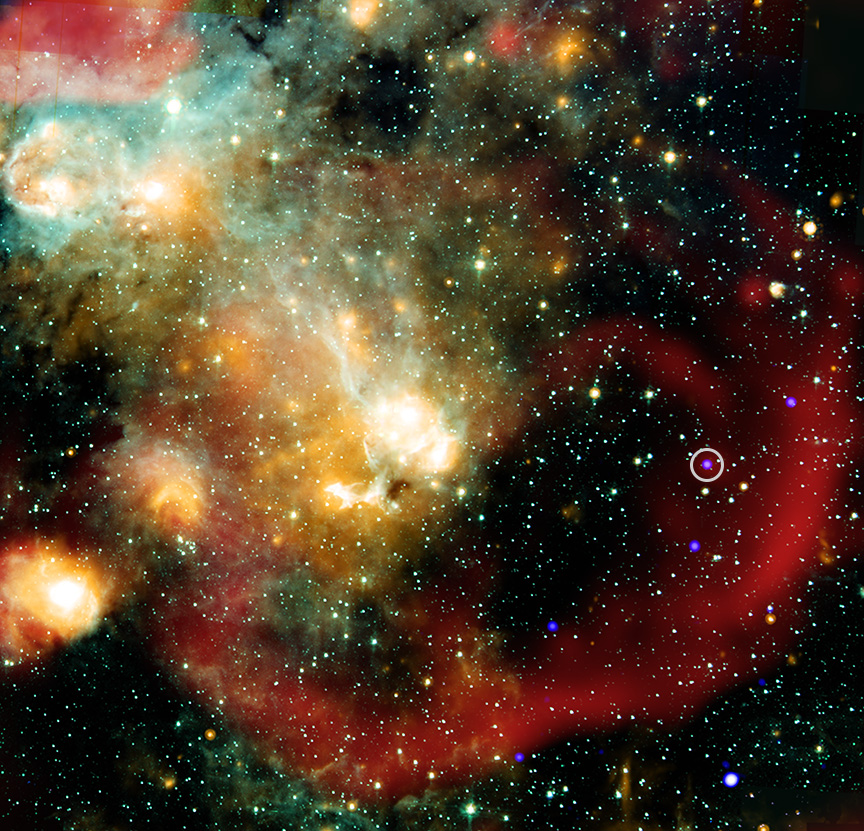
ASKAP J1832 circled. Note the red arc denoting the supernovae remnant
ASKAP J1832 circled. Note the red arc denoting
the supernovae remnant. Click for original image.

Using both the Chandra X-Ray Observatory and the Square Kilometer Array in Australia, astronomers have discovered a star that pulses in both X-rays and and radio frequencies in a manner previously unseen and that fit no known theory.

ASKAP J1832 belongs to a class of objects called “long period radio transients,” discovered in 2022, that vary in radio wave intensity in a regular way over tens of minutes. This is thousands of times longer than the length of the repeated variations seen in pulsars, which are rapidly spinning neutron stars that have repeated variations multiple times a second. ASKAP J1832 cycles in radio wave intensity every 44 minutes, placing it into this category of long period radio transients.

Using Chandra, the team discovered that ASKAP J1832 is also regularly varying in X-rays every 44 minutes. This is the first time that such an X-ray signal has been found in a long period radio transient.

…However, that is not all ASKAP J1832 does. Using Chandra and the SKA Pathfinder, the team found that ASKAP J1832 also dropped off in X-rays and radio waves dramatically over the course of six months. This combination of the 44-minute cycle in X-rays and radio waves in addition to the months-long changes is unlike anything astronomers have seen in the Milky Way galaxy.

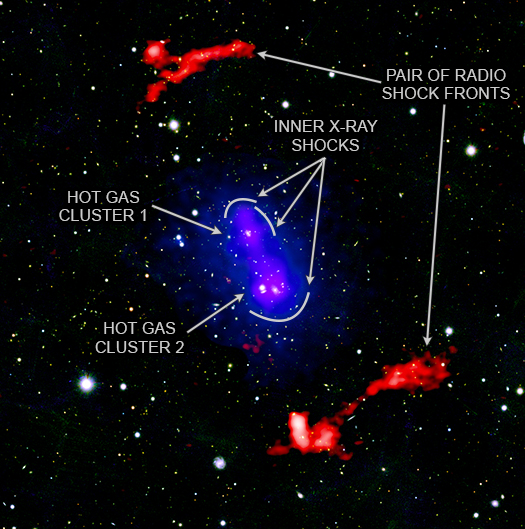
The false-color X-ray/radio image to the right shows the star (circled). Based on the data, it is unlikely that the star is a neutron star or a pulsar. Its properties also do not fit with a magnetar (a pulsar with a very strong magnetic field). Though located within a supernova remnant, the astronomers determined this to be a coincidence, the star unrelated to the remnant.

The best explanation so far is that this is a white dwarf with a companion and the strongest magnetic field ever conceived. The astronomers however do not appear enthused by that explanation either.

0 comments

A galactic pinwheel

A galactic pinwheel
Click for original image.

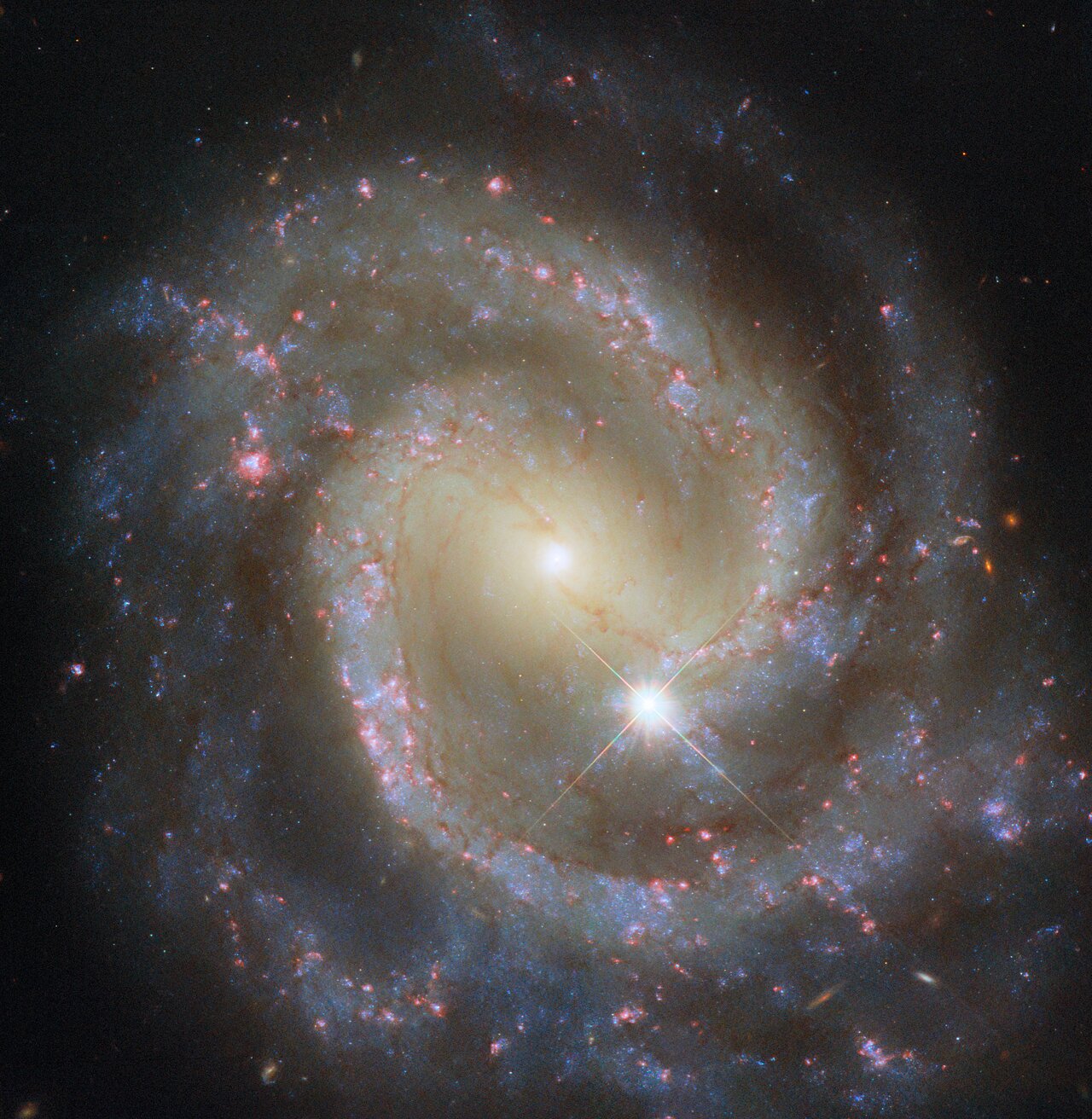
It’s cool image time, partly because we have a cool image and partly because there is little news today due to the holiday. The picture to the right, cropped, reduced, and sharpened to post here, was taken by the Hubble Space Telescope and was released today as the science team’s picture of the week. It shows us a classic pinwheel galaxy located approximately 46 million light years away. From the caption:

A spiral galaxy seen face-on. Its centre is crossed by a broad bar of light. A glowing spiral arm extends from each end of this bar, both making almost a full turn through the galaxy’s disc before fading out.

The bright object with the four spikes of light is a foreground star inside the Milky Way and only 436 light years away. The bright orange specks inside the spiral arms are likely star forming regions, with the blue indicating gas clouds.

As for the holiday, I’ll have more to say about Memorial Day later today.

1 comment

Astronomers discover a perfect sphere in radio

Radio object Teleios

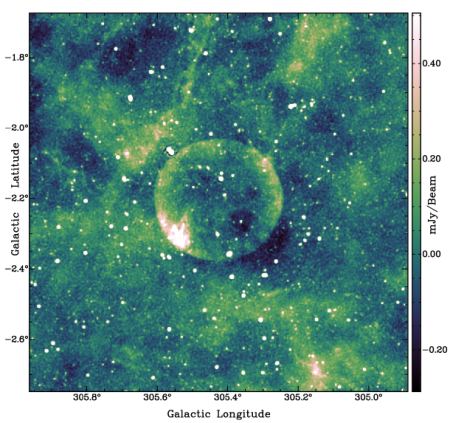
Using the array of radio dishes dubbed the Australian Square Kilometre Array, astronomers have made the serendipitous discovery of what appears to be a perfect sphere of radio emissions tens of light years in diameter and tens of thousands of light years away and near the galactic center.

The scientists have dubbed the object Teleios, Greek for ‘complete’ or ‘perfect’. The image to the right is that radio image. Though the astronomers posit that it must have been formed from a supernova explosion, there are problems with that conclusion. From their paper [pdf]:

Unfortunately, all examined scenarios have their challenges, and no definitive Supernova origin type can be established at this stage. Remarkably, Teleios has retained its symmetrical shape as it aged even to such a diameter, suggesting expansion into a rarefied and isotropic ambient medium. The low radio surface brightness and the lack of pronounced polarisation can be explained by a high level of ambient rotation measure (RM), with the largest RM being observed at Teleios’s centre.

In other words, this object only emits in radio waves, is not visible in optical or other wavelengths as expected, and thus doesn’t really fit with any theories describing the evolution of supernova explosions. Yet its nature fits all other possible known space objects even less, such as planetary nebulae, nova remnants, Wolf-Rayet stars, or even super-bubbles of empty space (such as the Local Bubble the solar system is presently in).

Baffled, the scientists even considered the possibility that they had discovered an artificially built Dyson Sphere, but dismissed that idea because Teleios emits no infrared near its boundaries, as such a sphere is expected to do.

At present the best theory remains a supernova remnant, though this remains a poor solution at best.

Hat tip to reader (and my former editor at UPI) Phil Berardelli.

7 comments

Astronomers discover another object in an orbit so extreme it reaches the outskirts of the theorized Oort Cloud

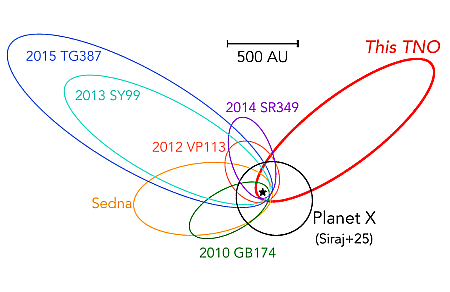
Orbits of known Trans-Neptunian Objects

Astronomers analyzing a dark energy survey by a ground-based telescope have discovered what might be another dwarf planet orbiting the Sun, but doing so in an orbit so extreme that it reaches the outskirts of the theorized Oort Cloud more than 151 billion miles out.

This object, dubbed, 2017 OF201, was found in 19 different observations from 2011 to 2018, allowing the scientists to determine its orbit. The map to the right is figure 2 from their paper [pdf], with the calculated orbit of 2017 OF201 indicated in red. As you can see, this new object — presently estimated to be about 450 miles in diameter — is not the first such object found in the outer solar system with such a wide eccentric orbit. However, the object also travels in a very different region than all those other similar discoveries, suggesting strongly that there are a lot more such objects in the distant outer solar system.

Its existence also contradicts a model that proposed the existence of a larger Planet X. That theory posited that this as-yet undetected Planet X was clustering the orbits of those other distant Trans-Neptunian objects shown on the map.

As shown in Figure 2, the longitude of perihelion of 2017 OF201 lies outside the clustering region near π ≈ 60◦ observed among other extreme TNOs [Trans-Nepturnian Objects]. This distinction raises the question of whether 2017 OF201 is dynamically consistent with the Planet X hypothesis, which suggests that a distant massive planet shepherds TNOs into clustered orbital configurations. Siraj et al. (2025) computed the most probable orbit for a hypothetical Planet X by requiring that it both reproduces the observed clustering in the orbits of extreme TNOs.

…These results suggest that the existence of 2017 OF201 may be difficult to reconcile with this particular instantiation of the Planet X hypothesis. While not definitive, 2017 OF201 provides an additional constraint that complements other challenges to the Planet X scenario, such as observational selection effects and the statistical robustness of the observed clustering.

Planet X might exist, but if so it is likely simple one of many such objects in the outer solar system. It is also likely to be comparable in size to these other objects, which range from Pluto-sized and smaller, making it less unique and less distinct.

In other words, our solar system has almost certainly far more planets than nine (including Pluto).

Hat tip to BtB’s stringer Jay.

7 comments

Astronomers detect evidence of exoplanet in weird orbit

Perpendicular planet
Click for original image.

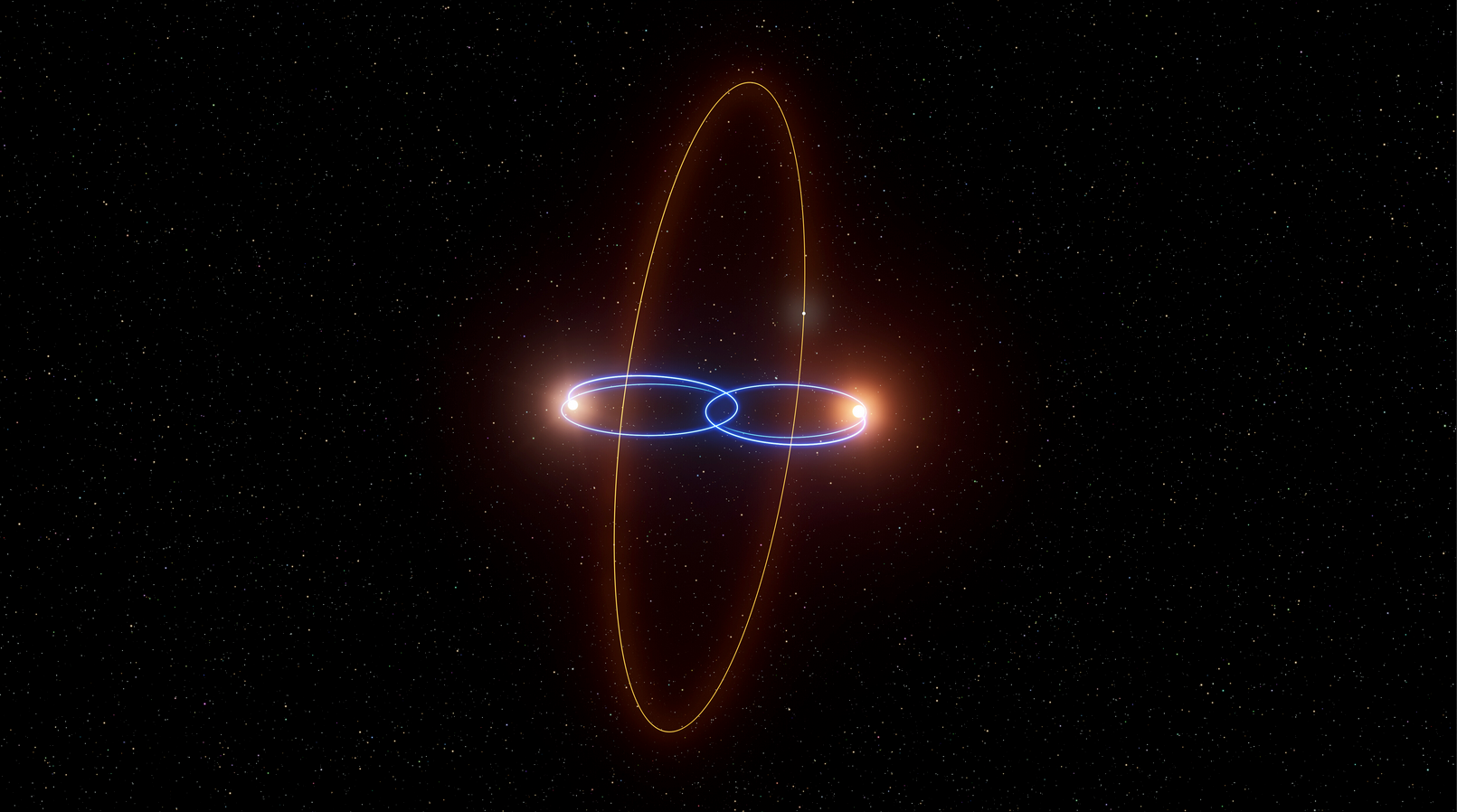
Though there is much uncertainty in their data, astronomers now believe they have discovered an exoplanet orbiting a binary system of two brown dwarfs, but doing so tilted 90 degrees to the ecliptic of the orbits of those brown dwarfs.

The graphic to the right illustrates the theorized system, with the orbits of the brown dwarfs indicated in blue and the exoplanet’s orbit in orange. While sixteen exoplanets have been found orbiting outside a binary pair of stars, this is the first doing so at such an inclination.

The detection has great uncertainty however.

The candidate planet cannot be detected the way most exoplanets – planets around other stars – are found today: the “transit” method, a kind of mini-eclipse, a tiny dip in starlight when the planet crosses the face of its star.

Instead they used the next most prolific method, “radial velocity” measurements. Orbiting planets cause their stars to rock back and forth ever so slightly, as the planets’ gravity pulls the stars one way and another; that pull causes subtle, but measurable, shifts in the star’s light spectrum. Add one more twist to the detection in this case: the push-me-pull-you effect of the planet on the two brown dwarfs’ orbit around each other. The path of the brown dwarf pair’s 21-day mutual orbit is being subtly altered in a way that can only be explained, the study’s authors conclude, by a polar-orbiting planet.

The radial velocity method however requires the scientists to make a number of assumptions, and provides limited information that can result in a misinterpretation of the data. It is for this reason this exoplanet is described as a “candidate planet.” Its theorized existence must be confirmed by other measurements before it is considered real.

I think this was posted as a quick link back in early May, when the scientists first announced their work, but can’t find it now.

11 comments

Astronomers detect evidence of numerous protoplanetary disks in three molecular clouds near the galactic center

Using the ground-based ALMA telescope in Chile, astronomers have detected evidence of the existence of numerous protoplanetary disks in three molecular clouds near the galactic center.

The findings suggest that over three hundred such systems may already be forming within just these three CMZ clouds [Central Molecular Zone]. “It is exciting that we are detecting possible candidates for protoplanetary disks in the Galactic Centre. The conditions there are very different from our neighbourhood, and this may give us a chance to study planet formation in this extreme environment,” said Professor Peter Schilke at the University of Cologne.

You can read the paper here.

These results once again suggest that the formation of stars, solar systems, and planets is more ubiquitous than ever expected, that they can all form in very extreme and hostile environments, of which the center of the Milky Way is one of the most hostile.

And if planets can form here, they can likely form everywhere else. This increases the likelihood of many planets throughout the galaxy capable of supporting the development of life.

0 comments

Astronomers measure the vibrations of a star 21 light years away

Using an instrument on the ground-based Keck telescope in Hawaii, astronomers have been able to measure the internal vibrations of a star 21 light years away, the equivalent of recording a star’s seismology.

Keck Observatory’s KPF instrument precisely measures the motion of the stellar surface towards and away from the observer. Over four consecutive nights, the team used KPF to collect over 2,000 ultra-precise velocity measurements of the star — enabling them to catch the star’s vibrations in action. This is the first asteroseismic inference of the age and radius for a cool star using KPF.

The astronomers next claim that this data allowed them to date the star’s age as 10.2 billion years old, and that it was about 4% smaller in diameter than measured by other observations. Both these conclusions carry uncertainties, but the former has implications if true for the present theories of stellar evolution, since this star appears to be behaving differently than expected for a star this old.

Astronomers have been doing this kind of stellar seismology for the Sun for several decades. To now have instruments sensitive enough to detect it on stars light years away is truly astonishing.

0 comments

Giant galactic magnetic filament disturbed by pulsar

A giant galactic filament disturbed by a pulsar
Click for original image.


Cool image time! The false-color X-ray picture to the right, reduced and sharpened to post here, was released today by the science team for the Chandra X-ray Observatory, showing some interesting astronomical features about 26,000 light years away near the galactic center.

The press release attempts to catch the ignorant press’s interest by referring to the long white filament that crosses this image as “a bone”, implying that this is similar to a medical X-ray of a person’s bones. Hogwash. What we are looking at is a filament of energized particles forced into this long thin shape by the magnetic field lines that exist in the central regions of the Milky Way galaxy.

What makes this X-ray data of interest is shown in the inset. The pulsar appears to have disturbed that filament, pulling those energetic particles away to form a trailing cloud.

In the first composite image, the largely straight filament stretches from the top to the bottom of the vertical frame. At each end of the grey filament is a hazy grey cloud. The only color in the image is neon blue, found in a few specks which dot the blackness surrounding the structure. The blue represents X-rays seen by NASA’s Chandra X-ray Observatory.

In the annotated close-up, one such speck appears to be interacting with the structure itself. This is a fast-moving, rapidly spinning neutron star, otherwise known as a pulsar. Astronomers believe that this pulsar has struck the filament halfway down its length, distorting the magnetic field and radio signal.

As big and empty as space is, there is still enough stuff within it to cause these kinds of interactions. It just requires the luxury of endless eons, something that we as short-lived humans have trouble conceiving.

4 comments

Astronomers discover a cluster of a thousand very young stars that is flying apart for unknown reasons

Astronomers using data from Gaia, which measured the precise distance and position of more than two billion stars, have discovered a very young cluster of a thousand stars that is flying apart for unknown reasons.

The cluster is about 650 light-years away in Ophiuchus, the Serpent Bearer, and has been nicknamed “Ophion” in honor of its resident constellation. “Ophion is filled with stars that are set to rush out across the galaxy in a totally haphazard, uncoordinated way, which is far from what we’d expect for a family so big,” said Huson in a statement. “What’s more, this will happen in a fraction of the time it’d usually take for such a large family to scatter. It’s like no other star family we’ve seen before.”

You can read the peer-reviewed paper here [pdf]. The scientists proposed several theories that might explain what disrupted this cluster so early in its history, but none are very convincing, with the data available.

0 comments

Hubble snaps picture of barred spiral galaxy

A barred spiral galaxy as seen by Hubble
Click for original image.

Cool image time! While NASA celebrates the 35th anniversary of the Hubble Space Telescope with photos from its past, astronomers continue to use it to produce new wonders. The picture to the right, cropped, reduced, and sharpened to post here, was taken by Hubble recently and released today.

NGC 5335 is categorized as a flocculent spiral galaxy with patchy streamers of star formation across its disk. There is a striking lack of well-defined spiral arms that are commonly found among galaxies, including our Milky Way. A notable bar structure slices across the center of the galaxy. The bar channels gas inwards toward the galactic center, fueling star formation. Such bars are dynamic in galaxies and may come and go over two-billion-year intervals. They appear in about 30 percent of observed galaxies, including our Milky Way.

The theorized formation process of that bar is based on computer modeling using the limited data we presently have, and thus carries a great deal of uncertainty.

2 comments

NASA re-releases a slew of Hubble images to celebrate its 35th anniversary

Eta Carina, in focus, after 1993 repair mission

As part of its celebration of the telescope’s 35th anniversary, NASA on April 25, 2025 re-released what it called 27 key images from the history of the Hubble Space Telescope.

More than half the images are historical, showing the telescope’s conception by astrophysicist Lyman Spitzer, its construction, its launch in 1990, and its repair in 1993 of its faulty optics. The subsequent sharp astronomical images include only a few of Hubble’s most famous and significant later photographs, including the first Hubble Deep Field, the Hourglass planetary nebula, and the Pillars of Creation snapshot.

What NASA did not include in this collection however was without doubt to those alive at the time after Hubble was finally repaired its most historically significant photo. That picture is to the right. It shows the exploding star Eta Carina as taken by Hubble in 1993 right after its repair.

For the very first time, we had a telescope above the Earth’s fuzzy atmosphere capable of taking sharp in-focus images of the mysteries of the heavens. And for the first time, we could see in this star its actual nature. It wasn’t simply surrounded by a pretty cloud — as all previous ground-based images had suggested — that cloud was formed by eruptions from the star itself. Those earlier eruptions, which had occurred in the previous century, had spewed from the star’s poles, forming two bi-polar clouds that were expanding away from the star most dramatically.

In the three decades since astronomers have used Hubble and its later upgraded cameras to track those expanding clouds, with the most recent photo taken in 2019. Hubble has shown that such massive heavenly objects are not static, but evolving, and with the right high resolution telescopes in space we can track that evolution, in real time.

At the moment no comparable replacement of Hubble is planned, or even on the drawing board. The Einstein space telescope, just launched, will provide magnificent optical images at a slight lower resolution. So will China’s planned Xuntian space telescope, set for launch in 2027. Neither however matches Hubble’s capabilities.

And Hubble is now long past its original lifespan of fifteen years. Though engineers say it is in good shape, this is not true. It presently has only two trustworthy working gyroscopes. To extend its lift, the telescope is operated on only one gyroscope, with a second held back in reserve. When these go, however, so will Hubble.

Meanwhile, the astronomy community continues to put most of its energy in building giant ground-based telescopes that not only cannot match Hubble but are threatened by the coming wave of new communication constellations. Do they rethink their approach and shift to orbital astronomy?

Nah. Instead, the astronomical community demands new powers to to ban those constellations!

Of all people, one would think astronomers more than anyone else would not put their head in the sand. But that’s what they continue to do.

1 comment

A telescope picture of blackness

A dust cloud in space
Click for original image.

Cool image time! The picture to the right, cropped, reduced, and sharpened to post here, was released today by the science team running the Dark Energy Camera on the Blanco 4-meter telescope in Chile.

This winding, shadowy form, accentuated by a densely-packed starry background, is the Circinus West molecular cloud — a region rich in gas and dust and known for its host of newly formed stars. Molecular Clouds, the cradles of star formation, are interstellar clouds that are so dense and cold that atoms within them bond with each other to form molecules. Some, such as Circinus West, are so dense that light cannot pass through, giving them a dark, mottled appearance and earning them the name dark nebulae. The cloud’s flourishing population of young stars has offered astronomers a wealth of insight into the processes driving star formation and molecular cloud evolution.

…Circinus West is known for harboring dozens of young stellar objects — stars that are in their early stages of development. Despite being shrouded in dense gas and dust, these infant stars make themselves known. Zooming in, various clues to their presence can be seen dotted throughout Circinus West’s snaking tendrils.

The cloud is about 2,500 light years away and is estimated to be about 180 light years across. Scientists estimate the mass in the cloud to be about 250,000 times that of the Sun.

No one however would ever even know this cloud existed if it wasn’t back dropped by thick field of stars behind it.

1 comment

Astronomers detect chemicals on exoplanet that on Earth come from life

The uncertainty of science: Using the Webb Space Telescope, astronomers have detected two different molecules that on Earth are only linked with biology in the atmosphere of an exoplanet orbiting a red dwarf star within its habitable zone.

Earlier observations of K2-18b — which is 8.6 times as massive and 2.6 times as large as Earth, and lies 124 light years away in the constellation of Leo — identified methane and carbon dioxide in its atmosphere. This was the first time that carbon-based molecules were discovered in the atmosphere of an exoplanet in the habitable zone. Those results were consistent with predictions for a ‘Hycean’ planet: a habitable ocean-covered world underneath a hydrogen-rich atmosphere.

However, another, weaker signal hinted at the possibility of something else happening on K2-18b. “We didn’t know for sure whether the signal we saw last time was due to DMS, but just the hint of it was exciting enough for us to have another look with JWST using a different instrument,” said Professor Nikku Madhusudhan from Cambridge’s Institute of Astronomy, who led the research.

…The earlier, tentative, inference of DMS was made using JWST’s NIRISS (Near-Infrared Imager and Slitless Spectrograph) and NIRSpec (Near-Infrared Spectrograph) instruments, which together cover the near-infrared (0.8-5 micron) range of wavelengths. The new, independent observation [of dimethyl sulfide (DMS) and/or dimethyl disulfide (DMDS] used JWST’s MIRI (Mid-Infrared Instrument) in the mid-infrared (6-12 micron) range.

This data is not yet proof of biology. For example, the concentrations of these molecules in K2-18b’s atmosphere is thousands of times greater than on Earth. It is just as likely that numerous as yet unknown non-biological chemical processes in this alien environment have produced these chemicals. The scientists however are encouraged because the theories about ocean life on this kind of habitable ocean-covered superearth had predicted this high concentration of these chemicals.

At the same time, they readily admit there are many uncertainties in their data. They have asked for another 16 to 24 hours of observation time on Webb — a very large chunk rarely given out to one research group — to reduce these uncertainties.

You can read the peer-reviewed paper here [pdf].

4 comments

Astronomers discover a well-developed spiral galaxy too soon after the Big Bang

The early spiral galaxy
Click for original image.

Using the Webb Space Telescope, astronomers have discovered the earliest known well-developed spiral galaxy, dubbed Zhúlóng (meaning torch dragon in Chinese), that exists only about one billion years after the Big Bang and much too soon for such a spiral galaxy to have formed.

The false-color infrared Webb image to the right, cropped to post here, shows clearly the galaxy’s spiral structure.

Zhúlóng has a surprisingly mature structure that is unique among distant galaxies, which are typically clumpy and irregular. It resembles galaxies found in the nearby Universe and has a mass and size similar to those of the Milky Way. Its structure shows a compact bulge in the center with old stars, surrounded by a large disk of younger stars that concentrate in spiral arms.

This is a surprising discovery on several fronts. First, it shows that mature galaxies that resemble those in our neighborhood can develop much earlier in the Universe than was previously thought possible. Second, it has long been theorized that spiral arms in galaxies take many billions of years to form, but this galaxy demonstrates that spiral arms can also develop on shorter timescales. There is no other galaxy like Zhúlóng that astronomers know of during this early era of the Universe.

You can read the peer-review research paper here. The scientists posit a number of theories to explain this spiral galaxy, none of which have much merit at this time because so little data exists from that time period. That only one such spiral galaxy is presently known does not mean such galaxies were rare at that time. It merely means our census of galaxy populations in the early universe remains woefully incomplete.

3 comments

The structure of a ringed planetary nebula revealed in the infrared

A planetary nebula as seen by Webb
Click for original image.

Cool image time! Using the mid-infrared camera on the Webb Space Telescope, astronomers have been able to image in false colors the ringed structure surrounding a dying star about 1,500 light years away.

The nebula’s two rings are unevenly illuminated in Webb’s observations, appearing more diffuse at bottom left and top right. They also look fuzzy, or textured. “We think the rings are primarily made up of very small dust grains,” Ressler said. “When those grains are hit by ultraviolet light from the white dwarf star, they heat up ever so slightly, which we think makes them just warm enough to be detected by Webb in mid-infrared light.”

In addition to dust, the telescope also revealed oxygen in its clumpy pink center, particularly at the edges of the bubbles or holes.

NGC 1514 is also notable for what is absent. Carbon and more complex versions of it, smoke-like material known as polycyclic aromatic hydrocarbons, are common in planetary nebulae (expanding shells of glowing gas expelled by stars late in their lives). Neither were detected in NGC 1514. More complex molecules might not have had time to form due to the orbit of the two central stars, which mixed up the ejected material.

Though this false-color image of a planetary nebular is hardly ground-breaking (Hubble has been producing such pictures for decades), Webb’s better infrared data, in higher resolution, will help astronomers untangle the nebula’s complex geography. It remains however a question whether the improved capabilities of Webb were worth its $10 billion-plus cost. For that money NASA could have built and launched many different astronomical missions in the past two decades, many of which would have been able to match this data for far less.

4 comments

Italy awards Italian company contract to design constellation of radio telescopes orbiting the Moon

Capitalism in space: The Italian Space Agency has awarded the Italian company Blue Skies Space a contract to design a constellation of radio telescopes orbiting the Moon and designed to map the universe’s earliest radio emissions.

The project, named RadioLuna, aims to uncover whether a fleet of small satellites in a lunar orbit could detect faint radio signals from the universe’s earliest days—signals that are nearly impossible to pick up on Earth due to man-made radio interference. These signals, in the FM radio range, come from a time before the first stars formed, when the universe was mostly hydrogen gas. By listening from the far side of the Moon, free from Earth’s radio noise, scientists could use the satellites to uncover a missing piece of the puzzle in our understanding of the cosmic “dark ages.”

The study will establish the viability of operating simple and cost-effective CubeSats equipped with commercial off-the-shelf (COTS) components orbiting the Moon and will be led by Blue Skies Space Italia S.r.l., a subsidiary of UK-based Blue Skies Space Ltd. Project partner OHB Italia will be responsible for the definition of a viable platform in a Moon orbit.

The contract is another example of Italy (and Europe) shifting to private enterprise in space. Rather than design this project in-house, its space agency is contracting it out to private companies.

0 comments

Astronomers: Potentially dangerous asteroid 2024 YR4 originally came from main asteroid belt

Using new data from ground-based telescopes, astronomers now believe that the potentially dangerous asteroid 2024 YR4 originally came from main asteroid belt and is a stony solid body, not a rubble pile.

The study reveals YR4 is a solid, stony type that likely originated from an asteroid family in the central Main Belt between Mars and Jupiter, a region not previously known to produce Earth-crossing asteroids. “YR4 spins once every 20 minutes, rotates in a retrograde direction, has a flattened, irregular shape, and is the density of solid rock,” said Bryce Bolin, research scientist with Eureka Scientific and lead author of the study.

You can read the paper here [pdf].

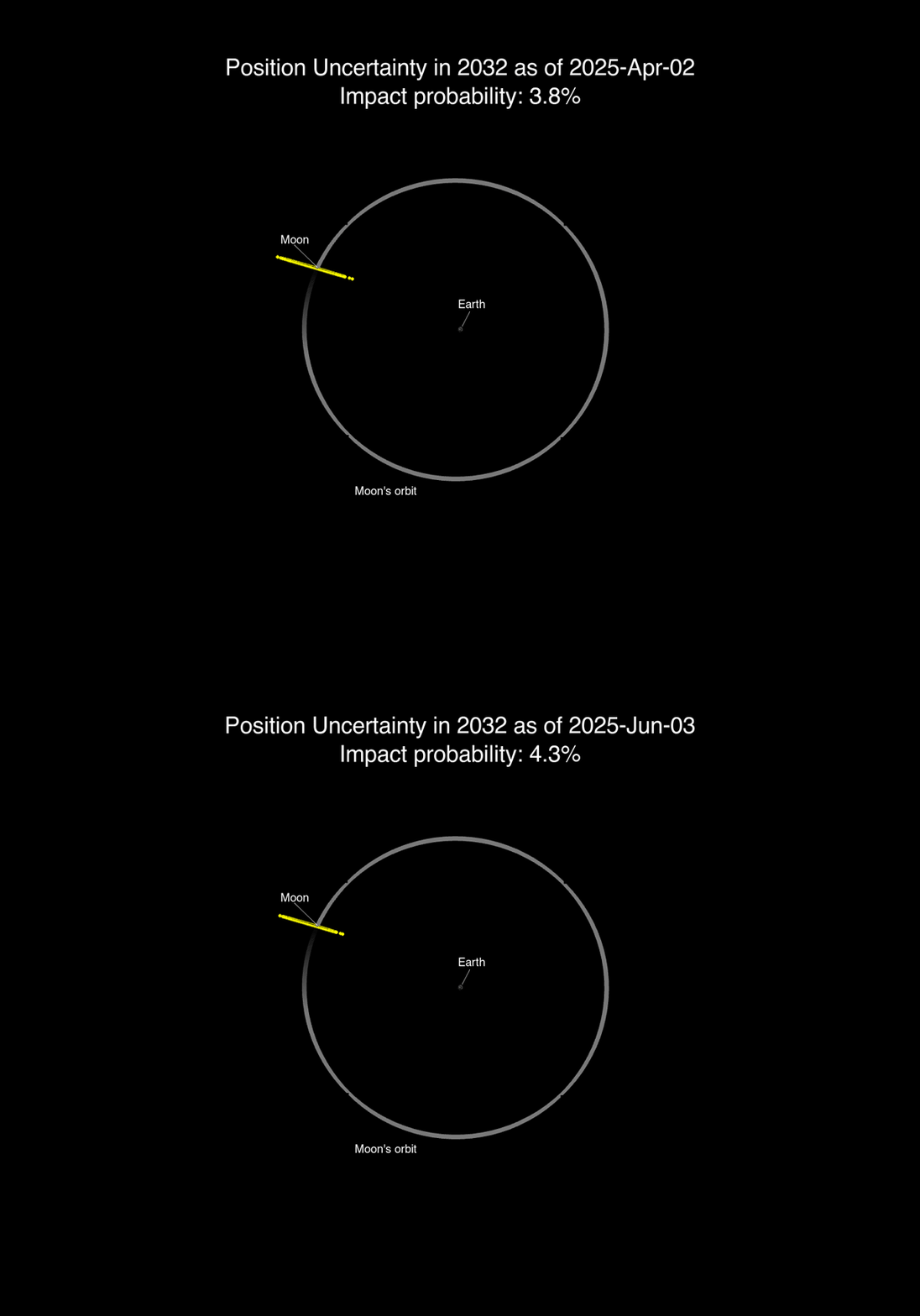
At present calculations suggest it has an almost zero chance of hitting the Earth in 2032, though during that close approach the chances of it hitting the Moon range from 2% to 4%, depending on which scientist you ask.

6 comments
1 6 7 8 9 10 113