
Tag: astronomy
The first solar eclipse to cross the continental United States in two decades will occur on May 20.
Set your calendar: The first solar eclipse to cross the continental United States in two decades will occur on May 20.
An annular solar eclipse occurs when the moon passes between the earth and sun, but the lunar disk does not completely block out the sun and instead leaves a “ring of fire” visible around the moon at the point of maximum eclipse. Most anyone west of the Mississippi will see a partial eclipse, but the real treat will be for those located in the 200-mile wide path of the eclipse which will trek east from the California / Oregon border through Nevada, Utah, Arizona, New Mexico, and finally set below the horizon in west Texas.
Remember, you will need good eye protection if you choose to look.
A Japanese astronomy professor has been found murdered in Chile.
A Japanese astronomy professor has been found murdered in Chile.
One astronomer has found that the habitable zone around some smaller stars is smaller than first calculated because of tidal heating.
One astronomer has found that the inner edge of the habitable zone around some dwarf stars is smaller than first calculated because tidal forces overheat planets close to the star.
Then again, this heating might expand the habitable zone in other directions. Stars might overheat when close to the star, but get a boost of needed heat when they would normally be too far away.
Astronomers now believe that Type 1a supernovae — used to discover dark energy — can be produced in two different ways.
The uncertainty of science: Astronomers now believe that Type 1a supernovae — used to discover dark energy — can be produced in two different ways.
Type Ia supernovae are known to originate from white dwarfs – the dense cores of dead stars. White dwarfs are also called degenerate stars because they’re supported by quantum degeneracy pressure. In the single-degenerate model for a supernova, a white dwarf gathers material from a companion star until it reaches a tipping point where a runaway nuclear reaction begins and the star explodes. In the double-degenerate model, two white dwarfs merge and explode. Single-degenerate systems should have gas from the companion star around the supernova, while the double-degenerate systems will lack that gas.
For astronomers, this possibility raises several conflicting questions. If two different causes produce Type 1a supernovae, could their measurement of dark energy be suspect? And if not, why is it that these two different causes produce supernovae explosions that look so much alike?
Using the Moon as a mirror
Using the Moon as a mirror.
Scientists have discovered that the half life of one of their key isotopes for dating the solar system is 30% shorter than previously believed.
The uncertainty of science: Scientists have discovered that the half life of one of their key isotopes for dating the age of the solar system is 30% shorter than previously believed.
The main result of the work of the international scientists, detailed in a recent article in Science, is a new determination of the half-life of 146Sm, previously adopted as 103 million years, to a much shorter value of 68 million years. The shorter half-life value, like a clock ticking faster, has the effect of shrinking the assessed chronology of events in the early solar system and in planetary differentiation into a shorter time span.
The new time scale, interestingly, is now consistent with a recent and precise dating made on a lunar rock and is in better agreement with the dating obtained with other chronometers. The measurement of the half-life of 146Sm, performed over several years by the collaborators, involved the use of the ATLAS particle accelerator at Argonne National Laboratory in Illinois.
The Department of Energy has approved the start of detailed engineering for the Large Synoptic Survey Telescope.
Ground-based astronomy moves forward: The Department of Energy has approved the start of detailed engineering for the camera on the Large Synoptic Survey Telescope.
I have to admit, I am puzzled why the Department of Energy is involved in this. Government funding for ground-based telescopes normally comes from the National Science Foundation.
Europe has decided to build a probe, dubbed JUICE, to study Ganymede, Callisto and Europa, Jupiter’s big icy moons.
Europe has decided to build a probe to study Ganymede, Callisto and Europa, Jupiter’s big icy moons.
Known as JUICE, the Jupiter Icy Moons Explorer, the probe will enter orbit around the gas giant planet in 2030 for a series of flybys of Ganymede, Callisto and Europa. JUICE will brake into orbit around Ganymede, Jupiter’s largest moon, in 2032 for at least one year of close-up research.
The destruction of a star by a black hole, seen by astronomers for the first time.
The destruction of a star by a black hole, seen by astronomers for the first time.
Another breathtaking Hubble image of the Egg Nebula.
Another new breathtaking Hubble image of the Egg Nebula.
The image combines data taken in both optical and infrared wavelengths.
Three new Earthlike exoplanets, orbiting M dwarf stars in the habitable zone, have been identified by astronomers using Kepler data.
Three new Earthlike exoplanets, orbiting M dwarf stars in the habitable zone, have been identified by astronomers using Kepler data.
New data suggests that the giant ancient asteroid barrage during the early solar system may have lasted much longer than previously thought.
Duck! New data suggests that the giant ancient asteroid barrage during the early solar system may have lasted much longer than previously thought.
More problems for Dark Matter
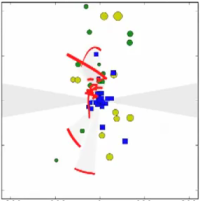
A new study by astronomers has found a vast structure of satellite galaxies and star clusters aligned perpendicular to the Milky Way and extending outward above and below the galaxy’s nucleus by as much as a million light years.
In their effort to understand exactly what surrounds our Galaxy, the scientists used a range of sources from twentieth century photographic plates to images from the robotic telescope of the Sloan Deep Sky Survey. Using all these data they assembled a picture that includes bright ‘classical’ satellite galaxies, more recently detected fainter satellites and the younger globular clusters.
“Once we had completed our analysis, a new picture of our cosmic neighbourhood emerged”, says Pawlowski. The astronomers found that all the different objects are distributed in a plane at right angles to the galactic disk. The newly-discovered structure is huge, extending from as close as 33,000 light years to as far away as one million light years from the centre of the Galaxy.
An animation illustrating this galactic distribution is posted below the fold. You can read the actual preprint paper here.
The problem with this polar alignment with the Milky Way’s core is that the theories for explaining the distribution of dark matter do not predict it.
» Read more
Scientists studying Cassini images have spotted the trails of objects as they punch through one of Saturn’s rings.
Scientists studying Cassini images have spotted the trails of objects as they punch through one of Saturn’s rings.
New data from a neutrino telescope in Antarctica had found that cosmic rays don’t come from gamma ray bursts, as had been believed by astronomers.
The uncertainty of science: New data from a neutrino telescope in Antarctica has found that cosmic rays don’t come from gamma ray bursts, as had been believed by astronomers. You can read the paper here. [pdf]
Which means that astronomers at this moment have no idea what produces these high energy cosmic rays.
Dark matter disappears
The uncertainty of science: A new study has found no evidence of dark matter within 13,000 light years of the Sun, something that had not been expected.
According to widely accepted theories, the solar neighborhood was expected to be filled with dark matter, a mysterious invisible substance that can only be detected indirectly by the gravitational force it exerts. But a new study by a team of astronomers in Chile has found that these theories just do not fit the observational facts. This may mean that attempts to directly detect dark matter particles on Earth are unlikely to be successful.
These findings will be as controversial as the now abandoned faster-than-light neutrino results last fall. Here, however, the new data is likely going to be more robust, which will cause the entire astrophysical community some real conniptions.
» Read more
The ring and planets of Formalhaut
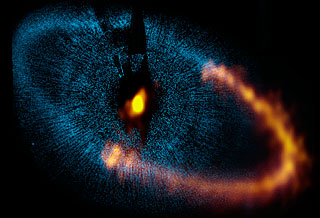
New observations from the new ground-based submillimeter ALMA telescope in Chile have given astronomers a clearer picture of the ring/disk of debris orbiting the nearby star Formalhaut. Moreover, the data suggests that two planets that are shepherding that ring are smaller than previously thought, no larger than a few times the size of the Earth.
» Read more
Astronomers have identified two of the oldest known stars, about 12 billion years old, both only a hundred light years away.
Astronomers have identified two of the oldest known stars, about 12 billion years old, both only a hundred light years away.
What is intriguing about this discovery is that these two white dwarfs had to have formed very soon after the Big Bang, long before the Milky Way galaxy existed as we know it today. How they ended up here is an interesting puzzle.