
More overruns in NASA’s SLS program, this time with the mobile launchers

A new inspector general report [pdf] has found massive cost overruns in NASA over the building of the two mobile launch platforms the agency will use to launch its SLS rocket.

The original budget for the first mobile launch was supposed to be $234 million. NASA has now spent $927 million.

Worse, this platform will see limited use, as it was designed for the first smaller iteration of SLS, which NASA hopes to quickly replace with a more powerful version. Afterward it will become obsolete, replaced by the second mobile launch platform, now estimated to cost $486 million.

That’s about $1.5 billion just to build the launch platforms for SLS. That’s only a little less than SpaceX will spend to design, test, build, and launch its new Starship/Super Heavy rocket. And not only will Starship/Super Heavy be completely reusable, it will launch as much if not more payload into orbit as SLS.

But don’t worry. Our geniuses in Congress will continue to support SLS no matter the cost, even if it bankrupts NASA and prevents any real space exploration. They see its cost overruns, long delays, and inability to accomplish anything as a benefit, pumping money into their states and districts in order to buy votes.
7 comments

House about to renew FISA with only cosmetic changes

The fix is in: The House is about to vote on a renewal of the Foreign Intelligence Surveillance Act (FISA), incorporating what appear to be only cosmetic changes to the law.

The deal reached by House leaders would require officers overseeing FISA applications to certify that the Justice Department has been fully informed of any issues with the accuracy of the application, and require that agencies submitting applications appoint officers to ensure the applications are compliant with the law.

The bill also includes measures to assuage concerns by Democrats and libertarians worried about government overreach in surveilling of American citizens, such as ending the National Security Agency’s to collect call detail records. It also includes measures to increase transparency, requiring the Justice Department to publish reports explaining its positions on how information is derived for FISA applications.

These are changes desired by the Democrats in the House. Or to put it another way, they are working hard to renew a law that I would call “The Law to Enable Democrats and their Allies in the Justice Department, FBI, and CIA to spy on Republicans”.

This law should expire. Trump should veto any renewal effort, no matter who writes it. It is unconstitutional., has done nothing to protect us, even as it is has been abused to violate our constitutional rights.

And even if it could be argued that the law provided the country some added security that would be lost if it expires, freedom is more important.

UPDATE: The House has passed the bill, which Senator Rand Paul (R-Kentucky) condemned as “weak sauce.”

“The ‘Deal’ on FISA is weak sauce diluted [and] made impotent by A.G. Barr. None of the reforms prevent secret FISA court from abusing the rights of Americans. None of the reforms prevent a President of either party from a politically motivated investigation. Big Disappointment!” Paul tweeted early Tuesday evening.

Paul and Sen. Mike Lee (R-Utah), who have both vocally called for sweeping reforms to FISA, are urging President Trump to veto the bill if it arrives at his desk.

Barr was first pushing for passage of a renewal that would have changed nothing in the law, making me think that his so-called investigations into the FISA corruption are probably hogwash. He might make noises about upholding the law, but so far what he has done makes him appear a willing partner in the Washington corrupt culture, working to keep the status quo.

8 comments

New inspector general report slams NASA’s SLS management

A new report [pdf] by NASA’s inspector general released today harshly slams the management of NASA for the never-ending cost overruns and scheduling delays that have plagued the agency’s effort to build and launch the Space Launch System (SLS).

From the report’s introduction:

Based on our review of SLS Program cost reporting, we found that the Program exceeded its Agency Baseline Commitment (ABC)—that is, the cost and schedule baselines committed to Congress against which a program is measured—by at least 33 percent at the end of fiscal year 2019, a figure that could reach 43 percent or higher if additional delays push the launch date for Artemis I beyond November 2020.

… [T]he SLS Program now projects the Artemis I launch will be delayed to at least spring 2021 or later. Further, we found NASA’s ABC cost reporting only tracks Artemis I-related activities and not total SLS Program costs. Overall, by the end of fiscal year 2020, NASA will have spent more than $17 billion on the SLS Program—including almost $6 billion not tracked or reported as part of the ABC.

The graph below, taken from page 45 of the report, illustrates the management failures here quite starkly.
» Read more

11 comments

Trump refuses to renew FISA without changes

President Trump yesterday once again told Congressional leaders that he will let the law that authorizes the FISA court to expire rather than sign a renewal with no changes in the law.

The surveillance provisions are set to expire on March 15, and the White House indicated to Republican leaders Tuesday that it would support only a temporary, 30-day extension to allow Congress to iron out the reforms.

House Democratic leaders have indicated publicly they are open to bipartisan compromise.

“Just got back from the White House. @realDonaldTrump made it abundantly clear that he will NOT accept a clean reauthorization of the Patriot Act without significant FISA reform! I agree with him!” Kentucky GOP Sen Rand Paul tweeted Tuesday.

Paul has been pushing for some fundamental changes, and it is very clear now that he has Trump backing him.

As far as I am concerned, we will be better off letting this unconstitutional law expire entirely. It was specifically designed to to give the courts and federal agencies a method for violating the Constitution in order to allow them more freedom for providing us better security. The result however has been that those agencies did a poor job of protecting us even as they misused the law in an effort to overthrow a legal election.

That Congress was even contemplating a renewal without changes illustrates once again how little they care about the interests of the American people, or the Constitution. They apparently like such violations, and want the ability to allow them to continue. Trump (and Senator Paul) are forcing them to do their proper jobs.

6 comments

The modern blacklist in climate science

Link here. This story, which outlines the effort by global warming scientists to blacklist any scientist who expresses skepticism about human-caused global warming, is really not news. This odious effort was documented more than a decade ago in the climategate emails, where people like Michael Mann and others revealed their attempts to block publication of any papers by such skeptics.

The horrible part of the story however is how the blacklist effort has grown in fury and effectiveness since those climategate emails were released. Instead of being outraged that these scientists were warping peer review, the climate field rallied around them in support. Now, not only do global warmists try to block publication by any skeptics, they now work to deny them funding and to get them fired from their jobs.

And they have been increasingly successful. Do not expect any really honest science to come from the climate field for years to come. It has created for itself a very secure bubble. Nothing can challenge its work, even when that work involves data tampering and falsification.

12 comments

Trump pushing for major FISA reform or he will let law expire

It appears that President Trump is now demanding a major rewrite of the law that authorizes the FISA court or else he will allow the law to expire.

Congress has approximately 10 working days to reauthorize three expiring provisions of the USA Freedom Act, a 2015 bill that overhauled the country’s surveillance laws, with Attorney General William Barr and Senate Majority Leader Mitch McConnell (R-Ky.) backing a “clean” extension.

But Trump threw a grenade into those already fragile plans Thursday, when Sen. Rand Paul (R-Ky.) told reporters that the president supports his effort to include broader reforms of the Foreign Intelligence Surveillance Act (FISA) as part of any reauthorization of the intelligence programs. “I’ve talked to the president, and I plan on insisting on getting a vote,” Paul said, asked by The Hill about including broader FISA reforms in a bill would authorize the expiring provisions of the USA Freedom Act.

Paul wants a vote on an amendment that would prevent FISA warrants from being used against Americans. Paul’s proposal would also prevent FISA information from being used against Americans in a domestic courtroom. The president, according to Paul, is supportive of his amendment.

Trump’s apparent support for including broader changes to the surveillance court associated with FISA comes as he’s railed repeatedly about his campaign being “spied” upon by the Obama-era FBI. [emphasis mine]

The simple fact is that the FISA court has always been unconstitutional. As written, it is designed — and been used — to bypass the fourth amendment’s requirement that no searches be conducted of a person’s private property without probably cause and a search warrant. Paul’s amendment would simply bring the FISA court into line with constitutional law.

It would be criminal if both Congress and Trump allow this court to be renewed without making this change, especially considering the abuse committed by the Obama administration and government officials of the court in the past four years. Yet, Attorney General Barr as well as Senate leader Mitch McConnell (R-Kentucky) are calling for exactly that.

Barr indicated during the lunch that Trump would support a clean extension of the three programs. McConnell threw his support behind extending the authorities during a press conference after the powwow with Barr. “These tools have been overwhelmingly useful according to our intelligence advisors, and I hope that when the Senate deals with these expiring provisions in a couple of weeks, we will be able to continue to have them in law, which will, of course, provide maximum protection for the American people,” McConnell told reporters.

As good as McConnell has been in getting Trump’s conservative judges confirmed to the courts, he sometimes infuriates me. Considering the abuse of power seen in the FBI, Justice Department, and Obama administration, it makes no sense to renew these laws unchanged.

3 comments

College apologizes because teacher accurately quotes historical document

The coming dark age: The head of the University of Oklahoma has publicly apologized for a journalism professor because that professor had, after warning the class, accurately read aloud an historical document that included the word “nigger.”

The heart of the apology says it all:

The professor, a faculty member in History, read from a historical document that used the “N-word” repeatedly. While she could have made the point without reciting the actual word, she chose otherwise. Her issuance of a “trigger warning” before her recitation does not lessen the pain caused by the use of the word. For students in the class, as well as members of our community, this was another painful experience. It is common sense to avoid uttering the most offensive word in the English language, especially in an environment where the speaker holds the power.

This apology is downright hostile to the pursuit of knowledge, and coming from the head of a university is especially appalling.

My regular readers know that I forbid the use of obscenities by commenters, as I oppose the recent cultural trend to make their use ubiquitous and casual. I think it debases everyone, and prevents thoughtful debate. However, if you want to get an accurate sense of history you must have the open-mindedness to tolerate hearing such things in order to understand that history.

Moreover, this administrator assumes that his students are so pathetically weak and delicate that hearing this word would destroy them. Poppy-cock! What is really happening is that he is bowing to the race-mongers and political bullies who have been using their demands on what language to speak to force everyone to endorse their political rule.

The future is grim if it will become impossible to learn anything that might offend you. In fact, in that culture you really will not be able to learn anything at all.

22 comments

Space Force lobbies for $1 billion extra

The Space Force has put forth an extra wish list of missions/projects that require an $1 billion more above the $15 billion the agency has already requested in the next federal budget for 2021.

While about 10 percent of the request is for classified programs, the remaining funding runs the gamut, from bolstering space situational awareness to accelerating the development of navigational satellites to establishing new commercial satellite communication capabilities in low earth orbit.

Overall this wish list appears properly focused, aimed at upgrading or improving existing space military assets rather than growing the Space Force’s bureaucracy. We shall see over time if this proves true. I can’t help having doubts.

4 comments

First SLS launch pushed back again to April 2021

NASA on February 20, 2020 finally admitted that the first SLS launch cannot happen in 2020, and set a new target date no earlier than April 18, 2021.

The previous target launch date in November 2020 was always a pure fantasy. NASA just held off admitting it in order to defuse any political consequences for having a program, building SLS, that will end up taking them almost two decades to complete.

This new launch date is likely the most realistic so far, since the hardware for SLS is actually finally coming together. Nonetheless, if anything at all should go wrong along the way, especially with the full static test firing of the core booster of the first stage scheduled for no earlier than August, then expect more delays, possibly lasting years.

14 comments

NOAA’s aging fleet of sun-observation satellites

In testimony during a Senate hearing on February 12, the head of NOAA’s space weather division admitted that the agency’s ability to monitor the Sun is threatened by its aging fleet of solar satellites, combined with the agency’s slow progress on a large single replacement satellite, presently scheduled for launch in 2024.

NOAA currently uses the Deep Space Climate Observatory (DSCOVR) and NASA’s Advanced Composition Explorer (ACE) spacecraft to collect solar wind data, and uses the ESA/NASA Solar and Heliospheric Observatory (SOHO) spacecraft to observe the solar corona, using those data to forecast solar storms that can affect satellites and terrestrial infrastructure such as power grids.

However, SOHO, launched in December 1995, is well past its design life. In addition, DSCOVR has been offline since June 2019 because of technical problems, forcing NOAA to depend solely on ACE, which launched in 1997. [emphasis mine]

NOAA has been trying, and failing, to build a replacement for ACE for more than a decade. Worse, the agency’s inability to deal with these issues was further revealed by this quote:

Congress has pushed to speed up work on that [replacement] mission, despite NOAA’s assurances about the availability of data from other spacecraft. NOAA sought about $25 million for the mission in its fiscal year 2020 budget request, but Congress appropriated $64 million. NOAA has yet to release its fiscal year 2021 budget request, more than a week after the White House published the overall federal government budget proposal.

Something has been wrong in the management at NOAA now for at least a decade. They can’t seem to get new satellites built, and when they try they can’t seem to do it on schedule and for a reasonable cost. Their weather satellite program has been rife with problems, including cost overruns, schedule delays, and failing satellites.

But why should we be surprised? This kind of mismanagement at the federal government has been par for the course for the past half century.

7 comments

Trump proposes an increase in science spending in 2021

Read any analysis by any mainstream news or science publication of Trump’s 2021 proposed science budget, released this week, and you will come away thinking that the future of science research in the U.S. is doomed and that Donald Trump is a neanderthal who wishes to send us back to the dark ages.

Consider for example this article from the journal Science, Trump’s new budget cuts all but a favored few science programs, which begins like so:

For the fourth straight year, President Donald Trump has proposed sizable reductions in federal research spending. To be sure, it’s no longer news that the president wants deep cuts to the budgets of the National Institutes of Health (NIH), the National Science Foundation (NSF), and science programs at the Department of Energy (DOE) and NASA. And in past years, Congress has rejected similar proposals and provided increases. But Trump’s 2021 request brings into sharper focus what his administration values across the research landscape—and what it views as unimportant.

The article then outlines how Trump is slashing spending on science research across the board, even to the point of spinning the NASA budget to make a significant budget increase appear as a cut, by cherry-picking only some of that budget’s science programs.

This article is typical of the mainstream press. These articles never provide any context for the proposed budget numbers. They look at what was spent the year before, see what is being proposed for the next year, and if they see any reduction they scream. And if it is an evil Republican president proposing the cuts they scream far harder, implying that those cuts will guarantee the coming of a new dark age.

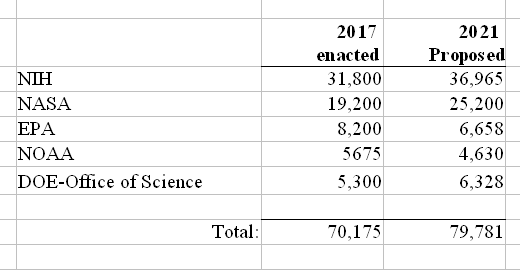
Trump's proposed science budget compared to Obama's last science budget

To the right however are the budget numbers (shown in thousands) for five of the biggest science agencies in the federal government, comparing Trump’s 2021 proposed budget numbers with the last science budget approved at the end of the Obama administration in 2016.

Notice anything? » Read more

2 comments

NASA get boost in Trump proposed budget for 2021

The 2021 budget request by the Trump administration includes a big budget increase for NASA while also proposing major cuts to many of its science programs.

According to the analysis at the second link, the big gainer is Artemis. The losers in astronomy are the space telescope WFIRST and the airborne telescope SOFIA, both of which the administration wants terminated. Also on the chopping block are two climate satellites.

I plan to go through the budget in the next day or so and do my own analysis, which will also provide a longer term context that I guarantee no other news source will do. For example, routinely when most mainstream sources declare a cut in any program, it only means either a reduction in its growth rate, or a reduction to spending levels deemed entirely satisfactory only a few years before. To understand any new budget proposal, you need to look at the long term spending trends.

I will, as I have done in the past, also include more than just NASA in my analysis, reviewing the budget changes for all the science agencies.

I would do this today, but an eye doctor’s appointment this afternoon takes priority.

1 comment
1 169 170 171 172 173 239