
Wisconsin Republicans hold off Democrats in recall elections
Wisconsin Republicans have held off the Democrats in the first round of recall elections.
Wisconsin Republicans have held off the Democrats in the first round of recall elections.
With the recently passed debt ceiling deal, there are going to be a lot of news reports talking about how that deal is going to force cuts and reductions in government spending. Everyone one of these stories will be a lie.
Take for example this story today in Nature, discussing the fate of science research under the deal. Here is how they describe what will happen if the Congressional “super-committee” cannot come up with an agreement and across-the-board “cuts” are triggered:
“Then there will be extraordinary pain,” says Michael Lubell, director of public affairs for the American Physical Society in Washington DC. “And it will get worse in 2014.”
The two-stage structure of the debt deal explains both the short-term reprieve and the long-term worry. The first set of agreed cuts, totalling US$917 billion, will be spread over 10 years, but two factors mitigate their effect. First, reductions to defence spending will account for a significant share of the cuts — meaning that other US agencies won’t bear the entire burden. Second, the cuts are heavily loaded forward onto the 2014 fiscal year and beyond, in an apparent effort to shelter the current fragile economy. Only minimal cuts will be implemented in fiscal years 2012 and 2013.
The trouble with this is that it is simply not true. There will be no cuts at all, under any condition, according the debt deal.
» Read more
Finding out what’s in it: Federal payments required by Obamacare actually understate the cost by as much as $50 billion, according to a new study.
In May a congressional committee set the accounting rules that determine who will qualify for federal health care subsidies under the 2010 Patient Protection and Affordable Care Act. When the committee handed down the rules to the Congressional Budget Office, its formula excluded the health care costs of millions of workers’ spouses and children. The result was a final estimate for 2010 that hides those costs.
Get ready for another battle in Congress: The U.S. Treasury added another $20 billion in debt last night, putting it just $160 billion below the newly passed debt ceiling.
The total US treasury balance (subject to the ceiling) is $14.54 trillion (and $14.58 trillion for total), an increase of $20 billion overnight, the Treasury will hit its latest ceiling no later than the end of September. . . . The debt ceiling now is $14.694 trillion: a number which Tim Geithner will hit in about a month.
According to the bill that raised the debt ceiling, the ceiling is only raised in stages. The next stage of $500 billion requires Obama to request it and Congress to okay it.
An excellent summary of the consequences of a lower credit rating for the U.S. government.
There is a lot of anger at the moment in the US over the embarrassment of the downgrade, as well as shock. I’m most amused by the shock, to tell the truth. S&P didn’t say anything yesterday that was not common knowledge and common sense. If you had to rate a potential investment that had an income of, say, $22,000 a year but had costs of $37,000 per year, a standing debt of $143,000, and contracted future debt that exceeded $1 million, would you give that investment a gold-plated AAA rating and buy their bonds at the lowest interest rate possible, or at all? Of course not, but that’s exactly the fiscal situation of the US, at a 100,000,000:1 scale.
Maybe this is why NASA has been stalling about releasing its plans: The Congressionally-designed moon rocket, what I call the program-formerly-called-Constellation, is estimated to cost $38 billion to complete.
The Dow today dived below 12,000, a nine-month low.
The report above tries to look past the just signed debt agreement, but I wonder if maybe it was the debt deal itself that worried investors, since the deal really did little to gain control of the federal government’s out-of-control spending.
Leftwing civility: Joe Biden accused the tea party Republicans today of “acting like terrorists” in the negotiations over the debt limit.
And why? Because they simply refused to back down to those who want to spend us into oblivion.
Then there’s this quote from Mike Doyle (D-Pennsylvania): “We have negotiated with terrorists. This small group of terrorists have made it impossible to spend any money.”
Impossible to spend any money? What kind of fantasy world does this idiot live in? The federal budget has doubled in the past ten years. Meanwhile, this debt ceiling bill does nothing to reduce the size of government. On the contrary, the so-called reductions in the deficit merely slow the growth of government. Under the agreed plan, in each of the next ten years the federal government’s budget will still grow, and it will do so at a rate far exceeding inflation in an dying economy choked by regulation and government interference.
How is it even possible to deal with this problem if you have to deal with people like this, who are so divorced from reality and consider anyone who disagrees with them the worst sort of monster? Sadly, it is impossible. Until we see a wholesale change in government, with most of these idiots thrown from office, we will see no change in how our government is operated.
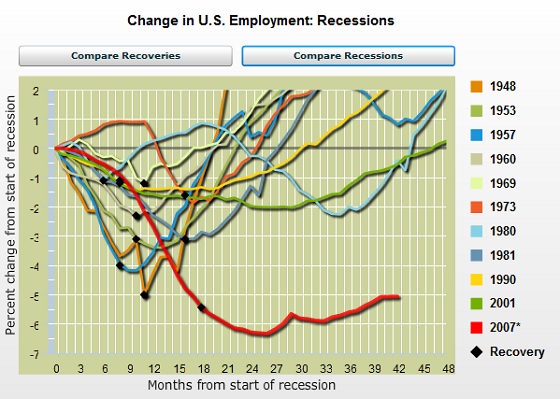
Guess what happened to that Obama recovery?
There never was one. And this graph from the article says it all. The Obama recession stands out as the worst by far.
Reactions to the debt deal: almost all unhappy.