
Did Obamacare cause the economic collapse

“The elephant in the room.”

By the spring of 2010, private sector job growth turned positive. In April job growth increased to 230,000 net private-sector jobs. The economy appeared on track for a normal recovery from an awful recession. The administration began confidently predicting a “Recovery Summer.” But Recovery Summer fizzled instead of sizzled. In May private sector job growth dropped sharply to less than 50,000 net jobs. Thereafter, monthly improvement in private job growth averaged just 6,500 jobs.

What else happened in the spring of 2010? Despite obstacles that many believed would kill the bill, Congress passed the Affordable Care Act. Within two months, the trend in job growth dropped sharply. Monthly job creation had been on pace to top out in the hundreds of thousands. Post-Affordable Care Act, it has barely kept pace with population growth. [emphasis mine]

and

The health-care measure raises business costs and makes planning for the future more difficult. It should be expected to slow hiring.

Federal Reserve officials report that the law has had exactly this effect. Dennis Lockhart, president of the Atlanta Fed, reports that “prominent among these (factors businesses explain are impeding hiring) is the lack of clarity about the cost implications of the recent health care legislation. We’ve frequently heard strong comments to the effect of ‘my company won’t hire a single additional worker until we know what health insurance costs are going to be.'” Surveys bear out these warnings. In a recent poll one-third of small business owners identified the healthcare bill as one of their top two obstacles to hiring. [emphasis mine]
1 comment

66 Percent of CEOs Plan to Freeze or Downsize Workforce Size

Two-thirds of the country’s CEOs plan to freeze or downsize their workforce over the next year, according to a new survey.

β€œAs I approach my 44th year in business, the last 20 as CEO, I can never remember a time when I felt so disenfranchised from our leadership in Washington. They seem determined to continue their ongoing anti-business attitude and to frustrate small and mid-sized businesses by uncertainty on taxes, government regulations, and simply too many bureaucratic restrictions. We desperately need a change in Washington.”

I guarantee that much of this reluctance to hire stems from uncertainty and fear of Obamacare and the regulations it brings.

2 comments

The job boom for government regulators under Obama

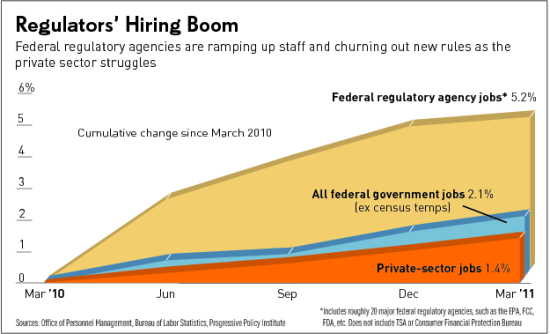
The chart of the day, from John Merlune at Investor’s Business Daily:

Boom in jobs for regulators

Merlune’s article outlines in frightening detail how there has been a job boom in only one place during the Obama administration, the government regulatory industry.

Regulatory agencies have seen their combined budgets grow a healthy 16% since 2008, topping $54 billion, according to the annual “Regulator’s Budget,” compiled by George Washington University and Washington University in St. Louis. That’s at a time when the overall economy grew a paltry 5%.

Meanwhile, employment at these agencies has climbed 13% since Obama took office to more than 281,000, while private-sector jobs shrank by 5.6%.

0 comments

Making hard choices

A new poll shows that the congressional special election to replace Anthony Weiner in the traditionally Democratic district in Queens/Brooklyn, New York is surprisingly competitive.

The poll found [Democrat] Weprin, a state assemblyman, leading [Republican] Turner, a retired broadcasting executive, 48 percent to 42 percent in the race for the Democratic-friendly Queens and Brooklyn-area seat.

Two thoughts: First, this poll fits with another that shows for the first time a majority of adults don’t want their own Congressman reelected. If so, it shouldn’t be surprising that the Democrat appears so weak in Brooklyn/Queens, a place I lived for most of my life and a place I found to be so knee-jerk Democrat that you couldn’t admit to being Republican without risking being blacklisted from all things.

Second, despite the mess the federal government is in as well as the disgraceful scandal that caused the previously elected Democratic Congressman to resign, it is also not surprising that 48 percent of the population still wants to vote Democrat in this district. This is my biggest fear: the continuing unwillingness of too many Americans to honestly face our government’s budget problems.
» Read more

0 comments

2012 is gonna be nasty

2012 is gonna be nasty.

There’s no doubt that we’re in for a high level of personal nastiness and invective. This election is not going to be about some minor adjustment to spending, or some trifling adjustment of tax rates, or some nibbling at the edges of the regulatory state. What is at stake in the 2012 election is the continuation of a world-view; a political philosophy that sees ever-larger government as the cure to whatever ails us. This next election is the first big battle for the survival of that worldview as the majority view of the political class, or the survival of the insurgent TEA party idea that government has become to large, too intrusive, and too expensive, so therefore must be radically reduced. There is little room to compromise between these two visions of government. Indeed, in most ways, they are worldviews that are mutually exclusive. Over the next decade or so, we are going to learn which of these two views will prevail, and if the US, as presently composed, will remain a united polity.

2 comments
1 67 68 69 70 71 107