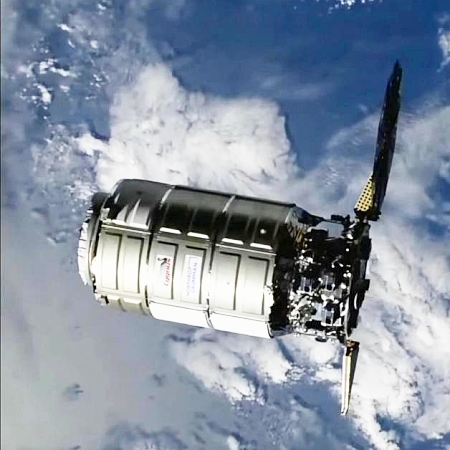
Private satellite snaps picture of ISS in orbit

ISS as seen by HEO Robotics satellite
Click for original image.

One of the satellites in the commercial satellite constellation run by the Australian company HEO Robotics to monitor objects in space successfully took a picture of ISS this week as it zipped by only 43 miles away.

That picture is to the right, reduced to post here. The relative speeds between the satellite and ISS was about 3.7 miles a second. The station’s main truss, which holds up its solar panels and heat radiators, is the vertical structure going from upper left to lower right. The habitable modules cross this at right angles, with what appears to be the Russian section on the right with a Soyuz or Progress docked to the port at the end. A Dragon capsule can be seen at the opposite end, docked to the American section on the left.

The company’s satellites have previously provided imagery of other objects in orbit, including the ERS-2 satellite just before it was de-orbited as well as China’s Tiangong-3 space station during its assembly.

0 comments

Congress passes new authorization bill for FAA that includes short extension of “learning period”

The new FAA authorization bill that that House approved yesterday and was passed previously by the Senate includes a short extension to the end of the year of the so-called “learning period” that is supposed to restrict the agency’s ability to regulate the new commercial space industry.

That limitation was first established in 2004 with a time period of eight years. It has been extended numerous times since then. The most recent extensions however have been very short, suggesting Congress (mostly from the Democrat side of the aile) wants to soon eliminate it. Whether that happens when it comes up for extension again at the end of 2024 will depend greatly on which party is in control after the election.

It really doesn’t matter. Everything the FAA has been doing in the past three years suggests this learning period no longer exists anyway. The agency has been demanding every new American company or rocket or spacecraft meet much higher regulatory requirements, which appears to have slowed significantly the development of those new companies, rockets, or spacecraft in the past two years.

1 comment

Lithuania signs Artemis Accords

Lithuania yesterday became the 40th nation to sign the Artemis Accords, joining the American alliance for exploring the solar system.

The alliance now includes these nations: Angola, Argentina, Australia, Bahrain, Belgium, Brazil, Bulgaria, Canada, Columbia, Czech Republic, Ecuador, France, Germany, Greece, Iceland, India, Israel, Italy, Japan, Lithuania, Luxembourg, Mexico, the Netherlands, New Zealand, Nigeria, Poland, Romania, Rwanda, Saudi Arabia, Singapore, Slovenia, South Korea, Spain, Sweden, Switzerland, the United Kingdom, the United Arab Emirates, the Ukraine, the United States and Uruguay.

The press release for this announcement differed slightly from the last few, all of which emphasized how the accords were designed to “reinforce” the Outer Space Treaty, the exact opposite of its original goals, which was to build an alliance of nations focused on getting around or eliminating the restrictions of the Outer Space Treaty on private property in space. Today the press release was more vague:

NASA, along with the Department of State and seven other nations, established the Artemis Accords in 2020 to lay out a set of principles grounded in the Outer Space Treaty of 1967 and three related space treaties. With the commitment of now 40 nations, the accords community will facilitate a long-term and peaceful presence of deep space exploration for the benefit of humanity.

Does this mean the Biden administration is going to return to the accords’ original goal? I doubt it. I think instead they decided they needed to be less obvious about their new intentions, which increasingly appears to be to use this alliance to foster globalist international cooperation aimed at keeping all power and legal control in the hands of the governments themselves.

1 comment

FAA schedules first three public meetings for Starship/Superheavy impact statement review

The FAA has now scheduled the first three public meetings as part of its new environmental impact statement review of SpaceX’s proposed construction plans at Cape Canaveral.

The in-person open houses will feature information stations where the FAA will “provide information describing the purpose of the scoping meetings, project schedule, opportunities for public involvement, proposed action and alternatives summary, and environmental resource area summary. Fact sheets will be made available containing similar information,” the project website says.

“At any time during the meetings, the public will have the opportunity to provide verbal comments to a court reporter or written comments via a written comment form at one of several commenting stations,” the website says.

It appears that SpaceX is proposing two different options for establishing an additional launchpad for Superheavy/Starship. Its preferred option is to refurbish pad LC-37, which was most recenly used by ULA to launch its Delta-4 Heavy in April. A second option is to develop a new pad entirely, dubbed LC-50.

Though the FAA claims this new impact statement is necessary because SpaceX has upped the planned annual Superheavy/Starship launches from 24 to 44, that claim is bogus. The difference is not that significant, and more important, rockets have been launching from these pads now for almost three-quarters of a century, and the environment has not only not been harmed by that activity, the wildlife surrounding the cape has prospered tremendously by the creation of a large zone where no development can occur.

That history is the real impact statement, and it proves the new red tape is unecessary. What the FAA (and the Air Force) are now doing is simply lawfare against SpaceX.

5 comments

Ispace gets a new payload for its first NASA lunar landing mission

Capitalism in space: The Japanese company Ispace has won a contract with the European company Control Data Systems (CDS) to place CDS’s precise localization instrument on Ispace’s APEX lunar lander, its first NASA mission.

CDSโ€™s technology, which combines precision localization with telecommunications, uses Ultra-Wideband for determining precise positions and was developed specifically for space applications with support from the European Space Agency. The lack of a GPS-like system on the Moon, makes the technology ground-breaking for future applications related to lunar exploration.

The agreement … also represents the first Romanian payload to be delivered to the lunar surface. The technology will be integrated into the APEX 1.0 lunar lander as part of ispace technologies U.S. (ispace-U.S.) Mission 3, currently scheduled for 2026. A lunar rover will transport the CDS equipment on the surface to test the localization technology using an antenna that will remain on the APEX 1.0 lander.

Though Ispace is based in Japan, it has divisions in both the U.S. and Europe, which is allowing it to sign contracts with NASA and companies in both locations.

0 comments

Atlas-5 launch of Starliner slips to May 21, 2024

While ULA has successfully replaced the valve in the upper stage of the Atlas-5 rocket, the first manned launch of Boeing’s Starliner capsule has slipped another four days, to May 21, 2024, because a newly discovered helium leak in the capsule’s service module.

Starliner teams are working to resolve a small helium leak detected in the spacecraftโ€™s service module traced to a flange on a single reaction control system thruster. Helium is used in spacecraft thruster systems to allow the thrusters to fire and is not combustible or toxic.

NASA and Boeing are developing spacecraft testing and operational solutions to address the issue. As a part of the testing, Boeing will bring the propulsion system up to flight pressurization just as it does prior to launch, and then allow the helium system to vent naturally to validate existing data and strengthen flight rationale.

The prevous launch scrub was entirely due to the ULA’s rocket, not anything related to Boeing. This delay however is a Boeing issue, and it only reinforces the general uneasiness everyone feels about Boeing’s quality control work.

3 comments

SpaceX launches 20 more Starlink satellites

SpaceX last night successfully placed another 20 Starlink satellites into orbit, its Falcon 9 rocket lifting off from Vandenberg in California.

The first stage completed its eighteenth launch, landing on a drone ship in the Pacific.

The leaders in the 2024 launch race:

51 SpaceX
21 China
6 Russia
5 Rocket Lab

American private enterprise now leads the world combined in successful launches, 58 to 33. SpaceX by itself now leads the rest of the world, including other American companies, 51 to 40.

2 comments

Air Force sends letter of concern about Vulcan to ULA

According to a report yesterday [behind a paywall], the Air Force has sent a letter of concern to ULA and its joint owners, Boeing and Lockheed Martin, about the long delays getting its new Vulcan rocket operational.

When the military chose in 2021 ULA and SpaceX to be its two launch providers for the first half of the 2020s, it expected ULA to complete 60% of the launches and SpaceX 40%. It also expected Vulcan to being launching within a year or two, at the latest.

Instead, the first launch of Vulcan did not occur until 2024, and its second launch — required by the military before it will allow Vulcan to launch its payloads — won’t occur until late this year. Worse, the military has a large backlog of launches it has assigned to Vulcan that need to launch quickly.

“I am growing concerned with ULAโ€™s ability to scale manufacturing of its Vulcan rocket and scale its launch cadence to meet our needs,” [Air Force Assistant Secretary Frank] Calvelli wrote. “Currently there is military satellite capability sitting on the ground due to Vulcan delays. ULA has a backlog of 25 National Security Space Launch (NSSL) Phase 2 Vulcan launches on contract.”

These 25 launches, Calvelli notes, are due to be completed by the end of 2027. He asked Boeing and Lockheed to complete an “independent review” of United Launch Alliance’s ability to scale manufacturing of its Vulcan rockets and meet its commitments to the military. Calvelli also noted that Vulcan has made commitments to launch dozens of satellites for others over that period, a reference to a contract between United Launch Alliance and Amazon for Project Kuiper satellites.

ULA says that once operations ramp up, it plans to launch Vulcan twice a month. The Air Force doubts about whether that will be possible however are well founded. To meet that schedule ULA will need delivery per month of at least four BE-4 engines from Blue Origin, and so far there is no indication the Bezos company can meet that demand. Delays at Blue Origin in developing that engine are the main reason Vulcan is so far behind schedule in the first place.

In order to get Vulcan operational, ULA needs to fly a second time successfully. The second launch of Sierra Space’s Tenacity mini-shuttle is booked for that flight, and was originally supposed to launch this spring. Tenacity however was not ready, as it is still undergoing final ground testing. The launch is now set for the fall, but both ULA and the Pentagon are discussing replacing it with a dummy payload should Tenacity experience any more delays.

The source of all of these problems points to Blue Origin. Not only has it been unable to deliver its BE-4 rocket engine on schedule — thus blocking Vulcan — the long delays in developing its own New Glenn orbital rocket (which uses seven BE-4 engines) has given the military fewer launch options. As a result the military has been left with only one rocket company, SpaceX, capable of launching its large payloads.

To put Blue Origin’s problems in perspective, for Blue Origin to finally achieve its many promises and get both Vulcan and New Glenn flying regularly, it will need to begin producing a minimum of 50 to 150 BE-4 engines per year, with two-thirds for its own New Glenn rocket. Right now all evidence suggests the company is having problems building two per year.

In other words, the Pentagon might send a letter of concern to ULA, but it should instead be focusing its ire on Blue Origin.

8 comments

SpaceX launches 23 more Starlink satellites

SpaceX tonight successfully launched 23 Starlink satellites, its Falcon 9 rocket lifting off from Cape Canaveral.

This was the 50th successful launch by SpaceX this year, in only a little more that five months. Reaching the company’s goal of 150 launches in 2024 (six of which were planned to be Starship/Superheavy test launches) remains a challenge, but if the company reaches even 80% of that goal (120) it will have set a record for launches greater than what the entire world achieved for every year of the space age until 2020.

This was also the 15th launch of the rocket’s first stage, landing successfully on a drone ship in the Atlantic.

The leaders in the 2024 launch race:

50 SpaceX
21 China
6 Russia
5 Rocket Lab

American private enterprise now leads the world combined in successful launches, 57 to 33. SpaceX by itself now leads the rest of the world, including other American companies, 50 to 40.

4 comments

FAA and Air Force initiate new environmental impact statements for Starship/Superheavy launchpads in Florida

We’re here to help you! Really! Late yesterday, in a typical Friday story dump just before the weekend to reduce any notice, the FAA announced it has begun a new environmental impact statement (EIS) of SpaceX’s Starship/Superheavy launchpad infrastructure being built in Florida, working in parallel with a similar environmental impact statement now being conducted by the Air Force.

The EIS will be the second environmental review involving SpaceXโ€™s plans to use LC-39A for Starship launches. NASA completed an environmental assessment (EA) in 2019 of the companyโ€™s plans at the time to build launch infrastructure at LC-39A for Starship, finding it would have no significant impact. At the time SpaceX was planning up to 24 Starship launches from that pad annually. A new EIS, the FAA concluded, is needed because of changes in the design of Starship and its operations since the 2019 assessment.

The FAA claims a new assessment is needed because SpaceX is now planning as many as 44 launches. The Air Force has not said why its new assessment is needed. That EIS, which began in March, covers a launchpad previously used by the Saturn-1B and Delta-4 rockets from 1964 to 2022, another pad use by the Air Force’s Titan rocket from 1965 to 2005, as well as a new pad, dubbed SLC-50.

LC-39A meanwhile has been used for launches since the 1960s. The Saturn-5, the space shuttle, and the Falcon 9 all launched from this pad.

The dishonest absurdity of these impact statements can not be overstated. There is zero reason to do new assessments. All the pads have been in use for decades, with all kinds of rockets, some comparable to Superheavy/Starship. The environment and the wildlife refuge at Cape Canaveral have both thrived.

Moreover, to force completely new impact statements because the design and plans for Superheavy/Starship have changed somewhat (but not fundamentally) is even more stupid. This is a new rocket, being developed day-by-day and launch-by-launch. Will the FAA and the Air Force require new EIS’s every time SpaceX changes anything? It seems so.

This is clearly lawfare against Elon Musk and SpaceX by the White House and the administration state. It doesn’t like Musk, and it is now searching at all times for ways to block or damage him.

I confidently predict that neither statement will be completed by the end of 2025. Based on the timeline of most EIS’s, which when politics are involved are almost always slowed by the legal action of activists, the earliest either will be approved will be mid-2026, though likely later.

What is not clear is whether the FAA and Air Force will stop all work while this red tape is being unwound. If so, then the first operational launches of Superheavy and Starship cannot happen out of Cape Canaveral until well into 2027, which means NASA entire Artemis program will be seriously delayed. My previous prediction that the first manned lunar landing can’t happen before 2030 is becoming increasingly too conservative.

And remember this: If Joe Biden and the Democrats remain in power after November, all bets are off. At that point they are certain to ramp up the lawfare against those they see as political enemies, even if their targets are doing great things for the nation and the American people.

11 comments

Update of the reusable cargo capsule by the French company, The Exploration Company

Link here. The article provides a detailed look at the development of the company’s second demonstrator capsule, dubbed Mission Possible, which it hopes to fly in an orbital test sometime in ’25.

Beforehand a smaller demonstrator capsule, dubbed Mission Bikini, will fly on the first launch of the Ariane-6, set for this summer.

Both demonstrators will lay the groundwork fo the launch of the company’s Nyx capsule, designed to provide freighter services to any one of the four private space stations presently being built.

0 comments

German startup loses prototype of aerospike spaceplane during test

The prototype aerospike test spaceplane of the German startup Polaris Spaceplanes was destroyed recently during its first test flight.

The MIRA I, from German aerospace startup Polaris Raumflugzeuge, was traveling at approximately 105 mph during takeoff when a “landing gear steering reaction” plus a side wind caused a “hard landing event,” rendering the space plane inoperable and it’s fiberglass airframe damaged beyond repair.

Its subsystems remained mostly intact โ€“ however, rather than attempt to repair the prototype spaceplane, Polaris has opted to decommission 13.9-foot-long MIRA I to go ahead with the identically shaped 16 foot MIRA II and III design.

Had it flown, it would have been the first flight test ever of an aerospike nozzle. Such a nozzle has been proposed by engineers for decades to take full advantage of the changing atmospheric pressure as a rocket lifts off. Traditional nozzles can only be shaped for one specific air pressure, and lose efficiency as the pressure changes. By using the air pressure to form one wall of the nozzle, an aerospike uses that changing pressure to always function at the highest efficiency.

The company hopes to use this design to eventually create a spaceplane that will take off from a runway, reach orbit, and then return to a runway, all without any additional stages.

Neither of the upcoming prototypes however will be able to do this. Their purpose will mostly be to test the aerospike engine at various altitudes. The company hopes to fly its full scale spaceplane, dubbed Aurora, in ’26 or ’27.

4 comments
1 135 136 137 138 139 676