French rocket startup MaiaSpace announces its launch schedule

The French rocket startup MaiaSpace is now planning to launch a suborbital test rocket in 2026 to be followed by its first orbital flight in 2027.

As the company works toward the commencement of commercial operations in 2027, it is planning to launch an initial suborbital demonstration flight in late 2026 to validate key elements of the Maia launch system. The rocket will be launched in its full two-stage configuration and will carry a reduced propellant load, with MaiaSpace aiming for a minimum altitude of 100 kilometres. … “For what concerns our first flight, we will deploy a minimum viable product designed to test critical phases (lift-off, stages separation, engine ignition of the second stage, …) and to validate the key features required for our first orbital flight.”

Maiaspace is a wholly owned subsidiary of ArianeGroup, the Airbus-Safran partnership that builds the Ariane-6 rocket for Arianespace. Its goal with Maiaspace is to quickly develop a small reusable rocket that can compete with the other new European startups in Germany (Isar and Rocket Factory Augsburg) and Spain (PLD).

1 comment

FCC approves SpaceX request to expand Starlink by 7,500 satellites

The Federal Communications Commission (FCC) yesterday approved SpaceX’s request to both expand its Starlink constellation by 7,500 satellites as well as use additional bands of spectrum.

The Federal Communications Commission on Friday approved SpaceX’s request to launch an additional 7,500 of its Starlink Gen2 satellites, bringing the total allowed Gen2 constellation to 15,000. The agency also granted the company’s request to operate in additional spectrum bands and to operate at higher power in other bands between 10.7-30 GigaHertz (GHz), pending the completion of an existing FCC rulemaking where the question is being considered.

…The order also allows SpaceX satellites to use lower orbits, down to 340 kilometers, and provide direct-to-cell service. The company is seeking approval for a separate 15,000-satellite constellation that would provide upgraded direct-to-cell service using spectrum it’s purchasing from EchoStar.

The article notes that under the Trump administration has also revamped the FCC’s grant program, that under Biden canceled an $886 million grant, claiming absurdly that Starlink did not provide service to rural areas. Under the new program “SpaceX is set to serve the most locations of any ISP under the $42.45 billion Broadband Equity, Access, and Deployment program after new Trump administration rules that made it easier for satellite providers to compete for funding.”

Not that SpaceX or any of the other constellations need this government grant. Trump would serve the country better to shut the program down.

9 comments

SpaceX launches 29 Starlink satellites

The beat goes on: SpaceX today successfully launched another 29 Starlink satellites into orbit, its Falcon 9 rocket lifting off from Cape Canaveral in Florida.

This was SpaceX’s third launch in 2026. It remains the only entity globally to complete a launch so far this year.

The first stage of its Falcon 9 rocket (B1069) flew for its 29th time, passing the space shuttle Columbia in the rankings of the most reused launch vehicles:

39 Discovery space shuttle
33 Atlantis space shuttle
32 Falcon 9 booster B1067
30 Falcon 9 booster B1071
30 Falcon 9 booster B1063
29 Falcon 9 booster B1069
28 Columbia space shuttle

Sources here and here.

0 comments

South Korean rocket startup Innospace signs deal with Portugal’s Santa Maria spaceport

Santa Maria spaceport

The South Korean rocket startup Innospace, which just last month attempted its first launch out of Brazil, has now signed a deal to launch its rocket from Portugal’s proposed Santa Maria spaceport in the Azores, located about 900 miles west of the European mainland.

Through this agreement, INNOSPACE has secured priority and long-term access to the Malbusca Launch Center, located on Santa Maria Island in the Azores, Portugal, for a five-year period starting in 2026. The company plans to gradually establish key launch infrastructure required for initial operations, including launch pads, operations and control systems, and testing facilities, with the goal of conducting its first commercial launch in the fourth quarter of 2026.

Despite the launch failure last month, Innospace has been aggressive about obtaining agreements for launching its rockets from multiple locations. That first launch occurred at Brazil’s long unused Alcantera spaceport on its eastern coast, and the company will use it for its second launch attempt later this year. It has also signed agreements with two spaceports in Australia (Southern Launch and Equatorial Launch), though the latter spaceport is not yet operational and might never exist.

0 comments

Billionaire to fund construction of an orbiting optical telescope larger than Hubble

Lazuli
Figure 1 from the proposal paper [pdf].

Schmidt Sciences, a foundation created by one of Google’s founders, announced yesterday it is financing the construction of four new research telescopes, one of which will be an orbiting optical telescope with a mirror 3.1 meters in diameter, larger than the 2.4 meter primary mirror on the Hubble Space Telescope.

Today at a meeting of the American Astronomical Society, Schmidt Sciences, a foundation backed by billionaires Eric and Wendy Schmidt, announced one of the largest ever private investments in astronomy: funding for an orbiting observatory larger than NASA’s Hubble Space Telescope, along with funds to build three novel ground-based observatories. The project aims to have all four components up and running by the end of the decade.

“We’re providing a new set of windows into the universe,” says Stuart Feldman, president of Schmidt Sciences, which will manage the observatory system. Time on the telescopes will be open to scientists worldwide, and data harvested by them will be available in linked databases. Schmidt Sciences declined to say how much it is investing but Feldman says the space telescope, called Lazuli, alone will cost hundreds of millions of dollars.

Eric Schmidt was once CEO of Google, and in recent years has been spending his large fortune (estimated to exceed $50 billion) on space ventures. For example, in March 2025 he acquired control of the rocket startup Relativity.

While the three new ground-based telescopes will do important work, the Lazuli space telescope is by far the most important, not only scientifically but culturally. » Read more

29 comments

An excellent summary of Europe’s rocket companies, both established and startups

Link here. This list is a great summary of all the rocket companies in Europe, most of which are startups that haven’t yet launched. It also includes the two companies that are already established, ArianeGroup and Avio.

With each company the report provides a nice quick status overview. It ranks some lower than I (Rocket Factory Augsburg), but the analysis is based on all the same stories I’ve posted here on Behind the Black in the past year, plus a few extra details about companies I had not yet heard of.

Based on this review, it appears that at least three European startups are gearing up for a first launch in 2026. It would be surprising if all three succeed in getting off the ground, but the momentum is definitely building towards a lot of excitement in the next year or two.

1 comment

Rocketdyne to reappear with sale by L3Harris of its civilian rocket engine division

The name Rocketdyne is about to rise from the ashes with the sale by L3Harris of its civilian rocket engine division to the private equity firm AE Industrial Partners.

The firm is selling a 60 percent stake, worth $845 million, and maintaining about a 40 percent share of the space propulsion business unit, which focuses on technologies related to NASA and civil space activities. For example, its products include nuclear power systems for future missions to the moon and Mars, and the RL10 engine that powers the upper stage for United Launch Alliance’s Vulcan heavy lifter.

That said, the RS-25 rocket engine business is excluded from the sale; the engine is the primary propulsion system on NASA’s Space Launch System being designed to send crews to the moon under the Artemis mission.

When L3Harris purchased Aerojet-Rocketdyne in 2023, the names of these two companies from the very beginnings of the space age vanished. It now appears that AE is going to bring one back.

AE Industrial ― which previously has invested in commercial space companies including York Space Systems, Redwire and Firefly — said in an announcement today that the new entity will be named Rocketdyne “in recognition of its heritage and longstanding innovation within space propulsion technology.”

Aerojet-Rocketdyne had been in trouble for years prior to is purchase, and it remains uncertain whether the engine part of this new Rocketdyne company can compete. Its main business right now is building the engines used by the SLS rocket, which in the long run has a limited future.

4 comments

A UK law professor and news outlet prove the UK is not the place to launch rockets

Proposed or active spaceports in North Europe

If I had any remaining hopes that the United Kingdom might finally begin to reform its Byzantine space regulations that bankrupted one rocket company and has blocked any launches from its proposed spaceports for almost a decade — allowing other spaceports in Europe to attract rocket companies and leap ahead — those hopes vanished in reading an article in the Shetland Times today, in which a professor specializing in UK space law described its red tape as “very good,” drawing “on best practice from other industries and jurisdictions.”

Alexander Simmonds of the University of Dundee says a balance should be struck to avoid launch operators being put off by strict regulatory requirements. The lecturer in space law and writer behind The Space Legislation of the United Kingdom says UK regulation of the space industry is “very good” and draws on best practice from other industries and jurisdictions.

Licences are in place for SaxaVord to host the first vertical satelite launch in 2026, and Dr Simmonds says operators have taken responsibilities “very seriously”. But he fears future operators could look elsewhere if compliance becomes too much of a problem and more cost-effective alternatives are available.

“My own view is we’re in a very good place at the moment, as regards to regulation,” Dr Simmonds told The Shetland Times. “I think that the legilsators have been cautious with this and have been very entitled to be, given the nature of what we are dealing with.”

Both this so-called expert and the journalist interviewing him appear entirely ignorant about the history of past decade. While red tape in the UK has blocked or seriously delayed launches, rocket startups have “looked elsewhere,” signing deals and launching from Norway’s long established Andoya spaceport that has now gone commercial with enthusiastic government support. At the same time, new spaceport projects have begun at three other locations, all of which appear to also have support from their local governments in Sweden and Germany. While the UK government has choked off business, the governments at these other spaceports have moved aggressively to ease regulation.

The cluelessness of both Simmonds and the Shetland Times reporter indicates there is absolutely no urgency in the UK to fix things, and in fact it appears they aren’t even aware their emperor is wearing no clothes.

9 comments

The space station race: Startup Max Space to establish factory at Kennedy in Florida

Thunderbird, with cut-out showing interior and person for scale
Max Space’s proposed Thunderbird station, with cut-out showing
interior and person for scale. Click for original images.

The space station startup Max Space has apparently decided to establish its manufacturing facility at the Kennedy Space Center in Florida, and expects to hire its first 30 to 50 employees there this year.

Currently working with Space Florida, Max Space is moving toward setting up operation in Exploration Park on Space Commerce Way, and has already begun hiring. While the company already has a address in Exploration Park, they are seeking to set up in an existing 20,000 to 30,000 square-foot manufacturing facility. This is where the large space habitat modules will be manufactured.

While Space Florida confirmed Max Space’s intentions to move into the area, no further details were provided. Max Space said they expect to bring 30 to 50 new hires onboard within the first half of 2026.

The company had previously positioned itself as the builder of modules that any one of the four other commercial private space stations could buy and add to their stations. It now appears it has decided to enter the competition as its own station, proposing Thunderbird as its bid. It is gearing up to fly a smaller demonstration mission in ’27 to prove its inflatable design that is based on the same technology used by the modules built by the now-defunct company Bigelow.

With this in mind, I have now added Max Space to my rankings of the commercial stations under construction, and have placed it ahead of Blue Origin’s Orbital Reef station, based on my impression of where both projects presently stand. Essentially, they are tied for last place, but I put Max Space ahead because it seems to have positive momentum, while the partnership of Blue Origin and Sierra Space appears to be faltering.
» Read more

9 comments

Innospace releases preliminary results of launch failure

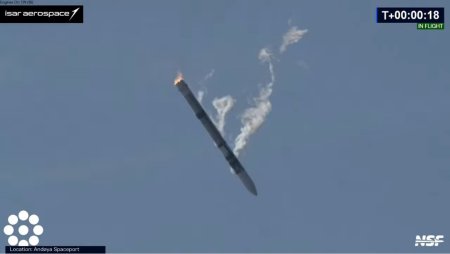
The South Korean rocket startup Innospace last week released its first preliminary results of its investigation into the December 22, 2025 failure during the first orbital launch attempt of its Hanbit-Nano rocket.

Based on video footage and preliminary data available to date, the vehicle achieved approximately 30 seconds of nominal ascent. During its passage through cloud layers, communication between the vehicle and ground systems was lost. Subsequently, the vehicle sustained structural damage of an undetermined cause, leading to separation into multiple sections and indications of first-stage engine thrust termination. As a result, the vehicle lost propulsion and attitude control and entered free fall, separating into the first stage, second stage, and smaller debris fragments.

As the calculated Instant Impact Point (IIP) remained within the launch site’s designated safety perimeter, and to prevent debris dispersion and residual hazards, the Flight Termination System (FTS) was activated in accordance with procedures pre-coordinated with Brazilian safety authorities. The launch vehicle was detonated at the point of ground impact, resulting in early mission termination.

In plain language, the rocket broke up about 30 seconds after lift-off, and as its pieces hit the ground engineers activated the self-destruct software.

The company says it hopes to try again in ’26, launching once again from Brazil’s Alcantera spaceport. I suspect it will take longer than that to pin down the cause of the rocket’s “structural damage” and fix it. The data so far suggests a fundamental flaw that require a major redesign.

3 comments

Review of SpaceX’s 2026 Superheavy/Starship test flights

Link here. The article begins by reviewing the work SpaceX is doing at both Boca Chica in Texas and Cape Canaveral in Florida. In the end, the company is aiming to have two Starship launchpads at Boca Chica and three launchpads in Florida, with both locations have extensive manufacturing facilities capable of building ships and boosters almost continually.

It then provides a nice review of all five Superheavy/Starship test flights that took place in 2025, a review that makes it very clear how much was accomplished, and indicates the possibilities for ’26. If SpaceX could manage almost one flight every two and a half months last year, despite two test stand explosions, the odds are excellent it will exceed that pace this year.

8 comments

SpaceX launches 29 more Starlink satellites, plus a review of its Falcon 9 first stage fleet

The beat goes on: SpaceX tonight successfully launched another 29 Starlink satellites, its Falcon 9 rocket lifting off from Cape Canaveral in Florida.

This was SpaceX’s second launch in 2026. At this moment the company is the only one to have launched anything this year.

The rocket’s first stage was on its first flight, landing successfully on a drone ship in the Atlantic. As new boosters are now introduced so rarely, I decided to look back at how many new stages SpaceX has been introducing each year to get a sense of the size of its fleet. The rough chart below is based on the data on this Wikipedia page. It begins in 2018 because that is when SpaceX introduced the Block 5 version of the stage that it still uses, and says is designed to do as many as 40 flights.

New stages introduced each year:
—————————————–
2018: 6 (all now deactivated or expended)
2019: 7 (all now deactivated or expended)
2020: 4 (all now deactivated or expended)
2021: 3
2022: 7 (5 deactivated or expended)
2023: 9 (5 deactivated or expended)
2024: 9 (3 deactivated or expended)
2025: 8

According to that webpage, SpaceX has approximately 25 active stages in its fleet. The numbers above suggest the company has been increasing the size of its fleet steadily. In fact, since 2022 it appears the company has added 23 stages to the fleet. In 2025 it appears it added a new stage about every 20 launches.

This estimate is rough and is almost certainly not precisely accurate. For example, several stages listed as active have flown only once, or have not flown in awhile.

Nonetheless, this rough count helps explain how SpaceX can launch so frequently. It now has a robust fleet of Falcon 9 boosters to draw on, and it is growing that fleet to meet its needs. All it needs to do is make sure it can manufacture enough upper stages and satellites to fill its launch manifest.

6 comments
1 25 26 27 28 29 677