China releases data and images from Yutu-2 and Chang’e-3

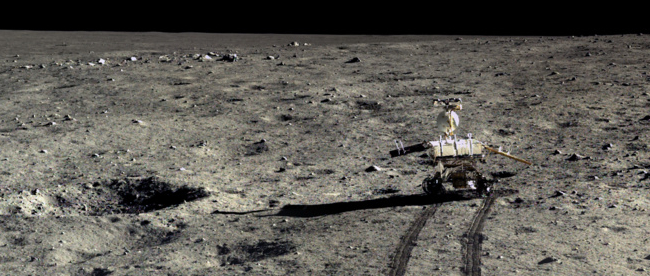
Yutu-2 on the far side of the Moon
Click for full image.

The new colonial movement: To celebrate the completion of a year on the lunar surface, China has released the bulk of the data and images produced by the lander Chang’e-3 and the rover Yutu-2.

The link includes a nice gallery of images. I especially like the image to the right, cropped to post here. It shows Yutu-2 moving away from Chang’e-3 early in the mission. It also shows how truly colorless the Moon is. The rover proves this is a color image, but if it wasn’t in the shot you’d have no way of knowing.

And then there is that pitch black sky. I wonder what’s behind it.

0 comments

China’s Chang’e 3 finds no water on Moon

The uncertainty of science: After more than 2 1/2 years on the lunar surface China’s Chang’e 3 lunar lander has detected no water at its landing site.

This result, while not in direct conflict with the orbital data from India’s Chandrayaan-1, suggests that the question of water on the Moon is a very complex one. Chandrayaan-1 detected evidence that suggested their might be deposits of water in certain surface regions, locked up in the regolith. Chang’e 3 found no water at its specific location. The two results do not have to conflict, but the latter does raise the uncertainty of Chandrayaan-1’s detection.

0 comments

China releases images from lunar rover and lander

Yutu on the Moon

China has made available a new batch of very cool images taken by its Chang’e 3 lander and Yutu rover, and Emily Lakdawalla at the Planetary Society has figured out how to view them.

In a recent guest blog post, Quanzhi Ye pointed to the Chinese version of the Planetary Data System, and shared the great news that Chang’e 3 lander data are now public. The website is a little bit difficult to use, but last week I managed to download all of the data from two of the cameras — a total of 35 Gigabytes of data! — and I’ve spent the subsequent week figuring out what’s there and how to handle it.

So, space fans, without further ado, here, for the first time in a format easily accessible to the public, are hundreds and hundreds of science-quality images from the Chang’e 3 lander and Yutu rover. I don’t usually host entire data sets (PDS-formatted and all) but I made an exception in this case because the Chinese website is a bit challenging to use.

The image above is a cropped version of Yutu, taken by the lander. Be sure and go to the link to see the full image as well as others.

5 comments

Yutu still operational after two years

Despite an inability to move, China’s rover Yutu has now set the longevity operational record for rover on the Moon.

Yutu was deployed and landed on the moon via China’s Chang’e-3 lunar probe in 2013, staying longer than the Soviet Union’s 1970 moon rover Lunokhod 1, which spent 11 months on the moon. Its operations have streamed live through Sina Weibo, a Chinese microblogging site, and its Weibo account has nearly 600,000 followers.

Yutu experienced a mechanical control abnormality in 2014, but it was revived within a month and, though it is unable to move, it continues to collect data, send and receive signals, and record images and video.

1 comment

Yutu is slowly dying

China’s lunar rover Yutu, unable to move since its first few weeks on the moon, is slowly dying.

The rover is currently in good condition and works normally, but its control problem persists, said Yu Dengyun, deputy chief designer of China’s lunar probe mission. “Yutu has gone through freezing lunar nights under abnormal status, and its functions are gradually degrading,” Yu told Xinhua at an exclusive interview. He said that the moon rover and the lander of the Chang’e-3 lunar mission have completed their tasks very well. The rover’s designed lifetime is just three months, but it has survived for over nine.

As China’s first planetary rover mission, the limited roving success of Yutu is well balanced by its ability to continue functioning on the lunar survey for so long. The engineering data obtained from this mission will serve Chinese engineers well as they plan future missions.

2 comments

Was Yutu stopped by rough ground?

One of the designers of the Chinese lunar rover Yutu said in a news interview today that the rocky nature of the Moon’s surface, far rougher than expected, was what caused it to stall.

The rover was tested in Beijing, Shanghai and the desert in northwestern China before its launch, but the terrain of the landing site proved to be much more rugged than expected, said Zhang Yuhua, deputy chief designer of the lunar probe system for the Chang’e-3 mission. “It is almost like a gravel field.”

Data from foreign researchers projected that there would be four stones, each above 20 cm, on average every 100 square meters, but the quantity and size of the stones that Yutu has encountered has far exceeded this expectation, Zhang said in an exclusive interview with Xinhua. “Experts’ initial judgement for the abnormality of Yutu was that the rover was ‘wounded’ by colliding with stones while moving,” she said. [emphasis mine]

The implication of the highlighted quote is that it isn’t their fault, it was the fault of those evil Americans and Russians who incorrectly estimated the roughness of the ground. This article also doesn’t fit the information released when Yutu first stalled, where they explained that their problem was partly an inability to retract equipment in preparation for lunar night. While this story could be true, it isn’t the whole story.

2 comments

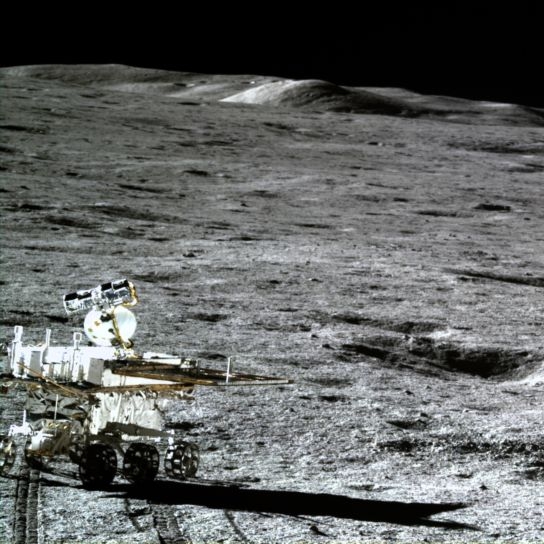
As China’s Yutu lunar rover barely continues to survive, unable to move, its scientists prepare to publish their results.

As China’s Yutu lunar rover barely continues to survive, unable to move, its scientists prepare to publish their results.

But other systems and scientific instruments β€” a panoramic camera, infrared and X-ray spectrometers and a ground-penetrating radar β€” are operating normally, says Zheng: β€œThe rover can still carry out measurements from the fixed location and send scientific data to the ground station.” …

Yutu’s penetrator radar has detected several layers underneath its path, says Long Xiao, a planetary scientist at China University of Geosciences in Wuhan. Under the surface soil, known as regolith, it found a layer of debris from a crater-forming impact and two layers of lava flows, made of basalt.

Though the rover lost its ability to rove within days of landing on the Moon, the mission is certainly an overall success for China. When they send their next rover to the Moon this first experience will serve them very well.

0 comments

China’s Yutu rover is still functioning but cannot move.

China’s Yutu rover is still functioning but cannot move.

Last week Yutu and its companion spacecraft, the Chang’e 3 Moon lander, awoke from a period of dormancy after the frigid, two-week lunar night β€” the third awakening since landing on 14 December, Chinese scientists said this week at the Lunar and Planetary Science Conference in The Woodlands, Texas. The probes continue to gather data and send it back to Earth.

But Yutu may never move more than the 100–110 metres it has already travelled from its landing site β€” in the Mare Imbrium. Mission officials had hoped that Yutu would travel to the rim of a nearby crater and explore it, but a mechanical failure in Yutu’s drive system has stilled the rover since late January.

I wish they would get their story straight. This article suggests that the problem wasn’t in the circuit that controls the storage of equipment during the long lunar night, as reported previously, but in the system that actually moves the rover.

It also appears from the story above that scientists were disappointed by the amount of information released at the Texas conference.

0 comments
1 2