IAU approves China’s proposed names for Chang’e-4 landing site

That was fast! The International Astronomical Union (IAU) has approved all of the proposed names that China submitted for the features at or near Chang’e-4 landing site.

The IAU Working Group for Planetary System Nomenclature has approved the name Statio Tianhe for the landing site where the Chinese spacecraft Chang’e-4 touched down on 3 January this year, in the first-ever landing on the far side of the Moon. The name Tianhe originates from the ancient Chinese name for the Milky Way, which was the sky river that separated Niulang and Zhinyu in the folk tale “The Cowherd and the Weaver Girl”.

Four other names for features near the landing site have also been approved. In keeping with the theme of the above-mentioned folk tale, three small craters that form a triangle around the landing site have been named Zhinyu, Hegu, and Tianjin, which correspond to characters in the tale. They are also names of ancient Chinese constellations from the time of the Han dynasty. The fifth approved name is Mons Tai, assigned to the central peak of the crater Von Kármán, in which the landing occurred. Mons Tai is named for Mount Tai, a mountain in Shandong, China, and is about 46 km to the northwest of the Chang’e-4 landing site.

Compare this fast action with the IAU’s approval process for the names the New Horizons team picked for both Pluto and Ultima Thule. It took the IAU more than two years to approve the Pluto names, and almost three years to approve the Charon names. It is now almost two months after New Horizons’ fly-by of Ultima Thule, and the IAU has not yet approved the team’s picks for that body.

Yet it is able to get China’s picks approved in less than a month? Though it is obviously possible that there is a simple and innocent explanation for the differences here, I think this illustrates well the biases of the IAU. Its membership does not like the United States, and works to stymie our achievements if it can. This factor played a part in the Pluto/planet fiasco. It played a part in its decision to rename Hubble’s Law. And according to my sources, it was part of the background negotiations in the naming of some lunar craters last year to honor the Apollo 8 astronauts.

The bottom line remains: The IAU has continually tried to expand its naming authority, when all it was originally asked to do was to coordinate the naming of distant astronomical objects. Now it claims it has the right to approve the naming of every boulder and rock anywhere in the universe. At some point the actual explorers are going to have to tell this organization to go jump in a lake.
1 comment

Chang’e-4 & Yutu-2 enter sleep mode for second lunar night

The Chinese lunar lander Chang’e-4 and its rover Yutu-2 have both gone into hibernation as part of their preparation for surviving their second night on the Moon’s surface.

The Yutu-2 rover and lander will resume science and exploration activities on Feb. 28 and March 1, respectively, according to the release, with the rover needing to unfold solar panels and dissipate heat.

The previous lunar night saw the Chang’e-4 lander record a temperature low of -190 degrees Celsius (-310 Fahrenheit), with measurements made possible by a Russian-developed radioisotope thermoelectric generator which also acts as a prototype for future deep-space exploration.

Official updates on the progress of the mission had been sparse during the second lunar day of operations, though some new images and footage were released ahead of the Chinese New Year holiday, which ran from Feb. 4 to Feb. 10.

Yutu-2 has traveled about 400 feet so far.

0 comments

LRO spots Chinese lunar rover

Yutu-2 and Chang'e-4 on far side of Moon

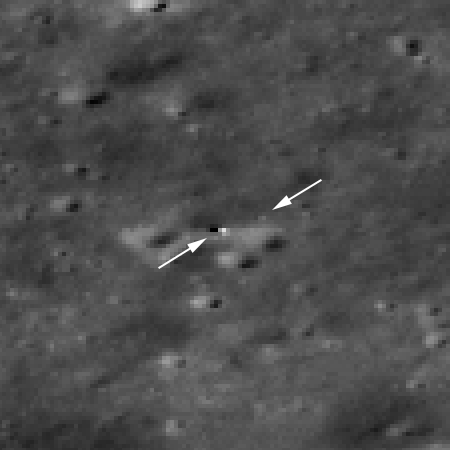
The Lunar Reconnaissance Orbiter (LRO) science team has now released a second and closer image of Chang’e-4’s location on the far side of the Moon, which now also shows the nearby rover Yutu-2.

The two arrows in the image to the right, cropped to post here, show both. The rover is the dot on the right, with the lander to the left, both just beyond the arrow tips. Both are very small, with Yutu-2 for example only two pixels across. Still, with both you can see their shadows, equally small, to the left of both bright dots. With sunlight coming from the right, all the craters, which are recessed, have their shadows on the right. The spacecraft, sticking up from the surface, have shadows going to the the left.

As Yutu-2 continues its travels, LRO will likely take more images, allowing us to track it even if the Chinese provide limited information.

1 comment

Chinese cubesat snaps picture of Earth and Moon from deep space

The Moon and Earth

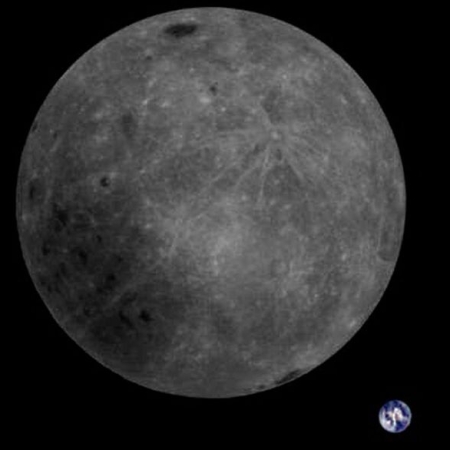
A interplanetary cubesat, Longjiang-2, launched with China’s communications relay satellite that they are using to communicate with Chang’e-4 and Yutu-2 on the far side of the Moon, has successfully taken a picture of both the Moon and Earth, as shown in the picture on the right.

Longjiang-2 is confirming what the MarCo cubesats proved from Mars, that cubesats can do interplanetary work.

And the picture is cool also. This was taken on February 3, when the entire face of the Moon’s far side is facing the Sun, illuminating it all. This timing also meant that the globe of the Earth would be entirely lit.

2 comments

LRO photographs Chang’e-4 on lunar surface

Chang'e-4 on the lunar surface

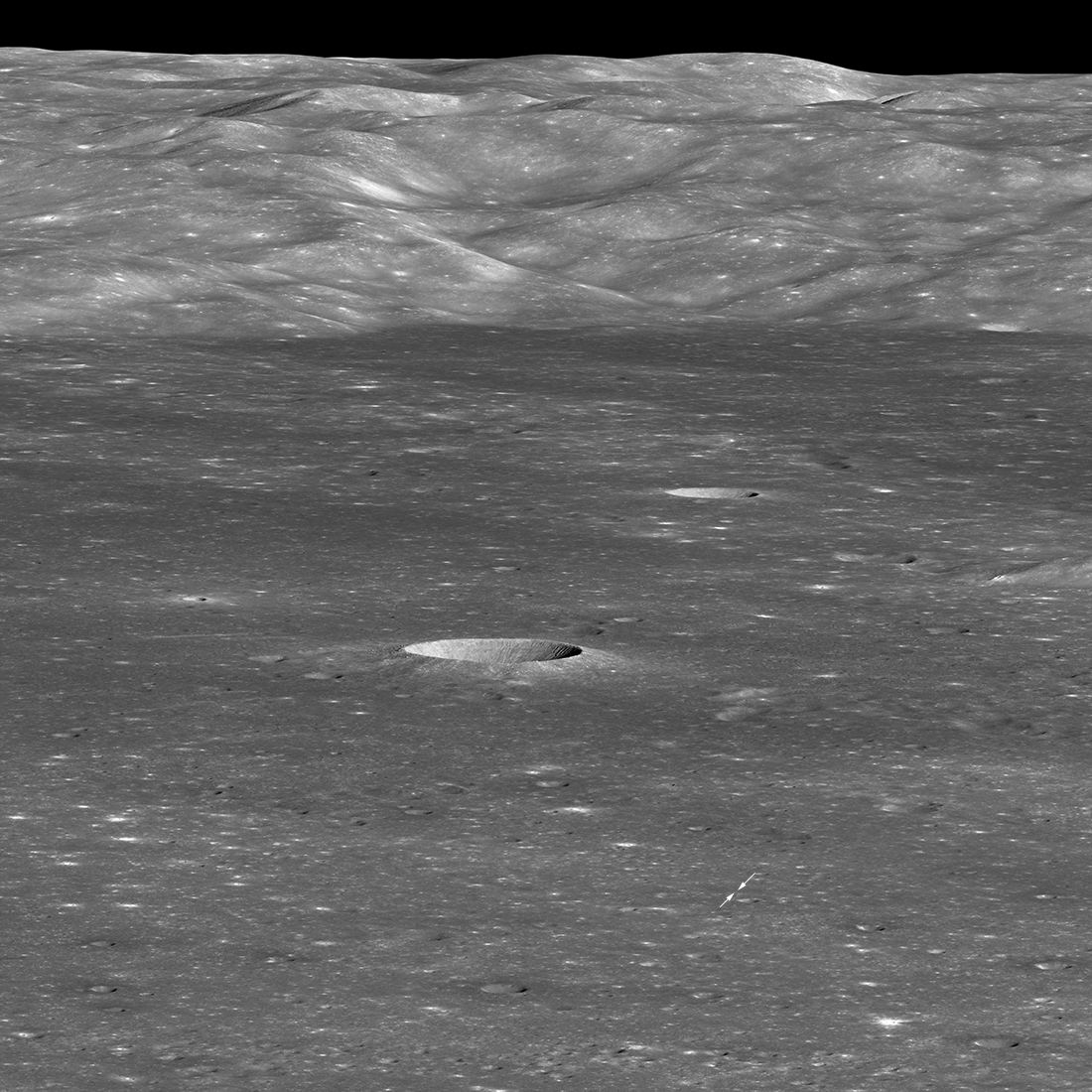
The Lunar Reconnaissance Orbiter (LRO) science team has released a spectacular oblique image that shows Chang’e-4 on the floor of Von Kármán crater.

Four weeks later (30 January 2019), as LRO approached the crater from the east, it rolled 70° to the west to snap this spectacular view looking across the floor towards the west wall. Because LRO was 330 kilometers (205 miles) to the east of the landing site, the Chang’e 4 lander is only about two pixels across (bright spot between the two arrows), and the small rover is not detectable. The massive mountain range in the background is the west wall of Von Kármán crater, rising more than 3000 meters (9850 feet) above the floor.

The image on the right has been reduced to post here. If you click on it you can see a larger version, but you need to download a very large file at the above link to see it at full resolution.

0 comments

China’s unsupervised radio antenna in Argentina

A Chinese invasion? A Chinese radio antenna in Argentina, initially proposed as a communications facility for use with China’s space program, operates without any supervision by the Argentinian government and appears to have military links.

Though U.S. government officials are pushing the idea that this facility is being used by China to eavesdrop on foreign satellites, and though China’s space program is without doubt a major arm of its military, I doubt the radio antenna is being put to military use. As the story notes

Tony Beasley, director of the U.S. National Radio Astronomy Observatory, said the station could, in theory, “listen” to other governments’ satellites, potentially picking up sensitive data. But that kind of listening could be done with far less sophisticated equipment. “Anyone can do that. I can do that with a dish in my back yard, basically,” Beasley said. “I don’t know that there’s anything particularly sinister or troubling about any part of China’s space radio network in Argentina.”

It was installed to support China’s effort to send spacecraft to the Moon and Mars, and that is likely its main purpose. China does not wish to be dependent on the U.S.’s Deep Space Network for such interplanetary communications. This facility helps make that independence possible.

At the same time, the fact that China has been allowed to establish a remote facility in another country and operate it with no oversight is definitely an issue of concern. Essentially, China has obtained control over a piece of Argentinian territory, and unless the Argentine government takes action, China can do whatever it wants there. While the antenna itself might not be an issue, the facility itself is.

0 comments

A close look at Russia’s Vostochny spaceport

Link here. The article provides an excellent overview of the spaceport, its history, its corruption. It also gives some detailed information how the spaceport is affecting the remote cities nearby. This quote however is telling:

Across the space faculty and university at large, signs are written in Russian and in Chinese. Exchange students from across the river flock here in droves, and students participate in countless scientific and engineering projects with Chinese students. It is a very clear reflection of growing talk among Russian leadership that the country’s future in space does not lay in cooperation with NASA and the West, but with the ascendant Chinese space program.

Indeed, in the halls of Amur State University, the rich history of U.S.-Russia space rivalry and cooperation has already been relegated to the various rooms set aside as little space history museums. Something for students to ponder and reflect upon as they go about planning presentations for their next student scientific congress with their Chinese peers. Caught between the pull of Vostochny and China, these students have discovered hope for a future of opportunity in space.

This makes sense. Russia’s aerospace industry is in trouble. Worse, any future dependence on NASA’s very dubious lunar Gateway project to save it is questionable. China however is closer, and has a thriving and very successful space program. It would make sense for Russia to switch its partnership from the U.S. to China. Whether China is interested remains an open question.

3 comments

China fails to reduce its methane coal mine emissions

Surprise, surprise! Using satellite data, a new study has now shown that China has not only failed to reduce its methane coal mine emissions, it has allowed those emissions to increase.

China, already the world’s leading emitter of human-caused greenhouse gases, continues to pump increasing amounts of climate-changing methane into the atmosphere despite tough new regulations on gas releases from its coal mines, a study shows.

China is the world’s largest producer and consumer of coal, which accounts for approximately 72 percent of the country’s electricity generation. While data show that coal production has increased in China, it has been unclear until now much methane gas, or CH4, has increased. Methane that is released during coal mining is responsible for the majority of coal-related CH4 emissions and is likely the largest human-caused CH4 source in China.

“Our study indicates that, at least in terms of methane emissions, China’s government is talking the talk, but has not been able to walk the walk,” says Scot Miller, an assistant professor of environmental health and engineering and of earth and planetary sciences at Johns Hopkins University.

The truth is that while China might say it has imposed “tough new regulations,” its commitment under the Paris climate accords actually allowed it to increase its emissions significantly for years to come, even as those same accords required the U.S. to decrease its emissions. This unfair situation, which China has apparently taking full advantage of, is one of the major reasons Trump dumped the accords. It also illustrates how little the Paris Accords had to do with climate change. Its real goal was to shift the balance of power and wealth from the U.S. to other countries.

8 comments

China aims for at least 30 launches in 2019

The new colonial movement: The China Aerospace Science and Technology Corporation (CASC), China’s main government agency supervising its space program, has revealed that they have at least 30 launches planned for 2019.

This number brings the known predicted launches for 2019 to about 125, which I think would be the most ever in a single year, since Sputnik. It definitely would be the most since the 1980s.

The article also has the following information about the problems and delays that have prevented a third Long March 5 rocket launch since its second launch failed in 2017.

A redesign has been carried out to the liquid oxygen and liquid hydrogen YF-77 engines, two of which power the Long March 5 first stage, to correct the turbopump issue reported to be behind the 2017 failure. The return-to-flight mission will carry the Shijian-20 communications satellite, or “Practice-20” in Chinese, based on a new, large DFH-5 satellite platform which supports satellites from 6,500 to 9,000 kilograms.

A successful launch would mean the fourth Long March 5 would then be used to launch the Chang’e-5 lunar sample return toward the moon in late 2019. The mission will aim to collect up to 2 kilograms of rocks and regolith from a site near Mons Rümker in Oceanus Procellarum on the lunar near side and bring the samples to Earth.

A nominal return-to-flight would also clear the way for the test launch of the Long March 5B, a variant of the Long March 5 designed specifically for lofting the 20-metric ton modules of the planned Chinese Space Station (CSS) into low Earth orbit. CASC official Shang Zhi told China’s state-run Xinhua news agency that joint tests and exercises involving a test model of the rocket and the CSS core module will be carried out at Wenchang at the end of 2019 in preparation for the maiden flight of the Long March 5B. Launch of the first CSS module is currently slated for 2020.

I wonder if we will ever see the Long March 5 version ever launch again after the 5B launches successfully. I suspect not, as it appears to me that the new variant is really a cover for the significant redesign required after the 2017 launch failure.

2 comments

Next Long March 5 launch delayed six months to July

The next launch of China’s largest rocket, the Long March 5, has now been delayed another six months until July.

The second Long March-5 rocket was launched from the Wenchang Space Launch Center in the southern province of Hainan on July 2, 2017, but a malfunction happened less than six minutes after its liftoff.

In October the Chinese had predicted this launch would occur in January, so this new schedule represents a six month delay. This further delay also confirms to me that their problem in 2017, which the Chinese have never fully explained other to say it caused damage to a turbopump in one first stage engine, resulted from a fundamental design flaw in the rocket’s first stage engines, requiring major reworking.

This delay also delays the launch of the first module of their space station, as well as their first sample return mission to the Moon.

0 comments

A detailed update on China’s numerous smallsat rocket companies

Link here. Based on this report, we should expect the first orbital launches from several of these Chinese smallsat rocket companies in 2019.

These numerous companies are ostensibly independent private companies who have raised Chinese investment capital. This is partly true. It is not the entire story however.

While the companies emerging in China’s nascent commercial launch sector are being backed by private funds, the firms are also apparently receiving significant support from the State Administration for Science, Technology and Industry for National Defense (SASTIND), a government body overseeing the country’s space activities.

A national military-civilian integration strategy is also crucial to the progress made, facilitating the transfer of required and sensitive technologies to the startups, as well as opportunities to share facilities and expertise. [emphasis mine]

Unlike Russia, China’s government might have decided here to embrace competition to encourage innovation, but we mustn’t forget that these companies only exist because the Chinese government allows them to exist. Everything that happens in China’s space industry is done with the approval of the government, for the government’s purposes. Once these companies succeed, the government will co-op them. I guarantee it.

0 comments
1 79 80 81 82 83 118