Update on Chang’e-4 plant experiments

Link here. It appears the plant experiment has now run its course, designed as it was to end before the arrival of the first lunar night.

The experiment’s chief designer, Xie Gengxin of Chongqing University, told Xinhua that life inside the canister would not survive the lander’s first lunar night, which started on Sunday. The moon’s nighttime period lasts for about two Earth weeks.

It also appears that though the plant experiment included potato, cotton, and oilseed rape, only the cotton seeds spouted. China has only released a limited amount of information about this research, so to get further details we will likely have to wait for the published papers.

6 comments

Seeds sprout on Chang’e-4

The new colonial movement: The cotten seeds in a plant experiment on Chang’e-4 have now sprouted, becoming the first biological life to grow on the Moon.

On Tuesday, Chinese state media said the cotton seeds had now grown buds. The ruling Communist Party’s official mouthpiece the People’s Daily tweeted an image of the sprouted seed, saying it marked “the completion of humankind’s first biological experiment on the Moon”.

Fred Watson, Australian Astronomical Observatory’s astronomer-at-large, told the BBC the development was “good news”. “It suggests that there might not be insurmountable problems for astronauts in future trying to grow their own crops on the moon in a controlled environment. …I think there’s certainly a great deal of interest in using the Moon as staging post, particularly for flights to Mars, because it’s relatively near the Earth,” Mr Watson said.

Prof Xie Gengxin, the experiment’s chief designer, was quoted as saying in the South China Morning Post: “We have given consideration to future survival in space. Learning about these plants’ growth in a low-gravity environment would allow us to lay the foundation for our future establishment of space base.” He said cotton could eventually be used for clothing while the potatoes could be a food source for astronauts and the rapeseed for oil.

This experiment is actually a very big deal, as it is the first biological experiment, ever, to take place in a low gravity environment. All previous plant experiments in space have taken place in zero gravity, and thus failed to tell us anything about growth in a partial Earth gravity environment.

That the seeds have sprouted only tells us that they can. What we don’t know yet is if the low lunar gravity distorts their growth.

4 comments

China completes first launch of 2019, followed by SpaceX

The new colonial movement: China yesterday successfully completed the first launch of 2019, sending a military communications satellite into orbit with its Long March 3B rocket.

It is my impression, from various sources, that China might not launch quite as many rockets in 2019 as it did in 2018. Like SpaceX in the past two years, it was clearing out a backlog of launches caused by the failed launch of their biggest rocket, Long March 5, in 2017.

Still, I expect an active year from China. It is going to be very interesting to watch the 2019 launch race unfold. SpaceX for example has just successfully launched ten Iridium satellites into orbit, the first launch from Vandenberg this year, successfully landing the first stage on a barge.

Right now the U.S. and China are tied in the 2019 launch race, 1-1.

1 comment

Want to see a panorama of Chang’e-4 landing site? You can!

If you want a really good look at the Chang’e-4 landing site on the far side of the Moon — with Yutu-2 about thirty feet away — photographer Andrew Bodrov has produced a spectacular 360 degree panorama from images sent down by the lander.

This panorama reveals two things. First, the lander landed close to two small craters, which it thankfully missed. Second, there are some hills in the distance which I suspect are central peaks of Von Kármán crater. They are probably beyond Yutu-2’s range, but would make a worthwhile exploratory target.

Meanwhile, the rover and lander have come back to life after a brief hibernation to protect them from the heat of the lunar mid-day.

Finally, China has released a video showing Chang’e-4’s descent and landing, which I have embedded below the fold. In it, you can see the spacecraft computer maneuver to land between those two craters shown in the panorama.
» Read more

1 comment

Chinese rocket company tests vertical landing

The new colonial movement: A Chinese rocket company has conducted its first vertical flight and landing tests of a prototype rocket.

Linkspace…has tested a tech demonstrator reusable rocket similar in utility to the Grasshopper rocket SpaceX used in its development of the Falcon 9 launch vehicle. The RLV-T5 technology demonstrator, also known as ‘NewLine Baby’, for vertical takeoff, vertical landing (VTVL) is designed to verify key technologies including variable thrust, multiple engine restarts and roll control with its flight and recovery tests, according to the press release (in Chinese).

The latest footage, released on Sunday, shows a tethered test which followed three months of preparations. The demonstrator is 8.1 metres high with a mass of 1.5 tonnes and uses five variable thrust engines. Linkspace now describes itself as the world’s third-largest recyclable rocket development team, after SpaceX and Blue Origin.

The article also describes an engine test by a different Chinese company. Both are being touted as part of China’s new private space effort, but I find myself somewhat skeptical. China might have given these companies some independent leeway, but in the end nothing they do is unsupervised by the Chinese government.

Regardless, they are making technical progress. It appears that Linkspace is aiming for a suborbital test flight later this year.

0 comments

Using LRO to find Chang’e-4

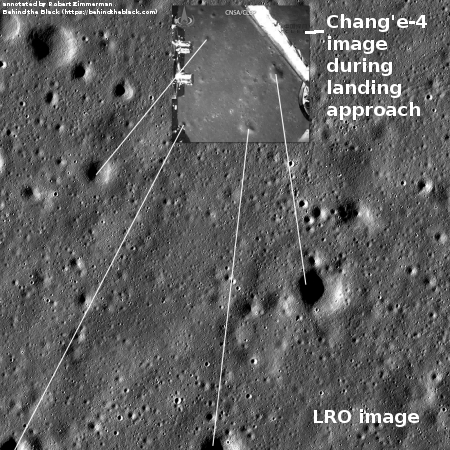
LRO image of Chang'e-4 landing area

The Lunar Reconnaissance Orbiter (LRO) science team has released a high resolution image from 2010 pinpointing the area on the floor of Von Kármán crater where Chang’e-4 landed. On the right is a reduced and partly annotated version.

They have not actually found the lander/rover, since this image was taken long ago before Chang’e-4 arrived. However, this image, combined with the Chang’e-4 landing approach image, tells us where the lander approximately landed. It also pinpoints where to look for it when LRO is next able to image this region, around the end of January.

By then, Yutu-2 will hopefully have traveled some distance from Chang’e-4, and LRO will be able to spot both on the surface.

0 comments

Yutu-2 has rolled out and has begun roving

The new colonial movement: China’s second lunar rover, Yutu-2, has rolled off of the Chang’e-4 lander and begun its roving.

Yutu will rove within Von Kármán craterand analyse the variations of composition of the lunar surface the Visible and Near-Infrared Imaging Spectrometer (VNIS), while also returning unprecedented images with a panchromatic camera.

The rover’s two offer science payloads, the Lunar Penetrating Radar (LPR) and Advanced Small Analyser for Neutrals (ASAN), the latter developed by the Swedish Institute of Space Physics in Kiruna, will provide insight into the lunar subsurface to a potential depths of hundreds of metres and the space environment and interactions with the surface respectively.

1 comment

Chang’e-4 successfully lands on far side of Moon

The new colonial movement: China’s Chang’e-4 lander/rover has successfully landed on far side of Moon.

Early reports of a successful landing sparked confusion after state-run media China Daily and CGTN deleted tweets celebrating the mission. China Daily’s tweet said: ‘“China’s Chang’e 4 landed on the moon’s far side, inaugurating a new chapter in mankind’s lunar exploration history.”

Official confirmation of the landing came two hours later via state broadcaster CCTV, which said the lunar explorer had touched down at 10.26am (2.26am GMT). The Communist party-owned Global Times also said the probe had “successfully made the first-ever soft landing” on the far side of the moon.

No reason has been given for the deletion of the tweets, though I suspect they did so because they were simply premature.

Update: More information here, including images.

11 comments

The 2018 global launch race plus predictions for 2019

In 2018 the global launch industry turned a significant corner. While there have been strong signs in 2016 and 2017 that we were about to see the arrival of a boom, it was not until this past year that we finally saw the beginnings of this boom.

Below is my updated launch graph showing what was accomplished in 2018. To put what was done in context, the graph shows all launches by every nation and private company for each year beginning in 1980, with 1968 added to provide a sense of what the launch industry was like during the height of the Cold War space race.

Before reading further, however, it is worthwhile to review what I wrote in my 2017 launch industry assessment, written in January 2018. My assessment then, as well as my predictions, provide some worthwhile context for understanding what actually happened this past year.
» Read more

11 comments

Engineers adjust Chang’e-4’s orbit

The new colonial movement: Engineers have adjusted Chang’e-4’s lunar orbit in preparation for landing.on the Moon’s far side.

The probe has entered an elliptical lunar orbit, with the perilune at about 15 km and the apolune at about 100 km, at 8:55 a.m. Beijing Time, said CNSA.

Since the Chang’e-4 entered the lunar orbit on Dec. 12, the ground control center in Beijing has trimmed the probe’s orbit twice and tested the communication link between the probe and the relay satellite Queqiao, or Magpie Bridge, which is operating in the halo orbit around the second Lagrangian (L2) point of the earth-moon system.

The space engineers also checked the imaging instruments and ranging detectors on the probe to prepare for the landing.

They need to time the landing so that it comes down in the Moon’s early morning. This will not only provide better visuals, with shadows to see surface details, but more importantly will give them 14 Earth days before sunset to get settled on the surface and initiate rover operations.

26 comments

China launches first of planned 320 communications satellite constellation

The new colonial movement: China today used its Long March 2D rocket to launch the first satellite in a proposed 320 satellite constellation designed to provide worldwide phone service.

The Hongyan constellation is composed of more than 320 satellites, along with data processing centers, and will be built in three stages. The orbital group will consist of 54 main satellites, accompanied by another 270 smaller satellites for coordination of the system.

Six or nine satellites will be launched before the end of 2020 for network testing. The 54 larger first phase satellites will be placed in orbit by the year 2023 and the 270 smaller satellites will be placed into orbits to supplement the main satellites.

Once completed, the satellite communication network will take the place of the ground-based network and allow a mobile phones to be connected everywhere on the planet, either in a remote desert or at sea, according to CASC. The project has drawn an investment of about 20 billion yuan (about 2.9 billion U.S. dollars) for its first phase, making it the largest investment for a single commercial aerospace program in China.

This constellation is essentially in direct competition with Iridium.

This is likely China’s last launch for 2018. It is also likely to be the last launch this year, since the ULA launch that had been planned for December 30 has now been pushed back a week. The leaders in the launch race:

38 China
21 SpaceX
15 Russia
11 Europe (Arianespace)
8 ULA

In the national rankings, China tops the U.S. 38 to 34. It also came only two launches short of meeting its ambitious goal of 40 launches in 2018, an achievement that pretty much doubled its previous launch record.

I am preparing my annual launch report. Stay tuned.

0 comments
1 80 81 82 83 84 118