
Radar data from the European satellite has been used to make a map of ocean circulation across the Arctic basin.
Radar data from the European satellite, Cryosat-2, has been used to map the ocean circulation across the Arctic basin.
Radar data from the European satellite, Cryosat-2, has been used to map the ocean circulation across the Arctic basin.
For the first time since October 10, and only the third time since August, the Earth-facing side of the Sun is blank, showing no sunspots. All told, 2010 has only been blank 13% of the time, for a total of 46 blank days, with only 12 days left in the year. These numbers contrast sharply with 2009, when the Sun was blank 71% of the time, or 260 out of 365 days.
It is very clear that the solar minimum is now over, and that the Sun ramping up to its next maximum. Blank days should soon cease (today might very well be the last for years), and the number of sunspots should continue to increase through approximately 2013, when astronomers now expect the maximum to peak.
It will be a weak maximum, however, likely accompanied with cold weather. At least, this has been the pattern for the last ten centuries, based on the best data that scientists have. When the Sun produces sunspots, the Sun gets hotter, and though that increase in radiation appears slight, it seems enough to warm the Earth’s climate. This is what appears to have happened around the year 1000, during what climate scientists call the Medieval Warm Period.
And when the Sun goes blank, or produces fewer sunspots, the Sun dims, and the Earth’s climate cools. This is what happened in the 1600s and 1700s, when the Little Ice Age gripped much of the Earth. It also happened in the first two decades of the 1800s, the last time the Sun produced as few sunspots as it is now, and when at least one year was called “the year without a summer”. Interestingly, that cold period at the beginning of the 1800s was also a period of intense volcanic activity, which threw a lot of dust and material into the atmosphere and thus helped contribute to the cooling of the Earth.
The last half of the 20th century, however, has not seen that much volcanic activity, which has made the atmosphere today clearer than any time in the past five decades. It has also been a time of increased solar activity, with most of the solar maximums peaking at generally higher numbers. No wonder scientists have detected evidence of a slight warming in the climate.
However, that warming appears to be ending, and it is doing so at the same time the Sun is going spotless. Though we don’t yet fully understand the mechanics of how these two events are linked, it behooves us to pay close attention. No climate prediction or computer model will mean anything if it does not.
Meanwhile, solar scientists remain unclear about the causes behind the solar cycle’s ebbs and flows. They have a reasonable idea that the cycle is caused by the Sun’s magnetic dynamo as it flips from one polarity to another. But why this happens is still subject to debate.
More importantly, it remains a complete unknown how long the next sunspot minimum will be. The Sun could spring back to life, as it did in the 1850s, producing lots of sunspots. Or sunspots might fade out for a few additional decades, as they did in the 1600s.
Sadly, based on the state of our science today, this is a question that probably no one will be able to answer — until we actually see it happen.
Two stories on the recent attempts of the EPA under the Obama administrions to create new climate regulations. First, a federal appeals court decided Friday not to block the new EPA climate regulations. Second, the war between Texas and the EPA over the EPA’s effort to regulate Texas industry continues unabated.
Eight observations from the Cancun climate conference. I like this quote the best:
“The enterprise is pompously and risibly dedicated in equal parts to wealth redistribution and self-perpetuation, as a platform for, and along the way, engaging in visceral anti-Americanism.”
Read the whole thing. Very entertaining, in a depressing sort of way.
“Elections have consequences.” EPA suddenly delays new rules governing industry emissions.
It appears the climate meeting in Cancun has ended without much success. Unable to get an renewal of the Kyoto Protocol, which expires in 2012, the diplomats instead agreed to create a $100 billion “Green Climate Fund” that is mostly funded by the First World nations but is mostly distributed by the Third World. See the notes at 10:45 am on this blog and at 12:20 am on this blog. Key quote:
[The fund] will have 25 members of developing countries on its board, compared to only 15 for developed countries. This gives developing countries a much stronger role. The World Bank is a trustee.
The real question is whether the new Congress in the U.S. will appropriate any money at all to this scam.
The Obama administration’s $30 billion cash pledge at last year’s climate summit is in doubt.
Not only do I think this is good, I continue to wonder how any administration (not just Obama’s) can make such a pledge in the first place, considering the fact that under our Constitution all such allocations must first be approved by Congress.
Want to follow the Cancun climate summit come to an end, for good or ill, on this its final day? Check out this blog.
NASA satellite sees an early meteorological winter in the American midwest.
I know this is weather, not climate, but according to the repeated claims of global warming scientists for the past decade, cold winters like this should no longer be happening. But they are, which means there must be holes in their science!
Two seemingly conflicting research papers, both focusing on how the formation of clouds might affect, or be affected by, global temperatures, actually end up combining to show that the world’s climate models can’t be trusted. In other words the basic science of predicting climate change remains seriously flawed.
At issue in both papers is how much and under what circumstances clouds help to warm or cool the planet. Do they reflect solar energy back into space or hold it within the atmosphere like a blanket – and by how much? The answer is crucial to determining where global temperatures will be heading in this century – and what if any policies the world’s governments should be adopting to deal with the situation.
The latest research, appearing this week in the journal Science, is the work of Andrew Dessler of Texas A&M University. In it he examines the weather-satellite databases covering atmospheric conditions over the past 10 years, looking for discernible patterns where changes in temperature have resulted in changes in cloud cover, or vice versa.
In particular, Dessler chooses El Niño and La Niña events in the Pacific Ocean. El Niño, which occurs every three to seven years, is accompanied by an enormous finger of warm water extending eastward along the tropical Pacific, all the way to South America and first appearing around year end. La Niña, which also erupts periodically, produces the opposite effect – a large zone of colder-than-normal water stretching across the Pacific. Both events tend to attract attention, because they usually generate severe weather affecting large areas of North and South America and elsewhere.
El Niño and La Niña are ideal subjects for climate researchers. They both develop quickly and produce, respectively, recognizable spikes and troughs in temperatures. For example, scientists studying the relationship of clouds to temperature can observe changes in cloud cover over the Pacific that precede, coincide with, and follow El Niño and La Niña and then use those changes to estimate how cloud cover affects or is affected by air temperature.
As Dessler describes in the Science paper, he did find evidence of what he calls a small positive feedback, meaning that clouds may prevent some solar heat from radiating into space, thereby warming the planet. He also doesn’t rule out the possibility of a small negative feedback, but says it probably isn’t large enough to overcome other factors contributing to warming.
But Dessler includes several assertions in his text that completely debunk the idea that climate science is “settled,” as asserted by former Vice President Al Gore and a host of others. For example, early on in the paper, Dessler acknowledges that “the most complex and least understood” of climate-feedback mechanisms is cloud feedback. And later on, he admits that “what we really want to determine is the cloud feedback in response to long-term climate change. Unfortunately, it may be decades before a direct measurement is possible.”
The earlier paper, published in the summer of 2010 in the Journal of Geophysical Research, by Roy Spencer and William Braswell of the University of Alabama at Huntsville, goes much farther in challenging the cloud-temperature link. The global warming community has tried for years to discredit Spencer’s work and to brand him as a “denier,” partly because for more than a decade he has produced findings that call into question the reliability of the host of earthbound instruments used to collect global temperature data.
Such accusations have been entirely unfair, because even Spencer, in his eminently readable and informative blog, has asserted from time to time that he isn’t sure whether the climate is changing and human activity is responsible. What gets him into trouble with the conventional wisdom is his emphasis on what’s wrong with current climate science and what remains unknown – and though it’s a short list, it’s formidable:
[Ed. Concerning the second and third quotes: Since water vapor in the atmosphere is by far the most powerful greenhouse gas, far more important than carbon dioxide, not understanding its detailed relationship with temperature means no model can do a reliable job of predicting the climate.]
In their paper Spencer and Braswell likewise look at the relationship between clouds and temperature. In an extremely detailed and – even to climate researchers – dense examination of the same satellite database, the two authors present an argument that separates the phenomenon of cloud formation from anything relating to temperature changes. As Spencer comments in his blog, regarding the feedback data, “even the experts in the field apparently did not understand them.”
But even interested lay readers can glean the gist of Spencer and Braswell’s findings simply by looking at the graphs they present, which contain jumbles of data points suggesting a complete disconnect between cloud formation and temperatures. This is a strong indication that we don’t know which is the cause and which is the effect, though most climate researchers assume temperature is the cause and clouds are the effect. At best, the researchers conclude, there’s evidence for a slight negative feedback – clouds causing cooling when temperatures rise – but overall there appears to be no link between the two phenomena over long periods.
“I cannot remember a climate issue of which I have ever been so certain,” as Spencer wrote about this finding on his blog.
The debate over the cloud-temperature link is bound to go on, but these two papers should make one thing clear: Until the connection between cloud formation and temperature is established or debunked once and for all, the models being used to predict future climate cannot be trusted. So perhaps when the new Congress looks at climate-related issues its members might want to consider them in this context.
The uncertainty of science! A top NASA scientist says that the models used by global warming scientists are far too gloomy, leaving out the cooling effects of increased plant production in a carbon dioxide rich atmosphere. Key quote:
It now appears, however, that the previous/current state of climate science may simply have been wrong and that there’s really no need to get in an immediate flap. If Bounoua and her colleagues are right, and CO2 levels keep on rising the way they have been lately (about 2 ppm each year), we can go a couple of centuries without any dangerous warming.
It ain’t about science: WikiLeaks cables confirm worst fears of climate skeptics.
Maybe I’ll be able to eat corn again instead of putting it in my car! Corn ethanol tax credits on the way out?
And these are the people who want to tinker with the climate: Cancun climate summit attendees eagerly sign petition to ban “dihydrogen monoxide,” which in plain language is nothing more than water!
This will make things chilly in Cancun: More than 1000 scientists dissent over man-made global warming claims.
“Gore effect” strikes Cancun Climate Conference 3 days in a row.
NOAA’s Space Weather Prediction Center today published its monthly update of the Sun’s developing sunspot cycle (see below). The graph shows the slow rise in sunspots (blue/black lines) in comparison with the consensis prediction made by the solar science community in May 2009 (red line).
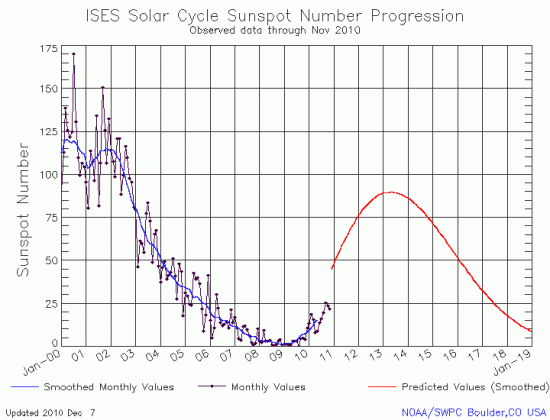
As I noted last month, the rise in sunspots as we ramp up to the next solar maximum has definitely slowed, which indicates clearly that we are heading towards the weakest solar maximum in more than two centuries. And as I have noted repeatedly on this website as well as on the John Batchelor Show, that means very cold weather!
A recent paper published in Hydrological Sciences Journal states that climate models used by IPCC cannot even predict known past climate patterns. Key quote:
It is claimed that GCMs [General Climate Models] provide credible quantitative estimates of future climate change, particularly at continental scales and above. Examining the local performance of the models at 55 points, we found that local projections do not correlate well with observed measurements. Furthermore, we found that the correlation at a large spatial scale, i.e. the contiguous USA, is worse than at the local scale. However, we think that the most important question is not whether GCMs can produce credible estimates of future climate, but whether climate is at all predictable in deterministic terms.
Cool news! India said Wednesday that future climate negotiations would be unlikely if the Kyoto protocol is not extended in some manner this week at the climate summit in Cancun.
What can we learn from 120 years of climate catastrophe reporting? We are all gonna die! Or to put it more clearly:
1: The mainstream media outlets are going to publish whatever sells. If someone publishes a story about the world getting colder and people buy it, you can be sure there will be many more stories touting the same headline.
2: There is a long lag between what nature is doing and what the media will report. The lag seems to be anywhere from 10 to 15 years after the climate changes. There is an inertia problem with the mainstream media even when the evidence is clear.
3: When all the stories are about warming or cooling, you can be sure they are all wrong.
When government agencies or United Nations Climate Change conferences warn you that the climate is changing you can be sure that is true — the climate is always changing. Determining the direction is the hard part. Based on the past reporting of these changes, be it from global cooling or warming, the trend will have reversed many years earlier than reported.
Incidentally there has been no global warming for a decade. Get a good grip on your long johns. Maybe a trip to Cancun is not such a bad idea after all, but I’ll wait until the delegates have gone home.