
The solar minimum and the Earth’s upper atmosphere
NASA scientists report, not surprisingly, that the Earth’s upper atmosphere experienced the largest contraction ever recorded during the recent very deep and prolonged solar minimum.
NASA scientists report, not surprisingly, that the Earth’s upper atmosphere experienced the largest contraction ever recorded during the recent very deep and prolonged solar minimum.
Still have doubts whether the climategate investigations were awhitewash? Then read this blistering condemnation by Clive Cook, senior editor at The Atlantic and a global warming advocate.
Steve Goddard has posted on Anthony Watt’s webpage a very detailed update on the state of the icecap covering Greenland. Surprise! There are no signs of it disappearing anytime soon. (Note that you might have to scroll to the right to see the text of Goddard’s post, as on some computers Watts’s webpage is unfortunately far too wide for the screen.)
On July 6, the National Snow and Ice Data Center (NSIDC) of the University of Colorado published its monthly report on the state of the polar ice caps. The Arctic ice cap, which this winter had been larger and more extensive than seen for many years, also shrank this spring at the fastest rate in years. (This chart, produced by data from the Japanese AMSR instruments on two research satellites, shows these trends very clearly.) Meanwhile, NSIDC reports that the ice cap in Antarctica is far larger than normal. Not unexpectedly, NSIDC immediately argues (quite unconvincingly if you ask me) that more ice in Antarctica is evidence for global warming.
From my perspective, the data continues to be inconclusive. We still do not really understand the long term trends of the Earth’s climate.
It appears that the chief investigator of the recently released climategate investigation of Phil Jones and the University of East Anglia never attended any of the investigation’s interviews of Phil Jones. What a strange way to do an investigation!
More questions are being raised about the various climategate investigations, this time in the UK Parliament. Key quote:
Climategate may finally be living up to its name. If you recall, it wasn’t the burglary or use of funding that led to the impeachment of Nixon, but the cover-up. Now, ominously, three inquiries into affair have raised more questions than there were before.
The University of East Anglia has been found in violation of the UK’s freedom of information law in connection with the climategate emails, suggesting again and strongly that the final conclusions of the investigation of Phil Jones was a whitewash.
On July 6 NOAA’s Space Weather Prediction Center published its monthly graph, showing the progress of the sun’s sunspot cycle in comparison with the consensis prediction made by the solar science community in May 2009.
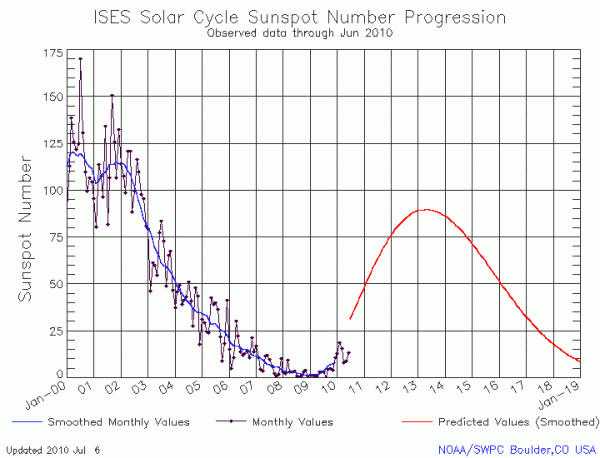
The graph shows clearly that, despite press-release-journalism stories like this, the sun remains in a very quiet state, with the number of sunspots far less than predicted by the red line on the graph. If these trends persist (as they have for the last three years), the next solar maximum will either be much later than expected or far weaker. In fact, the upcoming solar maximum might very well be the weakest seen in almost two centuries. Note also that the prediction shown on this graph is a significant revision downward from the science community’s earlier prediction from 2007.
Another climategate whitewash? The Netherlands Environmental Assessment Agency has reviewed the 2007 UN IPCC report and decided that, though the report did have some really embarrassing errors (including some new ones uncovered by the review), the IPCC’s conclusion — that global warming is happening and that it is caused by humans — must still be correct.