The levels of greenhouse gases in the atmosphere hit a new high in 2011.

The levels of greenhouse gases in the atmosphere hit a new high in 2011.

The atmospheric concentration of carbon dioxide (CO2) – the single most important greenhouse gas – reached 390.9 parts per million in 2011 and is now 40% above the pre-industrial level of 280 ppm, the WMO reports in its new Greenhouse Gas Bulletin released today. Methane (1,813 parts per billion) and nitrous oxide (324 parts per billion) β€” both potent greenhouse gases β€” also reached new highs last year.

Mysteriously, however, there has been no measured rise in the temperature of the climate for the past sixteen years, even though every computer model predicted that this increase in greenhouse gases would force a temperature rise.

The conclusion? I have none, other than to point out once again that climate science remains a difficult and complex area of research, filled with large gaps in knowledge and many questions and uncertainties that remain unanswered.

However, we will never get these questions answered if we make believe they don’t exist. It is essential that the climate science community stop pretending that they know what is going on while simultaneously playing politics with the science. Do the research, ask the right questions, and focus on what we don’t know. And tell the politicians to shut up and keep out, as they are surely the last people to understand the science of climate.

That way, we might finally begin to understand what is happening and can deal with it rationally.

3 comments

Scientists have found that the method used by the IPCC to measure droughts has significantly overestimated their number during the the past 60 years.

The uncertainty of science: Scientists have found that the method used by the IPCC to measure droughts has significantly overestimated their number during the the past 60 years.

Although previous studies have suggested that droughts have increased over that 60-year period, the team’s new analysis hints that the increase in drought has been substantially overestimated. For instance, the new assessment technique found that between 1980 and 2008, the global area stricken by drought grew by approximately 0.08% per yearβ€”less than one-seventh the increase estimated by the temperature-only [IPCC method].

The IPCC and the global warming activists that run it had claimed that the warming climate was causing more droughts. It turns out that claim was essentially false. The number of droughts has apparently not gone up. Note that this fact is actually not a surprise to those who have read the IPCC reports carefully. Deep down past their simplistic summaries, the reports have consistently pointed out that these conclusions were very uncertain and could be found to be wrong.

Not surprisingly, the article above spends a lot of time trying to rationalize this new data, quoting one scientist who insists there is nothing to see here, move on! The trouble is that there is plenty to see here. Our knowledge of the climate remains very incomplete.

0 comments

This is the first time since 1988 that climate hasn’t been mentioned in the presidential debate cycle

Good news: “This is the first time since 1988 that climate hasn’t been mentioned in the presidential debate cycle.”

When you try to sell government policy based on crisis, and that crisis doesn’t take place as predicted, and in fact is shown to be based on fraud and dishonesty, the sales job will eventually fail. Thus, better to forget the whole thing and make believe it never happened.

0 comments

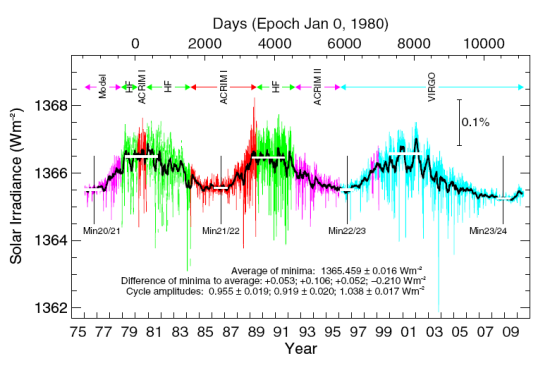
Kepler reveals our Sun might be more variable than we imagine

More exoplanet news: The problems of Kepler.

The article outlines the status — both good and bad — of Kepler in its hunt for Earthlike exoplanets.

I have already reported on Kepler’s failed reaction wheel. It no longer has a backup and needs every reaction wheel it has to keep it pointed in so precise a manner. Thus, the loss of one more wheel will shut the telescope down.

However, I had not been aware that the scientists now need more than twice as much time, eight years instead of three, to do their work, because they have discovered that sunlike stars are far more variable than expected. To quote the article,
» Read more

1 comment

“There is no statistical case to be made for a global temperature increase in the past 15 years.”

“There is no statistical case to be made for a global temperature increase in the past 15 years.”

The database is the one created by the Met Office in Great Britain. Also this:

None of these adjustments are, considering the errors of measurement, statistically significant, but they do affect the ranking of years, which is important if the associated errors are not considered, as is often the case in the media. The overall conclusion is that global temperature datasets are fluid and change from month to month, and this must be taken into account in any analysis. It would be nice to have explanations for such changes.[emphasis mine]

Because of the unexplained adjustments, 1998 is no longer the hottest year on record, a “fact” trumpeted loudly by global warming scientists for more than a decade.

2 comments

Polar bear fraud

The scientist famous for identifying drowning polar bears in the Arctic has been reprimanded for leaking emails and following “inappropriate” procurement procedures at his job at the Department of Interior.

The investigation also criticized the scientist, Charles Monnett, for fudging his data in reporting the death of the polar bears, a report that the global warming movement used extensively to falsely prove that global warming was causing the destruction of the polar bear population.

The Nature story above tries to make light of Monnett’s misconduct, especially in connection with his polar bear report as well as his work in awarding contracts. The report itself [pdf] is far more harsh.

In connection with Monnett’s contract work, it appears he actually helped one contractor write his proposal, then sat on the board that awarded the contract to that contractor.
» Read more

1 comment

James Hansen’s Goddard Institute of Space Studies has once again been caught changing its past climate temperature data without explanation.

James Hansen’s Goddard Institute of Space Studies has once again been caught changing its past climate temperature data without explanation.

Surprise of surprise, the change had the effect of making the long-term temperature record support conclusions of faster warming. The biggest changes were mostly pre-1963 temperatures; they were generally adjusted down. That would make the warming trend steeper, since post-1963 temperatures were adjusted slightly upward, on average. Generally, the older the data, the more adjustment.

Hat tip to reader jwing who alerted me to this story. As I commented to him, this “also is old news, to my mind, even though this is a new discovery of corruption. This kind of fraud has now been on-going for the past decade, with no signs of any effort to fix it. Worse, the climate science field even denies that it has a problem. Thus, I don’t trust anything they tell me. I check everything twice, and then have doubts besides. Which is why I remain entirely skeptical of any claims these climate scientists make.”

And in this case, the climate scientist in question is James Hansen.

9 comments
1 48 49 50 51 52 84