The Winds of Mars

changing martian dunes
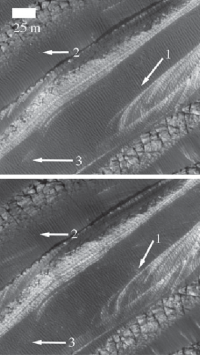
Images taken 1363 days apart.

In two different papers published in two different journals in the past month, scientists have concluded that — despite the thinness of the planet’s atmosphere — the dunes and sands of Mars are being continually shaped and changed by its winds. In both papers the data from which this conclusion was drawn came from high resolution images taken by the HiRISE camera on Mars Reconnaissance Orbiter.

What is especially interesting about this conclusion is that the climate models that had been developed for the Martian atmosphere, combined with wind measurements gathered by the various Martian landers, had all suggested that the kind of strong winds necessary to move sand were rare. To quote the abstract of the paper published on Monday in the journal Geology, Bridges, et al,

Prior to Mars Reconnaissance Orbiter data, images of Mars showed no direct evidence for dune and ripple motion. This was consistent with climate models and lander measurements indicating that winds of sufficient intensity to mobilize sand were rare in the low-density atmosphere.

Similarly, the second paper, Silvestro, et al, published on October 22 in Geophysical Research Letters, stated that

results from wind tunnel simulations and atmospheric models show that such strong wind events should be rare in the current Martian atmospheric setting.

Yet, both studies found significant evidence that such winds do occur on Mars, and are moving sand in many different places.
» Read more

1 comment

A fired up Sun

As it does every month, NOAA’s Space Weather Prediction Center today released its monthly update showing the ongoing changes of the Sun’s solar cycle sunspot activity. I have posted the graph below the fold.

For the fourth month in a row the Sun’s sunspot activity has leaped upward. In fact, for the first time since I have been tracking sunspot activity, beginning in 2008, the Sun’s sunspot activity exceeds the predicted activity by a significant amount. Since the end of the previous maximum, the Sun had consistently failed to meet the expectations of solar scientists by producing far fewer sunspots than expected.

In the past few months, however, the Sun has recovered, its activity firing upward, including some of the most active and largest sunspots in years.
» Read more

1 comment

The global output of atmospheric carbon dioxide jumped in 2010 by the biggest amount on record, according to the U.S. Department of Energy

The global output of atmospheric carbon dioxide jumped in 2010 by the biggest amount on record, according to the U.S. Department of Energy.

In 2007 when the Intergovernmental Panel on Climate Change issued its last large report on global warming, it used different scenarios for carbon dioxide pollution and said the rate of warming would be based on the rate of pollution. Boden said the latest figures put global emissions higher than the worst case projections from the climate panel.

And yet, the global temperatures are not rising, as also predicted by those same IPCC models.

4 comments

The long minimum continues

Though it has been very clear for the past few months that the sun has finally transitioned from solar minimum and begun its ramp up to solar maximum, that ramp up has also been very slow and wimpy.

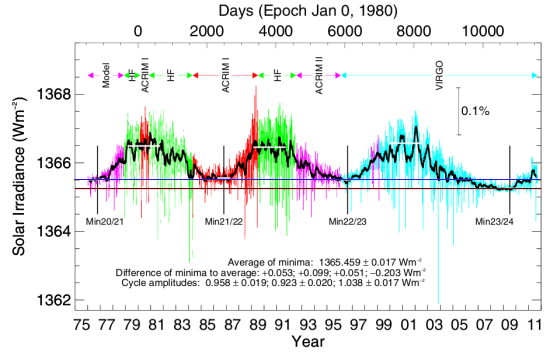
On October 9, 2011 the scientists at Physikalisch- Meteorologisches Observatorium Davos (PMOD) posted an updated summary of the satellite data that has been carefully measuring the variation of the sun’s total solar irradiance since 1978. The graph below, which can be found here [pdf], brings that data up through the present. (I had posted the previous update about a year ago.)

Total solar irradiance

I have added a brown line to illustrate how deep the recently ended solar minimum was, compared to previous minimums. Note also that this most recent minimum would also be far below the minimum prior to 1975. I have also added a blue line to show that the sun has only very recently finally brightened enough to finally exceed the previous minimum. All told, the sun remained dimmer than the previous minimum for over five years!
» Read more

2 comments

Another global warming scientist is accused of hiding the decline

The lead scientist in a recent climate study has been accused of hiding the fact that the global temperature has been flat for more than a dozen years.

The new study, led by Richard Muller, had taken raw land data and re-analyzed it in an attempt to clear up the doubts caused by the climategate scandal. In an announcement last week, Muller claimed that their work had proven that the climate had been warming continuously since 1950.

Now, another climate scientist, Judith Curry, has accused Muller of failing to point out that his same re-analysis had also shown that climate temperatures have been totally flat for the past 13 years, even as carbon dioxide levels in the atmosphere continue to rise. As Curry told the Daily Mail, “This is nowhere near what the climate models were predicting. Whatever it is that’s going on here, it doesn’t look like it’s being dominated by CO2.”

Curry is also accusing Muller of going to the press to spin the results in favor of global warming, before the research was complete.
» Read more

0 comments

An independent study of climate suggests the climate has warmed 0.9 degrees Celsius since 1950

An independent study of land temperature records by a team led by Richard Muller concludes that the climate has warmed 0.9 degrees Celsius since 1950.

Does this prove that human-caused global warming is happening? No, not even close. The study has not yet been peer-reviewed, and others have not yet been able to duplicate its results. Also, a warming trending since 1950 can be caused many things, and it is only a very short snapshot of a vastly longer movie.

Nonetheless, it does appear that real science (open data, honest analysis, and a willingness to entertain opposing viewpoints) is beginning to return to the field of climate research. For this we should celebrate.

0 comments

A UN report says that nearly one billion people are hungry because of biofuels such as ethanol from corn

A UN report this week says that nearly one billion people are hungry, partly because of biofuels such as ethanol from corn.

The findings are echoed in a report published today by the International Food Policy Research Institute (IFPRI), based in Washington DC. Maximo Torero, one of the report’s authors, says policymakers must “curtail biofuels subsidies” and “discourage the use of food crops in biofuel production” to limit food price volatility.

4 comments
1 61 62 63 64 65 84