
Smarter Every Day – Mind-Blowing Magic Magnets
An evening pause: Rather than post an April Fool’s prank today, why don’t we see some modern magical engineering that even engineers can’t figure out.
Hat tip Tom Biggar.
An evening pause: Rather than post an April Fool’s prank today, why don’t we see some modern magical engineering that even engineers can’t figure out.
Hat tip Tom Biggar.
Even though SpaceX’s first demonstration manned mission to ISS has not yet occurred, NASA yesterday announced the selection of the full four person crew for the second flight, set for later this year and intended as the first operational mission to ISS, lasting six months.
This announcement tells us several things, all good. First, it appears NASA has now definitely decided that the demo mission, presently scheduled for mid-May, will be a short-term mission. They had considered making it a six-month mission, but it now appears they have concluded doing so will delay the demo launch too much.
Second, that NASA is solidifying its plans for that operational flight, the second for Dragon, including a tentative launch date later in 2020, is further evidence that they intend to go through with the demo mission in mid-May.
Finally, it appears that NASA has decided that it will not buy more seats on Russian Soyuz capsules, something that they had previously hinted they needed to do because the agency was worried the American capsules would not be ready this year. The article describes the negotiations on-going with the Russians about the use of Dragon, as well as the future use by Americans of Soyuz. NASA wishes to have astronauts from both countries fly on both spacecraft (Starliner too, once operational), but Russia is as yet reluctant to fly its astronauts on Dragon. They want to see that spacecraft complete more missions successfully.
Regardless, future flights of Americans on Soyuz will cost NASA nothing, as the agency wishes to trade the seats on the U.S. capsules one-for-one for the seats on Soyuz. It also means that NASA has decided it doesn’t need to buy Soyuz flights anymore, as it now expects Dragon to become operational this year.
Capitalism in space: According to a new industry report, 2019 was one of the strongest in years for the entire commercial space industry.
More than 183,000 workers were employed in the U.S. space workforce at the end of 2019, according to the U.S. Bureau of Labor Statistics. Core employment, those jobs most closely aligned with the space industry and not the larger aerospace industry, rose to 141,520 jobs in 2019. This represents a 4.1% increase from the 135,930 private sector workers in 2018 and marks the third year in a row of increasing employment in this workforce and the highest level since 2012.
Some sectors saw significant gains in employment over the last five years. Together, the workforce supporting manufacturing of space vehicles, space vehicle propulsion units, and other space vehicle parts grew by nearly 20% over the past five years, adding more than 14,000 new employees. Other sectors experienced decline. Broadcast and wireless communications equipment manufacturing employment decreased 9.8% over the past five years, shedding more than 5,000 workers.
The report also noted that the COVID-19 panic will likely cause a major negative impact to the industry in 2020, hurting the smaller companies the most.
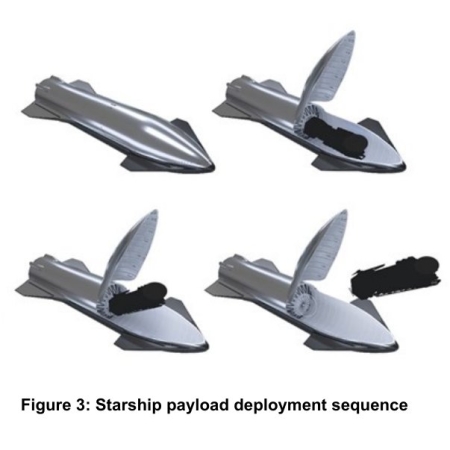
Capitalism in space: Even as SpaceX has begun preparing its third Starship prototype for new testing, it has also released a first user manual for the rocket, outlining its proposed capabilities and potential uses by customers.
From the first link:
The next round of testing is anticipated to begin this week with cryogenic proof testing. These tests will see the vehicle filled with liquid nitrogen at cryogenic temperatures and flight pressures. Prior Starship test vehicles have had their campaigns cut short by failed cryogenic testing, including the last flight vehicle SpaceX rolled to the Boca Chica launch pad, Starship SN1.
If all goes right, they hope to begin short flight tests with this prototype, moving to longer and higher flights with the next.
The user manual [pdf] is mostly a short description of what they hope they will be able to accomplish with Starship. It notes that they will build both a cargo and manned variety, and that both will be available for point-to-point transportation on Earth. It also notes:
Starship has the capability to transport satellites, payloads, crew, and cargo to a variety of orbits and
Earth, Lunar, or Martian landing sites. Potential Starship customers can use this guide as a resource for preliminary payload accommodations information.This is the initial release of the Starship Users Guide and it will be updated frequently in response to customer feedback.
I guarantee that much of what is written and drawn here, such as the illustration above, will change significantly as development proceeds.
An evening pause: Hat tip Diane Zimmerman.
Capitalsm in space: Stratolaunch announced today that they are now planning to build a reusable hypersonic test vehicle to launch from their giant Roc airplane.
That vehicle, powered by a liquid-propellant rocket engine, will launch from the company’s aircraft and fly to speeds of Mach 5 to Mach 7 before gliding back to a runway landing. It will also be able to take off on its own from a runway under rocket power.
“The Stratolaunch Talon-A is a flexible, high-speed testbed built for offensive hypersonics, hypersonic defense and hypersonic R&D,” the company said in a fact sheet about the program. That document emphasizes the vehicle’s ability to provide “here-to-fore unobtainable measurement access to the hypersonic flight environment on a recurring basis.”
Forgive me if I remain skeptical. From memory I think this is about the fifth different design or concept for launch from Roc, with the previous proposals differing from this hypersonic test vehicle in that they were all intended to go to orbit. All were the same however in that they were trying to find a design that could be launched from Roc and also make engineering and economic sense. So far none has done so.
This new proposal is clearly aimed at garnering government research dollars. It also probably wants those dollars to pay for Talon-A’s development. In a sane world, the military would tell Stratolaunch to build and prove Talon-A’s capabilities first, before signing on.
When it comes to government spending, however, we however are no longer in a sane world.
An evening pause: The lyrics speak a truth that more people should follow.
Hat tip Cotour.
Capitalism in space: OneWeb yesterday made official the rumors from the past week by filing for bankruptcy in the United States.
It appears that those rumors were essentially true, that one of the company’s biggest investors, Softbank, was having financial trouble due to the stock market crash caused by the Wuhan flu panic, and was not able to continue its investment in OneWeb. The result was that OneWeb could not pay its creditors, the biggest of which was Arianespace, which was managing the launch of most of the company’s satellites, using Russian Soyuz rockets from either French Guiana or Kazakhstan.
With about 18% of its constellation already in orbit and the rest pretty much ready for launch this year, the company has valuable assets that in bankruptcy will have value. It will likely be sold and continue operations under new management.
In the meantime this filing will hurt the bottom line of Arianespace and Russia.
Capitalism in space: Should NASA ever decide to build its proposed Gateway space station in orbit around the Moon (the odds of which have gone down recently), it announced today that it has signed a deal with SpaceX to use its Falcon Heavy rocket and an upgraded larger version of its Dragon capsule to ship cargo to that station.
The deal calls for at least two missions, and is SpaceX’s first deal in NASA’s Artemis program.
This deal is a major blow to SLS and Boeing, which up to now had a monopoly on all launches to supply and launch Gateway. In fact, Gateway was invented by Lockheed Martin, Boeing, and NASA (not Congress) in order to justify SLS’s existence. That NASA has now decided it is better off using the much cheaper and already operational Falcon Heavy for some Gateway missions suggests that SLS is increasingly vulnerable to cancellation. NASA is making it obvious that other commercial options exist. No need to wait years and spend billions for SLS, when they can go now, for much less.
An evening pause: He admits to doing some audio manipulation to his voice to get it to sound as it does, but no matter, it sounds really good.
Hat tip Cotour.
Capitalism in space: United Launch Alliance’s Atlas 5 rocket today successfully placed into orbit the first military satellite officially under the U.S. Space Force’s command.
The satellite is the fifth of a constellation designed to provide communications for all military operations.
The leaders in the 2020 launch race:
6 China
5 SpaceX
4 Russia
2 Europe (Arianespace)
2 ULA
The U.S. now leads China 9 to 6 in the national rankings.
Because of travel restrictions imposed by the worldwide panic over the COVID-19 virus, Argentina’s space agency has postponed the planned March 30, 2020 launch by SpaceX of an Earth observation radar satellite.
“This decision (to postpone the launch) has been made considering the restrictions imposed by the COVID-19 pandemic and that could affect the availability of own resources and foreign third-party resources, necessary not only for a safe insertion into orbit, but also for further operation of the satellite,” CONAE said in a statement.
CONAE said the decision to postpone the launch, which was made in consultation with SpaceX, is the “best decision in these moments of uncertainty … that the whole world suffers because of COVID-19.”
Argentina has halted all flights to and from the United States, impacting the ability of Argentine personnel needed to support the planned launch to travel to the Florida spaceport.
The more I research the Wuhan flu, the more I am convinced that the world’s governments have gone crazy. More on this later today.
Because of the failure of the equipment unrelated to the parachutes, the helicopter pilot for a drop test of SpaceX’s crew Dragon parachutes on March 24, 2020 was forced to release the dummy capsule early, causing its loss.
“During a planned parachute drop test today, the test article suspended underneath the helicopter became unstable,” SpaceX said Tuesday in an emailed statement. “Out of an abundance of caution and to keep the helicopter crew safe, the pilot pulled the emergency release,” the statement added. “As the helicopter was not yet at target conditions, the test article was not armed, and as such, the parachute system did not initiate the parachute deployment sequence. While the test article was lost, this was not a failure of the parachute system, and most importantly, no one was injured. NASA and SpaceX are working together to determine the testing plan going forward in advance of Crew Dragon’s second demonstration mission.”
This issue, combined with the loss of a Falcon 9 first stage (on its fifth flight) during re-entry, because one engine failed to function properly, is making some news sources suggest that NASA will delay the planned May launch of Dragon’s first manned mission to ISS.
If NASA demands a delay of that May manned mission because of these two issues, it will demonstrate how truly insane our society has become. While the issue prevented the drop test, it involved the equipment that suspended the dummy capsule below the helicopter, not the parachute system. Furthermore, this test was one of the very last tests of the parachute system, following a test campaign during the past few months that has worked repeatedly on numerous tests.
As for the first stage loss, do I have to repeat again that it occurred on the stage’s fifth reuse, and after it had successfully launched its payload into orbit? SpaceX will be using a new first stage for the manned mission, and they have experienced no failures on a new first stage like this for literally years.
In a sane society, NASA would look at the overall context, and put aside these issues as irrelevant to their launch schedule. They, and SpaceX, will want to figure out what happened, but they should insist on proceeding on schedule for the May launch.
We are no longer sane however. I will not be surprised if they announce a further launch delay.
An evening pause: Hat tip Mike Nelson.
Capitalism in space: NASA is now in the process of shifting from building its own communications satellites to communicate with ISS as well as many other Earth-orbiting NASA satellites to buying those services from the private sector, much as the agency has done with is cargo and crew ferrying service to the station.
This involves ground stations as well as upgrading its fleet of geosynchronous NASA-built TDRS satellites.
In addition, NASA is seeking industry assistance in replacing the Space Network, which provides communications for more than 40 missions including the International Space Station through government-owned Tracking and Data Relay Satellites (TDRS) and associated ground stations. “While the TDRS System is a fine investment that the government has made, for the future we are looking at commercial alternatives,” said Ted Sobchak, NASA Space Network project manager.
NASA plans a multistep campaign to encourage development of commercial space-based relay networks before the current TDRS spacecraft reach the end of their lives. “Based on past spacecraft performance, the newest generation of TDRS will remain operational well into the 2030s,” Younes said.
The original TDRS constellation of satellites, launched from 1983 to 1995, were actually built for a reasonable cost. At the time NASA did not try to put every bell and whistle on them, but focused instead on their basic mission and getting it launched for a reasonable cost. The management at NASA today almost certainly could not do this. Getting new satellites from competitive private companies will therefore save NASA money, and get the job done faster.
An evening pause: For those people hiding under their beds.
Hat tip Tom Biggar.
Capitalsm in space: Astra Space, attempting again to complete its first orbital launch, suffered what they call “an anomaly” during a launch dress rehearsal countdown yesterday.
The “anomaly,” of which we presently have no description other than it has cancelled their launch attempt later this week and that no one was hurt, apparently was serious enough that they noted that the launch site is “still hazardous and should be avoided.”
The company has said that it expected it would take three launches before they succeeded in getting into orbit, so this failure probably does not worry them overally. At the same time, I suspect that expectation was for actual launches, not explosions during the countdown.
Bigelow Aerospace, builder of commercial space stations, has laid off its entire workforce, stating this was due to the lockdown by Nevada’s state government due to the Wuhan flu.
According to sources familiar with the company’s activities, Bigelow Aerospace’s 68 employees were informed that they were being laid off, effective immediately. An additional 20 employees were laid off the previous week.
Those sources said that the company, based in North Las Vegas, Nevada, was halting operations because of what one person described as a “perfect storm of problems” that included the coronavirus pandemic. On March 20, Nevada Gov. Steve Sisolak signed an emergency directive ordering all “nonessential” businesses to close.
A company spokesperson confirmed March 23 that the company laid off all its employees because of the governor’s order, and that it faced “fines, penalties and threats of having our business license revoked” if it remained open. The spokesperson added that the company planned to hire workers back once the emergency directive was lifted, although other sources interpreted the layoffs as a permanent measure.
Considering how Bigelow has allowed other commercial space station companies, such as Axiom, to move ahead of it, this decision is not surprising. The panic over COVID-19 only pushed it along.
Whether Bigelow as a company returns once the coronavirus panic subsides however remains an open question.
An evening pause: Performed live in 2011. Somehow this seems appropriate at the moment.
Hat tip Diane Zimmerman.
Capitalsm in space: After aborting its first orbital launch attempt at T-53 seconds, Astra has announced that it will to try its first orbital launch again this week.
They have not revealed the payload. They also admit that they will not be surprised if they fail to reach orbit, as they already assume it will take about three launches to iron out their rocket and systems.
Regardless, if they succeed, they will become the second company, after Rocket Lab, to successfully enter the smallsat market.
No word on whether they will live-stream the launch.