
Pete Townshend – Let My Love Open The Door
An evening pause: Hat tip Edward Thelen.
An evening pause: Hat tip Edward Thelen.
The competition heats up: ULA and SpaceX will likely face-off for the right to launch the Air Force’s next GPS satellite.
SpaceX won the last GPS launch with an unopposed bid of $83 million. ULA has said that their average price for an Air Force launch under the EELV program has been $225 million. I suspect that their bid here will be significantly less than that.
The competition heats up: Moon Express, one of the leading private competitors in the Google Lunar X-Prize, has gotten FAA approval for its planned 2017 Moon landing.
It is looking like 2017-2018 will be very exciting years for private space. We will not only see the first launches of privately-built manned spacecraft, we will see the first privately-built and -funded missions to both the Moon and Mars.
The competition heats up: The smallsat rocket company Vector Space Systems successfully completed its first suborbital test launch on July 30 as part of the signing of a new contract for 21 launches.
This company is moving quickly. In April they obtained financing, In July they revealed their launch schedule, with the first launch set for 2018. Mere weeks later, they complete their first test flight and announce a major launch contract.
An evening pause: Performed live, on a houseboat in Sausalito, California.
Hat tip Frank Kelly.
In the heat of competition: Boeing is working to correct two serious design problems that cropped up during the construction of its Starliner manned capsule.
First the thing was weighing too much:
One issue involved the mass of the crew capsule, which outgrew the lift capability of the United Launch Alliance Atlas 5 rocket selected to put it into orbit. The CST-100 Starliner will ride an Atlas 5 rocket with two solid rocket boosters and a dual-engine Centaur upper stage, and although Boeing and ULA engineers considered adding a third strap-on motor to compensate for the capsule’s extra weight, managers now have the spacecraft back under its mass allowance, Ferguson said.
Second, the capsule has a shape problem:
Ferguson said Boeing has a model of the Atlas 5 rocket and CST-100 Starliner in a wind tunnel to verify a change to capsule’s outer shape devised to overcome higher-than-expected aerodynamic launch loads discovered in testing. “They had one issue, a non-linear aerodynamic loads issue, where they were getting some high acoustic loads right behind the spacecraft,” said Phil McAlister, head of NASA’s commercial spaceflight development office in Washington.
Something here is rotten. It seems to me that Boeing shouldn’t be having these very basic problems right off the bat. In the past, under the older cost-plus contracts NASA used to routinely hand out, these kinds of problems would simply have meant that Boeing would have gotten more money from NASA, This time, however the contract is fixed-price. If Boeing has problems or delays, the company will have to bear the cost, not NASA. I suspect these problems might have occurred because of some cultural laziness at Boeing. Their management is used to not having to eat the cost of these kinds of mistakes. Now, they will. I expect the culture to therefore begin changing.
A fire broke out in a battery room at SpaceX’s California facility yesterday, injuring no one.
Though the article suggests the fire was not significant, it is also gives no details.
An evening pause: From the Andrew Lloyd Weber musical, Song & Dance. Performed live in London in 1998.
Hat tip Edward Thelen.
My heart be still: Virgin Galactic has done its first taxi test of its new SpaceShipTwo, named Unity.
They have also received from the FAA a permit to do the spacecraft’s first flight tests this fall.
The competition heats up: Russia has signed its first international contract for its new still-underdevelopment Angara rocket.
Leading Russian rocket developer, GKNPTs Khrunichev, signed up the first foreign commercial passenger for the light version of its new-generation Angara rocket. The South-Korean Kompsat-6 remote-sensing satellite (a.k.a. Arirang) was booked for a ride on the Angara-1.2 launch vehicle from Plesetsk around 2020. Equipped with a Synthetic Aperture Radar, SAR, the 1.7 ton spacecraft should be inserted into the Sun-synchronous orbit.
More here.
An evening pause: At different performance of this song on youtube, Sheeran tells the audience that for this song to work “we’ve all got to be very very very quiet.” I agree. Take the time to listen quietly.
Hat tip Chris McLaughlin.
The competition heats up: In preparing its Dream Chaser engineering test vehicle for glide tests in California this fall, Sierra Nevada unveiled it to the press yesterday.
This is essentially the test vehicle’s first public viewing since its one glide test, when the front landing gear did not deploy correctly and the vehicle was damaged during landing. Since the landing gears were not the gears being developed for the flight craft, and since the glide test itself went well, both the company and NASA considered that glide test to be a success.
It has now been refurbished for new tests in conjunction with the company’s contract to use Dream Chaser as a cargo ship for NASA.
The competition heats up: SpaceX has completed a full duration test firing of one of its recovered first stages.
The JCSAT-14 stage [which was the third recovered stage and the second to land on a barge] isn’t expected to fly again due to the initial evaluations into damage received via its high-velocity return. However, it will still provide useful test data. “Most recent rocket took max damage, due to very high entry velocity,” noted Elon Musk. “Will be our life leader for ground tests to confirm others are good.”
That testing on the JCSAT-14 booster began on Thursday, with the stage placed on the test stand at McGregor – ironically after the stand was vacated by the JCSAT-16 first stage – which recently completed testing and has since been shipped to Florida for its launch next month. The returned stage is also sported a new cap, which may be providing some simulated weight to aid the required data gathering during the test firing.
The booster conducted a long firing of 2 minutes 30 seconds (the duration of first stage flight), that began around 7pm local time on Thursday (per L2 McGregor), which will provide vital data on the returned stage as SpaceX continue preparations for validating one of its recovered booster for a re-launch later this year.
It is once again important to point out that SpaceX’s engineers here have an enormous advantage over every other rocket engineer who has ever lived. They have in hand a recovered first stage that was actually used to launch a satellite into orbit, giving them the ability to test it and find out precisely how such equipment fares during launch. This will give them the ability, unavailable to others, to make engineering improvements that will make future first stages even more reliable and reusable.
An evening pause: This appears to a rehearsal for the 1973 BBC show, A Little Touch of Schmilsson, with Frank Sinatra’s arranger Gordon Jenkins.
Hat tip Edward Thelen.
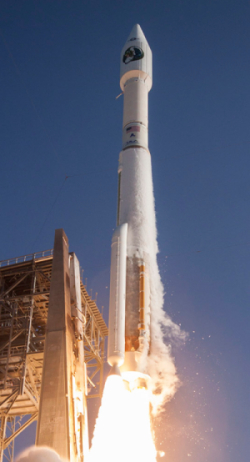
The competition heats up: A ULA Atlas 5 rocket today successfully launched a National Reconnaissance Office (NRO) surveillance satellite, dubbed NROL-61.
The image on the right is courtesy of Orbital ATK. From the link above:
NROL-61, however, launched atop an Atlas V 421 rocket, a configuration that has not previously been used by the NRO. The spacecraft itself was encapsulated within an Extra-Extended Payload Fairing (XEPF) – at 14 metres (46 feet) in length the longest of three available four-metre (13-foot) diameter fairings – which has also never before been used for an NRO mission.
…The most likely explanation is that NROL-61 will be the first in a new generation of Quasar satellite; which would appear to be larger in both size and mass than its predecessors. Quasar, also known as the Satellite Data System, or SDS, is a constellation of communications satellites operated by the NRO to support its other intelligence-gathering activities; relaying data from other satellites to the ground in real-time, without having to wait for the intelligence-gathering satellites to pass over ground stations on friendly territory. If NROL-61 represents a new version of Quasar, it will be the fourth generation of the constellation.
At a meeting of NASA’s Advisory Council yesterday a NASA official estimated that SpaceX will probably spend about $300 million on its Dragon mission to Mars.
Asked by the committee how much SpaceX was spending, Reuter indicated that the company’s investment was 10 times that of NASA. “They did talk to us about a 10-to-1 arrangement in terms of cost: theirs 10, ours 1,” he said. “I think that’s in the ballpark.” Given NASA’s investment, that implies SpaceX is spending around $300 million on Red Dragon.
SpaceX has not disclosed its estimated cost of the mission, or how it will pay for it. “I have no knowledge” of how the company is financing the mission, Reuter said when asked by the committee.
I suspect that the guess is significantly wrong. NASA is providing $32 million. SpaceX plans to charge customers $90 million for a single Falcon Heavy launch, which means its cost for that launch is likely half that, say $45 million. That adds up to $77 million. The cost for a Dragon capsule is not even close to $223 million, which is what remains if NASA’s guess is right, which based on this rough estimate I seriously doubt. I would bet that a single Dragon probably costs far less than $20 million. Remember, they are nothing more than basic manned capsules, and SpaceX is building enough of them to almost have an assembly line going.
So, let’s round up and say that the cost for the mission is really about $100 million (including NASA’s contribution). Other costs, such as the staff to run the mission for at least a year, will increase this cost, but not enough to bring the total to NASA’s guess of $300 million. I suspect that SpaceX will not spend anything close to $100 million of its own money for this Dragon mission to Mars.
All in all, this amount of investment seems reasonable, based on the scale of costs in the launch industry. And SpaceX’s willingness to invest some of its own money for this mission is probably wise. In publicity alone it is priceless.
An evening pause: Waterholes Canyon is a side canyon leading down into the Colorado River, north of the Grand Canyon. The people canyoneering here are caving friends of mine. The video was created by Kimberly Franke, whom you pretty much only see in the opening still shot, since she was wearing the camera most of the time. Her husband Kevin Franke is also a fellow caver who is the person with the white helmet and thick whitish beard. The woman in the red helmet doing the very long drop near the end is Belinda Norby, also a fellow caver. The music is “Point of No Return” by Roger Subirana Mata.
The world is filled with amazing things to see. This video does a nice job of highlighting just one of them.
China has built the world’s largest amphibious plane, designed initially for rescue and fire-fighting duties.
Made by the state’s aircraft maker, the AG600 is around the size of a Boeing 737 and will be used to douse forest fires and rescue people in danger offshore. Measuring 37 m (121 ft) long with a wingspan of 38.8 m (127 ft), the gargantuan amphibious aircraft is capable of taking off and landing both on terra firma and stretches of water, provided they are more than 1,500 m long, 200 m wide and 2.5 m deep (0.93 mi, 656 ft and 8.2 ft). It has a maximum take-off weight of 53.5 tonnes (59 tons), a top cruising speed of 500 km/h (310.7 mph) and a range of 4,500 km (2,800 mi), and can fly for 12 hours at a time, according to its builder, the Aviation Industry Corporation of China (AVIC).
Much like the Russians, the Chinese aerospace industry is controlled and supervised by the government. Unlike the Russians, however, the Chinese for the moment seem much more capable under this top-down system to develop new designs. They say for example that this new amphibious plane already has 17 domestic orders.
I must admit to a bit of skepticism however. Was this plane built because there was a demand, or because the powers-that-be decided they wanted it built? I am not sure. The video at the link suggests to me the latter, with its hard core sales pitch similar to a lot of other government projects I have seen, where the project is built because some politician or bureaucrat conceived and pushed it, but it doesn’t really have a viable purpose.
The competition heats up: A new smallsat satellite company, Sky and Space Global, is planning to launch a 200 nanosat communications constellation for less than $160 million.
More important, they have funded and built the first three, which they will launch in 2017:
The company, located in the U.K., Israel and Australia, has fully funded the first three satellites to precede an initial constellation of 200 nanosatellites. Coined the “Three Diamonds,” the nanosatellites are scheduled to launch as a rideshare aboard a Polar Satellite Launch Vehicle (PSLV) from the Indian Space Research Organization (ISRO) in the second quarter of 2017.
The pilot satellites are to determine the final characteristics of Sky and Space Global’s operational satellites, which are scheduled to begin launching in 2018 via Virgin Galactic’s LauncherOne. Sky and Space Global’s goal is to field a constellation that will eventually become global for low cost telecommunications services such as voice, instant messaging and data forwarding.
What this story illustrates is that the smallsat market is about to become a reality, and in doing so it will shake up the entire geosynchronous communications satellite industry, much as SpaceX has shook up the launch industry. As I’ve noted earlier, these new smallsats suggest that the space industry is splitting, with unmanned Earth-orbit satellites going small and manned capabilities staying large.
An evening pause: Performed live in 1972.
Hat tip Edward Thelen.