
Derek Macara – Morning Light
An evening pause: Watch a painting go from blank canvas to finished work. A work I would love to hang in my office.
May everyone have a great weekend.
Hat tip Cotour.
An evening pause: Watch a painting go from blank canvas to finished work. A work I would love to hang in my office.
May everyone have a great weekend.
Hat tip Cotour.
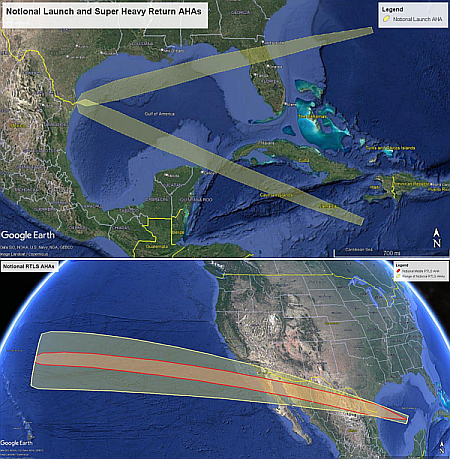
The planned return trajectories for both
Superheavy and Starship
The FAA today released [pdf] a new draft of the environmental assessment of SpaceX’s Superheavy/Starship operations at Boca Chica that will allow for full orbital flights as well as for both to return to that launchpad.
The two maps to the right show the two planned return paths for Superheavy (top) and Starship (bottom) as it comes back from orbit. In both cases the ships will return to Boca Chica to be caught by tower chopsticks. The reassessment analyzed the impacts of these trajectories, including its impact on aviation traffic, and concluded the proposal was acceptable. From its conclusion:
The 2022 PEA [Programmatic Environmental Assessment] and April 2025 Tiered EA [environmental assessment] examined the potential for significant environmental impacts from Starship-Super Heavy launch operations at the Boca Chica Launch Site and defined the regulatory setting for impacts associated with Starship-Super Heavy. The areas evaluated for environmental impacts in this Tiered EA include aviation emissions and air quality; noise and noise-compatible land use; hazardous materials; and socioeconomics. In each of these areas, the FAA has concluded that no significant impacts would occur as a result of the Proposed Action. [emphasis mine]
This approval is still only a draft. It must go through a public comment period, ending October 20, 2025. There will also be a virtual public meeting on October 7, 2025. Information about submitting comments or participating in that virtual meeting can be found here.
Such meetings are likely to see the leftist anti-Musk crowd come out in droves, screeching how we are all gonna die if these launches are allowed. The FAA will nod its head, and then ignore the Chicken Littles and approve this plan.
The plan itself tells us that SpaceX is definitely gearing up the first orbital flights of Starship next year, along with the first attempts to catch it with the tower chopsticks.
The Luxembourg cargo capsule startup Space Cargo has now raised $32 million in private investment capital in a new funding round focused on developing its BentoBox platform for in-space manufacturing and experimentation.
On 15 September, the company announced that it had closed a €27.5 million Series A funding round led by Expansion Ventures and supported by Eurazeo. The round included participation from the European Innovation Council, the European Investment Bank, and the Luxembourg Future Fund II, which is managed by Société Nationale de Crédit et d’Investissement and the European Investment Fund. It also included contributions from numerous private investors who participated through the crowd-equity platform Tudigo.
Unlike Varda’s returnable capsule, BentoBox is smaller and not designed to return to Earth. Instead it gets launched incorporated on orbital spacecraft built by others, such as Thales Alenia’s REV-1 tug and Atmos’s Phoenix returnable capsule.
According to a presentation by Astra officials this week, the company now plans the first launch of its larger Rocket-4 rocket in the summer of 2026, followed by a second launch in the fall for the Pentagon.
The summer 2026 inaugural launch will be a test flight, Kemp said, followed by one in October or November for the Defense Department’s Space Test Program. Astra plans quarterly launches of Rocket 4 in 2027, with long-term goals for much higher launch rates. Astra has maintained plans to make Rocket 4 a transportable launch system using standard shipping containers, allowing it to operate from sites with little more than a concrete pad.
This company has had a checkered history. It built and launched its smaller Rocket-3 rocket several times back in 2021 and 2022, with mixed results. After those launch failures it then decided to retire that smaller rocket for Rocket-4, only to run out of cash in 2023-2024. In 2024 its founders put together the cash to buy up the company’s stock to go private, and since then it has made most of its money from that one military test contract as well as selling its electrical propulsion systems to satellite companies.
If it gets Rocket-4 off the ground and begins regularly launches it will be an amazing recovery.
An evening pause: From the sound track for the 2000 movie Gladiator. Performed live c2012.
Hat tip Ferris Akel.
SpaceX very early this morning successfully launched another 28 Starlink satellites, its Falcon 9 rocket lifting off from Cape Canaveral in Florida.
The first stage completed its seventh flight, landing on a drone ship in the Atlantic.
The leaders in the 2025 launch race:
119 SpaceX
54 China
13 Russia
12 Rocket Lab
SpaceX now leads the rest of the world in successful launches, 119 to 93.
UPDATE: The plan worked and Cygnus is safely berthed at ISS.
According to a press release tonight, NASA and Northrop Grumman have figured out a new rendezvous plan to get Cygnus to ISS after its previous engine burns yesterday cut off prematurely and left it in the wrong orbit.
NASA and Northrop Grumman are targeting the safe arrival of the company’s Cygnus XL at approximately 7:18 a.m. EDT Thursday, Sept. 18, to the International Space Station. The Cygnus XL now will conduct a series of burns to bring the spacecraft to the space station for its robotic capture and installation.
NASA astronaut Jonny Kim is scheduled to capture Cygnus XL using the station’s Canadarm2 robotic arm with backup support from NASA astronaut Zena Cardman. After capture, the spacecraft will be installed on the Unity module’s Earth-facing port and will remain at the space station until March 2026.
The release also added this detail about why that engine burn ended too soon:
Data shared by the spacecraft confirmed that Cygnus XL operated as intended during two planned maneuvers when an early warning system initiated a shutdown command and ended the main engine burn because of a conservative safeguard in the software settings.
Apparently this cause has reassured them that the engine is in good shape for the final rendezvous burns.
An evening pause: Performed live 1985.
Hat tip Doug Johnson.
During the second of two engine burns today, designed to raise the orbit of Northrop Grumman’s Cygnus freighter to match ISS’s, the burn ended prematurely, placing the capsule in the wrong orbit.
Early Tuesday morning, Cygnus XL’s main engine stopped earlier than planned during two burns designed to raise the orbit of the spacecraft for rendezvous with the space station, where it will deliver 11,000 pounds of scientific investigations and cargo to the orbiting laboratory for NASA. All other Cygnus XL systems are performing normally.
The berthing, using one of the robot arms on ISS, had been planned for early tomorrow, Wednesday, but will not occur until both NASA and Northrop Grumman engineers have analyzed the issues and come up with “an alternate burn plan”.
An evening pause: Performed live 1989.
Hat tip Diane Zimmerman, who felt it was time Behind the Black had a pause by Swift, a performer whose work I have been completely unfamiliar with.
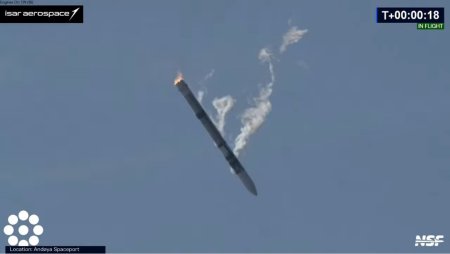
Spectrum falling seconds after launch
According to officials of the German rocket startup Isar Aerospace, its Spectrum rocket failed during its first launch in March 2025 because of a loss of attitude control, which then caused the rocket to self-destruct.
Alexandre Dalloneau, vice president of mission and launch operations at Isar, said that the company had not properly characterized bending modes of the vehicle at liftoff. “The controllability has to be tuned in order to counter such behavior,” he said. That environment was not fully modeled and incorporated into the vehicle’s control system. “We were outside the environment that we expected, so that the controllability does not succeed.”
That loss of attitude control caused the vehicle to go outside the safety zone at the launch site. That, in turn, triggered the flight termination system on the rocket. He said the company has revised its modeling of vehicle modes at liftoff to correct the problem.
The company is now working towards a second launch from Norway’s Andoya spaceport, which it hopes to attempt either late this year or early next year. Afterward it hopes to launch eight-plus times a year, based on the demand it is presently seeing for its rocket.
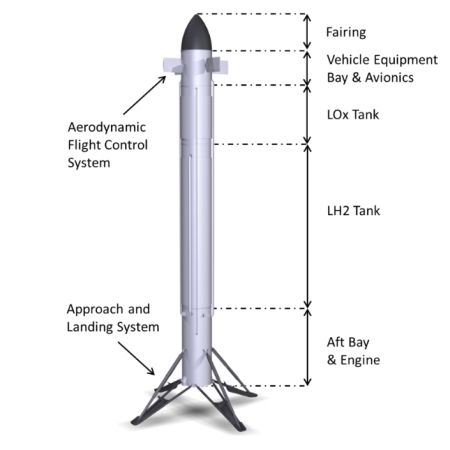
Callisto’s basic design
First proposed in 2015 as Europe’s answer to SpaceX’s Falcon 9, the first test flights of the European Space Agency (ESA)’s Callisto grasshopper-type reusable test prototype, as shown on the right, has once again been delayed, now from 2026 to 2027.
On Friday, CNES published a call seeking a partner to provide mechanical operations and procedures support ahead of the Callisto flight-test campaign, including contributions to operations user manuals, drafting mechanical operation procedures, and conducting detailed studies of mechanical interfaces between the vehicle and the ground segment. In the preamble to the scope of work, the notice states that the campaign will be carried out from the Guiana Space Centre in French Guiana in 2027. It will include an integration phase followed by eight test flights and two demonstration flights, all to be completed over a period of eight months.
The project, in which Japan’s space agency JAXA is participating, had an initial budget of $100 million, and originally planned to do its first hops in 2020. Instead, ESA spent a dozen years making powerpoint presentations, while SpaceX flew hundreds of operational flights with its Falcon 9, for profit.
Worse, this program is not attached to any rocket. It is a dead end. ESA and JAXA might get some useful engineering data from it, but it will belong to no one, and it is unclear anyone will care. At this moment it appears several private companies in Europe will have flown their own new rockets before Callisto even gets off the ground, and the data from those real rocket launches will be much more useful to them down the road.
In late August the FAA and Firefly completed the investigation into the launch failure of Firefly’s Alpha rocket in April, clearing the way for the company to resume launches.
At the time however this approval was reported here merely as a quick link on X. The company however also published its conclusions at that time which explained the cause of the failure. For completeness I post that now, describing what happened just after the first stage separated from the second stage.
Alpha’s first stage then experienced a rupture milliseconds after stage separation. The pressure wave hit Alpha’s second stage, leading to the loss of the engine’s nozzle extension and substantially reducing stage two thrust. The second stage was able to recover attitude control and continued to ascend to an altitude of 320 km until running out of propellant. The vehicle was three seconds short of achieving orbital velocity and five seconds short of the target payload deployment orbit.
The ground-based video, onboard telemetry, post-flight empirical testing and Computational Fluid Dynamics analysis corroborated excessive heat from Plume Induced Flow Separation as the most probable root cause of the mishap. Alpha Flight 6 flew a higher angle of attack than prior missions. Plume-induced flow separation intensified heat on the leeward side reducing structural margins, causing the booster to rupture from stage separation induced loads.
Fortunately, the corrective actions are straight forward: increase thermal protection system thickness on Stage 1 and reduce angle of attack during key phases of the flight. Corrective actions have already been implemented.
The company expects to resume flights in the very near future, probably before the end of 2025.
The Spanish rocket startup PLD has successfully conducted a short “burst test” of a full scale prototype of the first stage of its proposed Miura-5 rocket as it prepares for a first launch.
The test subjected the stage to pressures beyond its intended operating limits to determine the point of structural failure. According to the PLD Space update, the test validated the structural performance of the tank under cryogenic temperatures and extreme pressure conditions. The company will now proceed with a fully integrated qualification model of the stage that includes all the elements required for flight.
The company had hoped to launch the rocket for the first time from its French Guiana launchpad before the end of this year, but that schedule has slipped to 2026. At the same time, it clearly is making real progress, having also tested the engines of the rocket’s second stage in August.
The federal district court judge for the District of Columbia yesterday dismissed entirely the environmental lawsuit that had been filed against SpaceX and the FAA by anti-Musk activists following the first orbital test launch of Starship/Superheavy.
More details here. The lawsuit itself [pdf] was filed in 2023, claiming that the FAA’s environmental assessment of SpaceX’s activities at Boca Chica would do no harm to the environment were wrong.
SpaceX activities authorized in the FONSI/ROD [the environmental reassessment issued last year] have and will adversely affect the surrounding wildlife habitat and communities. In addition to harm from construction activities and increased vehicle traffic, rocket launches result in intense heat, noise, and light pollution. Furthermore, the rocket launches and testing result in explosions which spread debris across surrounding habitat and cause brush/forest fires — including one that recently burned 68 acres of adjacent National Wildlife Refuge. The FAA calls these explosions “anomalies,” but in fact they occur frequently, with at least 8 over the past 5 years. FAA acknowledged that many more such “anomalies” are expected over the next 5 years. The U.S. Fish and Wildlife Service has found that prior SpaceX rocket explosions harmed protected wildlife and designated habitat in violation of the Endangered Species Act (ESA).
At the time I noted this:
In other words, rockets and launch sites should never be placed inside wildlife refuges, because such activity is detrimental to wildlife.
A more false statement cannot be made. Under this conclusion the launch facilities at Cape Canaveral, which have been operating in the middle of a wildlife refuge now for more than six decades, should be shut down immediately. All the wildlife there must certainly be dead!
We have almost three-quarters of a century of empirical data in both Florida and California that spaceports are clearly beneficial to wildlife, because they actually create the refuge by reserving large areas where development cannot occur. This court decision merely confirms reality, something it appears increasingly the left doesn’t have much grasp of.
An evening pause: From the 1954 Italian film, Mambo.
Hat tip Judd Clark.
According to several major news sources, Starlink was down for about an hour last night globally, impacting several tens of thousands in the U.S. alone.
More than 37,000 US users were reporting issues with the internet service Monday at 12:30 a.m. ET, according to the website Downdetector.com. By 1:30 a.m., that number had fallen into the hundreds. The internet service owned by Musk’s SpaceX stopped working on “the entire frontline in Ukraine” around 7:30 a.m. Kyiv time (12.30 a.m. ET), said Maj. Robert “Magyar” Brovdi, the commander of Ukraine’s unmanned systems force, on Telegram. As of 8:00 a.m., service was gradually being restored, he said.
I link to CNN, but numerous other outlets thought this story significant enough to give it front page coverage. That this is considered news, however, illustrates perfectly how well Starlink functions normally. A brief outage lasting less than an hour makes the cover of every news outlet in the world, because normally Starlink works without problems for its more than six million subscribers.
SpaceX has not as yet provided any information about the cause of the outage. I suspect we are seeing the result of a hacker attack, possibly by Russia, but that is pure speculation. Even if not, it is in SpaceX’s interest to outline in detail what happened. This has been its policy in the past, but in the previous outage in July the company was not forthcoming. That lack of transparency has not served the company well.
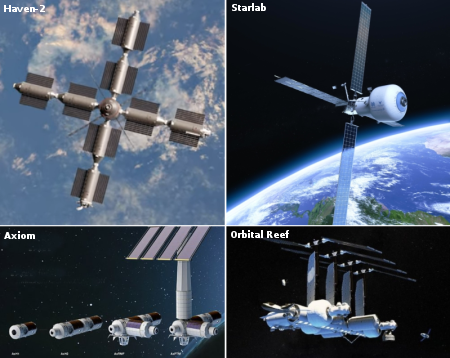
The American space stations under development
Officials from the space station startup Vast revealed at a conference last week that they endorse NASA’s new strategy that, not only no longer requires the commercial stations to immediately establish a continuous human presence in space, will also award multiple development contracts to the commercial stations.
Speaking Sept. 11 at the Global Aerospace Summit, Max Haot [chief executive of Vast] endorsed NASA’s new strategy, announced more than a month ago, that calls for multiple Space Act Agreements to support development leading to a four-person, 30-day demonstration mission. “We think it’s really the right direction,” he said, noting it accelerates the award timeline. NASA said in a draft solicitation this month it expects to award multiple funded agreements by April 2026, months sooner than under earlier plans.
The original plan had been to choose at most two, but likely only one of the four consortiums/companies that are developing station proposals. The winner would have gotten a big contract that would have also required it to push hard for continuous full time occupation, from day one.
The new plan will instead award smaller development contracts to as many as three of the four station projects, aimed at getting them off the ground and operating, even if astronauts only fly in them intermittently. Eventually the hope is that their capabilities will expand quickly to permanent occupation, especially if they start earning revenue from the private sector, outside NASA. In fact, the smaller government contracts will force them to seek investment and profits elsewhere.
The four commercial stations under development, ranked by me based on their present level of progress:
» Read more
SpaceX today successfully launched Northrop Grumman’s Cygnus freighter with more than five tons of cargo, its Falcon 9 rocket lifting off from Cape Canaveral in Florida.
The first stage completed its fourth flight, landing back at Cape Canaveral. The two fairing halves completed their 3rd and 6th flights respectively. Cygnus is expected to be berthed to ISS using the robot arm on September 24, 2025. This is also the first flight of the stretched version of Cygnus, capable of carrying more cargo.
The leaders in the 2025 launch race:
118 SpaceX
53 China
13 Russia
12 Rocket Lab
SpaceX now leads the rest of the world in successful launches, 118 to 92. China also had its own launch scheduled for this evening, but no information about it has yet been released.
The beat goes on. Since yesterday afternoon there have been two more global rocket launches, by Russia and SpaceX.
First, Russia launched the sixth GPS-type satellite as part of its next generation Glonass constellation, its Soyuz-2 rocket lifting off from its Plesetsk spaceport in northeast Russia. The rocket’s lower stage fell several different drop zones in Russia. No word if they landed near any habitable areas.
Next, SpaceX this morning launched another 24 Starlink satellites into orbit, its Falcon 9 rocket lifting off from Vandenberg in California. The first stage completed its 28th flight, landing on a drone ship in the Pacific.
The leaders in the 2025 launch race:
117 SpaceX
53 China
13 Russia
12 Rocket Lab
SpaceX now leads the rest of the world in successful launches, 117 to 92.
As for the rankings for the most reuse by a rocket, this is the present leader board:
39 Discovery space shuttle
33 Atlantis space shuttle
30 Falcon 9 booster B1067
28 Columbia space shuttle
28 Falcon 9 booster B1071
27 Falcon 9 booster B1069
27 Falcon 9 booster B1063