
Rich Mullins – You Gotta Get Up (It’s Christmas Morning)
An evening pause: For all the children that got up real early today.
Hat tip James Street.
An evening pause: For all the children that got up real early today.
Hat tip James Street.
A Christmas Eve pause: As I have done now for several years on Christmas day, I bring you the classic 1951 version of Charles Dickens’ A Christmas Carol, starring Alastair Sim. In my opinion still by far the best adaption of the book and a truly wonderful movie.
And as I noted in a previous year:
Dickens did not demand the modern version of charity, where it is imposed by governmental force on everyone. Instead, he was advocating the older wiser concept of western civilization, that charity begins at home, that we as individuals are obliged as humans to exercise good will and generosity to others, by choice.
It is always a matter of choice. And when we take that choice away from people, we destroy the good will that makes true charity possible.
It is also most important that we all heed the words of Christmas Present: ‘This boy is ignorance, this girl is want. Beware them both, but most of all beware this boy.’”
An evening pause: Performed by the London Symphony Orchestra.
Hat tip James Street.
Click for original image.
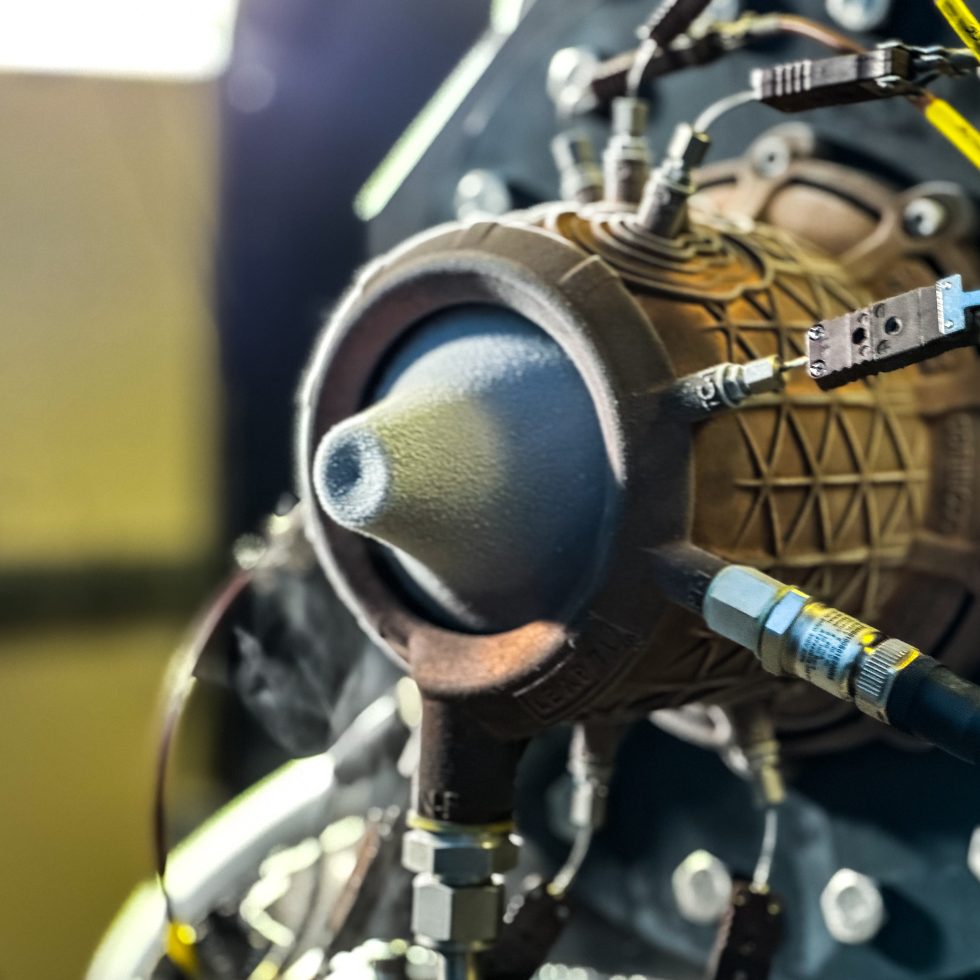
The Dubai-based startup LEAP71, focused on using AI software to quickly develop rocket engine designs it can then 3D print, has successfully test fired a prototype aerospike engine on December 18, 2024 during a static fire test campaign conducted in the United Kingdom.
Aerospikes are more compact and significantly more efficient across various atmospheric pressures, including the vacuum of space. They forego the conventional bell-shaped nozzle by placing a spike in the center of a toroidal combustion chamber [as shown in the photo to the right]. Since it is surrounded by 3,500ºC hot exhaust gas, cooling the spike is an enormous challenge.
Josefine Lissner, CEO and Co-Founder of LEAP 71, stated: “We were able to extend Noyron’s physics to deal with the unique complexity of this engine type. The spike is cooled by intricate cooling channels flooded by cryogenic oxygen, whereas the outside of the chamber is cooled by the kerosene fuel. I am very encouraged by the results of this test, as virtually everything on the engine was novel and untested. It’s a great validation of our physics-driven approach to computational AI.”
The spike in the center acts as one wall of the nozzle, and the changing pressure of the atmosphere acting as the other side of the nozzle, allowing the nozzle size to change as the rocket rises, thus making its thrust as efficient as possible.
This test was apparently with a small scale prototype, not a full scale engine. LEAP71 engineers are going to have to go though a lot more iterations using their AI software and 3D printing to get to a version usable on a rocket. The company claims that development will go far faster this way. That this company did its testing in the UK but is based in Dubai suggests its capital comes from that Middle Eastern country, which is trying to develop a space industry of its own, but it is mainly relying on British designers — at this point — to get things done.
It will have to do so quickly, since another startup, German-based Polaris Spaceplanes, in November 2024 actually completed the first test flight ever of a prototype using an aerospike engine.
After decades of speculation about the advantages of an aerospike engine but no successful flights, we now have a race between two companies to be the first to fly one, and the effort is going on in Europe.
SpaceX tonight successfully launched 21 Starlink satellites, its Falcon 9 lifting off from Kennedy in Florida. Thirteen of the satellites were configured for direct-to-cell capabilities.
The first stage completed its fourteenth flight, landing on a drone ship in the Atlantic.
The leaders in the 2024 launch race:
134 SpaceX
64 China
16 Russia
14 Rocket Lab
American private enterprise now leads the rest of the world combined in successful launches 154 to 96, while SpaceX by itself leads the entire world, including American companies, 134 to 116.
Tonight’s launch was also the 250th worldwide in 2024, a record that approximately triples the average number of successful launches each year from 1957 to 2017, when SpaceX and China began to ramp up their launch counts.
Capitalism in space: Rather than continue to build its own constellation of communications satellites, NASA yesterday awarded four companies contracts to provide that service to the agency’s many Earth orbit operations.
The work will be awarded under new Near Space Network services contracts that are firm-fixed-price, indefinite-delivery/indefinite-quantity contracts. Project timelines span from February 2025 to September 2029, with an additional five-year option period that could extend a contract through Sept. 30, 2034. The cumulative maximum value of all Near Space Network Services contracts is $4.82 billion.
The companies are Intuitive Machines, SSC Space, Viasat (based in Georgia), and the Norwegian company Kongsberg Satellite services.
Not only will these companies provide a better service faster and at less cost than the NASA TDRS satellite constellation, that there are four of them provides redundancy as well as fosters competition.
According to the Space Force as well as two commercial space tracking companies, a defunct military weather satellite launched in 1997 has broken up into more than fifty pieces.
The satellite, dubbed DMSP-5D2 F14, was in a sun-synchronous orbit over the poles. What makes the break-up significant is that it is not the first of this design of weather satellites to do so.
DMSP-5D2 F14 is part of a family of spacecraft that have suffered breakups in orbit. The F12 satellite broke up in October 2016, following the breakup of F13 in February 2015. In 2004, the F11 spacecraft broke up, creating 56 pieces of tracked debris. All the satellites had a battery assembly with a design flaw that made them vulnerable to explosion.
A similar spacecraft design was used for a line of civilian polar-orbiting weather satellites operated by the National Oceanic and Atmospheric Administration. The NOAA-16 satellite broke up in November 2015, followed by NOAA-17 in March 2021.
Overall the military launched nine satellites of this design, while NOAA launched three. Of these twelve satellites six have now broken apart. We should expect a large percentage of the remaining six to also break up.
This story explains why in the last ten years a number of companies have appeared attempting to develop the technology to remove space junk. There is a desperate need in the satellite industry for this capability, and those space junk companies are aiming to make profit from this need.
Note I do not expect or want the government to take the lead in this. This issue is mostly a need of the satellite industry, of which the world’s governments are merely just one more participant. This industry should band together to set up a fund to pay for this work, with those governments joining as just one more partner.
The tiny nation of Liechtenstein in Europe yesterday became the 52nd nation to sign the Artemis Accords.
The full list of nations now part of this American space alliance: Angola, Argentina, Armenia, Australia, Austria, Bahrain, Belgium, Brazil, Bulgaria, Canada, Chile, Colombia, Cyprus, Czech Republic, Denmark, Dominican Republic, Ecuador, Estonia, France, Germany, Greece, Iceland, India, Israel, Italy, Japan, Liechtenstein, Lithuania, Luxembourg, Mexico, the Netherlands, New Zealand, Nigeria, Panama, Peru, Poland, Romania, Rwanda, Saudi Arabia, Singapore, Slovakia, Slovenia, South Korea, Spain, Sweden, Switzerland, Thailand, the United Kingdom, the United Arab Emirates, the Ukraine, the United States and Uruguay.
There has been a flurry of new nations signing the accords since the November election of Trump. I suspect his coming encouraged these nations to sign, knowing the moribund leadership of Biden will soon be replaced with something more robust. It is also likely that these nations see a renewal of Trump’s original goals for the Artemis Accords, to create an international alliance, led by the United States, with the goal of overcoming the Outer Space Treaty’s limitations on private property.
I hope this turns out to be true. This alliance gives Trump a powerful lobby he can wield to force change.
Though one SpaceX launch early last night had a launch abort, both SpaceX and Rocket Lab completed additional launches later in the evening.
First, SpaceX completed its second Bandwagon in which 30 payloads were sent to mid-inclination orbits, its Falcon 9 rocket lifting off from Vandenberg in California. The first stage flew its twenty-first flight, landing successfully back its landing site at Vandenberg. The two fairings completed their 14th and 18th flights.
Next, Rocket Lab completed its sixth launch of sixteen for the commercial satellite company Synspective, its Electron rocket lifting off from one of its two launchpads in New Zealand. This was the 14th successful launch for Rocket Lab in 2024, a significant increase from the nine and eight launches it flew in 2022 and 2023.
The leaders in the 2024 launch race:
133 SpaceX
64 China
16 Russia
14 Rocket Lab
American private enterprise now leads the rest of the world combined in successful launches 153 to 96, while SpaceX by itself leads the entire world, including American companies, 133 to 116.
During a launch attempt tonight from Cape Canaveral in Florida, SpaceX experienced a launch abort at T-0 seconds for reasons that have not yet been determined but apparently were complex enough that mission control decided to scrub for the evening. No new launch has been scheduled as yet.
The launch was to have placed four smallsats into geosynchronous orbit. The satellites were built by the satellite company Astranis, which appears to be the first to launch smallsats to geosynchronous orbit. It had already placed one in orbit, and these four satellites expand its constellation.
An evening pause: If this doesn’t wake you up for the weekend, nothing will.
Hat tip to both Judd Clark and James Street.
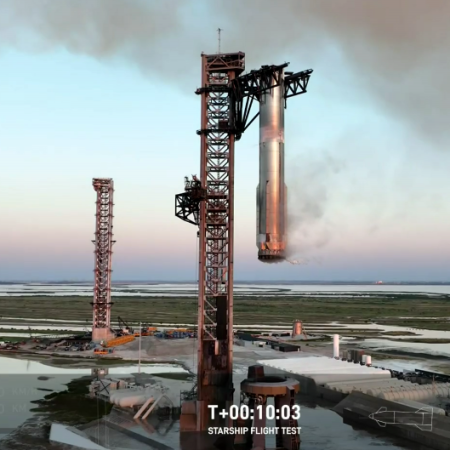
Superheavy after its flight, safely captured at Boca Chica
on October 13, 2024.
When the current (but soon to step down) administrator of the FAA Mike Whitaker testified before Congress in September 2024 and attempted to explain his agency’s red tape that have significantly slowed development of SpaceX’s Starship/Superheavy rocket, he claimed that the sonic booms produced when Superheavy returned to land at the launchpad posed a “safety issue” that needed a detailed review.
“I think the sonic boom analysis [related to returning Superheavy back to Boca Chica] is a safety related incident.”
The sudden introduction of this issue was somewhat out of the blue. While loud, the sonic boom of a rocket launch is hardly a concern. The space shuttle produced the same for decades when it landed, and that was always considered a fun plus to watching the landing. And even if SpaceX begins launching its rockets once a day from any spaceport, that added noise does nothing to hurt anyone. In fact, it is a local signal of a thriving economy.
Since then it appears the leftist “intellectual elitists” that don’t like it when they don’t run everything — which is one reason they now hate Elon Musk — have run a full court press trying to make these rocket sonic booms a cause celebre that can be used to block SpaceX launches.
» Read more
An evening pause: Played on the great Sauer Organ of the Berliner Dom.
At the time of its dedication in 1905, the great Sauer Organ of the Berliner Dom was the largest in Germany, with its 7269 pipes and 113 registers, distributed across four manuals and pedals.
While not directly related to Christmas or the holidays, I think this piece is still appropriate for the season.
Hat tip Judd Clark, who adds, “Though I had reservations because of its length and because it has been subject to innumerable transcriptions and performances on different organs by different organists it has become cliché. But, it is an exceptional performance on an exceptional organ in an exceptional hall.”
Depending on whether it gets NASA contractual approval, the space station startup Vast has now signed a deal with SpaceX for flying two tourist missions to ISS.
These two missions expand Vast’s launch manifest with SpaceX, which includes the company’s Falcon 9 rocket delivering Haven-1 to low-Earth orbit and a subsequent Dragon mission to fly crew to the commercial space station. Haven-1 will also be supported by Starlink laser-based high-speed internet.
Axiom, which has flown three tourist missions to ISS and has a fourth planned, is also bidding for the next two tourist slots NASA has made available for ISS in the coming years. It is not clear who will get those slots. Axiom has the advantage it has done it before, but the rumors that it lost money on those flights and now has a cash shortage work against it. Vast hasn’t yet flown, but it is moving fast to fly and occupy Haven-1 next year. NASA might want to give it at least one of those slots to balance the scales.
Hat tip to BtB’s stringer Jay.
NASA yesterday awarded the rocket startup Firefly a $179.6 million contract to carry six NASA science instruments to the Moon on its Blue Ghost lunar lander, the third lander contract the company has won and the fourth Moon contract overall.
[The four contracts include] three lunar landers as well as one to provide radio frequency calibration services from orbit to support a radio science payload on the second lander mission.
The first mission, Blue Ghost 1 or “Ghost Riders in the Sky,” is scheduled for launch in mid-January, with a landing in the Mare Crisium region of the near side of the moon about 45 days after launch. Blue Ghost 2 will follow in 2026, landing on the lunar farside. That mission will also deploy ESA’s Lunar Pathfinder communications satellite into orbit. Both the second and third Blue Ghost missions will use Firefly’s Elytra Dark as an orbital transfer vehicle, delivering the landers to lunar orbit. Those vehicles will remain in lunar orbit to provide communications services.
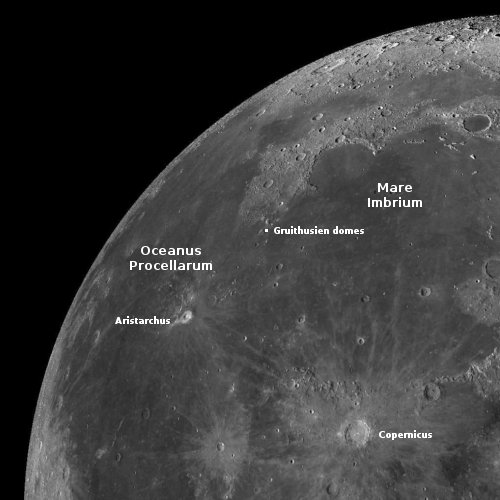
This new contract will have Blue Ghost land in the Gruithuisen Domes region, as shown on the map to the right. This had been the landing target for the Astrobotic’s Peregrine lander when it launched in January 2024, but that mission failed when it developed a fuel leak shortly after launch. Astrobotic was able to operate the spacecraft through most of its trip to and from the Moon, but had to cancel the landing.
Capitalism in space: The European Space Agency (ESA) yesterday awarded the Italian rocket company Avio three different contracts worth $372 million to further develop its Vega family of rockets.
The first two contracts subsidize work on upgrading the Vega-C launch site at the French Guiana spaceport as well as developing the company’s planned new rocket, Vega-E.
The third contract is more significant, because it signals the coming end of Arianespace, ESA’s commercial arm. Instead of going through that government-run agency — as ESA has done for a quarter century — ESA simply bought a Vega-C launch from Avio directly, the first time it has obtained launch services directly from a European company. The contract is to place in orbit an ESA climate research satellite.
The end of Arianespace was further signaled today by the announcement that Arianespace’s chief executive since 2013, Stephane Israel, is stepping down. It was Israel who in 2015 discouraged ESA from making Ariane-6 reusable. It was Israel who for years poo-pooed competition and free enterprise, lobbying continuously that ESA should do its launches through Arianespace exclusively.
Now, more than a decade later, ESA has finally rejected Israel’s arguments, and is eliminating the middle-man Arianespace entirely, purchasing launch contracts directly from the rocket companies while having its member nations as well as itself encourage the development of many private rocket companies across Europe.
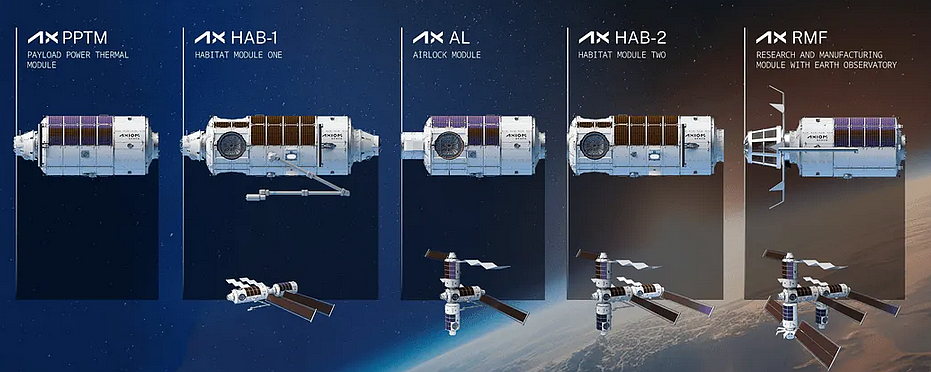
Axiom’s new module assembly sequence
Capitalism in space: In order to be able to fly its space station independent of ISS more quickly, Axiom has rearranged the order it will launch some modules.
Originally, the plan was to attach Habitat 1 (AxH1) first, before the power and thermal module. Now, the on-orbit assembly sequence will start with the Payload Power Thermal Module (AxPPTM), followed by AxH1, an airlock, Habitat 2 (AxH2), and finally the Research and Manufacturing Facility (AxRMF). “The result – free-flight capability after the launch and berthing of PPTM,” [Mark Greeley, Axiom Space COO and station program manager,] explained, “[will allow] us to add modules while on orbit once we have separated from station. Our goal is to ensure a smooth transition from a government to a commercial platform, maintaining a continuous human presence on orbit to serve a community of global customers and partners, to include NASA.”
The AxPPTM primary structure will be built by Thales Alenia Space in Turin, Italy, and then relocated to Houston no earlier than fall 2025, where the integration of the internal structure and systems will take place at Axiom Space facilities.
The new sequence is shown in the graphic above. This change will allow Axiom to fly free two years sooner than previously planned, in 2028. It appears NASA pushed for this change possibly because it considers remaining attached to ISS until 2030 a risk that should be avoided. NASA apparently is increasingly concerned about the state of Russia’s Zvezda module, and fears it might have a catastrophic failure due to the stress fractures in its hull. The sooner Axiom can get free of ISS the better.
This modification also appears to include some major changes from previous Axiom graphics. It appears the airlock module and its solar panels have undergone a major design change.
Below is my present ranking for the launch of the four space stations being designed and built:
An evening pause: Hat tip James Street.
SpaceX yesterday launched a National Reconnaissance Office (NRO) satellite, its Falcon 9 rocket lifting off from Vandenberg in California.
The first stage completed its 22nd flight, landing on a drone ship in the Pacific. The two fairings completed their ninth and tenth times respectively.
The leaders in the 2024 launch race:
132 SpaceX
62 China
16 Russia
13 Rocket Lab
American private enterprise now leads the rest of the world combined in successful launches 151 to 94, while SpaceX by itself leads the entire world, including American companies, 132 to 113.
Hat tip to reader Geoffrey Carman. I had missed this launch and he let me know.
In order to give SpaceX more time to complete work on a new manned Dragon capsule, raising its fleet of capsules to five, NASA has shuffled its springtime ISS crew launch and return schedules.
The change gives NASA and SpaceX teams time to complete processing on a new Dragon spacecraft for the mission. The new spacecraft is set to arrive to the company’s processing facility in Florida in early January. “Fabrication, assembly, testing, and final integration of a new spacecraft is a painstaking endeavor that requires great attention to detail,” said Steve Stich, manager, NASA’s Commercial Crew Program.
…NASA and SpaceX assessed various options for managing the next crewed handover, including using another Dragon spacecraft and manifest adjustments. After careful consideration, the team determined that launching Crew-10 in late March, following completion of the new Dragon spacecraft, was the best option for meeting NASA’s requirements and achieving space station objectives for 2025.
This decision however impacts the return of the Dragon crew presently on board ISS, including the two astronauts launched in June on Boeing’s Starliner capsule and whose stay was extended from its initial length of one-to-eight weeks to more than six months when NASA made the decision to bring Starliner home unmanned. Instead of returning in February 2024, that crew will now have to return after the next crew arrives in late March.
Most of the press has focused on this two month extension to the Starliner crew, but to me the real news is that SpaceX is building a fifth manned capsule, as yet unnamed. Having five reusable capsules will give the company greater flexibility. I suspect SpaceX decided to build this additional capsule because, in addition to its ISS missions for NASA, it is going to be flying in 2025 both an Axiom mission to ISS as well as a 30-day mission to Vast’s Haven-1 space station. That latter mission will tie up one manned capsule for many months both before and after that long flight.