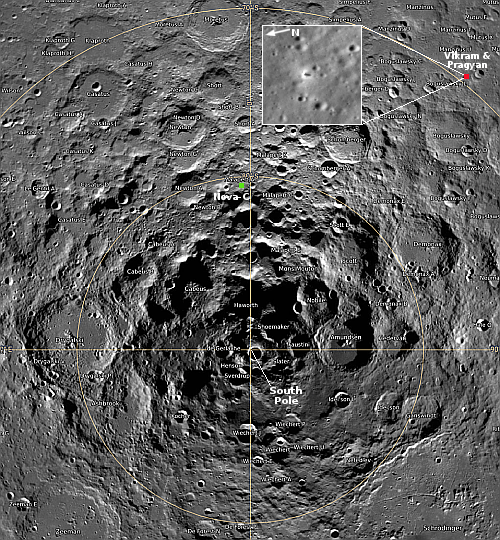
A detailed look at the international partners for China’s Moon base

Link here. The article provides a nice summary of who has signed on to China’s project to build a Moon base in competition with the American Artemis project, prompted by the announcement that an astronomical association in Colombia has now signed on.

The contrast is stark between the nations that have signed the Artemis Accords to participate in the American project (36 so far) and the entities that have partnered with the Chinese. China at present only has seven partner nations (Belarus, Pakistan, Azerbaijan, Russia, Venezuela, South Africa, Egypt), only one of which, Russia, has any space capabilities. The remaining nine partners are all academic organizations of one kind or another, all of which also have little or no major space capabilities.

Essentially, these partners are mostly PR by China to make it appear it has an international team. In reality almost all of its lunar project will be done by China. China doesn’t even expect Russia to contribute that much. As the article notes, “China has regularly omitted any mention of Russia as an ILRS partner” since the Russia invaded the Ukraine in February 2022. Before then Russia’s ability to accomplish much of anything new in space had long been questionable, and since then the doubts have escalated.

Though many of the nations who have signed the Artemis Accords are as weak, the list also includes almost all the world’s major players in space, such as France, Germany, India, Japan, and Luxembourg.

Like the Cold War, the western capitalist alliance is larger and more capable, because no one really wants to join an partnership that discourages freedom and private enterprise.

3 comments

SLIM survives its second lunar night, re-establishes contact

SLIM's view after surviving its 2nd night on the Moon
Click for original image.

According to Japan’s space agency JAXA, the SLIM lunar lander has successfully survived its long night on the Moon, re-establishiing contact with ground controllers yesterday.

Last night, we received a response from #SLIM, confirming that the spacecraft made it through the lunar night for the second time! Since the sun was still high and the equipment was still hot, we only took some shots of the usual scenery with the navigation camera

One of those pictures is to the right, reduced slightly to post here. It looks west across the floor of Shioli Crater, with the far rim about a thousand feet away. The picture is identical to previous images, tilted because the spacecraft landed on its side and has limited scientific capabilities, being primarily an engineering test mission.

That this engineering test has now survived two lunar nights speaks well for its design. It tells us that future Japanese lunar landers (and rovers) will have a good chance of surviving for a long time on the Moon.

5 comments

Real Space – Every Space Station Size Comparison

An evening pause: Some quick visual space station history. Note how almost all the non-U.S. stations are essentially assembled using revisions of the same early Soviet-era modules. Note too how the future private stations are all very different from each other. The contrast illustrates the difference between what you get when governments control everything, and when competition and freedom rule.

Hat tip Edward Thelen.

3 comments

Members of Texas Space Commission unveiled

The governor of Texas, Greg Abbott, yesterday revealed the names of the 18 individuals who will head the Texas Space Commission, created by the legislature to encourage the development of that state’s commercial space industry.

The Texas Space Commission will be tasked with developing a statewide strategy that promotes innovation, creates incentives (including grant funding) and develops workforce training. They initially have $350 million to work with, $150 million budgeted for grants and $200 million for a new research and training facility built by the Texas A&M University System.

The Texas Aerospace Research and Space Economy Consortium, which is part of the Texas Space Commission, will identify research and development opportunities and find ways to further integrate space into the Texas economy.

The commission appears strongly made up of representatives from many commercial companies, including the big companies SpaceX, Lockheed Martin, and Boeing as well as a number of newer smaller companies. Linked as it is so closely with the state government, this commission will be well placed to eliminate any obstacles within the state to commercial development.

2 comments

China’s Long March 6 rocket launches remote sensing satellite

China yesterday successfully launched a classified remote sensing satellite, its Long March 6 rocket lifting off from its Taiyuan spaceport in the northeast of China.

No word on where the rocket’s four solid-fueled strap-on boosters and liquid-fueld core stage crashed inside China.

The leaders in the 2024 launch race:

30 SpaceX
13 China
4 Rocket Lab
4 Russia

American private enterprise still leads the rest of the world combined in successful launches 35 to 23, while SpaceX still leads the entire world, including American companies, 30 to 28.

0 comments

Report: 3D printing in space

A new report released today [pdf] from the space think tank Intro-act provides a nice detailed summary of the economic and technological state of 3D printing industry in space.

The report first outlines the types of 3D printing presently available, using plastics and metals, and then outlines the advantages of printing things in orbit rather than carrying them up from Earth. Essentially, 3D printers are the real version of replicators seen in sci-fi movies, except that reality requires much more complexity, including a whole range of different machines designed for specific materials and final products.

The report lists four companies of note:

Made in Space (acquired by Redwire Corp.), Relativity Space, and AI SpaceFactory are the leading companies in the 3-D printing segment. With the addition of Vaya Space, the list provides a more comprehensive overview of the companies that are pioneering the use of 3-D printing technology in the realm of space exploration and development, showcasing the diverse applications and innovative strategies being employed in this exciting field.

Each company appears to have a different focus. Redwire is developing 3D printers for use on ISS, Relativity developing 3D printers for building rocket components, and AI Spacefactory developing 3D printed space colonies for Mars or the Moon.

If I had to choose which company to bet on, my pick would be Relativity followed by Redwire. The former’s large 3D printing technology for rockets can be very easily shifted to other uses and products, giving it a product of great value far beyond space. Redwire meanwhile has already launched and operated printers on ISS, proving it can provide that technology to future space stations.

This industry is however in its infancy. As the private space stations presently under construction launch, their need for this technology will skyrocket, and thus there will be opportunities galore.

3 comments

Orbital tug startup ExLabs plans mission to asteroid Apophis in 2028

The orbital tug startup Exploration Labs (ExLabs) has announced it is planning to use its tug to deliver three cubesats on a rendezvous mission to asteroid Apophis in 2028, shortly before the asteroid does a close fly-by of Earth in April 2029.

The article at the link provides no other information about this mission. In searching the web I was unable to find anything further. It seems this mission is at present nothing more than a proposal, issued at this time mostly for public relations purposes to showcase the abilities of its proposed orbital tug, presently under development.

This conclusion does not mean the mission won’t happen, only that it is very far from a reality.

0 comments

Intuitive Machines: Odysseus is dead

In a tweet on March 23, 2024 the company Intuitive Machines announced that the mission of its first lunar lander, Odysseus, is officially over with the spacecraft failing to come back to life after sunrise on the Moon.

As of March 23rd at 1030 A.M. Central Standard Time, flight controllers decided their projections were correct, and Odie’s power system would not complete another call home.

The engineers had begun listening for a signal on March 20th, when their computer models said enough sunlight would reach the solar panels to charge its communications system.

The failure of the lander to survive the lunar night is a disappointment, but it was never considered a strong possibility. Right now the company’s main task is to prevent the issues that caused Odysseus to land too fast and tip over, so that the next two missions, scheduled for either this year or next, each deliver their payloads properly on the Moon’s surface.

1 comment

SpaceX launches 23 more Starlink satellites

The beat goes on and on and on and… SpaceX today successfully launched another 23 Starlink satellites, its Falcon 9 rocket lifting off from Cape Caneveral.

The first stage completed its eighth flight, landing on a drone ship in the Atlantic.

The leaders in the 2024 launch race:

30 SpaceX
12 China
4 Rocket Lab
4 Russia

American private enterprise now leads the rest of the world combined in successful launches 35 to 22, while SpaceX now leads the entire world, including American companies, 30 to 27.

1 comment

France to award four rocket startups launch contracts worth as much as 400 million euros

Capitalism in space: According to a story today at the European Spaceflight website, the French government will later this week announce contract awards to four different rocket startups worth as much as 400 million euros.

The four launch startups that will receive a combined €400 million in subsidies are HyPrSpace, Latitude, Sirius Space Services, and the ArianeGroup subsidiary MaiaSpace.

The HyPrSpace OB-1 and Latitude Zephyr rockets will be the smallest of the lot and will be capable of delivering between 100 and 200 kilograms to low Earth orbit. The Sirius 1, Sirius 13, and Sirius 15 rockets will be capable of delivering between 175 and 1,100 kilograms to orbit. The Prometheus-powered Maia rocket is expected to be the most powerful, with a payload capacity of up to three tonnes when launched in its expendable configuration.

All four companies however will only receive a small upfront payment, with the bulk of the award only paid if a company achieves a maiden launch by 2028.

That the French government is now signing deals with new private and independent launch companies and not with Arianespace, the commercial arm of the European Space Agency (ESA) that has always been dominated by the French, is a major development. Up until now most of the action encouraging independent rocket companies has come from Germany and Spain. That France has now joined the party signals the almost certain death knell to the failed two decade-long effort by Arianespace to make a profit, even when it controlled about 50% of the launch market.

Expect the government monopoly of Arianespace to fade away in the next five years. Expect it to be replaced with a thriving industry of mulitple rocket companies, all charging less and coming up with new ways to lower cost.

2 comments

South Texas booming due to arrival of SpaceX

Link here. The article details the major tourism and industry dollars that have come into existence in the Brownsville region since SpaceX established its Boca Chica launch facility, including major development now underway to cater to the tourist business of travelers eager to get a close look at a Starship/Superheavy launch.

The article gives a sense of the reality on the ground. While the anti-Musk activist groups sue SpaceX in their attempt to shut down Starship/Superheavy development, claiming it is harming the region, stories like this put the lie to those claims.

Hat tip to Robert Pratt of Pratt on Texas.

7 comments

UK Space Agency proudly grows

The United Kingdom Space Agency today announced that it is opening four new offices in four different cities, giving it a brand new headquarters as well as a total of five regional offices.

The new HQ at Harwell is due to open in June, while offices at William Morgan House in Cardiff and Space Park Leicester will open in April, with the office at Queen Elizabeth House, in Edinburgh, opening later in the summer.

In addition, the agency will retain its offices in London and Swindon.

Will this expansion alleviate the serious red-tape issues in the United Kingdom that killed Virgin Orbit and have delayed launches at its two new spaceports in Scotland? I have my doubts. The licensing problems in the UK have centered on the number of different agencies and offices that must issue approvals to private space companies. While it might make sense for the UK Space Agency to hire more people, if anything it should be streamlining its operations to one central place.

It appears instead that this bureaucracy is doing what all government bureaucracies do, expanding and growing at the cost of private enterprise. I don’t see how opening many different small offices can possibly help make the licensing procedure faster or easier.

3 comments

Boom’s one-third-scale prototype supersonic jet finally takes off

The private startup Boom has finally flown its third-scale prototype supersonic jet, dubbed XB-1, on its first short flight, taking off on March 22, 2024 from the flight test facility in Mojave, California.

Following behind was Test Pilot Tristan “Geppetto” Brandenburg in a T-38 chase plane to observe the flight and confirm altitude and speed. With a length of 62.6 feet (19 m) and a wingspan of 21 ft (6 m) , the XB-1 achieved an altitude of 7,120 ft (2,170 m) and speeds up to 238 knots (273 mph, 440 km/h) under the force of its three GE J85-15 engines generating a maximum thrust of 12,300 lbs.

According to Boom, once its aerodynamic characteristics and flight worthiness are confirmed, the XB-1 will increase speed until it is flying on later tests in excess of Mach 1.

This prototype supersonic test plane was first unveiled in 2020, four years ago, but runway taxi tests did not begin until 2023. I suspect the Wuhan panic contributed to the three year delay between unveiling and first tests, though this is speculation.

The goal is to build the first commercial superonic passenger plane since the Concorde. At present Boom has a contract from United for fifteen Boom 12-passenger planes, plus development deals with Boeing, and Japan Airlines.

9 comments

SpaceX launches more Starlink satellites

The beat never ends: SpaceX last night successfully launched another 23 Starlink satellites, its Falcon 9 rocket lifting off from Cape Canaveral.

The first stage successfully completed its nineteenth flight, landing successfully on a drone ship in the Atlantic. This stage is now the third that has completed a record nineteen flights. One wonders when a stage will reach twenty.

The leaders in the 2024 launch race:

29 SpaceX
12 China
4 Rocket Lab
4 Russia

American private enterprise now leads the rest of the world combined in successful launches 34 to 22, while SpaceX now leads the entire world, including American companies, 29 to 27.

2 comments

ISRO completes second drop test runway landing of its own mini-reusable shuttle

Pushpak about to land
Click for original image

India’s space agency ISRO yesterday successfully completed the second runway landing of its own mini-reusable shuttle, dubbed Pushpak, after the vehicle was dropped from a helicopter at an altitude of 2.8 miles.

This mission successfully simulated the approach and high-speed landing conditions of RLV returning from space. With this second mission, ISRO has re-validated the indigenously developed technologies in the areas of navigation, control systems, landing gear and deceleration systems essential for performing a high-speed autonomous landing of a space-returning vehicle. The winged body and all flight systems used in RLV-LEX-01 were reused in the RLV-LEX-02 mission after due certification/clearances. Hence reuse capability of flight hardware and flight systems is also demonstrated in this mission. Based on the observations from RLV-LEX-01, the airframe structure and landing gear were strengthened to tolerate higher landing loads. [emphasis mine]

The highlighted sentences I think are the most significant. ISRO is pushing hard for reusability.

The concept of this spacecraft is somewhat comparable to the X-37B, though all the engineering can be applied to larger shuttles that can carry cargo and humans in and out of orbit. At the moment however Pushpak is simply an engineering test prototype, not yet ready for orbital flights. For example, the landing gears are too large and cannot be retracted, something unacceptable for orbital flights.

1 comment

SpaceX launches a cargo Dragon to ISS

SpaceX today successfully launched a Dragon freighter to ISS, its Falcon 9 rocket lifting off from Cape Canaveral in Florida.

The cargo Dragon was flying for the fourth time. It will dock with ISS on March 23, 2024. The first stage completed its sixth flight, landing back at one of SpaceX’s landing pads at Cape Canaveral.

This was also the first Dragon launch from this particular SpaceX launchpad in four years. The company only recently reconfigured it for Dragon flights, both manned and unmanned, so that it has two options for launching NASA manned missions. NASA had demanded this before it would give SpaceX permission to launch Superheavy/Starship from that rocket’s new launchpad in Florida. The agency thought it was too close to SpaceX’s first manned launchpad, and wanted an option in case a Superheavy launch failure damaged the Dragon launchsite. With this success SpaceX is one step closer to flying operational Superheavy/Starship flights out of Cape Canaveral.

The leaders in the 2024 launch race:

28 SpaceX
12 China
4 Rocket Lab
3 Russia

American private enterprise now leads the rest of the world combined in successful launches 33 to 21, while SpaceX now leads the entire world, including American companies, 28 to 26.

1 comment

Six launch companies give updates on the status of their rockets

Link here. The event was a panel at a conference where officials from SpaceX, ULA, Mitsubishi, Arianespace, Relativity, and Rocket Lab gave presentations.

Based on what is reported at the link, the Mitsubishi update was the most significant:

Mitsubishi Heavy Industries (MHI) successfully launched its H3 rocket Feb. 16 after the rocket’s inaugural launch failed nearly a year earlier, a setback that Iwao Igarashi, vice president and general manager at MHI, called a “nightmare.” “There were no major problems with the rocket” on its second flight, he said.

We will have to see. Though everything worked as planned on the second flight, the true test on whether Mitsubishi has overcome the issues from the first launch will be the rocket’s third launch, presently scheduled for sometime next year.

A Relativity official said their Terran-R rocket is still targeting a first launch in 2026, while Rocket Lab was hopeful that the first launch of its larger Neutron rocket would occur by the end of this year.

0 comments

China Long March 2D launches “group of satellites”; Russia scrubs manned Soyuz launch

China today successfully launched what it simply labeled as “a group of satellites”, its Long March 2D rocket lifting off from its Jiuquan spaceport in the northwest of China.

No other useful information was released about the payloads. Nor was there any word as to the crash site of the rocket’s first stage, which uses toxic hypergolic fuels and landed somewhere in China.

Meanwhile in Russia a launch of a Soyuz-2 rocket carrying three astronauts to ISS was aborted at about T-20 seconds for reasons that as yet remain unclear. According to NASA the next launch opportunity is March 23, 2024.

The leaders in the 2024 launch race:

27 SpaceX
12 China
4 Rocket Lab
3 Russia

American private enterprise still leads the rest of the world combined in successful launches 32 to 21, while SpaceX remains ahead of the entire world, including American companies, 27 to 26.

1 comment

Rocket Lab launches classified smallsat for National Reconnaissance Office

Rocket Lab in the early morning hours of March 21, 2024 successfully launched a classified payload for the National Reconnaissance Office, its Electron rocket lifting off from Wallops Island in Virgina.

For this launch Rocket Lab made no attempt to recover its first stage. As of posting the payloads had not yet been deployed.

A Chinese Long March 2D launch was also scheduled to occur just prior to the Rocket Lab launch, but as of posting there was no word on whether that launch had taken place.

The leaders in the 2024 space race:

27 SpaceX
11 China
4 Rocket Lab
3 Russia

American private enterprise presently leads the rest of the world combined in successful launches 32 to 20, while SpaceX leads the entire world, including American companies, 27 to 25.

2 comments

Spanish high-altitude balloon company to fly fullsize prototype capsule from Saudi Arabia

The Spanish high-altitude balloon startup Halo is now planning to fly from Saudi Arabia the second test flight of its fullsize prototype tourist capsule.

Headquartered in Madrid, the company, which specialises in stratospheric commercial flights, will embark on its sixth test flight from the kingdom in June, the company said in a release, with conditional approval from the Communications, Space and Technology Commission (CST), the Saudi Arabia authority responsible for space regulation.

Halo Space CEO Carlos Mira said in a statement that this test will validate the integrated operation of all critical systems, “bringing us one step closer to our goal,” which includes plans to begin commercial flights in 2026.

The company plans to set up bases for flights in Saudi Arabia, the U.S., Australia, and Spain, where it hopes to do high altitude tourist balloon flights to about 20 miles elevation. We should also not be surprised if it does classified reconnaissance flights for Saudi Arabia as well.

Whether it will do what it says however still depends on the final outcome of a lawsuit against it by another Spanish company, Zero 2 Infinity, which claims Halo stole its technology. The courts have ruled in Zero 2’s favor, but whether a final settlement has occurred is unclear.

0 comments
1 101 102 103 104 105 472