Rocket Factory Augsburg raises $33 million in private investment capital

The German startup Rocket Factory Augsburg revealed today that it has raised $32.9 million in private investment capital at the same time it has shifted the launch date for the first rocket launch of its RFA-1 rocket from this year into next.

That launch was scheduled to occur at the Shetland spaceport, Saxavord, and as recently as April 2023 officials there were saying that this launch would occur this year. In June however Rocket Factory signed a deal with France’s space agency to use its long abandoned launchpad in French Guiana. That same month I predicted the launch at Saxavord would not happen this year, possibly because of regulatory hurdles in the United Kingdom.

It appears those hurdles might have been part of the reason for Rocket Factory’s deal with France. It needs a place to launch, and it appears the UK’s government is not presently conducive to allowing such things to happen easily.

2 comments

SpaceX successfully launches another 15 Starlink satellites

I hope this doesn’t bore you: SpaceX tonight successfully used its Falcon 9 rocket to place another 15 Starlink satellites into orbit, lifting off from Vandenberg Space Force Base in California.

The first stage completed its fifth flight, landing successfully on a drone ship in the Pacific. The two fairings each completed their sixth flight. As of posting the satellites have not yet deployed.

The leaders in the 2023 launch race:

54 SpaceX
31 China
10 Russia
6 Rocket Lab
6 India

American private enterprise still leads China in successful launches 62 to 31, and the entire world combined 62 to 52, while SpaceX by itself leads the world (excluding American companies) 54 to 52.

7 comments

Boeing delays first manned Starliner flight again, until March of 2024

Because of both parachute and wiring issues in its Starliner capsule, Boeing revealed today that it is delaying the first manned Starliner flight again, until March of 2024, so that it has time to change and test the parachutes as well as remove the flammable tape inside the capsule.

The company had been hoping to finally fly that first manned flight last month, but was forced to cancel when in June it discovered two shocking problems. First the connections between the parachutes and the capsule were too weak, and second, for some reason engineers had used tape to protect the capsule’s wiring that was too flammable and had to be replaced or covered somehow.

Boeing is taking the tape off in places where it’s easy and safe to do so and considering other remediation techniques, such as protective barriers or coatings over it, in trickier spots, Nappi said.

The parachute work is multifaceted as well. For example, Boeing has modified the soft link design to make it stronger, and the new version is being manufactured now, Nappi said. The company also decided to swap out Starliner’s parachute system, putting a new version slated for the first operational mission on board for [the crew flight test]. The new soft links will be incorporated into the new chutes, which will get to strut their stuff during a drop test soon. “We expect that the drop test will occur in mid to late November,” Nappi said. “That’s what the planning indicates at this point, and we’ll watch that closely.”

The seemingly endless number of mistakes and bad engineering that we have seen during the development of Starliner speaks very badly of Boeing in almost every way possible. These last two problems are especially egregious. Neither should have ever happened, and if so should never had been unnoticed until a mere month before launch and years into the project.

It must also be noted that March ’24 is merely a target date. Don’t bet the house on it happening then.

5 comments

Russia launches new GPS-type Glonass satellite

Russia today used its Soyuz-2 rocket to place a new GPS-type Glonass satellite into orbit, lifting off from its Plesetsk spaceport in the northern Russian.

Apparently this launch resulted in its lower stages falling in areas in Russia not normally used as a drop zone. No word on whether they landed near habitable areas.

The leaders in the 2023 launch race:

53 SpaceX (with a launch planned for tonight, live stream here.)
31 China
10 Russia
6 Rocket Lab
6 India

American private enterprise still leads China in successful launches 61 to 31, and the entire world combined 61 to 52, while SpaceX by itself leads the world (excluding American companies) 53 to 52.

0 comments

Lockheed Martin opens factory to build smallsats on an assembly-line basis

Capitalism in space: As part of fulfilling a contract won from the Space Force, Lockheed Martin has now opened a new factory in Colorado expressly designed to build smallsats on an assembly-line basis.

Lockheed Martin’s 20,000-square-foot factory is located at the company’s Waterton campus near Denver, Colorado. It has six parallel assembly lines and capacity to manufacture 180 small satellites per year, Kevin Huttenhoff, Lockheed Martin’s senior manager for space data transport, told SpaceNews. The first satellites to be made at the facility are for the U.S. Space Force’s Space Development Agency. SDA plans to build a mesh network of hundreds of data transport and missile-detection sensor satellites in low Earth orbit.

Lockheed Martin in February 2022 won a $700 million contract to produce 42 communications satellites for SDA’s Transport Layer Tranche 1. The company in November 2020 also won a $187.5 million contract to manufacture 10 Transport Layer Tranche 0 satellites that are scheduled to launch later this month. The Transport Layer Tranche 1 satellites — projected to launch in late 2024 — will be made at the new factory. The Tranche 0 satellites were assembled at a different facility where Lockheed Martin manufactures Global Positioning System (GPS) spacecraft.

The multiple assembly lines allows the company to configure each for a different customer and satellite, with one for example producing smallsats for a military contract while another produces smallsats for a commercial customer.

Of all the big space companies, Lockheed Martin has made the most moves quickly adapting to the new space market of new rockets and small satellites. Not only has it built this facility, it has been an major investor in several new smallsat rocket companies, including Rocket Lab and ABL. It also opened its first assembly-line smallsat factory in 2017.

2 comments

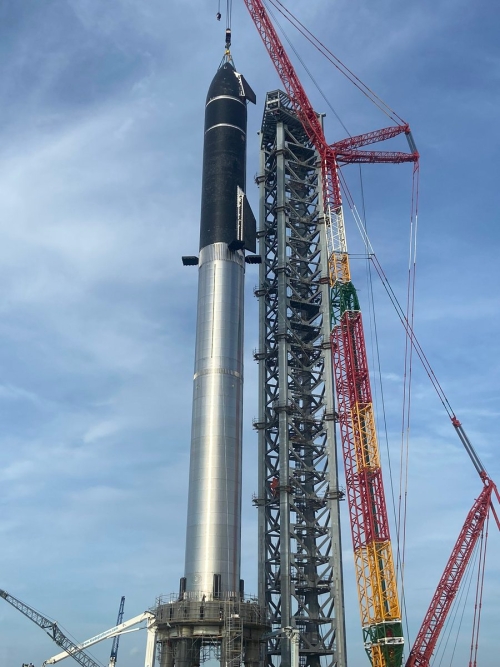
SpaceX conducts static fire test of Superheavy and its launchpad systems

SpaceX yesterday conducted a static fire test of Superheavy and its launchpad systems at Boca Chica.

After a couple of hours of chilling the fuel lines, filling of the liquid oxygen and liquid methane tanks aboard Booster 9 began at T-Minus 67 minutes. The liquid oxygen tank was fully filled with the liquid methane only partially filled with what was required for the test.

After a smooth countdown, Booster 9 lit all 33 Raptor engines, however, 4 shut down early during the 2.74-second duration test. The test was intended to last 5 seconds.

The new water deluge system seemed to work as intended, albeit with a very short firing of the engines. Instead of a giant dust cloud that is usually formed after a static fire test, this test created a steam cloud that dissipated fairly quickly following the test.

The premature shutdown and the even earlier shut down of four engines suggests SpaceX still has kinks it needs to work out. No surprise. It will now probably switch out those four engines, analyze the test, and do it again. It will do so partly because it needs to before the orbital test flight, and partly because it can’t do that test flight because the FAA has still not issued a launch license.

I have embedded the video of that test below the fold.
» Read more

3 comments

ISRO releases first images of the Moon from Chandrayaan-3

The Moon as seen by Chandrayaan-3

India’s space agency ISRO yesterday released the first images taken of the Moon by Chandrayaan-3, soon after entering lunar orbit.

The picture to the right is a screen capture from the short movie the agency compiled from those images, available at the link. The pictures were taken on August 5th, during the engine burn that put the spacecraft into lunar orbit. A solar panel can be seen on the left, with the cratered lunar surface to the right.

Chandrayaan-3 is presently undergoing a series of engine burns to lower its orbit in preparation for a planned August 23rd lunar landing in the high southern latitudes of the Moon.

0 comments

SpaceX tonight successfully launches another 22 Starlink satellites

SpaceX tonight successfully launched another 22 Starlink satellites, using its Falcon 9 rocket lifting off from Cape Canaveral.

The first stage completed its fourth flight, landing softly on a drone ship in the Atlantic. The two fairing halves completed their 8th and 10th flights respectively. As of posting the satellites have not yet been deployed.

The leaders in the 2023 launch race:

53 SpaceX
31 China
9 Russia
6 Rocket Lab
6 India

American private enterprise now leads China in successful launches 61 to 31, and the entire world combined 61 to 51, while SpaceX by itself leads the world (excluding American companies) 53 to 51.

7 comments

Astra lays off 25% of workforce, mostly in its rocket departments

Astra revealed yesterday that it has laid off 25% of its workforce, with most of those jobs coming from those working of developing its rocket, in order to focus the company on its rocket engine business, the only area it at present has a chance of earning revenue.

The reallocation and layoffs are expected to delay testing of the under-development Rocket 4 and Launch System 2.0, Astra said. The affected employees worked in the company’s launch, sales and administration and “shared services” departments. Workforce reductions are expected to save the company more than $4 million per quarter beginning in the fourth quarter of this year.

Astra, which is facing dwindling cash reserves, is no doubt looking for a way to further reduce operating expenses while also bolstering its spacecraft engine business, the only business unit that currently has a near-term chance of generating revenue. The spacecraft engine technology is sourced from Astra’s acquisition of propulsion developer Apollo Fusion, which closed the day Astra went public in July 2021.

Indeed, Astra said that it had closed 278 committed orders of the Astra Spacecraft Engine product through the end of March, which totals around $77 million in contracts once the engines are delivered. A “substantial majority” of these orders will be delivered through the end of 2024, the company said.

What these actions mean is that Astra is no longer a rocket company. It might return eventually, but for now there is little chance it will resume launches for years.

It is interesting that this action was revealed only one day after a class-action lawsuit was dismissed by investors against the company for claiming that it would soon be launching 300 times per year.

6 comments

Proposed exclusion zone restrictions revealed for new Sutherland spaceport in Scotland

A map of the proposed 50-square-kilometer exclusion zone that will be required for launches at the new Sutherland spaceport in Scotland has now been obtained by the Northern Times, which appears to be a local newspaper.

The zone would cover much of Melness Crofters’ Estate, and ironically it would also include a significant part of the neighbouring Eriboll Estate, owned by Danish entrepreneur Anders Holch Polvsen, who launched a failed legal challenge against the spaceport. Highland Council is in the process of finalising the details of the proposed restrictions which will then be put out for a 12-week public consultation and go before Highland councillors for final approval.

Ramblers Scotland, which promotes access to the outdoors, has said it will “carefully study” the final proposals.

Only during the launches does it appear the zone would be this large. Between launches the zone would be limited to a radius of 1.8 kilometers around the launchpads.

With twelve launches planned per year, this zone could seriously impact local activities, though how much is not clear. Not many people live in the area, and the land inside the zone is mostly used as grazing land or for recreational activities, many apparently organized by Ramblers Scotland. We should therefore expect some opposition to this plan when this zone is discussed during that 12-week public consultation time period.

1 comment

NASA agrees to let Axiom fly a fourth private manned mission to ISS

NASA and Axiom have now signed a new agreement allowing Axiom to fly a fourth private manned mission to ISS, tentatively scheduled for no earlier than August 2024.

Through the mission-specific order, Axiom Space is obtaining from NASA crew supplies, cargo delivery to space, storage, and in-orbit resources for daily use. The order also accommodates up to seven contingency days aboard the space station. This mission is subject to NASA’s pricing policy for the services that are above space station baseline capabilities.

The order also identifies capabilities NASA may obtain from Axiom Space, including the return of scientific samples that must be kept cold and other cargo, and the capability to use the private astronaut mission commander’s time to complete NASA science or perform tasks for the agency.

The company has already hired SpaceX to provide the transportation to and from ISS, using its Falcon 9 rocket and one of its fleet of four manned Dragon capsules.

1 comment

Update on the technical progress at Boca Chica, preparing for the next Starship/Superheavy orbital test

Link here. Lots of progress had been made in getting the pad and the rocket ready for that next orbital test flight, with the first static fires tests of Superheavy using the launchpad’s new water deluge system are now expected in the coming week.

The company is also preparing additional prototypes of Superheavy and Starship for later orbital tests. even as it upgrades the assembly facilities, replacing temporary tents with actual buildings. More details, including videos, at the link.

Meanwhile, the only word from the FAA about SpaceX’s application for a launch permit has been a warning that it will not issue that permit until it is good and ready, suggesting the company should not expect to launch in August, as I have been predicting for months.

12 comments
1 211 212 213 214 215 785